The 2002 launch, 2004 guidelines and subsequent implementation.
Reading Library · Anesthesia Epochs · 中文版
Watch the companion film
2002: The Barcelona Declaration — Surviving Sepsis Campaign · Watch on YouTube
Historical anchor: 2002. Date details and source qualifications are explained below.
October 2002 · The launch of the Surviving Sepsis Campaign
A declaration cannot deliver bedside care. It can ask who will turn research into routine practice and how progress will be assessed. In October 2002, the Surviving Sepsis Campaign (SSC) issued the Barcelona Declaration at the European Society of Intensive Care Medicine's congress. Its five-year ambition was a 25% relative reduction in sepsis mortality: a goal, not an achieved result or a reduction of 25 percentage points.[1, opening; 2, p537; 3, phase1]
The early collaboration comprised ESICM, the Society of Critical Care Medicine (SCCM) and the International Sepsis Forum (ISF). Today's official description emphasizes ESICM and SCCM. That later description should not erase ISF from the founding period.[1, paragraph2; 2, pp536,550; 4, history section]
The contemporary 2003 article set out six priorities in Table1: awareness, diagnosis, appropriate treatment, professional education, post-ICU care and counselling, and locally usable referral guidance. Its audience extended beyond clinicians to public bodies and the wider public; its concerns extended beyond the ICU stay. These were organizational priorities, not a list of six bedside procedures.[1, Table1]
The dates of aspiration and publication also differ. The 2003 article anticipated guidelines that October. The first guidelines read here appeared online in March 2004 and were jointly published in Intensive Care Medicine and Critical Care Medicine. Their methods describe a June 2003 committee meeting, further revisions and final approval that December.[1, “What will Surviving Sepsis do?”; 2, pp536,538; 3, phase2]
The guideline process brought together 44 experts representing 11 international organizations, producing 46 recommendations plus pediatric considerations. Yet the authors acknowledged that most recommendations lacked high-level supporting evidence and many rested on expert opinion. Consensus organizes evidence and judgment; the number of participating organizations does not strengthen an underlying trial.[2, pp537–538]
Funding belongs in the account. Early reports disclosed educational grants from companies including Eli Lilly, Edwards and Baxter. The guideline authors also stated that industry had not participated in developing the recommendations. Both the funding and that account of the process matter; neither a claim of no industry involvement nor a verdict on every recommendation follows from the sponsorship alone.[1, paragraph2; 2, pp536–537,550; 3, body and competing interests]
Implementation became the next task. The 2004 guidelines proposed working with the Institute for Healthcare Improvement to turn selected recommendations into improvement tools and track practice and outcomes. Dellinger and Vincent's 2005 commentary described resuscitation and management bundles alongside education, data collection and regular feedback. They expected the tools to change with evidence and experience. This describes an evolving implementation effort, not a treatment pathway already contained in the 2002 declaration.[2, p550; 3, phase3 and implementation paragraphs]
The connection with 2001: Rivers Puts Early Goal-Directed Therapy into a Randomized Trial is specific: the 2004 initial-resuscitation section cited the 2001 trial. That documents research entering recommendations. It does not establish that one trial alone caused the campaign's formation.[2, pp538,551, reference5]
The sequence poses distinct questions: what goal was set, what was recommended, what changed in practice, and what happened to patients? The contemporary accounts read here describe an intended reduction; they do not themselves establish a completed global mortality evaluation. Nor was the 2005 implementation commentary a randomized test of the campaign's overall effect. Assessing achievement requires the relevant outcome studies, not the campaign's statement of intent.[1–3]
Images

A modern editorial reconstruction of international medical discussion around 2002, not the declaration's signing or identified participants.
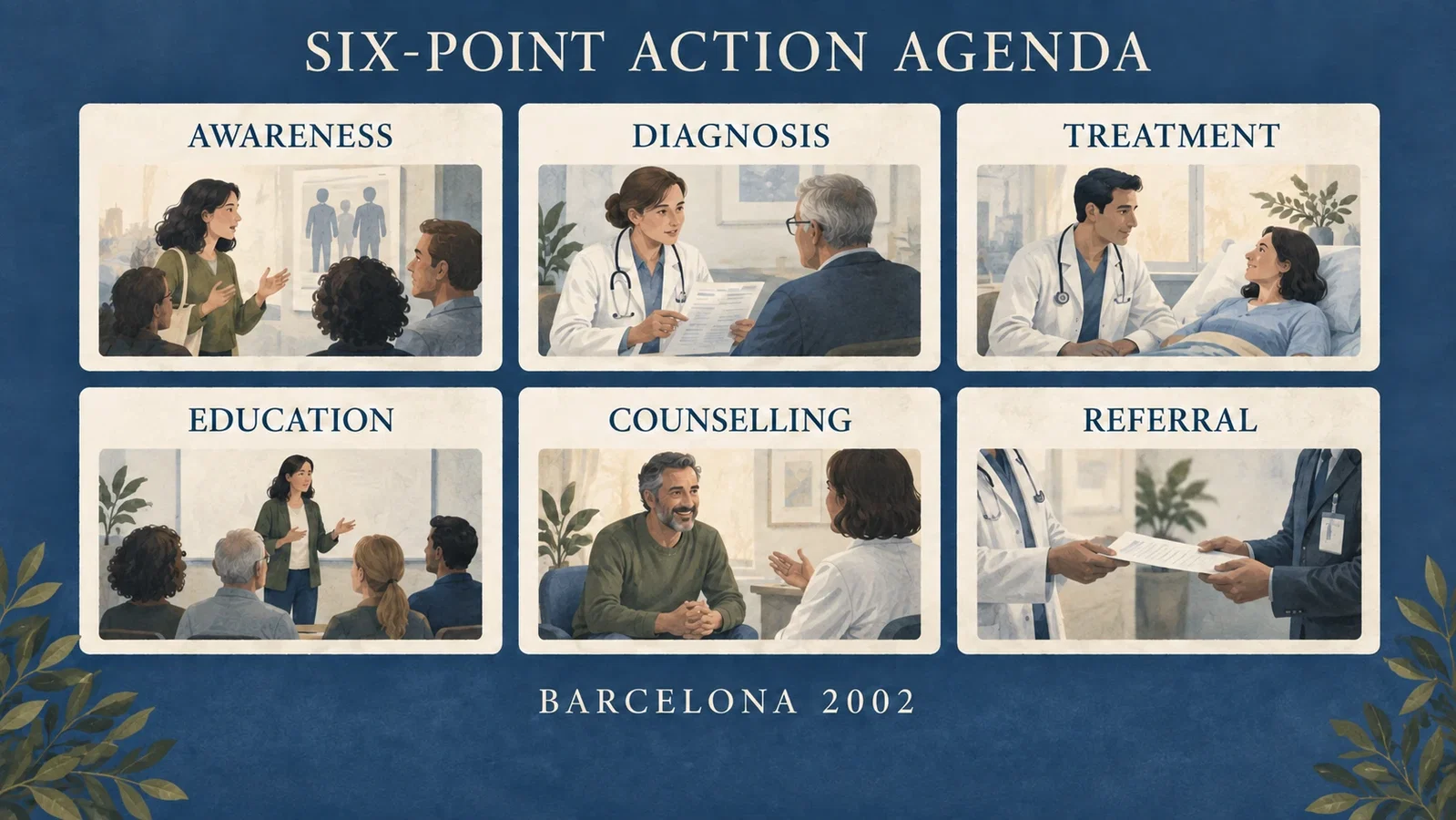
Six priorities in the contemporary account, including post-ICU care and referral; not six treatment procedures.
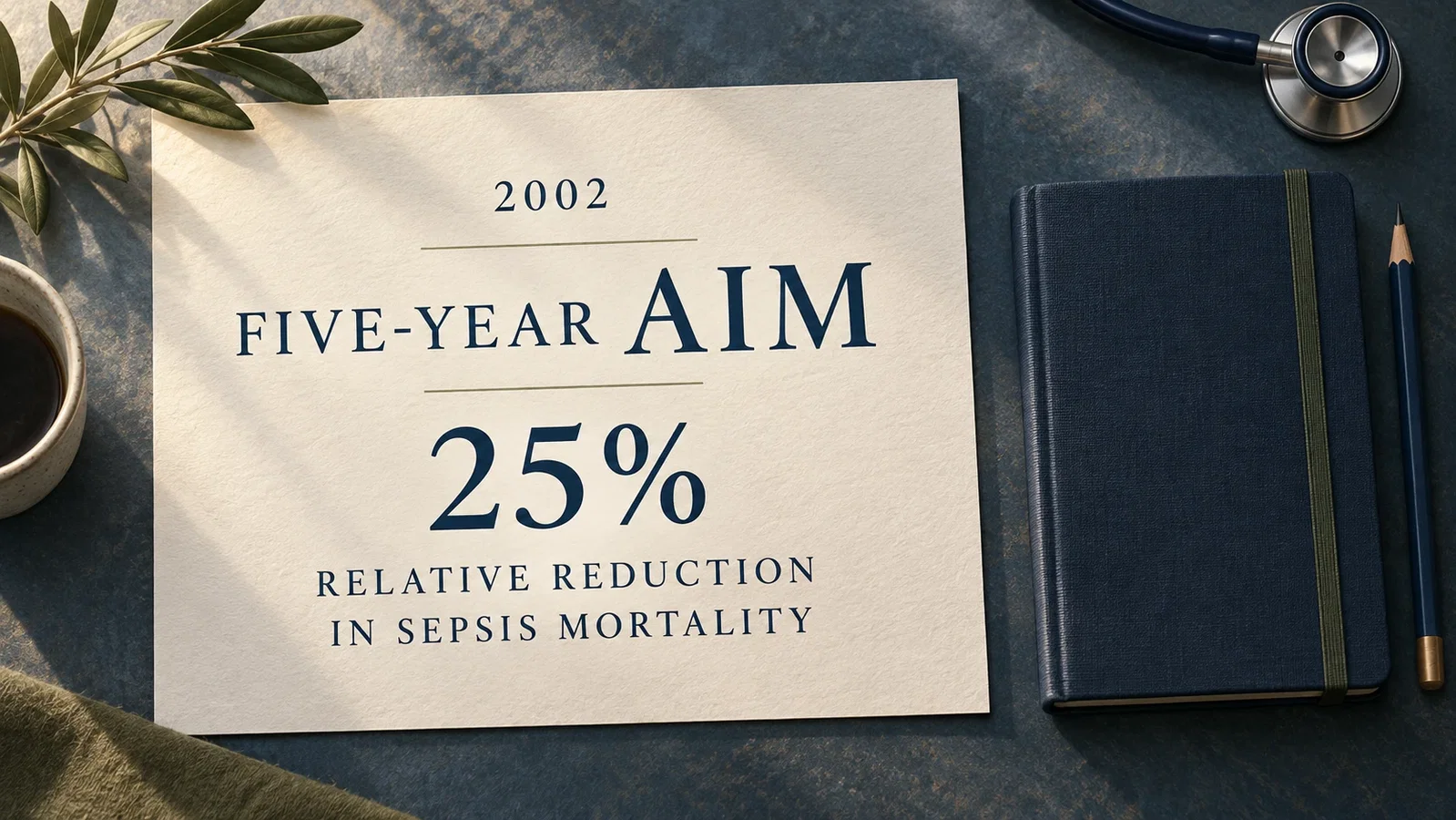
The five-year aim of a 25% relative mortality reduction. This is not an observed effect.
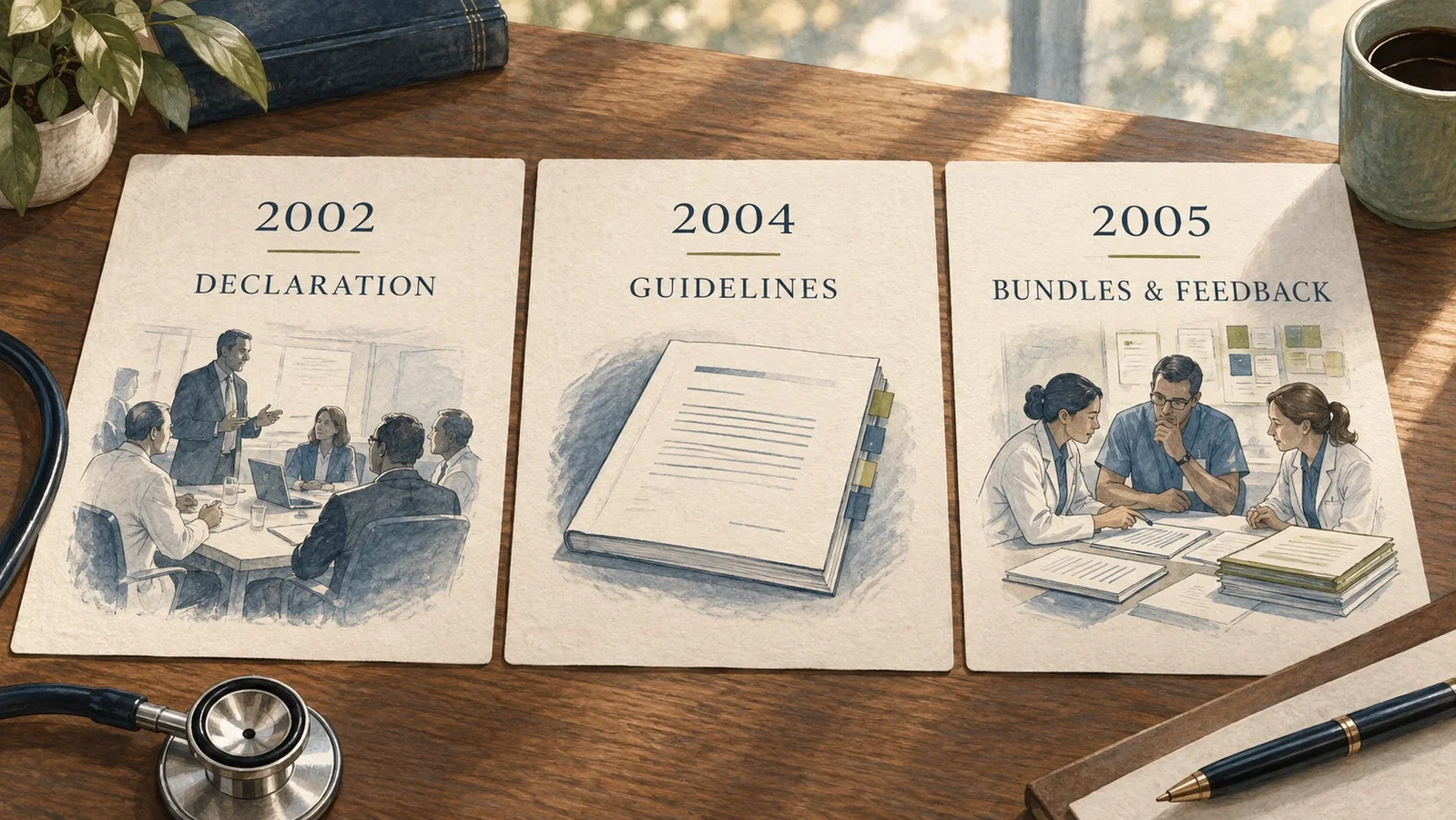
The 2002 declaration, 2004 guidelines and 2005 implementation commentary. This does not date the first appearance of every tool to 2005.
Sources and reading limits
- Slade E, Tamber PS, Vincent JL. The Surviving Sepsis Campaign: raising awareness to reduce mortality. Crit Care. 2003;7(1):1–2. DOI:10.1186/cc1876; PMID12617727. Official full-text archive. Complete XML, including Table1 and references, read; PDF unavailable, so original page layout was not inspected.
- Dellinger RP, Carlet JM, Masur H, et al. Surviving Sepsis Campaign guidelines for management of severe sepsis and septic shock. Intensive Care Med. 2004;30:536–555. DOI:10.1007/s00134-004-2210-z; PMID14997291. Archived original PDF. Text and actual pages 536–538, 550–551 read; the other 15 pages were not read.
- Dellinger RP, Vincent JL. The Surviving Sepsis Campaign sepsis change bundles and clinical practice. Crit Care. 2005;9(6):653–654. DOI:10.1186/cc3952; PMID16356261. Official full-text archive. Complete XML and references read; PDF unavailable. The underlying Gao study was not read for this article.
- ESICM. Surviving Sepsis Campaign. Official history. The “Over 20 years” section was read on September 16, 2026 to distinguish early and current organizational descriptions.
A standalone signed 2002 declaration is not covered; its six-point agenda is drawn from the contemporary Table1. Correction records exist for the 2004 CCM co-publication, but their full texts were not read. This article neither reviews every guideline recommendation nor provides current clinical advice. Where the sources mislink references, citations here follow the identified originals. All four images are modern editorial illustrations in the original landscape format.
Sources and reading limits are stated above. Illustrations are labelled as original source images or AI-made. Historical accounts are educational; they are not current treatment instructions.
Continue exploring
Related reading
Related reading connects shared questions and contexts; it does not by itself establish historical influence.