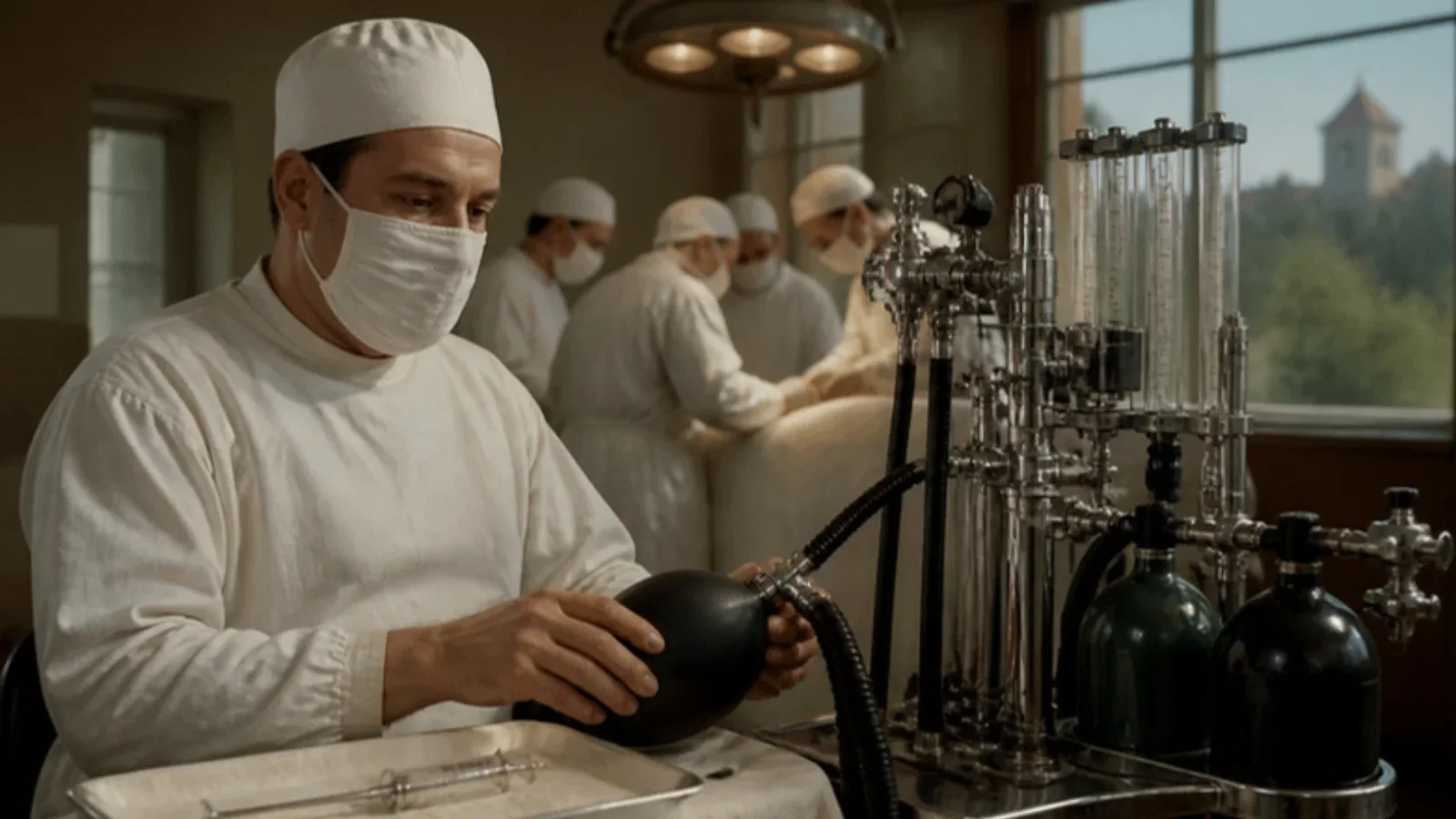
At Stanford's Division of Anesthesiology, Neff and colleagues gave nitrous oxide with at least 20% oxygen, added intravenous Demerol for pain relief and curare for relaxation, and inflated the lungs by hand, reporting 160 cases in 1947 and over 2,000 by 1950.
Reading Library · Anesthesia Epochs · 中文版
Watch the education video (for clinicians)
1947: William Neff — Nitrous Oxide, Oxygen and Curare · Anesthesia Epochs Education Series
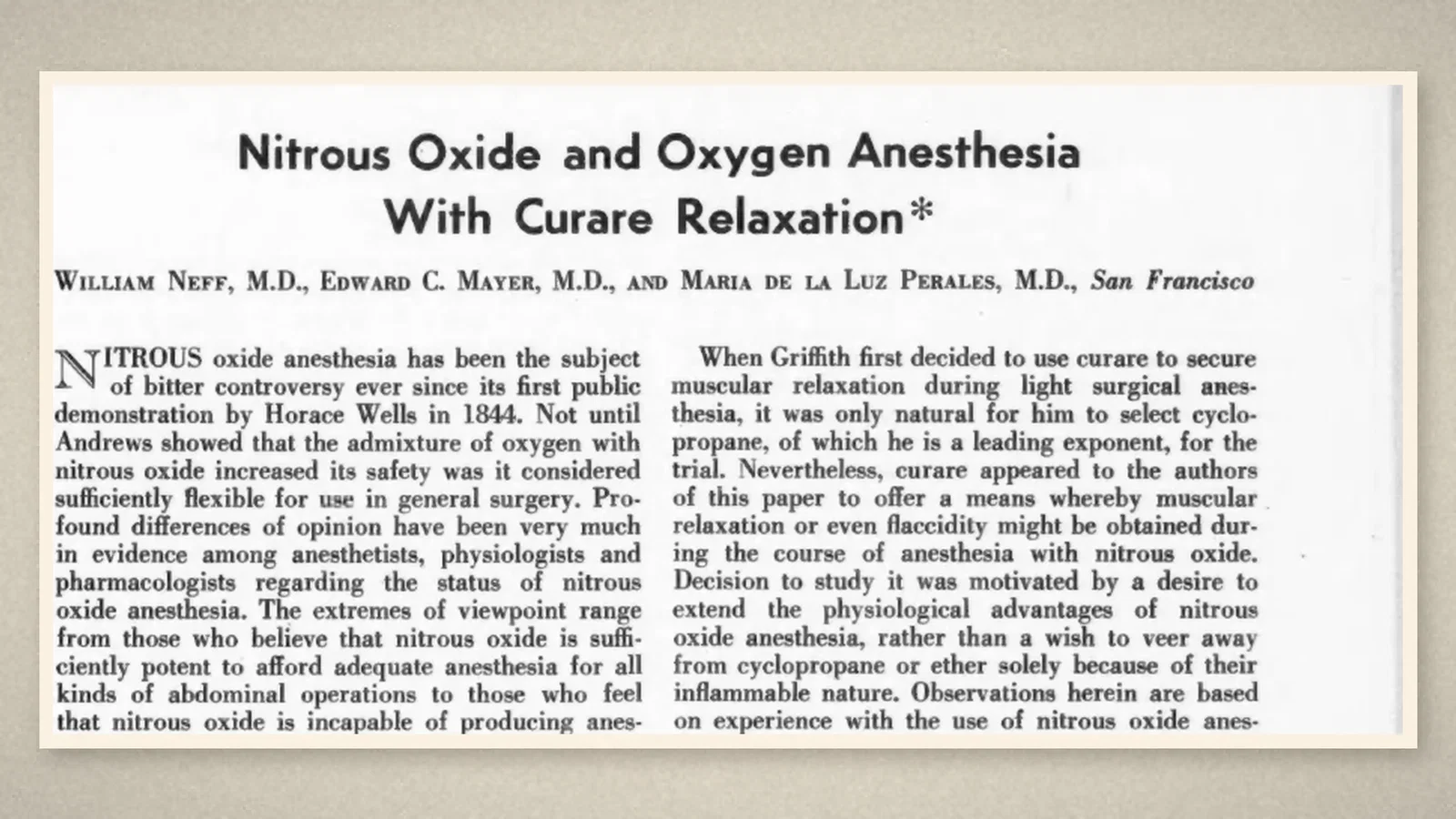
In May 1946, at the California Medical Association's meeting in Los Angeles, three anaesthetists from the Division of Anesthesiology of Stanford University School of Medicine, then located in San Francisco, read a paper to the Section on Anesthesiology. William Neff, Edward C. Mayer and Maria de la Luz Perales published it in California Medicine in February 1947 as "Nitrous Oxide and Oxygen Anesthesia With Curare Relaxation". [1] Neff already held a Stanford title: a Science note on the 1944 San Francisco centenary of anaesthesia described Neff as "associate clinical professor of surgery at the School of Medicine of Stanford University". [3] This article reads the 1947 paper and its 1950 sequel in the British Medical Journal for what they say about a gas that had long been made to work by starving patients of oxygen.
The problem with nitrous oxide
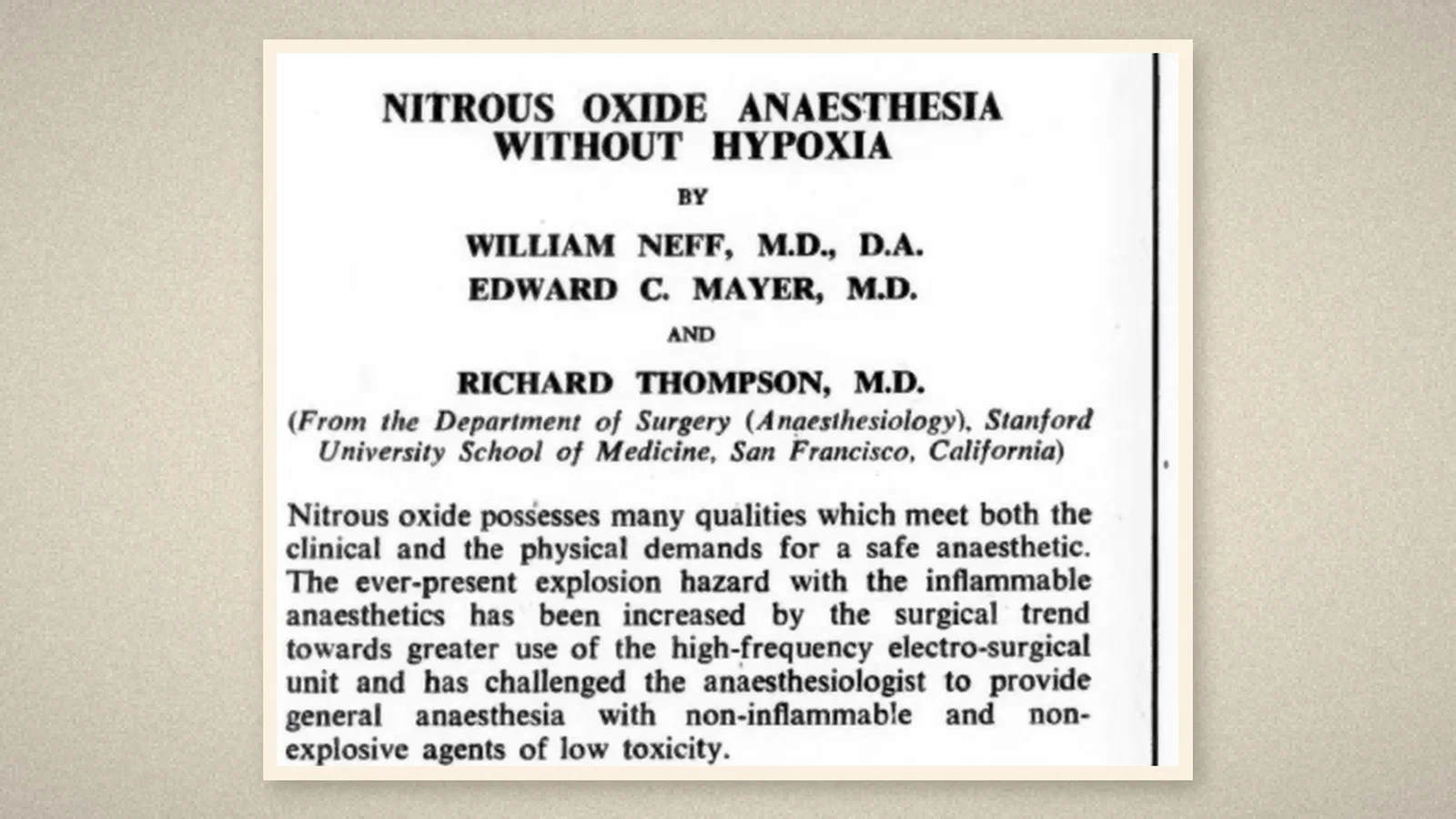
The authors opened by noting that nitrous oxide had been "the subject of bitter controversy" since Horace Wells's public demonstration in 1844. [1] The consensus, as they put it, was that nitrous oxide with oxygen in atmospheric proportions gave only light surgical anaesthesia and slight muscle relaxation. Deeper narcosis by restricting oxygen "has been properly discredited but frequently resorted to" to avoid adding ether, and the popularity of cyclopropane meant that many recently trained anaesthetists had little experience with nitrous oxide at all. [1] Yet nitrous oxide with oxygen was a general anaesthetic "neither inflammable nor explosive" and relatively non-toxic. [1] By 1950 the group added that the trend toward high-frequency electrosurgery had increased the explosion hazard of the flammable agents. [2]
Curare changed the arithmetic. Griffith had chosen cyclopropane for the first trials of curare; the Stanford group wanted instead to extend the physiological advantages of nitrous oxide, and judged that curare offered "the greatest advance in gas anesthesia since Andrews" suggested adding oxygen to it. [1] Their observations covered "160 in number, during the last two years". [1]
Pain relief first
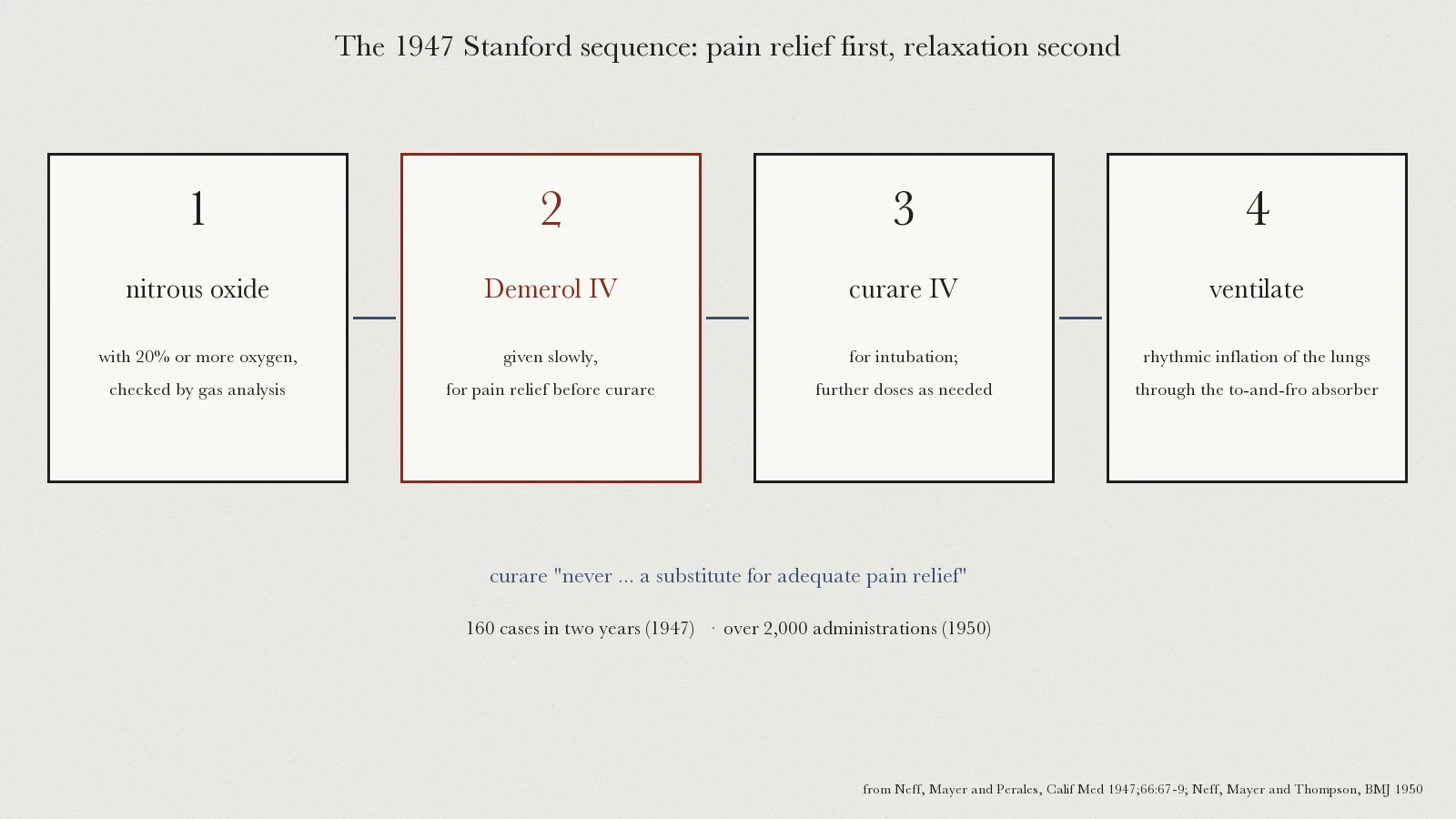
The first lesson the authors reported was that relaxation was not the only obstacle. Even when curare gave good relaxation, handling the abdominal viscera produced a grimace and a rise in pulse and blood pressure, signs of insufficient pain relief. [1] Morphine abolished these but depressed breathing, so they turned to intravenous Demerol (pethidine), given slowly, which fortified the analgesia of nitrous oxide with less, and shorter, respiratory depression. [1] Only then was curare to be given: a larger first injection to allow endotracheal intubation, then smaller increments as needed, the largest total in their series being for a bowel resection lasting six and a half hours. [1] Curare relaxation "should, in our opinion, never be considered a substitute for adequate pain relief", even if a patient might have amnesia for "the horrible experience". [1]
Breathing for the patient
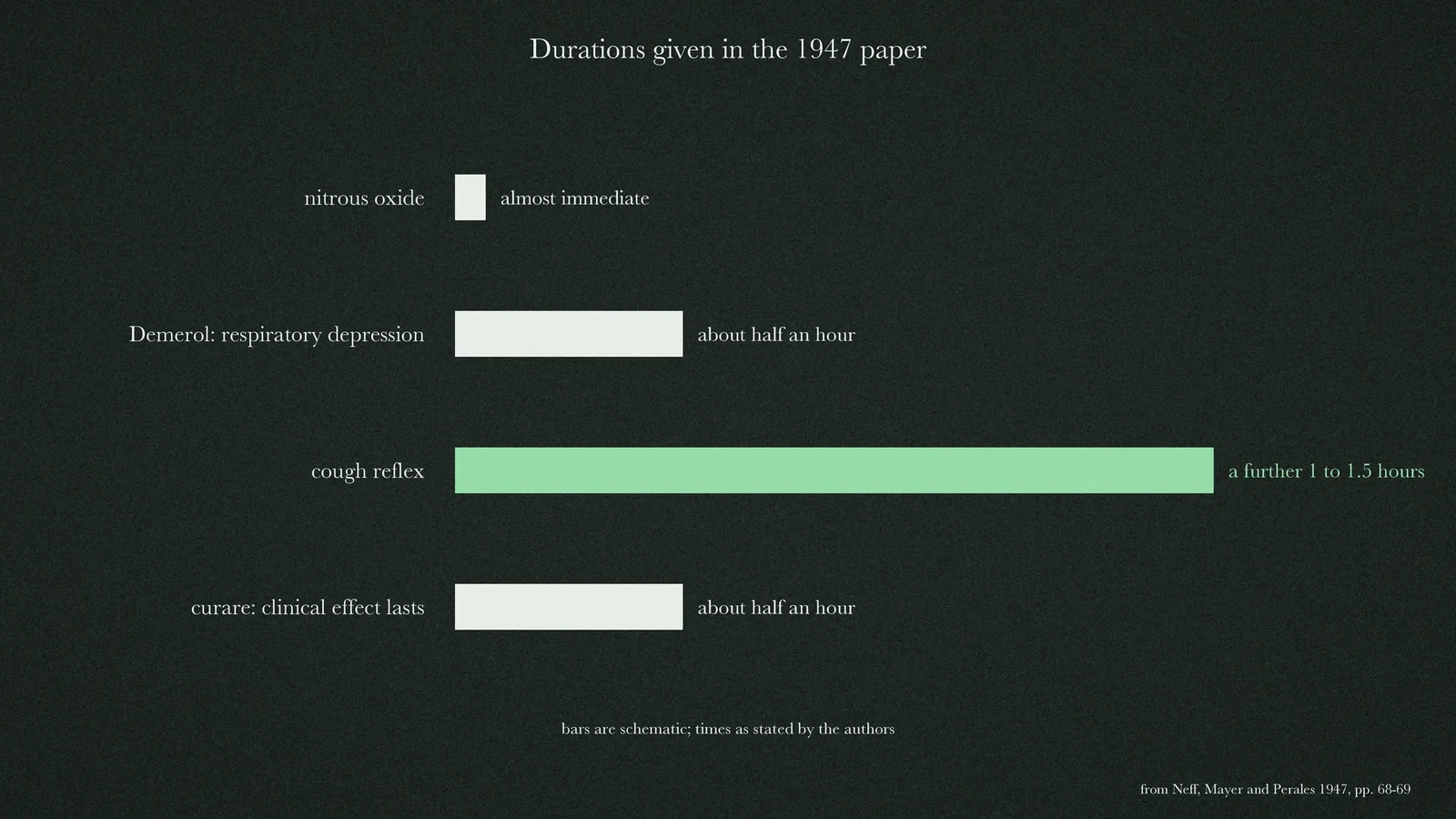
The second lesson concerned ventilation. Nitrous oxide, Demerol and curare each depressed breathing, so the authors' practice was to supplement the patient's efforts by rhythmically inflating the lungs through the to-and-fro carbon dioxide absorber, preferably after endotracheal intubation; without a tube, inflating the lungs could also distend the stomach and intestines. [1] Oxygen was kept at 20 per cent or more and checked by gas analysis, and "the residents are instructed to feel free" to take samples at any time. [1] The authors drew a line between giving curare, which "may be performed by anybody who is able to insert a needle into a vein", and controlling ventilation, which should never be delegated "except to a properly qualified physician anesthetist". [1] They also listed how long each effect lasted: recovery from nitrous oxide was almost immediate, Demerol's respiratory depression lasted about half an hour, and the cough reflex might take an hour to an hour and a half longer. [1]
1950: more than 2,000 cases
In June 1950 Neff, Mayer and Richard Thompson, writing from the Department of Surgery (Anaesthesiology) at Stanford, returned to the subject in the British Medical Journal. [2] They cited Wesley Bourne's earlier argument that nitrous oxide could anaesthetise with 20% oxygen, reported that two newer pethidine-like drugs offered no advantage over pethidine, and summarised experience "in over 2,000 administrations" for all kinds of operations, including intra-abdominal and intrathoracic procedures. [2] Pethidine and curare remained, in their words, "the preferred drugs" for adding reflex obtundation and relaxation to nitrous oxide given without oxygen restriction. [2]
What the record shows
The Stanford papers reorganised an old gas around new drugs: analgesia from an opioid, relaxation from curare, oxygen kept at or above atmospheric levels, and breathing taken over by the anaesthetist. The insistence that curare must never stand in for pain relief, and that ventilation belonged to a trained physician, reads as a teaching rule as much as a technique.
Sources and reading limits
Read: Neff, Mayer and Perales 1947 in full and Neff, Mayer and Thompson 1950 in full; the 1944 Science note on the San Francisco centenary.
Not covered: the California Society of Anesthesiologists memorial article on Neff (could not be accessed); Neff's 1932-1933 papers in the Canadian Medical Association Journal and the 1953 paper on sublingual curare (PMC copies could not be accessed); any biography or obituary. Neff's training, later career, teaching beyond what the 1947 paper says, and life dates are therefore not covered. Statements that the method was an advance are the authors' own; the papers themselves credit Griffith, Andrews and Bourne with earlier steps. Drug doses given in the papers are not repeated here.
Two illustrations are crops of the 1947 and 1950 papers; two are drawn from them.
- Neff W, Mayer EC, Perales MdlL. Nitrous oxide and oxygen anesthesia with curare relaxation. Calif Med. 1947;66(2):67-9. Internet Archive
- Neff W, Mayer EC, Thompson R. Nitrous oxide anaesthesia without hypoxia. Br Med J. 1950;1(4667):1400-4. Internet Archive
- News and notes. Science. 1944;100(2607). Internet Archive
Continue exploring
Related reading connects shared questions and contexts; it does not by itself establish historical influence.
Anesthesia Epochs · The Source Room · About & Editorial Method
Published November 2, 2026. Sources and reading limits are stated above. Illustrations are labelled as original source images or AI-made. Historical accounts are educational; they are not current treatment instructions.