Return, departmental establishment and the uncertain chronology of clinical adoption.
Reading Library · Anesthesia Epochs · 中文版
Watch the companion film
1956: Tan Huiying — Knowledge in Company · Watch on YouTube
Historical anchor: 1956. Date details and source qualifications are explained below.
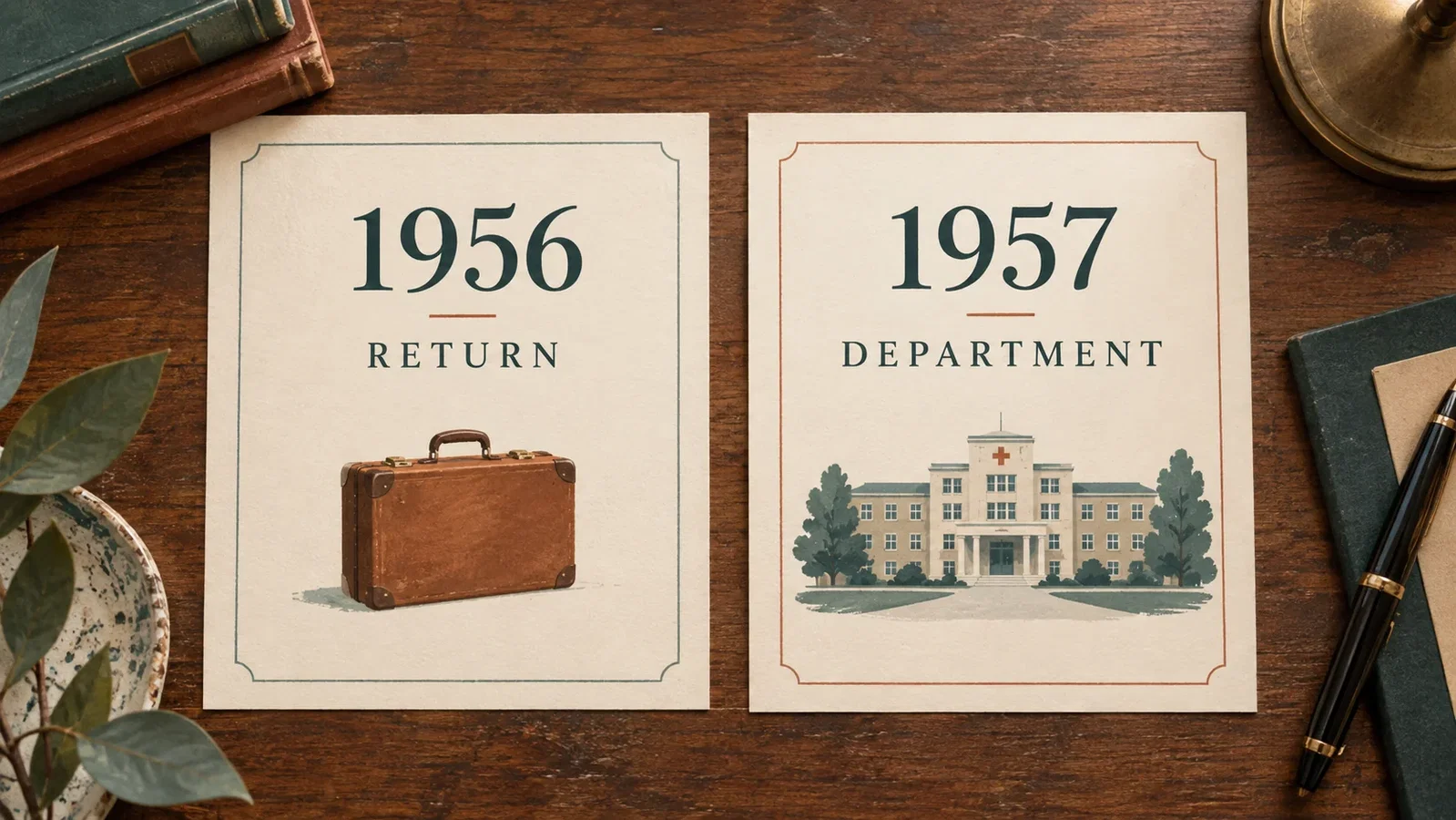
The departmental history at Beijing Friendship Hospital places Tan Huiying’s return from France in 1956. It dates the department’s establishment to 1957 and identifies her as its first director. These are adjacent events with separate dates.[1]
A later history of anesthesia in China describes her study and work in Paris and credits her with pioneering artificial hibernation therapy after her return.[2] The year attached to this article therefore marks a return journey. It does not identify a verified first Chinese patient or a precise day of clinical introduction.
What the name can conceal
Artificial hibernation may suggest cooling alone to a modern reader. The 2014 chapter instead describes deep sedation involving pethidine and chlorpromazine (or promethazine).[2, pp.348–349] That short retrospective description cannot reconstruct Tan’s original clinical protocol.
A memoir published on the Xiangya anesthesia website in 2008 recalls local clinical hypothermia in 1956 and the arrival of artificial hibernation in China in 1957. It also recalls earlier chlorpromazine use during cooling research.[4] Drugs, temperature management and the spread of a named method need their own histories.
The drug names here identify a historical discussion. They provide neither a fixed recipe nor a substitute for describing what happened to an individual patient.
A timeline with limits
The accounts do not supply one uncontested starting date. Alongside the 1956 return and the Xiangya memoir’s 1957, a museum visit report published in 2017 places Tan’s clinical introduction in 1960.[1,2,4,5]
These sources differ in purpose and distance from the events. None supplies the same earliest case record. Selecting a year and attaching an unqualified national priority claim would conceal that gap.
This article retains 1956 for Tan’s return. The hospital history supports 1957 for departmental establishment. The chronology of clinical adoption remains less certain. An original case report, contemporary meeting document or verifiable early book would be needed to settle a narrower priority question.
Following an actual connection
Zhao Jun’s recollection offers a concrete account of professional exchange. At a thoracic surgery and anesthesia meeting at Tongren Hospital on 21 November 1956, Tan and Fan Bingzhe were invited to discuss experience abroad. Xie Rong and Shang Deyan were among the organizers. Four Beijing hospitals subsequently arranged monthly anesthesia meetings in rotation.[3, section 1]
The available text is a public 2022 reprint identifying its original publication as 1995. It is not the contemporary meeting notice. It establishes a remembered professional connection, but does not identify that meeting as China’s first presentation of artificial hibernation.
The link to the Xie Rong training article rests on this later, specific exchange. It does not place Tan in his 1953 course or establish a teacher–student relationship. Nor does shared participation prove a particular route of therapeutic transmission.
Return from overseas is a convenient timeline marker. Meetings offer a way to investigate what followed: who explained an unfamiliar practice, where colleagues could discuss it, and which questions remained. That is an interpretation of the records, not a measured effect of the meetings.

Reading the uncertainty in a contemporary paper
A separate American report helps recover the uncertainty surrounding the same terminology. In 1956, Lambie, Joseph and Wilson described multiple pulmonary emboli after artificial hibernation with hypothermia. Their patient underwent surgery in 1955 and later died. The authors considered several possible contributing factors without resolving their respective roles.[6, pp.840–841]
This was not Tan’s patient. It cannot establish her outcomes, quantify the method’s risks, or prove that the treatment caused the complication. Its narrower value is to show that contemporaries were still investigating what these combinations of interventions could do.
The evidence supports a bounded account of Tan as a returning clinician, first departmental director and contributor credited by later historians with spreading artificial hibernation. Her experience entered an emerging professional network. Precise priority and clinical benefit remain questions for further records.
Sources and reading limits
- Beijing Friendship Hospital: Department of Anesthesiology and Surgery. Institutional retrospective, complete historical body read; return and establishment dates distinguished.
- Feng X, et al. A History of Anesthesia in China. In: The Wondrous Story of Anesthesia. 2014:345–354. Cover, copyright and pp.345,348,349,352,354 read; main Tan passage on pp.348–349. The whole book was not read.
- Zhao Jun. The road we have travelled, part 2: Beijing anesthesia. Public reprint, 22 July 2022. Section 1 identifies the original as Anesthesia Tribune, 1995(4):1–2. All four displayed sections read; neither the original print issue nor the 1956 notice is covered.
- Chapter six: Bu wei niu hou. Xiangya anesthesia website, 23 June 2008. No author named on the page; the opening two paragraphs supply retrospective chronology, not current procedural guidance.
- A visit to the Chinese Museum of Anesthesiology, Dazhong Jiankang issue 382. Museum publication dated 6 April 2017. Used only to preserve the differing chronology in its historical section.
- Lambie RS, Joseph LG, Wilson G. Multiple pulmonary emboli following artificial hibernation with hypothermia; report of a case. BMJ. 1956;1:840–841. DOI:10.1136/bmj.1.4971.840. Both original scanned pages read; a separate contemporary case, not evidence of Tan’s results.
Images are AI-generated editorial reconstructions, not portraits of Tan, historical photographs, original documents or clinical protocols.
Continue exploring
Related reading connects shared questions and contexts; it does not by itself establish historical influence.
The Source Room · About & Editorial Method
Sources and reading limits are stated above. Illustrations are labelled as original source images or AI-made. Historical accounts are educational; they are not current treatment instructions.