A joint course and lecture material, with a disputed first-edition date.
Reading Library · Anesthesia Epochs · 中文版
Watch the companion film
1953: Xie Rong — From Experience to a Lesson · Watch on YouTube
Historical anchor: 1953. Date details and source qualifications are explained below.
How does one clinician's experience become knowledge that another can study? A later history places Xie Rong at the centre of an organised attempt in July 1953: an anesthesia course jointly arranged by Peking Union Medical College and the Beijing medical school known as Beiyi, with accompanying lecture material.[1,p.350]
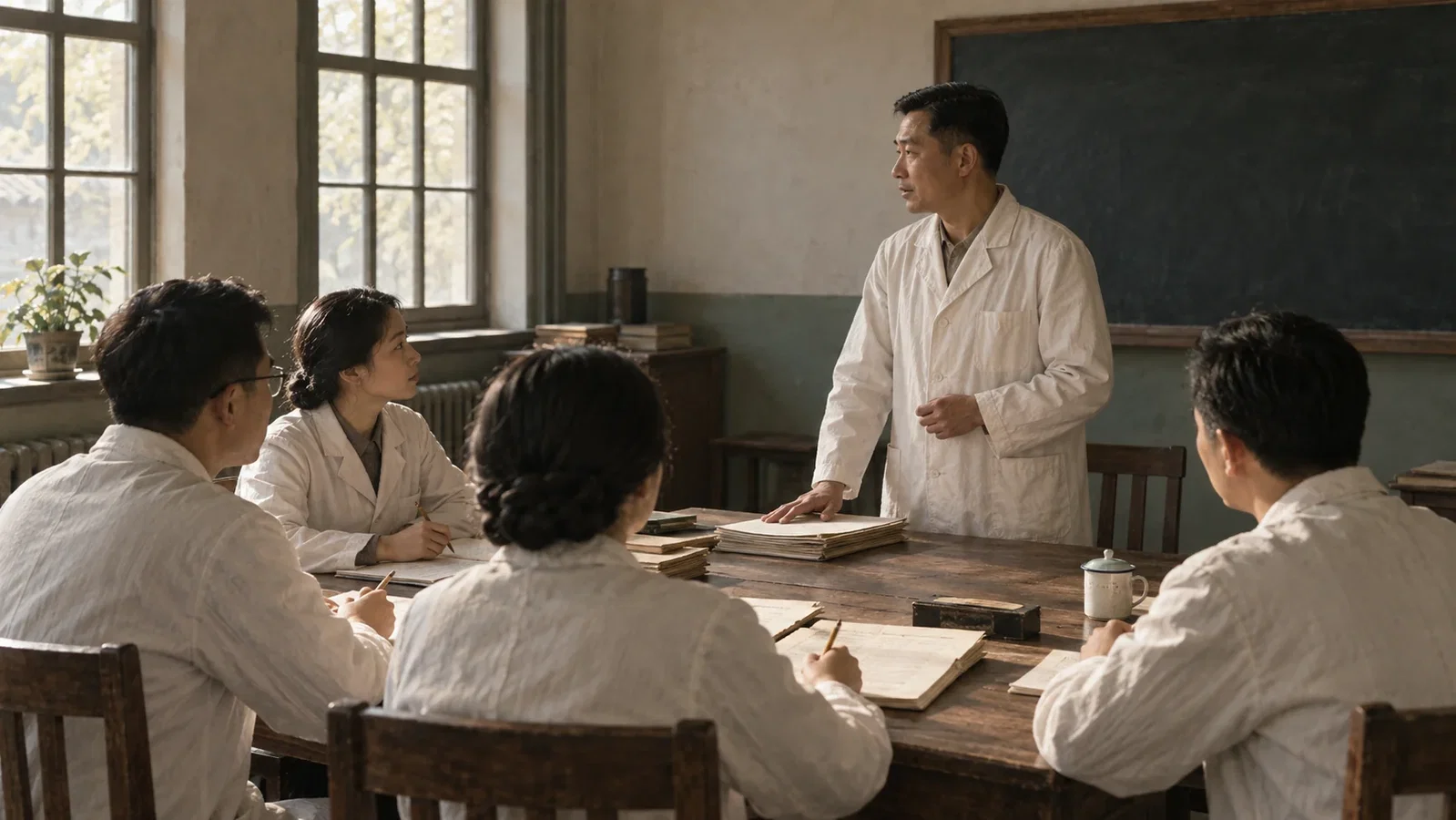
Editorial illustration of 1950s teaching. The people, room and number present are invented; the teacher is not a portrait of Xie.
Teaching already had a history
Specialist training already had local antecedents. A 2010 PUMCH history recalls discussion of specialist training after the hospital reopened in 1948. It dates Zhao Jun's full-time work to 1951 and Xie's arrival to December 1952. This is the institution's later account, not the contemporary meeting record.[2,p.11]
The 2014 chapter calls the 1953 course the first. That is an attributed historical assessment, not a nationwide audit excluding every earlier form of instruction. Its July date and course details come primarily from this retrospective chapter; the 2010 article does not describe the joint course itself.[1,pp.345,350;2,p.11]
Giving experience a teachable form
The chapter names supporting material as “Clinical Anesthesiology Lecture” and lists general anesthesia, spinal anesthesia and blood transfusion among its subjects. This is the historians' summary. The 1953 lecture text was not available for this article, so the list cannot reconstruct its complete syllabus or teaching hours.[1,p.350]
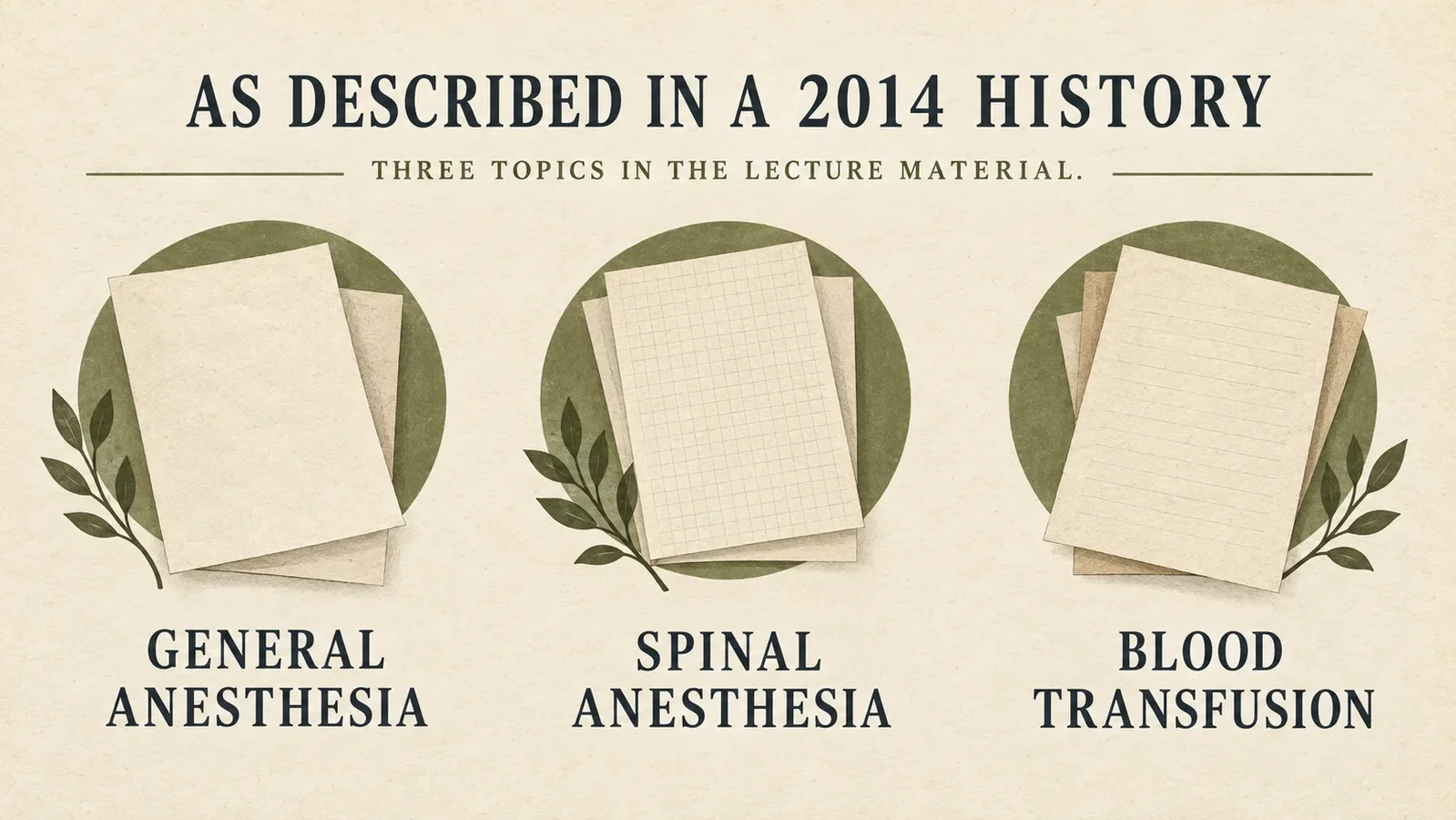
Editorial overview based on the 2014 chapter; not a 1953 timetable or lecture-page facsimile.
The list suggests a practical teaching task: organising experience into material that could be read and questioned. It includes different anesthetic approaches and transfusion during surgical care. That is an interpretation of the subjects listed, not a measurement of the course's effectiveness.[1,p.350]
A book's origins, two first-edition dates
A 2015 report from Peking University First Hospital links the course notes to Xie's writing of Anesthesiology in 1953 and describes revisions in 1964 and 1994. The report announced the release of his illustrated biography; reading it does not constitute reading either that biography or the early textbook.[3]

Invented papers and writing materials, not the textbook's cover, contents or text.
The first-edition date remains unsettled. The medical archives' 2006 biography explicitly gives 1953. Chaoxing's catalogue lists Xie's Anesthesiology as a first edition of October 1957, with 380 pages. Neither record supplies an original colophon that was available to read here.[4;5]
Lecture preparation in 1953 and publication in 1957 might describe different stages, but that remains an explanation to test. This account therefore dates the teaching activity recorded in later histories and preserves the conflicting first-edition records.[1,p.350;3–5]
Work involving colleagues
There is a specific connection with the 1949: Shang Deyan Organises Anesthesia and Its Teaching in Lanzhou: the 2014 history dates Xie's collaboration with Shang in Beijing to 1956. It does not establish that Shang's 1949 Lanzhou department caused the 1953 course.[1,p.348]
An imagined discussion, not an identifiable 1953 class or 1956 meeting.
The sources describe clinical experience being organised for teaching and writing. They do not provide data here to determine how many participants changed their practice or what happened to patient outcomes.[1,p.350;3]
Sources and reading limits
- Feng X, Yu B, Yu X, Huang Y, Wang G, Liu J. A History of Anesthesia in China. In: Eger EI II, Saidman LJ, Westhorpe RN, eds. The Wondrous Story of Anesthesia. Springer; 2014:345–354. Chapter DOI. All 10 chapter pages and 2 title/copyright pages read, not the entire book. The cited Zhao 1995 recollection is not covered; neither is a 1953 course original.
- Xu Zhonghuang, Luo Ailun. 协和麻醉走过的路 [The path travelled by PUMCH anesthesia]. Medical Journal of Peking Union Medical College Hospital. 2010 Jul;1(1):11–13. Original article. All 3 scanned pages read visually; institutional teaching background, not details of the joint 1953 course.
- Peking University First Hospital. 《中国麻醉学科奠基人——谢荣教授画传》发布会举行. 17 July 2015. Original hospital report. Full main text read; launch held 12 July. Biography book not read.
- Peking University Health Science Center Archives. 谢荣. 19 June 2006. Institutional biography. Full biography read; its 1953 first-edition statement is retrospective, not a colophon.
- Chaoxing Books. 麻醉学, 谢荣编著. Platform catalogue. Relevant entry read: October 1957, first edition, 380 pages. Original book text and colophon unavailable.
These are not three independent contemporary confirmations. Source 1 is later scholarship, 3 and 4 come from the same institutional setting, 2 supplies background, and 5 supplies conflicting bibliographic metadata. The 1953 lecture notes, course notice and participant register are not covered.
Continue exploring
Related reading connects shared questions and contexts; it does not by itself establish historical influence.
- 1949: Shang Deyan Organises Anesthesia and Its Teaching in Lanzhou
- 1956: Tan Huiying Returns with Artificial Hibernation
The Source Room · About & Editorial Method
Sources and reading limits are stated above. Illustrations are labelled as original source images or AI-made. Historical accounts are educational; they are not current treatment instructions.