A Lanzhou department in 1949 linked specialist practice with surgical teaching.
Reading Library · Anesthesia Epochs · 中文版
Watch the companion film
1949: Shang Deyan — A Department That Teaches · Watch on YouTube
Historical anchor: 1949. Date details and source qualifications are explained below.
The department described in later accounts of Shang Deyan's career carried teaching responsibilities as well as clinical work. Wang and Sim report that, after returning to China, Shang required medical students and surgical residents to study anesthesia. He held the chair of anesthesiology at Lanchou Central Hospital alongside appointments in surgery and surgical education. Those overlapping roles help explain how a specialist practice was organised within a surgical institution.[2,p.7,col.2]
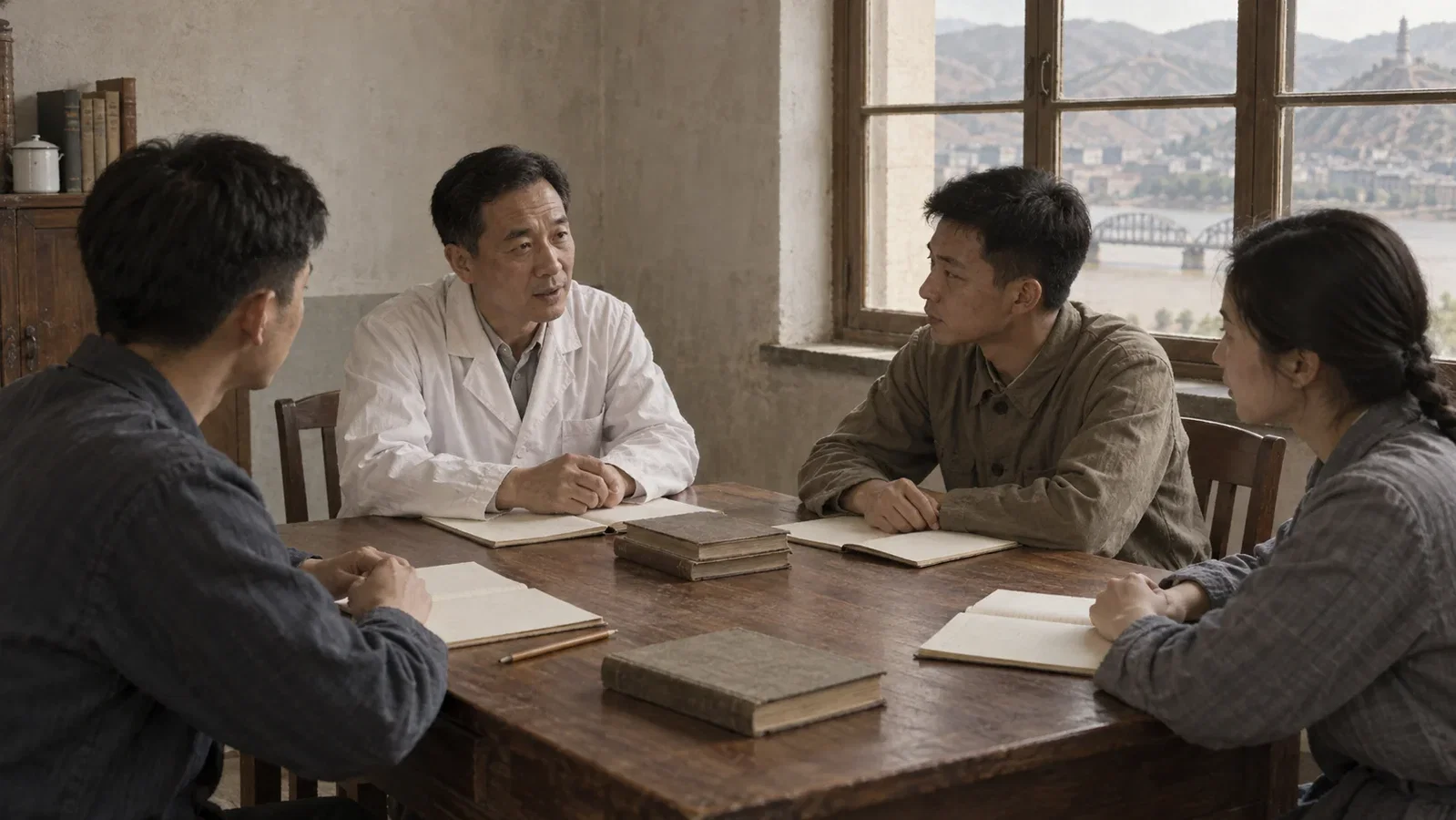
An imagined teaching scene around 1949. The people and room are not authenticated portraits or a reconstruction of the Lanzhou hospital.
What the 1949 date establishes
The chapter on China in the 2014 book The Wondrous Story of Anesthesia dates Shang's return and establishment of a Lanzhou anesthesia department to 1949. Its authors call this China's first department of anesthesiology. This is a retrospective historical account; the hospital's contemporary administrative record has not been obtained for this article.[1,p.347]
Wang and Sim's 2000 article describes the returned clinician's appointment, calling it the first of its kind in modern China, but does not independently give 1949 in that paragraph. Wang and Sim use Lanchou Central Hospital. The chapter uses National Lanzhou Hospital in its founding sentence and Lanzhou Central Hospital earlier in the same account. These English names do not establish a hospital-renaming date or two separate founding events.[2,p.7,col.2;1,p.347]
The accounts also differ on the year he went to America. Wang and Sim give 1947; the later chapter gives 1948. Both place his anesthesia training at the University of Illinois in Chicago. This article therefore describes the training as taking place in the late 1940s and leaves the departure-year discrepancy unresolved.[2,p.7,col.2;1,p.347]
A surgical career with teaching duties
Wang and Sim trace Shang's medical graduation to 1942 and his invitation to develop anesthesia services to 1945, after several years in surgery. His surgical interests continued after his anesthesia training. A department led by a specifically trained physician could remain closely connected to surgery; its establishment should not be read as the immediate adoption of today's institutional arrangements.[2,p.7,cols.1–2]
Their account describes teaching for students and surgical residents, followed by work in affiliated veterans' hospitals. The 2014 chapter also records his training of military anesthesia personnel after the Korean War. These passages establish teaching activity, without complete training-cohort data or outcome assessments that would allow its educational effects to be measured.[2,p.7,col.2;1,p.350]

The papers represent preparation for teaching. They reproduce neither Shang's manuscripts nor an identified textbook.
Assigning clinical work and teaching to the same post was a practical organisational choice. It is a contribution that can be described from the accounts themselves. They do not establish how much, if at all, that arrangement independently changed patient mortality.[2,p.7,col.2]
Why the priority label needs a boundary
The same 2014 chapter uses the term department of anesthesia when discussing Ma Yueqing's work at Peking Union Medical College Hospital in 1938–1941. It separately describes Jone Wu's 1954 Shanghai unit as an independent academic department. These terms concern institutional arrangements that need definition before a single national priority claim can be made.[1,p.347]
Lanzhou in 1949 remains the chronological anchor here. The claim to a national first is attributed to the historical authors, without treating it as a completed survey of hospital archives or the first administration of anesthesia in China. Both main accounts cite the work of Sim, Du and Bacon. Both are later historical narratives, not two independent administrative records from 1949.[1,pp.346–347,354;2,p.7,refs]
Later colleagues and professional organisation
The chapter places Shang in Beijing in 1956 and explicitly describes Xie Rong working with him that year. This supplies a specific professional connection. It does not show that the Lanzhou department caused Xie's separate 1953 training course.[1,pp.348–350]
An imagined collaboration, not a photograph of Shang and Xie or a documented meeting.
Shang later became the first president of the Chinese Society of Anesthesiology, founded in 1979. The chapter names Xie, Wu and Tan Huiying among the early leadership, while Wang and Sim also describe Shang's organising work. The hospital department and the society belong to different stages and levels of professional organisation, thirty years apart.[1,pp.348,352;2,p.7,col.3]
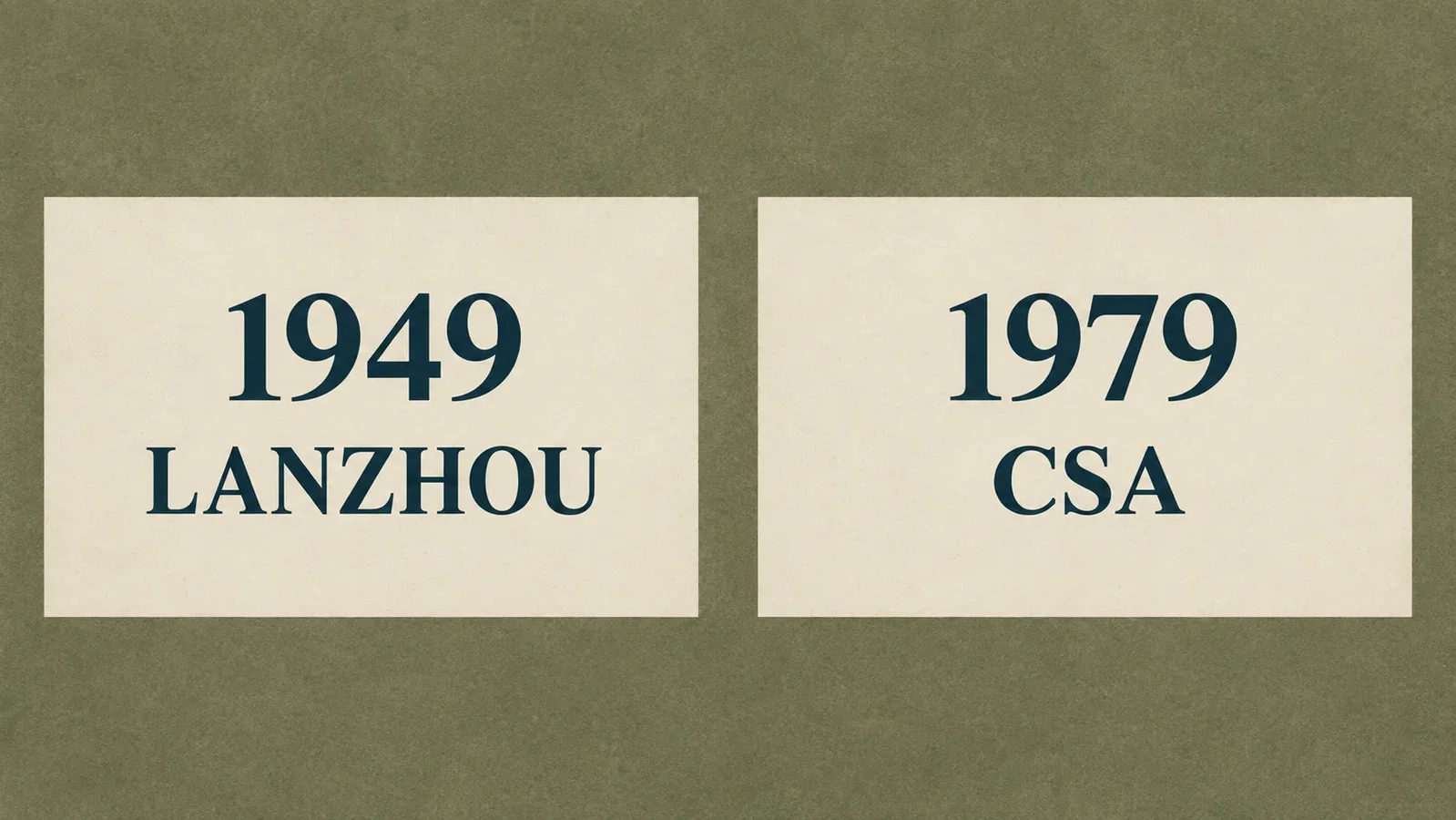
The cards separate two dated roles; they assert no demonstrated causal chain between them.
The accounts describe Shang successively leading an anesthesia department, training other doctors and organising a professional society. In Lanzhou, clinical and teaching responsibilities were brought into one specialist post. Later collaboration and society work extended his roles beyond that hospital.[1,pp.347–352;2,p.7]
Sources and reading limits
- Feng X, Yu B, Yu X, Huang Y, Wang G, Liu J. A History of Anesthesia in China. In: Eger EI II, Saidman LJ, Westhorpe RN, eds. The Wondrous Story of Anesthesia. Springer; 2014:345–354. Chapter DOI. The complete ten-page chapter, its fifteen reference entries, and the book's title/copyright pages were read as text and page images. The 930-page book was not read in full: systematic reading and page-image inspection covered these twelve pages; the other 918 pages are not covered. Retrospective scholarship, not a 1949 hospital record; underlying cited works were not all obtained.
- Wang G, Sim P. Deyan Shang and the Development of Modern Chinese Anesthesia. Bulletin of Anesthesia History. 2000 October;18(4):7. Article DOI. Entire one-page typeset article read through a public ad-supported Scribd viewer, with three overlapping screenshots covering all columns, the byline, footnote and references. This is a user-uploaded page representation, not a publisher PDF. Both authors appear on the actual byline; Crossref indexes Wang alone. The footnote records a presentation on 10 June 2000 in Montreal. Publication in October is a separate date.
Continue exploring
Related reading connects shared questions and contexts; it does not by itself establish historical influence.
- 1953: Xie Rong Brings Anesthesia Experience into the Classroom
- 1979: The Chinese Society of Anesthesiology Is Founded in Harbin
The Source Room · About & Editorial Method
Sources and reading limits are stated above. Illustrations are labelled as original source images or AI-made. Historical accounts are educational; they are not current treatment instructions.