Melzack and Wall put modulation inside the account of pain.
Reading Library · Anesthesia Epochs · 中文版
Watch the companion film
1965: Melzack and Wall — Gate Control · Watch on YouTube
Historical anchor: 1965. Date details and source qualifications are explained below.
Figure 4 is the place to begin. On page 975 of their 1965 Science paper, Ronald Melzack and Patrick D. Wall drew large and small sensory inputs, a spinal modulatory system, transmission cells and central control. The diagram made an argument about how incoming signals could be altered before they contributed to perception and response.[1]
Published on November 19, the paper called this a gate control theory. Its gate was a proposed function of the nervous system. It was not a newly observed anatomical door. The authors sought to explain cutaneous sensory input through interactions among peripheral activity, spinal processing and influences from the brain.[1]
The diagram’s large and small fibers both excited transmission cells, marked T. They differed in their proposed effects on the substantia gelatinosa, marked SG. In the proposed model, large-fiber activity increased SG-mediated presynaptic inhibition at incoming fiber terminals; small-fiber activity reduced it. The balance of activity therefore mattered, together with factors such as stimulus duration and adaptation.[1,3] Describing the drawing as one pain wire opposed by one painless wire would lose much of that proposal.
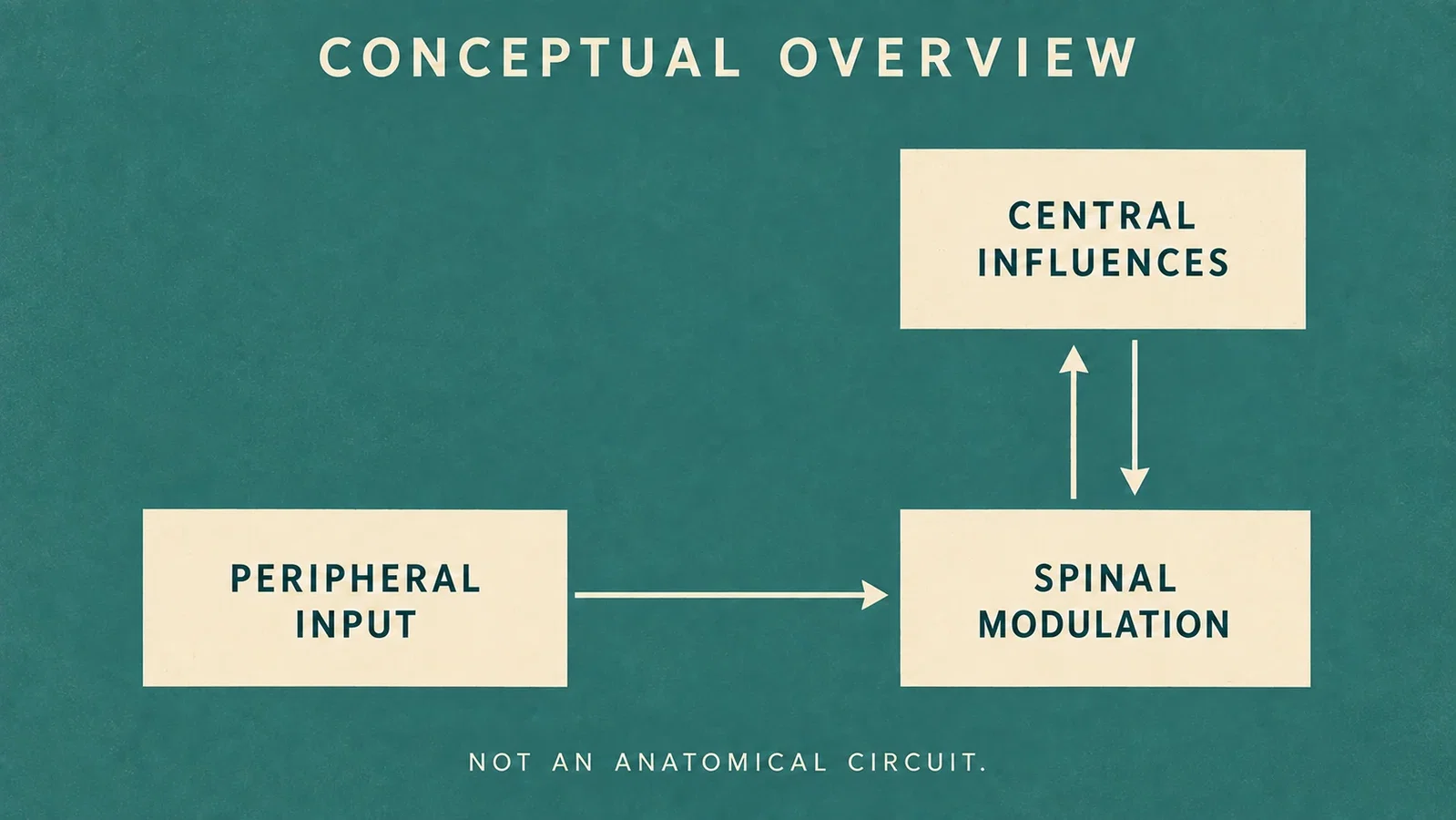
The brain was already part of the account. Attention, emotion and previous experience could influence sensory processing through central activity.[1,2] That gave the person’s circumstances a place in the model without making pain imaginary. It also did not imply that a patient could choose to shut pain off.
The paper left room for uncertainty. Although its diagram emphasized presynaptic control, the accompanying text allowed that undetected postsynaptic mechanisms might contribute. Looking back in 1982, Melzack and Wall recalled that acceptance had been neither immediate nor complete and that details remained disputed.[1,2] Their retrospective describes a developing field, not a theory that arrived fully confirmed.
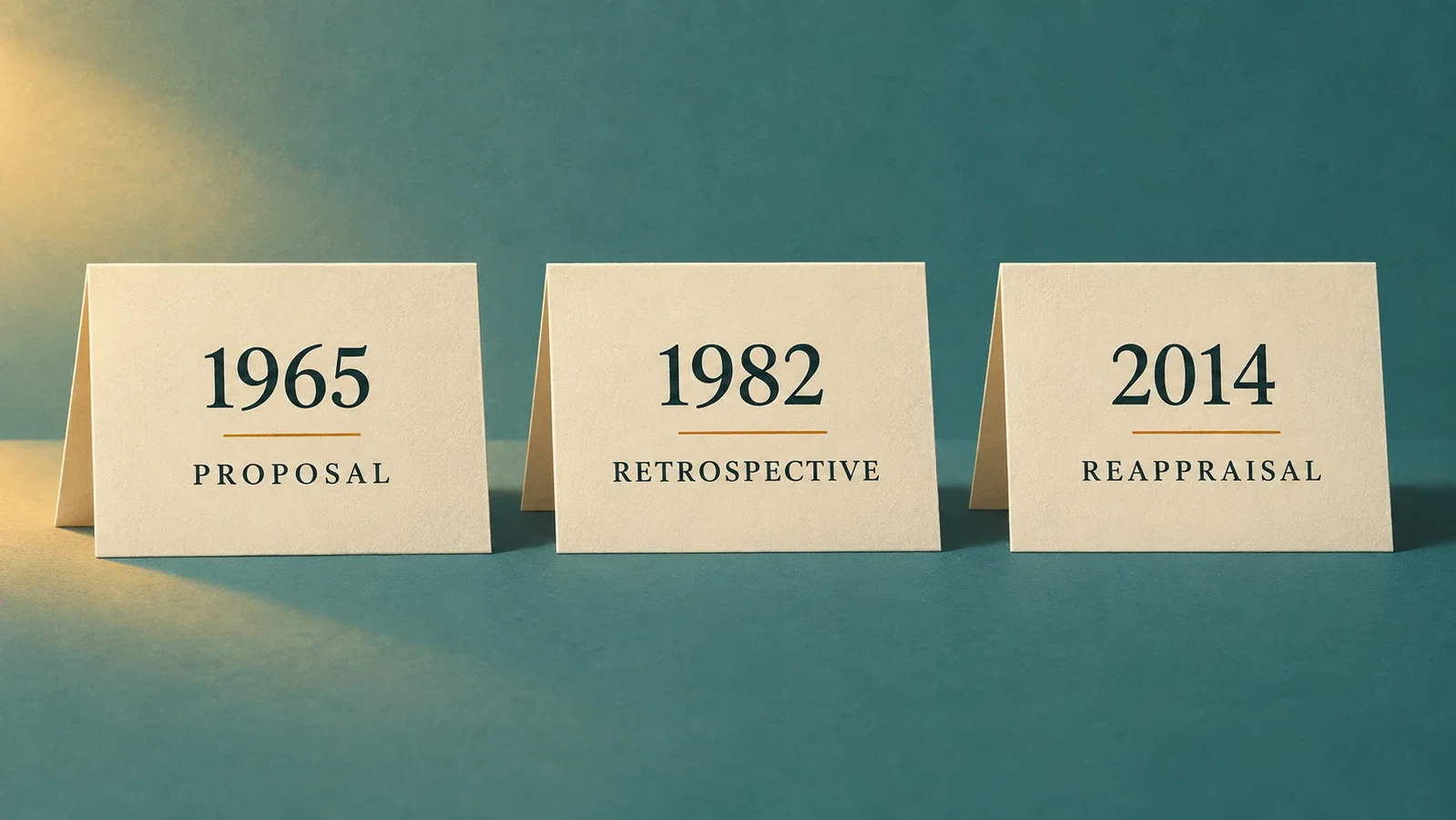
Mendell’s 2014 review makes the distinction explicit: the model prompted tests, while later findings showed that its details needed revision.[3] Its historical influence can be assessed without presenting every original connection as established modern physiology.
There is also a documented route from the theory to another article in this timeline. Melzack and Wall discussed the therapeutic possibilities of increasing large-fiber input. Mendell later identified gate theory as an origin of dorsal-column stimulation and cited the 1967 work of Shealy, Mortimer and Reswick.[1,3] This is a link in the development of a treatment idea. It is not proof of every mechanism in the Figure 4 diagram.
The proposal was precise enough to expose questions: where modulation occurs, how central activity changes processing, and which predictions survive experiments. Those questions remain part of the paper’s historical value even where its original answers changed.
Source and image note: The complete 1965 article was read in original page scans, together with the one-page 1982 participant retrospective. The 2014 review was read in full PMC author-manuscript HTML. This is a history of a theory, not treatment guidance. All four illustrations are modern editorial interpretations, not archival scenes, reproduced journal figures, experimental data or operating instructions.
Sources and reading limits
- Melzack R, Wall PD. Pain mechanisms: a new theory. Science. 1965;150(3699):971–979. DOI; PubMed 5320816. Original scanned article read page by page, including Figure 4 on p. 975 and the article’s final references at the top of p. 979. PDF obtained from the publicly accessible WikiAnesthesia file.
- Melzack R, Wall PD. Citation Classic commentary on “Pain mechanisms: a new theory.” Current Contents/Life Sciences. 1982;(23):22, June 7. Original one-page retrospective. Full page read. The authors signed the account on February 15, 1982; it is a participant retrospective, not an independent replication.
- Mendell LM. Constructing and deconstructing the gate theory of pain. Pain. 2014;155(2):210–216. Published online December 12, 2013. DOI; complete PMC author manuscript. Full HTML and references read; original PDF not covered. The link to Shealy, Mortimer and Reswick’s 1967 dorsal-column stimulation work is reported in the section “Tests of closing and opening the gate,” reference 58; that 1967 paper was not itself read for this article.
Continue exploring
Related reading connects shared questions and contexts; it does not by itself establish historical influence.
- Later connection: 1967: Dorsal Column Stimulation in One Patient, a Preliminary Report
The Source Room · About & Editorial Method
Sources and reading limits are stated above. Illustrations are labelled as original source images or AI-made. Historical accounts are educational; they are not current treatment instructions.