In 1882–1883 Sydney Ringer found that effects first credited to saline came from the piped water used to make it, and went on to compare calcium, potassium and sodium salts on the frog heart.
Reading Library · Anesthesia Epochs · 中文版
Watch the education video (for clinicians)
1882–1883: Ringer's Revision — The Solvent Was Not Neutral · Anesthesia Epochs Education Series

An imagined laboratory in the 1880s: an anonymous researcher considers glass bottles and notes. Neither the person nor the room claims to reproduce Ringer or a documented experiment.
Sydney Ringer opened the 1883 follow-up with a detail that changed the explanation of the earlier results. The saline used had been made with water supplied by the New River Water Company, rather than distilled water. When Ringer repeated the comparison with distilled water, the effects described in the earlier paper did not appear. [2, p. 29]
Ingredients that had never entered the stated recipe had nevertheless entered the experiment.
The setting was research on the detached heart. Ringer asked how a ventricle could continue contracting after its circulating fluid was changed, and how salts altered the shape of its contractions. These two papers were not reports of intravenous treatment in patients. [1–2] In a later methodological account, published in 1885, Ringer explicitly described the detached frog heart and its ventricle as experimental preparations. [3, opening on p. 731]
An answer that first appeared sufficient
The opening of the 1882 paper defined saline as a 0.75% solution of sodium chloride. Its comparison fluid was dried bullock’s blood reconstituted in water and then diluted with saline. The ventricle was tied to a cannula, and recordings were made with Roy’s tonometer. [1, p. 380]
That 0.75% belongs to the historical experiment. Replacing it with a familiar modern 0.9%, or presenting the experimental fluid as an intravenous prescription, would change the evidence.
Ringer changed the circulating liquid, added salts and compared the traces. Ringer reported prolonged ventricular relaxation with saline, relieved by small additions of potassium salts. On page 390 Ringer described saline supplemented with potassium chloride as a useful circulating fluid for the detached heart and included observations lasting several hours. [1, pp. 383–385, 390]
Taken alone, this might suggest that sodium chloride and a little potassium supplied the answer. The next paper showed why the word “saline” had concealed a more complicated experiment.
Modern editorial cards identify 1882 and 1883, the publication years discussed here. They do not establish exact experiment dates or reproduce journal covers.
The water supply became a variable
Page 29 of the follow-up listed inorganic constituents of the New River supply, including calcium and potassium. Ringer said that after discovering the source of the water, saline was tested made with distilled water and attributed the difference to inorganic material in the piped supply. [2, p. 29]
This passage neither named an assistant nor recorded a conversation assigning blame. It documented a correction to the experimental conditions and a renewed comparison. Adding a dramatic exchange would make the story more specific than its evidence.
The new work examined calcium, sodium and potassium salts. Ringer now had to separate what sustained contraction from what altered relaxation, while accounting for constituents that had entered unnoticed. [2, pp. 30–32]
Calcium and potassium did different things
In the follow-up, simple saline could not sustain ventricular contraction. Adding potassium chloride alone did not solve the problem. A calcium salt could restore contractions that had weakened or stopped. [2, pp. 31–32, 35–36]
Calcium did more than strengthen the beat. The trace could become broader and rounder, with greatly delayed relaxation. Appropriate additions of potassium salts relieved these changes. Ringer interpreted a more normal trace as the result of opposing actions of calcium and potassium, and emphasized that unsuitable proportions could still produce abnormal, weakened or arrested contractions. [2, pp. 31–32, 35]
These were observations on detached tissue and the author’s interpretation of them. They did not reveal the full modern machinery of cellular calcium signaling or demonstrate that the experimental mixtures were safe to infuse into patients.
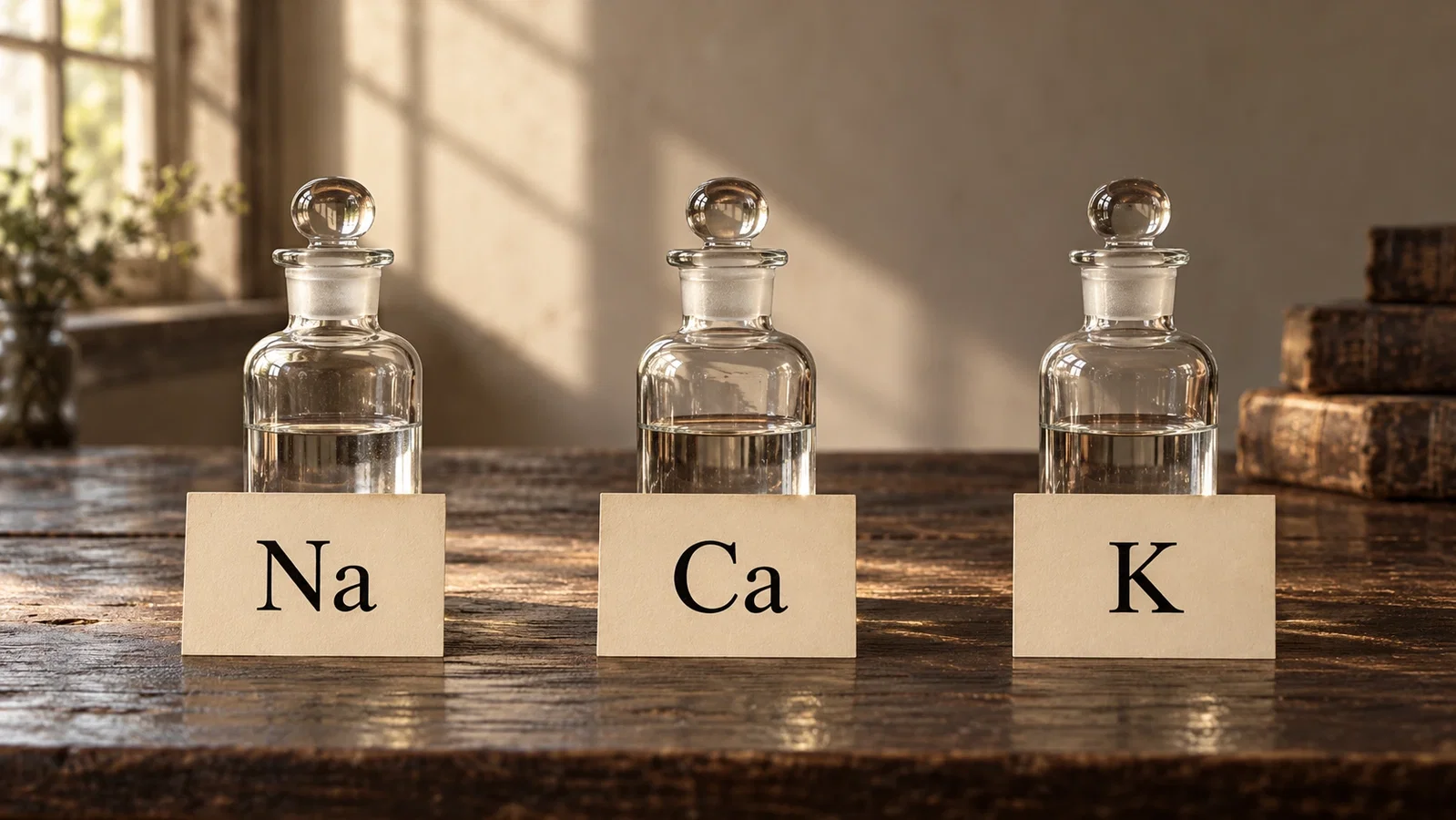
Cards marked Na, Ca and K beside three glass bottles provide modern editorial cues for sodium, calcium and potassium salts. The clear liquids do not depict elemental metals. No recipe, concentration or dose is supplied.
The traces belonged to separate experiments
The follow-up preserved more than a claim that beating returned. Figure IX and its explanation included a recording 56 minutes after one fluid change. Figure X documented another set of conditions at one hour. Figure XIV showed a further comparison, including sodium bicarbonate, with spontaneous contractions at 90 minutes. [2, pp. 35–36, 39, 41–42 and Plate I]
Those times belong to different experiments. They cannot be joined into one animal’s continuous survival record, still less into patient follow-up. The paper also distinguished electrically evoked contractions from spontaneous ones. Its traces recorded mechanical activity; redrawing them as modern ECGs would misrepresent the measurement. [2, pp. 30, 39–42]
Ringer compared neutral and alkaline fluids and considered an indirect role for sodium bicarbonate. [2, pp. 31–32, 36–39] The work was separating contributions to a physiological response, rather than announcing one permanently settled standard formula.
An imagined still life of a water jug and two bottles near a window. It invites attention to water as an experimental material without identifying either bottle as an authenticated historical sample.
Why the article is dated 1882–1883
The History of Anaesthesia Society timeline places Ringer under 1882 and, in the same entry, moves forward to Hartmann’s addition of lactate in 1932. [4, 1882 entry] That is a useful research lead, but it compresses laboratory perfusion and later clinical applications.
The date range used here identifies the two publications. PMC catalogs them as August 1882 and January 1883. The original papers mention experiments in April and May, and in October and November, respectively. Those month references do not independently establish an exact discovery date. [1–2]
Hartmann’s original clinical work is not covered here. The year 1932 is left for later investigation; the later name “lactated Ringer’s” cannot stand in for these earlier reports.
What changed most clearly was the status of an apparently ordinary background condition. Water became something to investigate. Alongside an enduring name, the two papers preserve a correction that can still be followed: what the successful fluid actually contained had to be asked again.
Sources and reading limits
Read: Ringer’s two papers in the Journal of Physiology (1882, vol. 3, pp. 380–393, with plates; 1883, vol. 4, pp. 29–42 and Plate I), in full; the opening of Ringer’s 1885 BMJ account on p. 731; the History of Anaesthesia Society timeline entry for 1882.
Not covered: the rest of the 1885 account; laboratory notebooks; early clinical infusion cases; Hartmann’s original papers. The last panel of Plate XIX of the 1882 paper bears “Vol. IV”, unlike the article’s volume 3; the discrepancy is not used to date the article. Experimental results remain attributed to the author; priority is not judged and no preparation instructions are given. The four illustrations are AI-made interpretive images, not historical photographs or original traces.
- Ringer S. Concerning the influence exerted by each of the constituents of the blood on the contraction of the ventricle. J Physiol. 1882;3(5–6):380–93. PMC
- Ringer S. A further contribution regarding the influence of the different constituents of the blood on the contraction of the heart. J Physiol. 1883;4(1):29–42. PMC
- Ringer S. Regarding the effect of the saline ingredients of the blood on the contraction of the heart. Br Med J. 1885;1(1267):731–4. PMC
- History of Anaesthesia Society. Timeline. Web page
Continue exploring
Related reading connects shared questions and contexts; it does not by itself establish historical influence.
- 1869–1872: Combined Anesthesia With Two Drugs
- 1872: Heidenhain's Salivary Experiments, Where Blood Still Flowed
Anesthesia Epochs · The Source Room · About & Editorial Method
Updated October 30, 2026. Sources and reading limits are stated above. Illustrations are labelled as original source images or AI-made. Historical accounts are educational; they are not current treatment instructions.