A pre-departure notice of May 1950 and the later accounts of the Japanese Society of Anesthesiologists: an American medical mission, an anaesthesia lecture and its influence.
Reading Library · Anesthesia Epochs · 中文版
Watch the education video (for clinicians)
1950: Meyer Saklad in Japan — Teaching Tracheal Intubation · Anesthesia Epochs Education Series
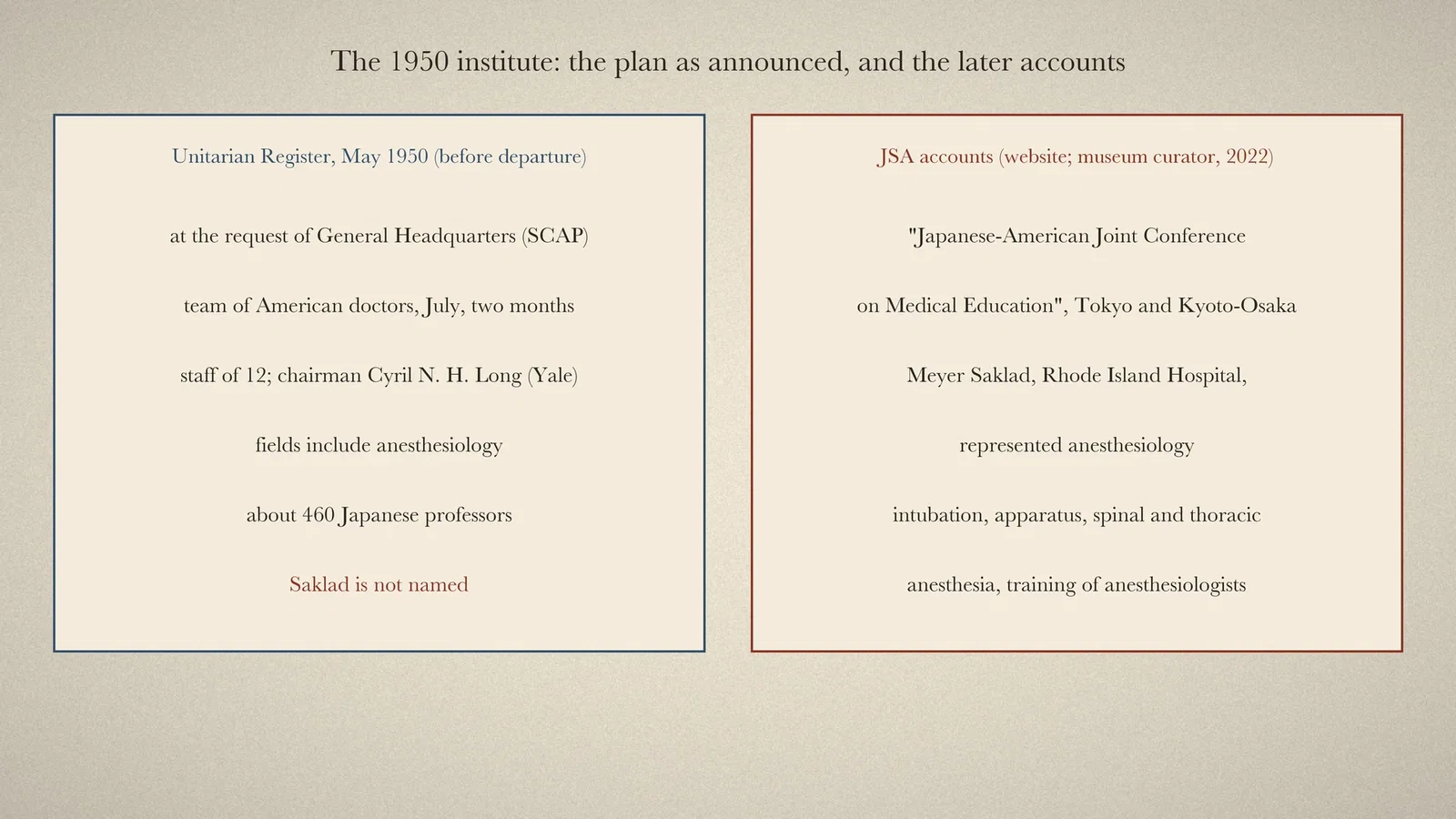
The Japanese Society of Anesthesiologists (JSA) traces the modern specialty in Japan to the summer of 1950, when an American medical team taught Japanese professors, and to the lectures given there by an anaesthetist from Rhode Island, Meyer Saklad. This article looks for that summer in two kinds of record: a notice printed before the team left, and what Japanese anaesthesiologists have written since. A third kind of record lies between them: Shigemasa Ikeda's 2007 study of the mission, written from the Unitarian Service Committee's papers. The notice does not name Saklad; the later accounts do.
The plan, as announced in May 1950
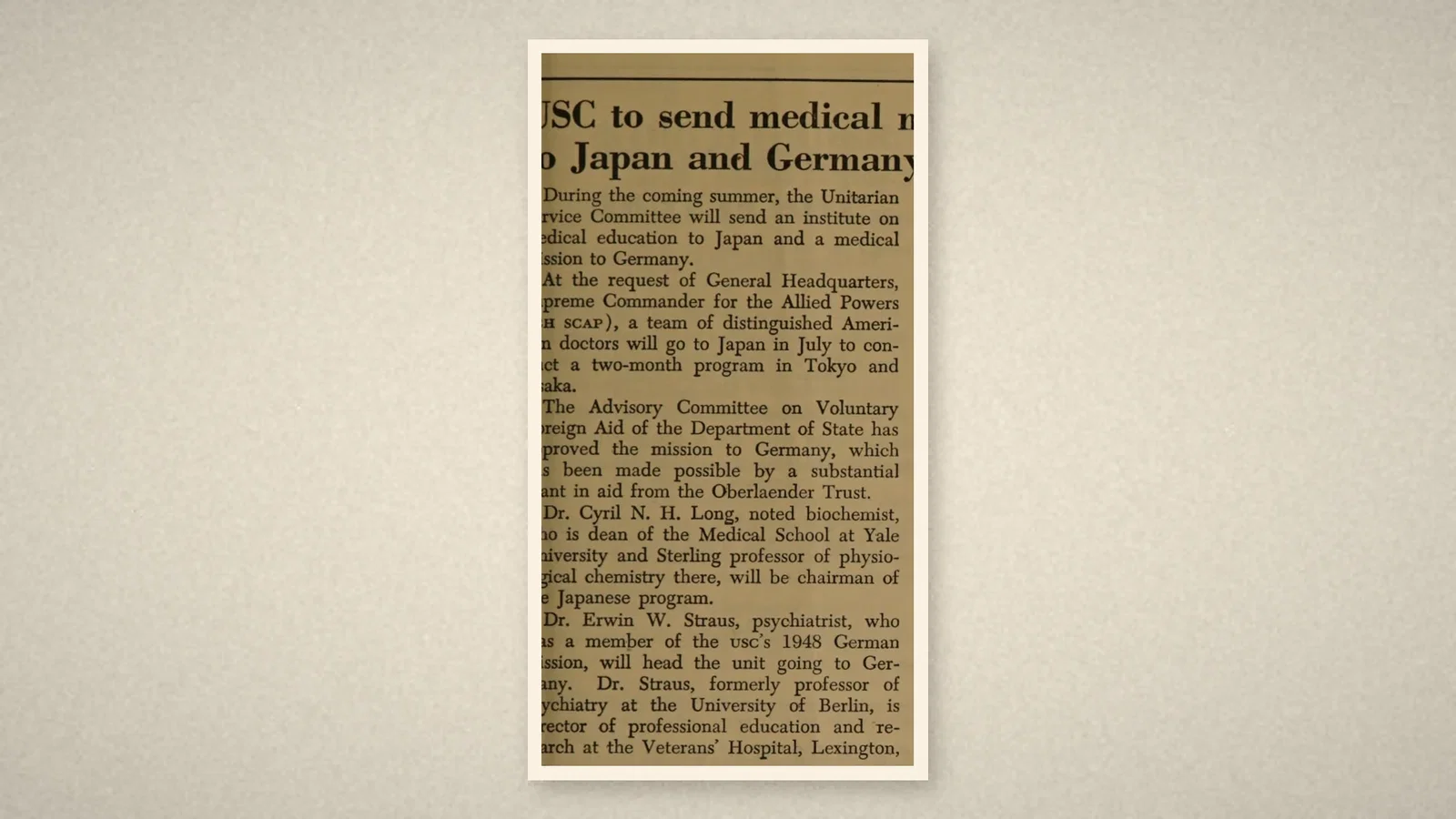
In May 1950 the Unitarian Register reported that "during the coming summer" the Unitarian Service Committee would send an institute on medical education to Japan and a medical mission to Germany. [1, p. 51] At the request of General Headquarters, Supreme Commander for the Allied Powers (SCAP), a team of American doctors would go to Japan in July to conduct "a two-month program in Tokyo and" a second city, whose name is lost in the margin of the scan. Cyril N. H. Long, biochemist and dean of the Yale medical school, would be chairman of the Japanese programme. [1, p. 51]
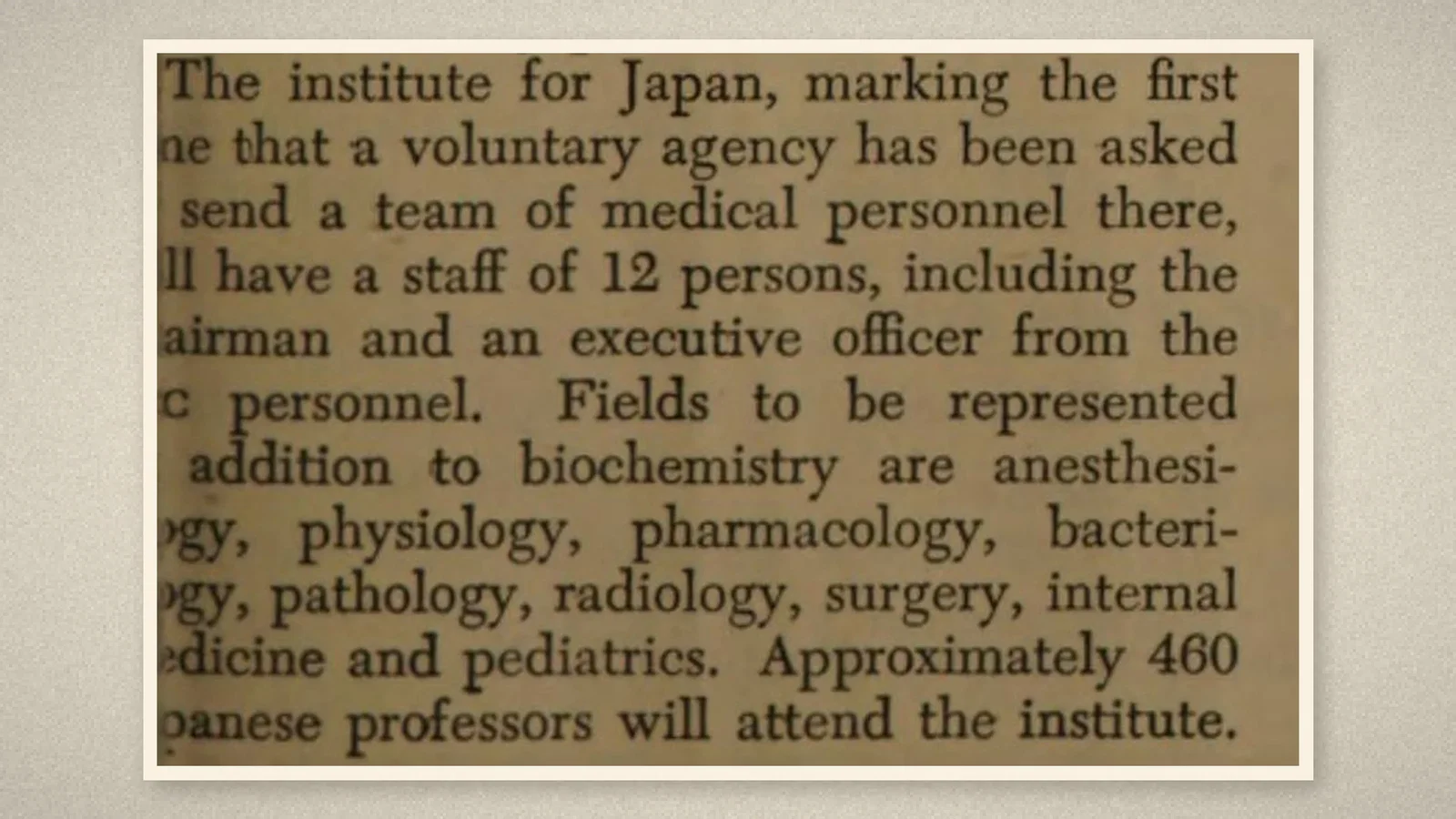
The institute had three purposes: to show Japanese medical professors what should be taught to Japanese medical students; to demonstrate how "teaching on the patient" could be done in what corresponded to the third and fourth years of the American curriculum; and to demonstrate laboratory teaching in the basic sciences, integrated with the lectures. Brigadier-General Crawford F. Sams, chief of Public Health and Welfare at SCAP headquarters, believed such a project would be of inestimable value. [1, p. 51] The notice called it the first time a voluntary agency had been asked to send a team of medical personnel to Japan. The staff would number 12; the fields represented, besides biochemistry, were anesthesiology, physiology, pharmacology, bacteriology, pathology, radiology, surgery, internal medicine and paediatrics; and "approximately 460" Japanese professors would attend. [1, p. 51] The notice does not name the anesthesiologist.
The institute, as remembered in Japan
The JSA's English history page sets the scene. In 1950, it says, textbooks, current English literature and essential anaesthetic equipment were scarce or absent in Japan, and "the words anesthesiology and anesthesiologist were non-existent". [2] Sams decided to hold "Institutes on Medical Education for Japan" with the Unitarian Service Committee Medical Mission, an event also called "The Japanese-American Joint Conference on Medical Education". [2] The curator of the Japanese Museum of Anesthesiology, writing for the history-of-anaesthesia symposium in Kobe in 2022, places the joint meetings "in Tokyo and Kyoto-Osaka". [3]
According to the JSA, "Meyer Saklad, Director of Anesthesiology at Rhode Island Hospital, represented anesthesiology." Saklad lectured to an audience of surgery professors on the scientific basis of anaesthesia, endotracheal intubation, anaesthesia apparatus, spinal anaesthesia, anaesthesia for thoracic surgery and the education of anaesthesiologists, and took part in interdisciplinary sessions with a pharmacologist, a physiologist and a surgeon. [2] The JSA writes that the conference "motivated some 50 doctors to study anesthesiology in the US over the following 10 years", that the journal Masui began in 1952, and that the first academic anaesthesia department was established in 1952 at the University of Tokyo by Hideo Yamamura. [2] The museum curator links the lecture to the founding of the JSA in 1954. [3]
Historians in Japan have made the same judgement. The abstract of A. Matsuki's paper in Masui (2016) states that the most significant influence on the modern advance of anaesthesia in Japan "was made in 1950 by Saklad's lectures", and describes how that influence was assessed: by the later roles of several professors, and by counting anaesthesia-related presentations at surgical meetings and papers in journals before and after the lectures. [4] Ikeda, Sugita and Tanaka (2016) place the mission within the occupation's reform of Japanese medical education, under the Council on Medical Education founded by Sams. [5]
The institute, from the mission's papers
Ikeda, writing in Anesthesiology in 2007 from the Unitarian Service Committee's archive and from interviews, fills in what the notice could only plan. In 1950 General Sams asked the Committee to send specialists "for the rehabilitation of medical education"; the mission of 12 physicians, headed by Cecil Norman Hugh Long of Yale, included Meyer Saklad, director of anesthesiology at Rhode Island Hospital in Providence, who "represented anesthesiology". The members received no fees. Before they left, the Committee's assistant director, Dorothy Snavely, wrote that anaesthesiology as a specialty was "completely unknown" in Japan and that the anaesthesia work "will probably be the most spectacular of any of our group of twelve members". [6, p. 179]
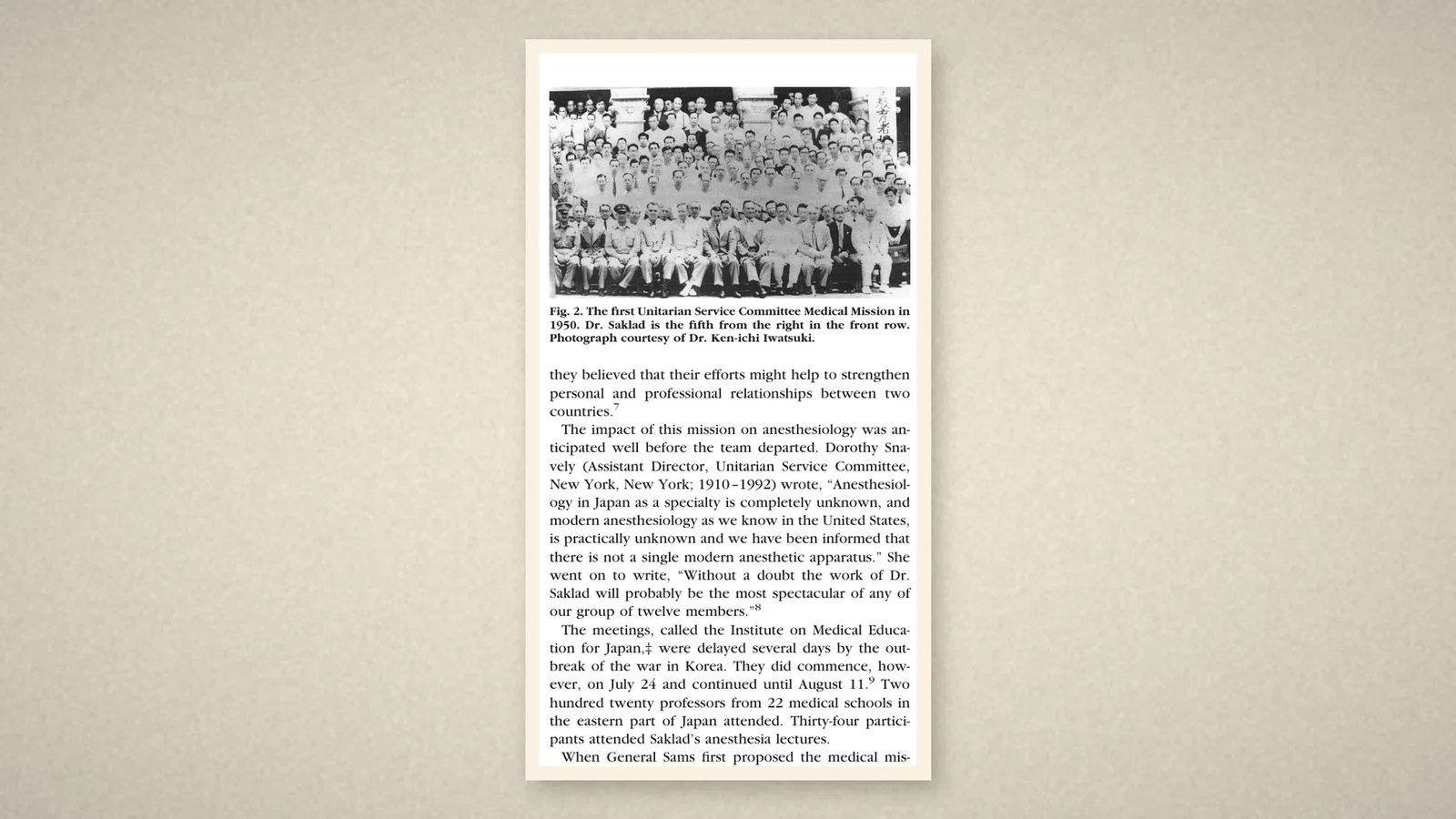
The outbreak of war in Korea delayed the start by several days. The Tokyo institute ran from 24 July to 11 August 1950: 220 professors from 22 medical schools in eastern Japan attended, and 34 of them attended Saklad's anaesthesia lectures. Saklad covered premedication, inhalation anaesthesia and breathing systems from open drop to closed circuit, the pharmacology of anaesthetic agents, tracheal intubation, spinal anaesthesia, anaesthesia for thoracic surgery and positioning, as well as shock, hypoxia, oxygen therapy and the training of anaesthesiologists, with joint sessions alongside a pharmacologist, a physiologist and a surgeon. The team then held a second institute in Osaka and Kyoto, from 14 August to 6 September, for 240 professors from 24 schools in western Japan. [6, pp. 179-80]
Ikeda follows the effects by name. Saklad stressed that anaesthesiology was "both clinical physiology and pharmacology". Kentaro Shimizu, the Tokyo surgeon who translated all of Saklad's lectures, asked a junior colleague who had attended them, Hideo Yamamura, to switch from surgery to anaesthesia, and Yamamura went on to head the department established at the University of Tokyo in 1952; Tohoku University followed in 1953. In February 1951 Sams wrote to Saklad that "the interest aroused in the subject of anesthesiology" had continued and asked Saklad to return; for reasons Ikeda could not establish, Perry Volpitto went in Saklad's place, and reported that "Dr. Saklad's visit last year stimulated thought", while noting that no university yet taught the subject. Surgeons who had heard the lectures sent trainees to Saklad's department, and in 1958 Saklad returned to Japan as a guest of the Japanese Society of Anesthesiologists. [6, pp. 180-3]
What the record shows
The May 1950 notice shows the plan from the American side: a voluntary agency, invited by the occupation authorities, sending twelve teachers for two months to about 460 professors, with anaesthesiology one field among ten. Ikeda's study and the Japanese accounts show what the specialty took from it: a lecturer remembered by name, 34 listeners, and a sequence of departures to the United States, a journal, a university department and a national society.
Sources and reading limits
Read: Ikeda S, Anesthesiology 2007;106:178-85, in full; the Unitarian Register, May 1950, p. 51; the JSA's English history page; the museum curator's greeting on the ISHA 2022 site; the PubMed abstracts of Matsuki (2016) and of Ikeda, Sugita and Tanaka (2016).
Not covered: the Unitarian Service Committee papers, Snavely's letters and Sams's 1951 letter that Ikeda quotes from the Andover-Harvard Theological Library; any report by Saklad; the full texts of the two 2016 papers.
Limits: the May notice is a plan; it expected about 460 professors over two months, while Ikeda gives 220 in Tokyo and 240 in Osaka-Kyoto. The notice calls the chairman Cyril N. H. Long, Ikeda Cecil Norman Hugh Long; both are reported as printed. Ikeda's account of influence rests on archival letters and on interviews held more than fifty years later. Phrases such as the nation's first department are Ikeda's or the JSA's, not this article's. The photograph is reproduced only as printed in Ikeda's article.
Two illustrations are crops of the May 1950 page and one of Ikeda's article; one is drawn from the sources.
- USC to send medical missions to Japan and Germany. Unitarian Register and the Universalist Leader. 1950 May;129(5):51. Internet Archive
- Japanese Society of Anesthesiologists. History [Internet]. Kobe: JSA; [cited 2026 Nov 1]. anesth.or.jp
- Takeda J. Greeting from the Japanese Museum of Anesthesiology curator [Internet]. 10th International Symposium on the History of Anesthesia, Kobe; [cited 2026 Nov 1]. isha2022.com
- Matsuki A. [Influence of the Unitarian Service Committee Medical Mission on the development of anesthesiology in Japan: focusing on the influence of Saklad's lectures of the first mission in 1950]. Masui. 2016;65(8):858-62. Abstract. PubMed
- Ikeda S, Sugita S, Tanaka S. Japanese medical education reforms during the Allied Forces occupancy. Nihon Ishigaku Zasshi. 2016;62(3):273-84. Abstract. PubMed
- Ikeda S. The Unitarian Service Committee Medical Mission: contribution by the United States to post-World War II Japanese anesthesiology. Anesthesiology. 2007;106(1):178-85. DOI
Continue exploring
Related reading connects shared questions and contexts; it does not by itself establish historical influence.
- 1941: Saklad's Physical Status Gives Patient Records a Shared Language
- 1954: Japan's Anesthesia Society Is Founded and Holds Its Opening Meeting
Anesthesia Epochs · The Source Room · About & Editorial Method
Published November 2, 2026; updated November 3, 2026. Sources and reading limits are stated above. Illustrations are labelled as original source images or AI-made. Historical accounts are educational; they are not current treatment instructions.