
In the British Medical Journal of 20 August 1892, Arthur P. Chadbourne reported that tropacocaine, a coca base isolated from the leaves of a Java coca plant, was less than half as toxic as cocaine in animals and, in Professor Schweigger’s eye clinic, produced complete anaesthesia faster than cocaine but for a shorter time.
Reading Library · Anesthesia Epochs · 中文版
Watch the education video (for clinicians)
1892: Chadbourne's Tropacocaine — Two Statements About Duration · Anesthesia Epochs Education Series
One article, one drug, two directions for duration. In the British Medical Journal of 20 August 1892, Arthur P. Chadbourne summarized animal observations suggesting that tropacocaine might produce longer local anaesthesia than cocaine. The account’s experience in human eyes, on the same page, described a faster onset but a shorter duration. [1, p. 406]
Those statements should not be compressed into “the new drug was better.” They concerned different subjects. Keeping animal averages separate from patients’ experiences is a starting point for reading this early local anaesthetic report.
A chemical history and a medical name
Chadbourne attributed the isolation of the new alkaloid to Giesel, working with material from a small-leaved Java coca plant. Chadbourne then described Liebermann’s chemical investigation and preparation of benzoyl-pseudo-tropein from pseudo-tropein. Footnotes referred to papers from 1891 and 1892. [1, p. 402]
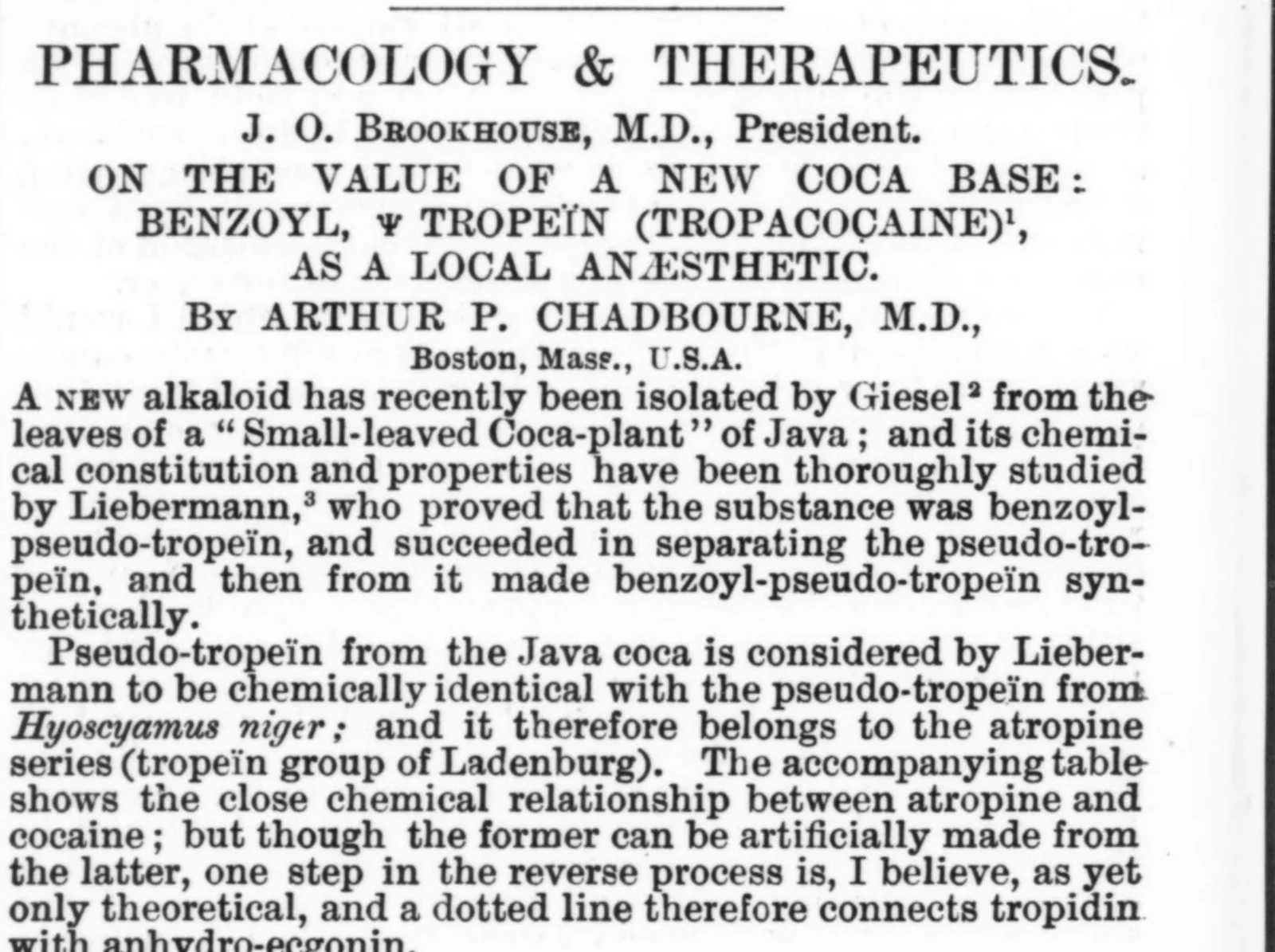
The date used here is the paper’s publication date, 20 August 1892. Isolation, chemical preparation, local anaesthetic observations and later spinal use should not be folded into a single event dated 1891.
The name also changed. A footnote says that “Tropsin” had been used at the British Medical Association meeting in Nottingham, but was replaced in this paper by “Tropa-cocaine,” intended to suggest relationships with atropine and cocaine. [1, p. 402] This records the author’s presentation of a substance to medical readers, rather than establishing a current classification or mechanism.
The sample mattered
Chadbourne specified that the experiments used the synthetically prepared hydrochloride. Oscar Liebreich supplied material obtained from C. Liebermann, whose laboratory furnished most of it; a smaller amount came from Giesel. A sample bought from Zimmer and Co. proved more irritating and toxic, according to the paper, but the difference disappeared after purification. [1, p. 403]
This was more than a supplier’s footnote. Before comparing two drugs, the investigator had encountered a question about the material being compared. The observation makes sample provenance and preparation relevant. It does not certify every manufacturing batch.
The experimental work took place at the Pharmacological Institute of the University in Berlin. Chadbourne said that experiments were accompanied by similar cocaine comparisons, while necessary methodological details would be published later. [1, p. 403] Comparison was part of the design. Randomization, blinding and a complete underlying dataset cannot be supplied retrospectively where the paper does not document them.
Whose numbers are in the tables?
The frog dose table on page 403 was based on 27 experiments, each with a cocaine control. Another table, on page 404, drew on 29 rabbit experiments restricted to a single subcutaneous injection followed by leaving the animal free. [1, pp. 403–404] Neither number describes a clinical patient cohort, and adding them would not establish a denominator for every experiment in the article.
The rabbit eye comparisons used one eye for each agent. In the 2% row, the average duration of complete corneal anaesthesia is 20 minutes for tropacocaine and 14 for cocaine. A footnote beside the cocaine onset time identifies incomplete data for one experiment. Chadbourne distinguished the impression given by averages from the less certain picture obtained by comparing individual experiments. [1, p. 404]
These were animal observations summarized as averages. They were not guaranteed durations for human eye surgery or present-day treatment schedules. Numerical tables did not erase differences in subjects, conditions or endpoints.
The direction changed in the clinic
The human-eye section occupies the end of the paper. Chadbourne relayed Schweigger’s comparison after several months of use: at equal strengths, complete anaesthesia developed faster with tropacocaine but lasted less long than with cocaine. Further applications were described as a way of maintaining the effect. [1, p. 406] That historical practice is not a current recommendation, and the animal table cannot be used to change “shorter” into “longer.”
The account mentions foreign-body removal, iridectomy and Silex’s experience with tenotomy, reporting painless short procedures. It also records occasional slight pupillary dilation, brief congestion and smarting. [1, p. 406] No overall clinical denominator is supplied, nor is there a case-by-case record. Procedures attributed to Schweigger and Silex should not all become operations performed by Chadbourne.
The statement that no harmful symptoms had been seen belongs to that reported clinical experience. Earlier pages explicitly describe animal convulsions, respiratory arrest and cardiac standstill. Their figures record rabbit respiration and carotid pulse, not human electrocardiograms. [1, pp. 404–406] The author’s summary that tropacocaine was less than half as toxic as cocaine likewise concerns the animal comparisons. It is not a measured population risk ratio or a universal assurance of safety.
Reading beside Koller’s 1884 report
In Bettman’s 1885 translation of Koller’s 1884 report on cocaine and the eye, page 99 describes a woman undergoing cataract surgery who did not perceive the corneoscleral incision but experienced slight pain during iris manipulation. [2, p. 99]
That page can be read beside the 1892 report to ask what a patient felt during particular steps. Different drugs, reports and cases do not become one comparative clinical trial. Chronology alone also supplies no direct line of influence.
Chadbourne ended by hoping for trials beyond ophthalmic practice. [1, p. 406] The paper’s discussion of the spinal cord belongs to animal physiology, not clinical spinal anaesthesia cases. This source does not establish spinal use in 1891.
The branch of local anaesthetic history preserved here concerns more than a new name. Sample provenance, experimental subjects, averages and clinical observations all change the meaning of a favorable comparison. The report opens a possibility while leaving the distance between its different kinds of evidence visible.
Sources and reading limits
Read: Chadbourne’s complete contribution, printed pages 402–406 of the British Medical Journal of 20 August 1892, in the Internet Archive scan, including its tables and tracings; and page 99 of Bettman’s 1885 translation of Koller.
Not covered: the earlier Giesel and Liebermann papers, whose content is given here as Chadbourne reports it; Veasey’s 1893 reprint; the rest of Koller’s translated article; questions of worldwide priority in isolation or synthesis, first spinal use, current mechanisms and clinical safety.
- Chadbourne AP. On the Value of a New Coca Base: Benzoyl, ψ Tropeïn (Tropacocaine), as a Local Anæsthetic. BMJ. 1892 Aug 20;2(1651):402–406. Original scan beginning at page 402.
- Koller K. The Application of Cocaine to the Eye as an Anæsthetic. Translated by Boerne Bettman. Chicago Medical Journal and Examiner. 1885 Feb;50(2):91–100. Original page images.
Continue exploring
Related reading connects shared questions and contexts; it does not by itself establish historical influence.
Anesthesia Epochs · The Source Room · About & Editorial Method
Published November 2, 2026. Sources and reading limits are stated above. Illustrations are labelled as original source images or AI-made. Historical accounts are educational; they are not current treatment instructions.