In 2016, CDC turned limited evidence, harm signals, and clinical context into chronic-pain prescribing guideposts, then later had to confront policies that turned guideposts into walls.
Reading Library · Anesthesia Epochs · 中文版
Watch the companion film
2016: The CDC Opioid Prescribing Guideline · Watch on YouTube
Historical anchor: 2016. Date details and source qualifications are explained below.
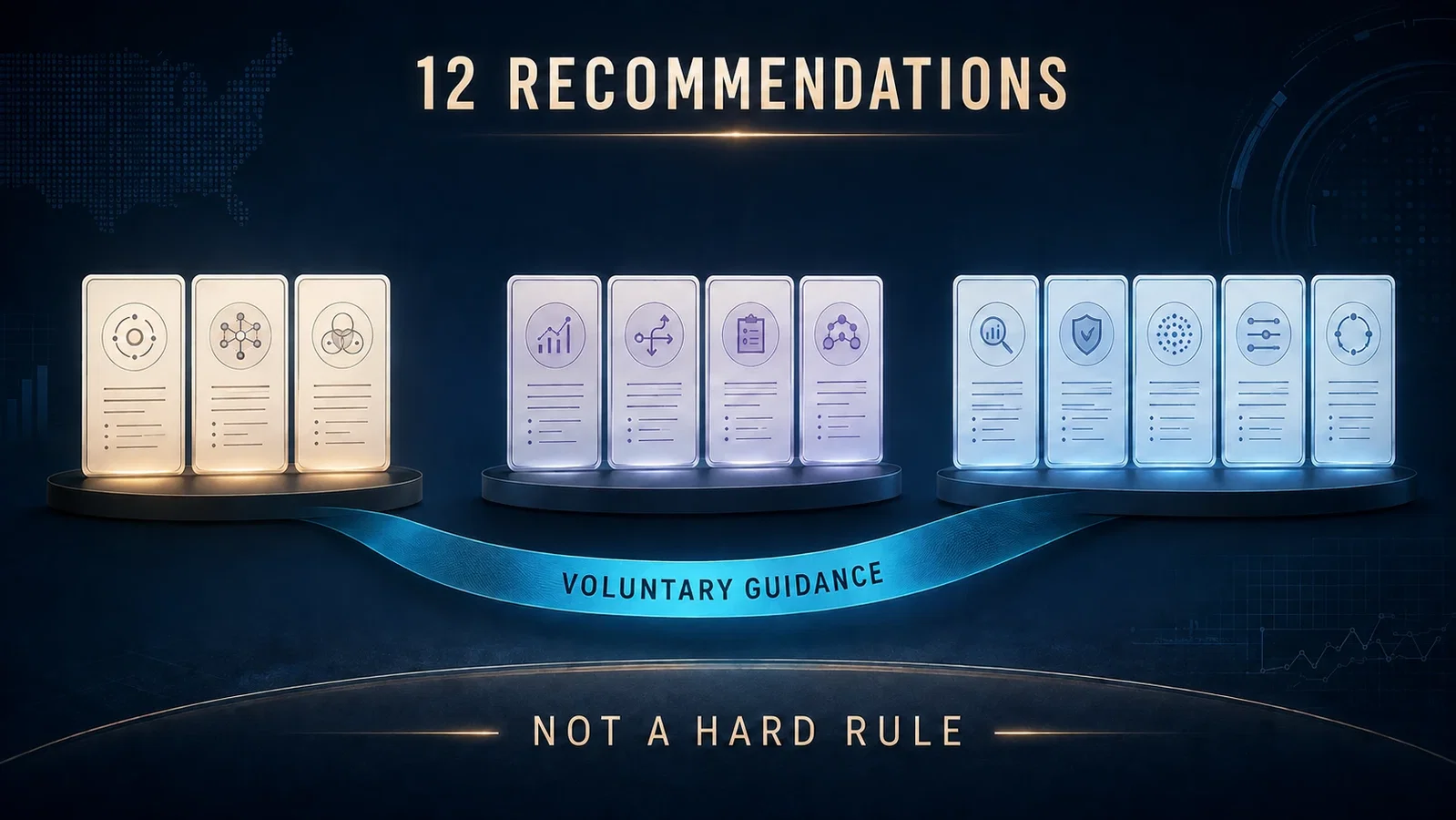
Eleven of the twelve recommendations in the 2016 CDC opioid guideline were Category A.
That sounds like a statement about evidence quality. It was not.
In the framework CDC used, the category described the strength of the recommended course of action. A separate number described the type of evidence. Most of the Category A recommendations rested on type 3 or type 4 evidence: observational studies, randomized trials with important limitations, clinical experience, or observations with major limitations.
The distinction is the key to reading this document historically. CDC did not claim that twelve high-certainty experiments had delivered twelve answers. It made a public-health judgment from an uneven body of evidence, then labelled the recommendations voluntary rather than prescriptive standards.
What happened when those qualifications met systems built to encode numbers is a second history. By 2022, CDC was documenting rigid dose thresholds, abrupt tapers, duration limits, and applications to populations the 2016 guideline had excluded.
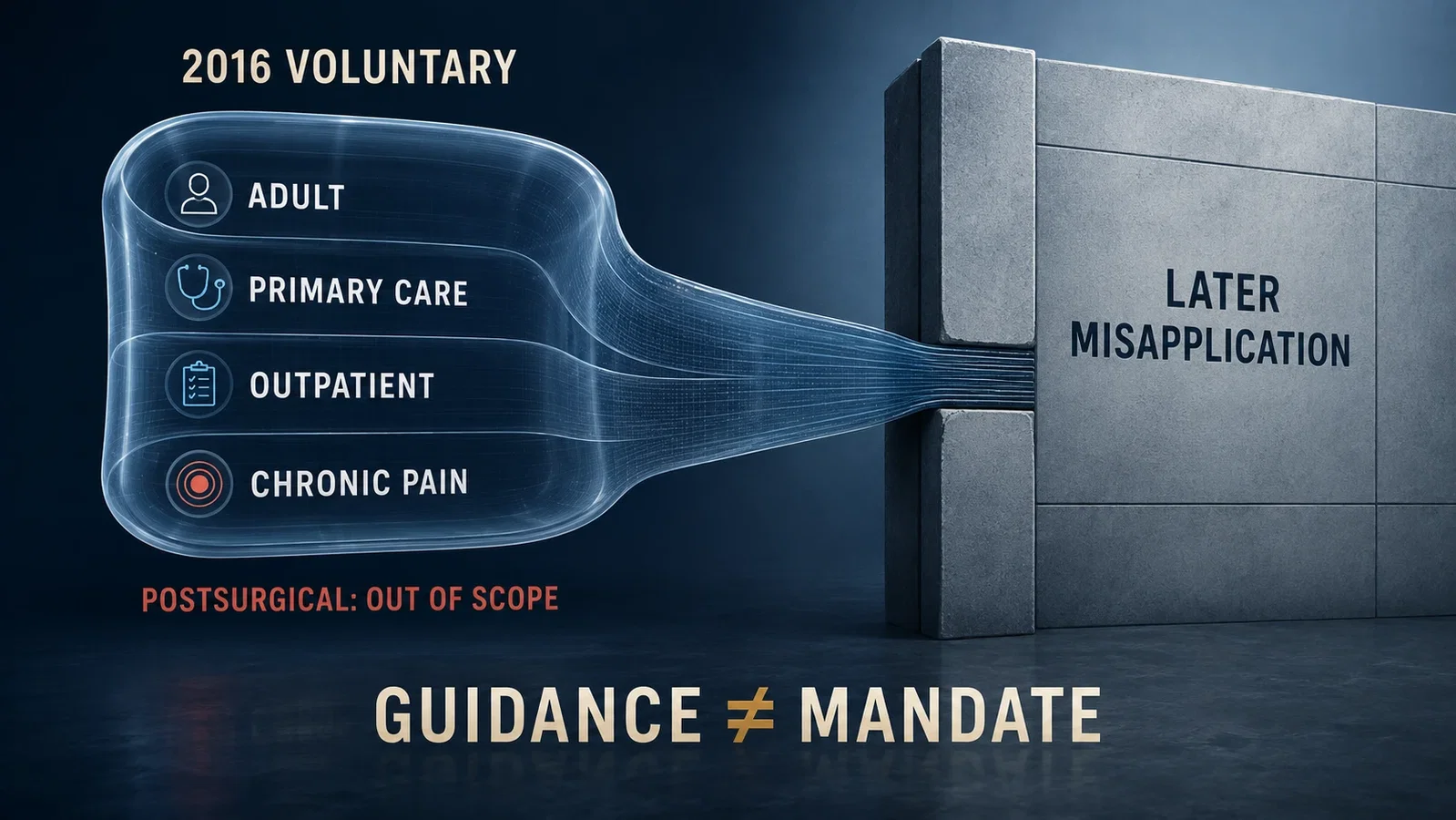
The original document had offered guideposts. Some later policies turned them into walls.
The event occurred on two dates
CDC posted CDC Guideline for Prescribing Opioids for Chronic Pain: United States, 2016 as an MMWR Early Release on March 15, 2016. A CDC press release issued that day described twelve new recommendations for primary-care treatment of chronic pain.
The bound issue of MMWR Recommendations and Reports is dated March 18. It lists Deborah Dowell, Tamara M. Haegerich, and Roger Chou as authors and runs from pages 1 through 49.
This article uses March 15 as the public-release anchor and preserves March 18 as the issue date. An erratum followed on March 25, but its three corrections concerned a resource sentence, the date of a Federal Register meeting notice, and one stakeholder affiliation. It did not revise the scope, recommendation count, evidence grading, or dose language.
Those distinctions are more than bibliographic tidiness. A guideline asks clinicians to preserve context around a decision. Its own publication history deserves the same treatment.
Scope came before dosage
The guideline addressed primary-care clinicians treating outpatients aged eighteen or older with chronic pain, defined as pain usually lasting more than three months or persisting beyond normal tissue healing.
Active cancer treatment, palliative care, and end-of-life care were excluded. Children and adolescents were not covered. The recommendations did not govern opioid agonist treatment for opioid use disorder.
Nor was this a perioperative guideline.
The text acknowledged that some recommendations might be relevant to emergency physicians, dentists, or other specialists, but said those settings were not its focus. It directed readers to separate acute-care and dental sources, including the American Society of Anesthesiologists' guideline for acute pain management in the perioperative setting.
Recommendation 6 contained the famous statement that three days or less would often be sufficient for acute pain and more than seven days would rarely be needed. The accompanying rationale narrowed that advice to reasonably diagnosed nontraumatic, nonsurgical acute pain. It then stated explicitly that opioid treatment for postsurgical pain was outside the guideline's scope.
That sentence prevents a tempting retrospective shortcut. The opioid crisis changed the environment in which anesthesiologists and surgeons practiced, but this particular document was not CDC's 2016 postoperative prescribing rule.
The twelve recommendations had three jobs
The first three recommendations addressed whether to initiate or continue opioids for chronic pain. Recommendations 4 through 7 addressed formulation, dosage, duration, reassessment, and discontinuation. Recommendations 8 through 12 addressed risk and harm, including naloxone, prescription-monitoring data, urine testing, concurrent benzodiazepines, and treatment for opioid use disorder.
Recommendation 10, on urine testing, was the only Category B recommendation. The other eleven were Category A.
CDC's adaptation of GRADE kept recommendation strength and evidence type separate. Category A meant that most people in the specified group should receive the recommended course of action. Category B meant that different choices would suit different patients and required decisions consistent with patient values and clinical circumstances.
Evidence type ran from 1, the greatest confidence, through 4, the least. The twelve recommendations ranged from type 2 to type 4. Recommendation 12, concerning evidence-based treatment for opioid use disorder, was type 2. The remaining recommendations were type 3 or type 4.
CDC explained how strong recommendations could emerge from limited evidence. A course of action could receive Category A status when the anticipated advantages substantially outweighed the disadvantages after considering harms, values and preferences, and resources. That is a governance judgment under uncertainty. It is not a concealed randomized trial.
The clinical review found an important absence
The companion clinical evidence review began with a 2014 AHRQ report and added a search through April 2015. Investigators screened 257 update records, reviewed sixteen articles in full, and included seven new studies.
No study compared long-term opioid therapy with no opioid therapy for pain, function, or quality of life at one year or longer.
The time horizon matters. The guideline did not say that opioids could never relieve pain. It acknowledged short-term efficacy in trials of nociceptive and neuropathic pain. Most placebo-controlled randomized trials, however, lasted no more than six weeks. They could not establish the net value of years of treatment.
Evidence on serious harm pointed in a more consistent direction but came largely from observational data. Higher prescribed dosages were associated with greater overdose risk. The studies did not reveal one biological threshold that separated safe from unsafe treatment for every patient.
The review also found no outcome study showing that opioid-management plans, patient education, urine testing, prescription-monitoring data, pill counts, monitoring instruments, more frequent visits, or abuse-deterrent formulations reduced overdose, addiction, abuse, or misuse.
That result does not prove that every mitigation practice is useless. It marks the difference between a plausible safeguard and a safeguard with demonstrated patient outcomes.
Contextual evidence carried part of the decision
CDC did not derive the recommendations from the clinical review alone. Its contextual review examined four additional domains: nonpharmacologic and nonopioid treatments; benefits and harms of opioid therapy; clinician and patient values; and resource allocation.
This was a rapid review, designed for speed during a public-health emergency. Searches were limited by database, year, and language. Parts of quality assessment and data extraction were streamlined. Some topic areas relied on one primary reviewer. The report described much of the original contextual evidence as observational and low quality.
The review nevertheless preserved complications that a simple dose-reduction narrative could miss. Urine-test results could be difficult to interpret. False findings, stigma, and dismissing a patient from care could themselves cause harm. Abrupt discontinuation or rapid tapering could produce withdrawal, worsen pain, disrupt care, or lead patients to seek opioids elsewhere.
Patients' goals, clinicians' constraints, the availability of alternatives, and the cost of care were therefore not ornamental considerations. They helped determine whether a recommendation could work without creating a different injury.
The evidence package had two forms of uncertainty at once: uncertainty about the long-term benefit of continued opioid therapy, and uncertainty about the consequences of changing that therapy badly.
Fifty and ninety were verbs in numerical form
Recommendation 5 is often remembered as a pair of numbers. Its action words are more informative.
Clinicians were to start with the lowest effective dosage and use caution at any dosage. Before increasing a total dose to at least 50 morphine milligram equivalents per day, they were to reassess individual benefits and risks. At that level, the rationale added closer follow-up and consideration of naloxone.
Before increasing to at least 90 MME per day, clinicians were to avoid escalation or carefully justify it through diagnosis, expected incremental benefit, alternative treatments, risks, and specialist input when appropriate.
The rationale said no single threshold eliminated overdose risk. It also recorded an expert's view that the evidence could not identify the precise dose at which the benefit-risk ratio declined. Fifty and ninety therefore represented prompts for different clinical actions. They did not define a green zone, a red zone, or an automatic taper.
The guideline also distinguished escalation from the management of people already receiving high doses. It acknowledged that dose reduction could be anxiety-provoking after years of treatment and that a collaborative taper might need to proceed very slowly, with pauses.
The one-page CDC checklist compressed these ideas for use in primary care. Compression made the guidance portable, but it also made the surrounding conditions easier to lose. An implementation aid cannot carry all the qualifications of a forty-nine-page report and its two evidence reviews.
The experts did not vote the document into existence
CDC supplied a core expert group with the clinical and contextual reviews and draft recommendation statements. Experts rated each proposal individually across benefits, harms, evidence strength, values, costs, clarity, importance, rationale, and ease of implementation.
There was broad agreement on some recommendations and disagreement on others. The experts did not vote and did not seek consensus. CDC decided which recommendations to include and how to state the rationale. Experts could comment on a revised draft, but they did not review the final version.
Stakeholders, members of the public, peer reviewers, federal partners, and a federally chartered advisory committee also contributed to the process.
The resulting document was neither a pure expert-consensus statement nor the automatic output of a systematic review. It was an institutional decision that joined imperfect evidence to public-health responsibility.
That helps explain its explicit language of restraint. Clinical decisions were to arise from the clinician-patient relationship, the patient's functioning and life context, and the circumstances and unique needs of each case. The recommendations were voluntary.
The 2022 update documented what had been lost
The 2022 CDC guideline expanded its scope to acute, subacute, and chronic pain in adult outpatients, including some procedure-related pain. That later scope should not be projected backward into 2016.
The update also reviewed the first guideline's afterlife. CDC reported that some laws, regulations, payer rules, and institutional policies had gone beyond the original clinical recommendations and violated their central commitment to flexible, individualized care.
The examples were concrete: applying the guideline to excluded populations; rapid or abrupt noncollaborative tapering; rigid dose thresholds; insurer and pharmacy duration limits; applying pain guidance to medications for opioid use disorder; and dismissing or abandoning patients.
CDC described these practices as inconsistent with the 2016 guideline and linked them to untreated or undertreated pain, serious withdrawal, psychological distress, overdose, and suicidal thinking and behavior.
The 2022 authors changed the architecture of the update in response. More detailed dosage considerations moved beneath the main recommendation statements, where nuance could accompany them. The new text again warned against inflexible standards across populations.
This is later evidence about implementation, not an outcome known on release day. It reveals, however, why the grammatical form of a recommendation matters. A number can travel easily into a coverage rule or electronic alert. Its qualifying verbs, target population, and evidence limits travel less reliably.
The perioperative connection is adjacent, not identical
One study in the 2016 clinical review followed 391,139 opioid-naive patients after low-risk operations. Receiving an opioid within seven days of surgery was associated with use at one year, with an adjusted odds ratio of 1.44.
That retrospective cohort made the transition from acute exposure to longer-term use visible. It did not randomize prescriptions, establish that every later use was inappropriate, or change the guideline's stated exclusion of postsurgical pain.
The historically accurate connection to anesthesia is therefore not that CDC ordered anesthesiologists to follow a postoperative duration limit. It is that perioperative clinicians faced the same emerging transition risk and the same danger of importing a numerical rule from a neighboring evidence domain without its scope.
Clinical systems retain what they can count. Dose, days supplied, testing frequency, and visit intervals fit readily into policy. Population boundaries, exceptions, uncertainty, and shared decisions are harder to encode.
A guideline's boundaries are part of its content
The 2016 CDC guideline confronted an asymmetrical record. Reliable evidence of long-term benefit was missing, while signals of dose-associated harm accumulated. Waiting for complete certainty was itself a choice with consequences.
CDC responded with twelve recommendations built from clinical studies, contextual evidence, values, preferences, and resource considerations. That was a defensible form of action under uncertainty. It also demanded disciplined reading.
Fifty must remain attached to reassess. Ninety must remain attached to avoid escalation or carefully justify. Three and seven days must remain attached to a nonsurgical acute-pain context. Category A must remain separate from evidence type. The 2016 chronic-pain scope must remain separate from the broader 2022 update.
Twelve voluntary recommendations were not written as hard rules.
When history preserves the numbers but discards the words around them, it no longer describes the guideline. It describes what the guideline was turned into.
Sources and reading limits
Sources: Dowell D, Haegerich TM, Chou R. MMWR Recomm Rep. 2016;65(1):1-49. PMID 26987082. DOI 10.15585/mmwr.rr6501e1; complete CDC Clinical Evidence Review and Contextual Evidence Review, 2016; CDC Checklist for Prescribing Opioids for Chronic Pain, March 2016; Dowell D et al. CDC Clinical Practice Guideline for Prescribing Opioids for Pain: United States, 2022. MMWR Recomm Rep. 2022;71(3):1-95. PMID 36327391. DOI 10.15585/mmwr.rr7103a1. All cited sources were read for this article. The AHRQ 2014 full report was not available and carries no unique claim.
Visual interpretations
These illustrations explore the setting and ideas. Depicted people, actions, instruments and documents are reconstructions, not evidence of their exact historical appearance.


Continue exploring
Related reading connects shared questions and contexts; it does not by itself establish historical influence.
Related reading
The Source Room · About & Editorial Method
Sources and reading limits are stated above. Illustrations are labelled as original source images or AI-made. Historical accounts are educational; they are not current treatment instructions.