From a 2015 proposal and 2018 release to formal adoption in 2019 and effect in 2022, one classification preserved both primary and secondary pain.
Reading Library · Anesthesia Epochs · 中文版
Watch the companion film
2019: ICD-11 — Chronic Pain Gets Its Own Codes · Watch on YouTube
Historical anchor: 2019. Date details and source qualifications are explained below.
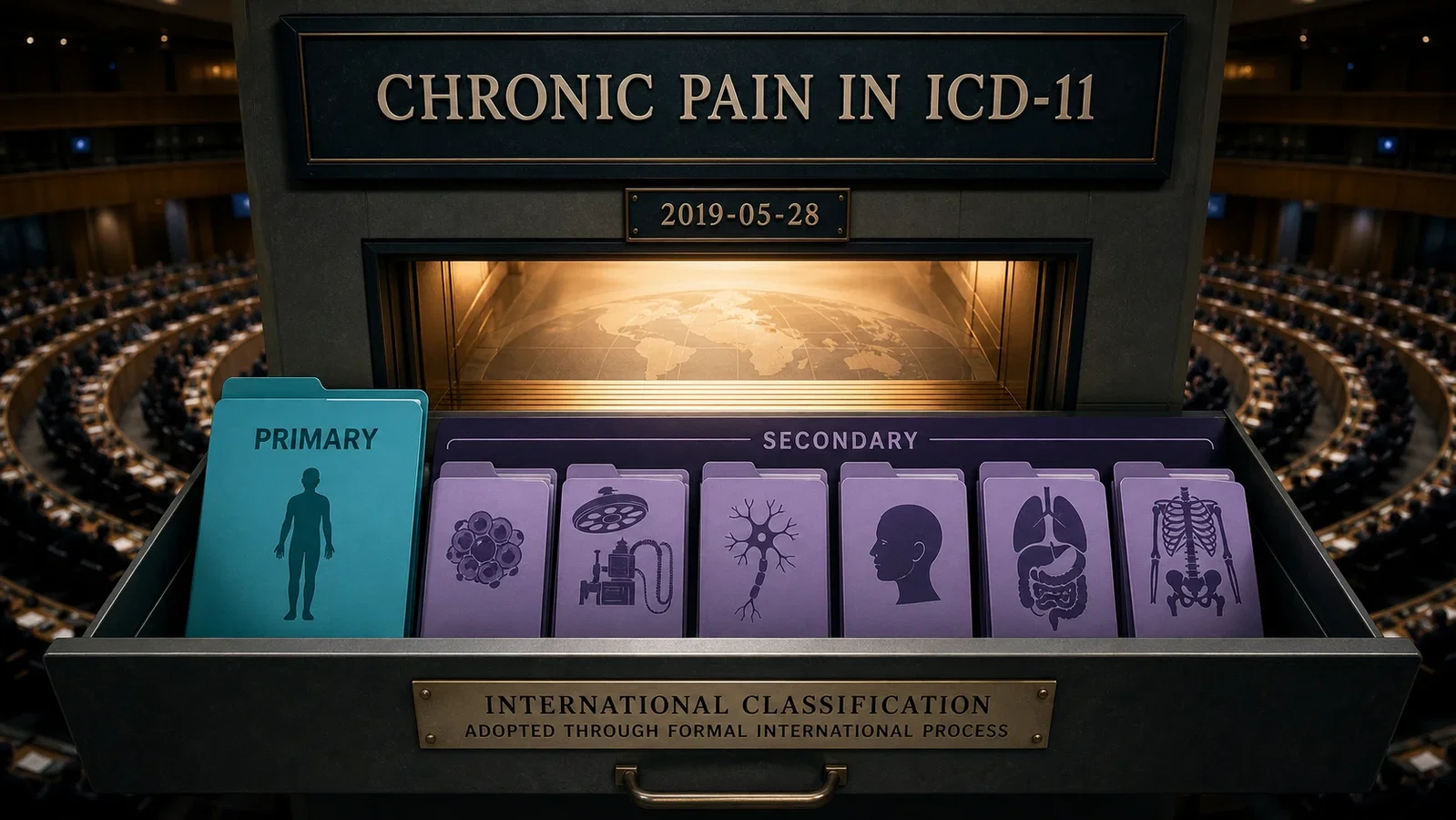
A pain has lasted for more than three months. Is it still a symptom of something else, or has it become a health condition that needs a name of its own?
Earlier international classifications did not answer that question systematically. Chronic pain diagnoses were scattered across diseases and body systems, sometimes following an underlying cause and sometimes borrowing a code that did not quite fit. Pain was present in patients’ lives without occupying an equally coherent place in the classification.
The adoption of ICD-11 in 2019 changed that. Yet the most important change was not that the World Health Organization had finally “declared pain a disease.” The new architecture preserved two possibilities: chronic pain could be a primary condition in its own right, or it could remain secondary to another disease.
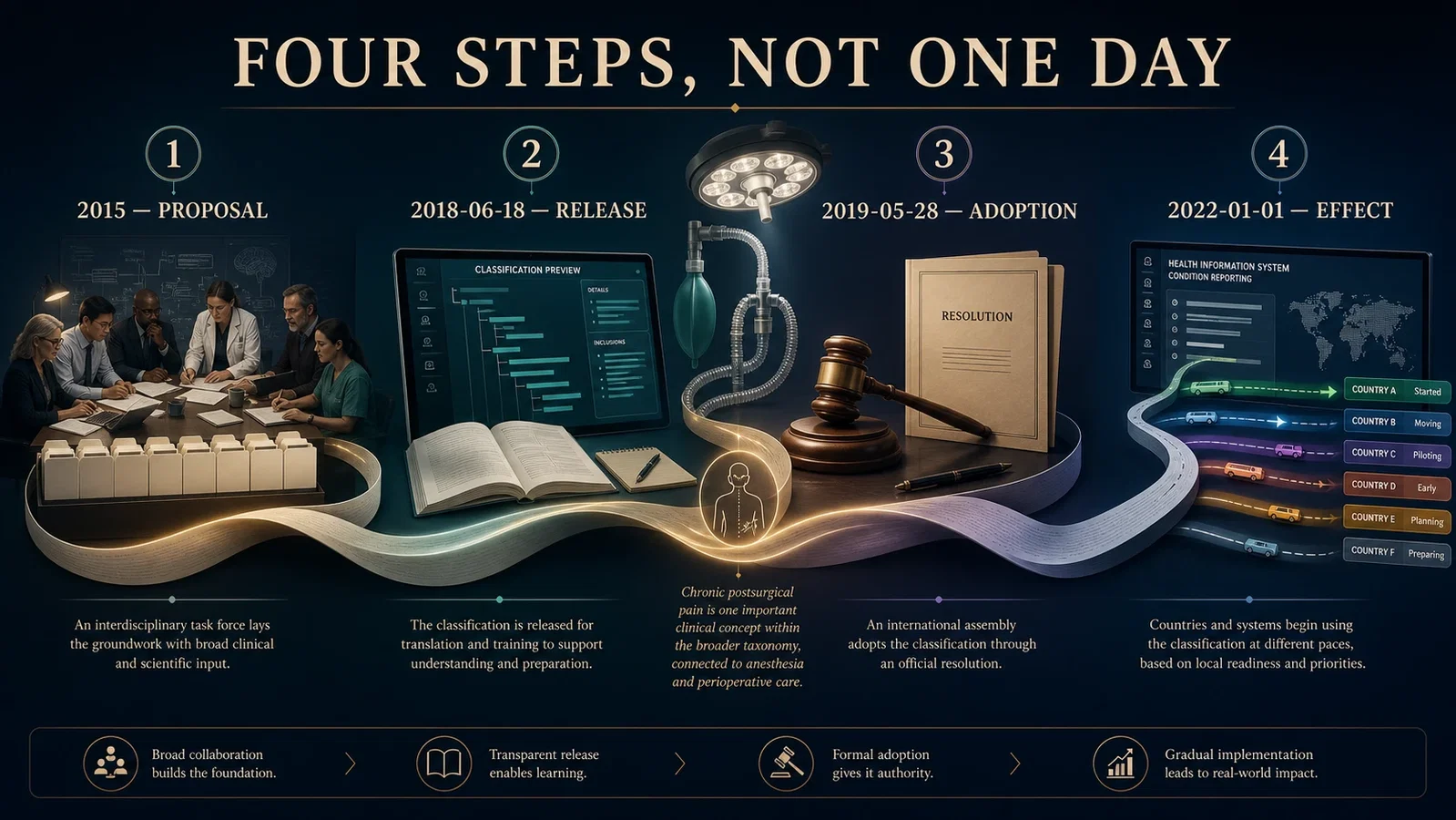
This did not happen in one day in 2019
Direct work between IASP and WHO began in 2012. A task force led by Rolf-Detlef Treede and Winfried Rief then developed definitions, diagnostic boundaries, and content models for chronic pain.
In 2015, the group published an early seven-part proposal. ICD-11 was still being revised, and the paper even anticipated a World Health Assembly vote in 2017. That forecast did not come true. Its value now is not as evidence of an adoption that never happened, but as a timestamp from an unfinished process.
WHO released an ICD-11 advance preview on 18 June 2018 so countries could prepare implementation, translation, and training. Its announcement was explicit: the revision would still be presented to the World Health Assembly in May 2019 for adoption.
Treede and colleagues’ central article appeared in the January 2019 issue of PAIN, but the manuscript had been accepted in July 2018. It described the chronic-pain structure already present in the 2018 version and looked ahead to the Assembly vote. It did not perform that vote.
A decision on the 25th, a formal resolution on the 28th
WHO’s Assembly update said on 25 May 2019 that Member States had agreed that day to adopt ICD-11. IASP’s subsequent news used the same date for the decision.
The formal document, WHA72.15, is dated 28 May. Its first operative paragraph records that the Seventy-second World Health Assembly adopted ICD-11 and that it would come into effect on 1 January 2022. Its closing line also places the seventh plenary meeting on 28 May.
The dates mark different institutional artifacts: one is the action date reported in Assembly news; the other is the formal resolution and plenary date. This article uses 28 May as its historical anchor while retaining the 25 May news chronology. Making the story tidier by erasing the distinction would make it less accurate.
Seven groups did not mean seven equivalent diseases
The classification operationalized chronic pain as pain that persists or recurs for more than three months. Treede and colleagues also acknowledged that three months was a pragmatic boundary, not a biological switch thrown at one particular midnight.
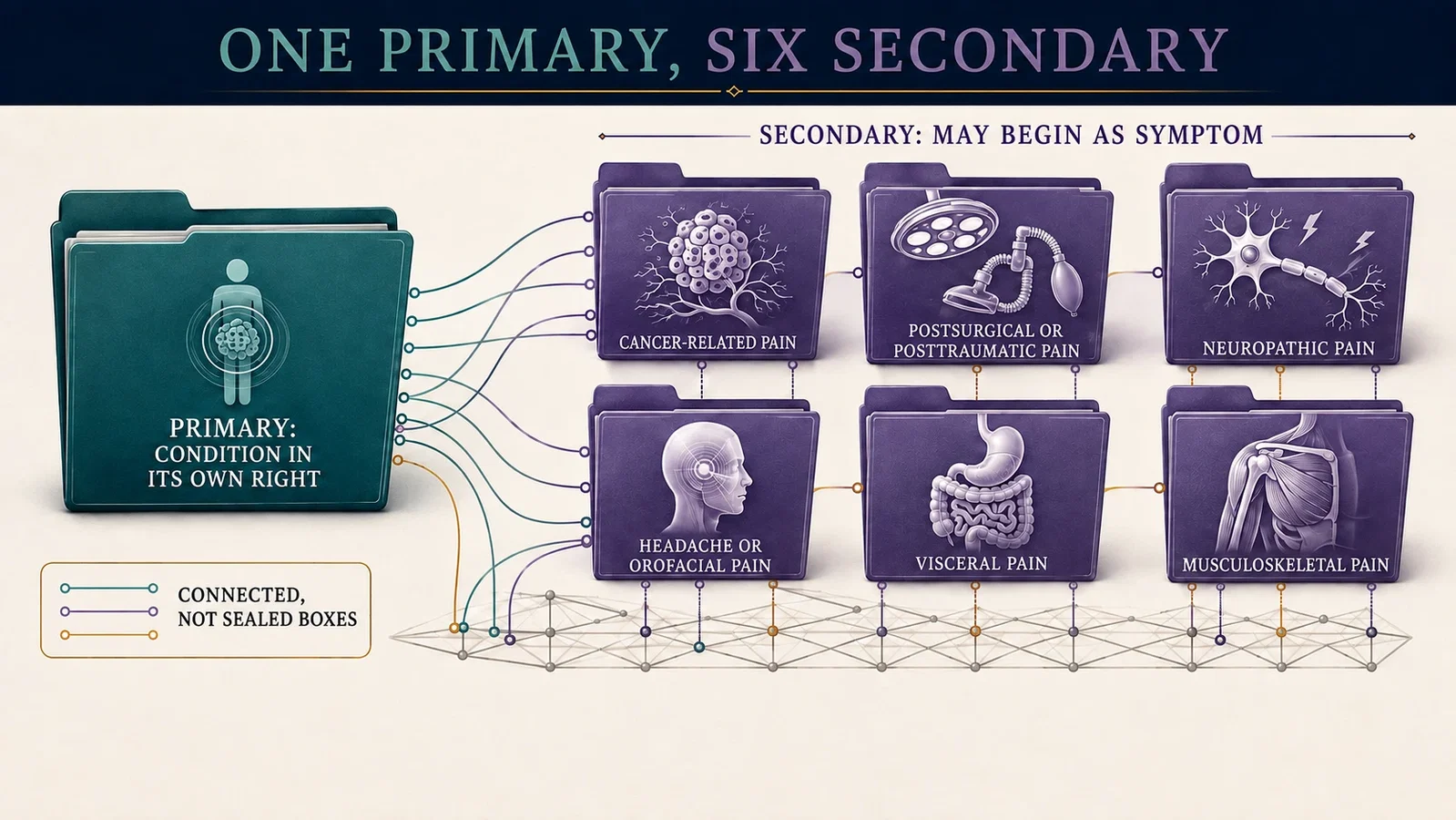
Only the first of the seven major groups was called chronic primary pain. Conditions such as fibromyalgia or nonspecific low-back pain could sit there; pain could be conceived as a disease or health condition in its own right.
The other six were forms of chronic secondary pain:
- chronic cancer-related pain;
- chronic postsurgical or posttraumatic pain;
- chronic neuropathic pain;
- chronic secondary headache or orofacial pain;
- chronic secondary visceral pain; and
- chronic secondary musculoskeletal pain.
In these groups, pain could at least initially be understood as a symptom of an underlying disease. Secondary did not mean minor, unreal, or undeserving of care. The pain itself could require specific management and could persist even after the original disease had been treated or had lost relevance.
ICD-11 therefore did not push every chronic pain into one disease box. It recognized that pain can be the central condition, or can begin inside another disease’s story and still become a problem that needs to be recorded in its own right.
The classification was not a row of sealed drawers
Earlier ICD revisions largely relied on a linear tree in which an entry occupied one place. ICD-11 created a foundation beneath its use-specific linearizations. Through multiple parenting, the same entity could be reached from more than one parent.
That matters for pain. Neuropathic pain after cancer treatment can be connected both to cancer-related pain and to neuropathic pain. The classification does not have to pretend that it belongs to only one world simply to keep a table neat.
Extension codes can also describe severity, temporal course, and psychological or social factors. These descriptors are not verdicts about causation. Recording psychosocial factors does not declare that pain is “only psychological” or require those factors to have causal priority.
Even the codes warn against treating one browser snapshot as timeless. Treede and colleagues recorded chronic pain as MJ60 in the 2017 version and MG30 in 2018. WHO’s 2022 account likewise noted that the classification had continued to be refined after 2019.
Postsurgical pain exposes the most dangerous shortcut
An anesthesia history is naturally drawn to the chronic postsurgical group because its name places an operation, pain, and a long interval beside one another.
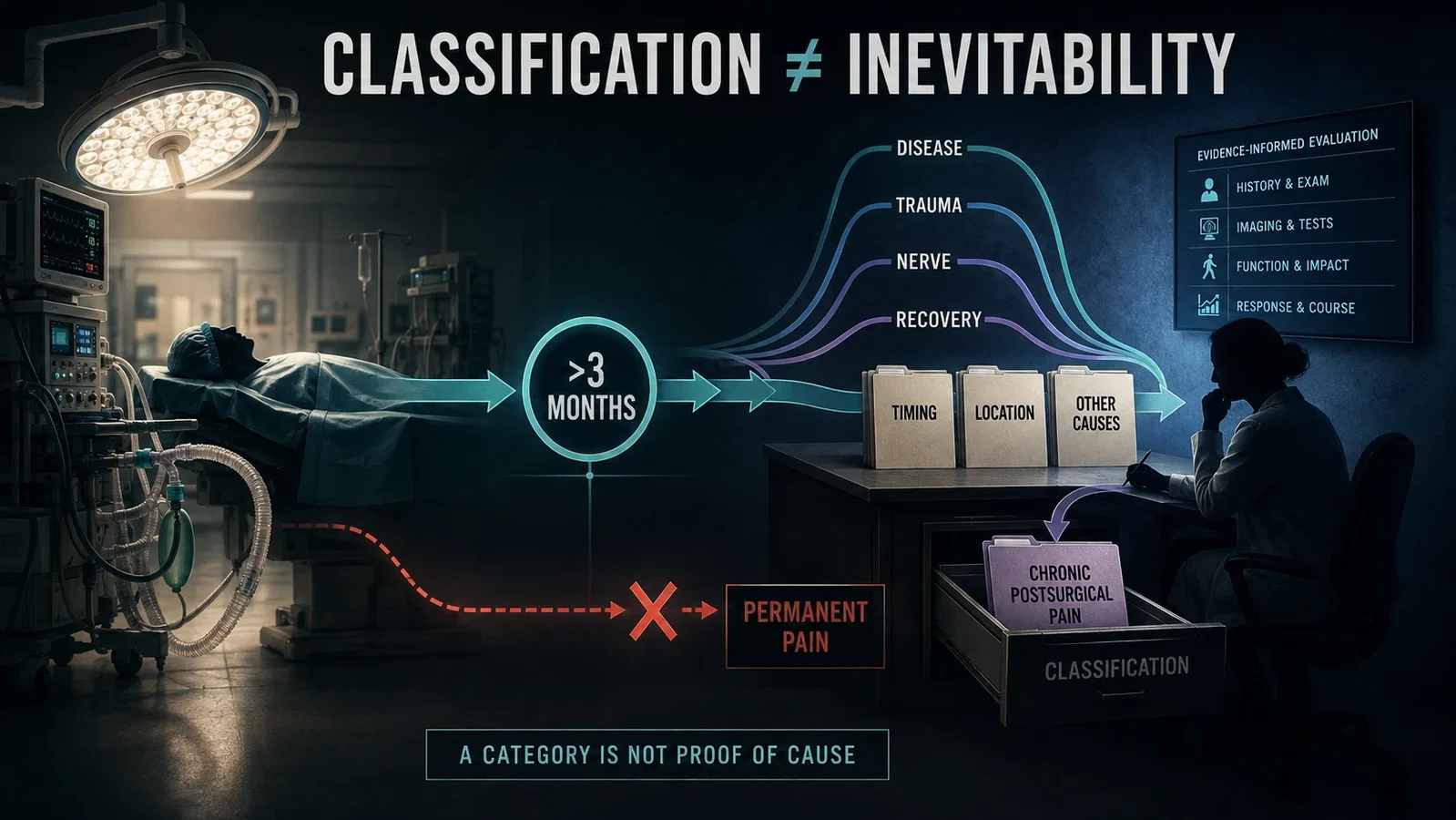
The classification treated surgery or trauma as the initiating event for this group and used a three-month temporal criterion. It remained a diagnostic and differential classification: pain occurring after surgery could not, by timing alone, exclude other explanations. The category gave a recurring clinical problem a systematic place without converting sequence into automatic proof of cause.
Pain present after an operation does not mean every later pain was inevitably produced by that operation. Conversely, careful classification does not mean surgery could never contribute. It means that evaluation and exclusion cannot be skipped by allowing a code to finish the explanation.
The boundary echoes other nomenclature stories on this site: a postoperative label can tell us where the clock stands. It cannot, by itself, tell us why it arrived there.
Adoption did not prove benefit
The authors expected better codes to improve documentation, epidemiology, resource planning, and the visibility of chronic pain. Those goals matter, but historical writing needs the right verbs: they were design aims and plausible expectations, not patient outcomes already measured by the classification article.
A limited 2016 coding exercise reported that coding was straightforward in 97% of cases. That result cannot become “ICD-11 was 97% accurate for patients worldwide,” nor can it prove that classification automatically improved treatment or payment.
World Health Assembly adoption likewise did not decide whether an opioid was appropriate for a particular patient, establish disability or compensation entitlement, prescribe reimbursement, or mean that every country completed a clinical-system transition on 1 January 2022.
The Assembly adopted a maintainable international classification framework, not a pass covering every clinical and social judgment downstream.
A new place preserved the complexity of the old question
Chronic pain no longer had to remain a residual item scattered among other disease chapters. It gained a systematic entry, seven major groups, connected parent paths, and additional descriptive dimensions.
The classification may have been most mature where it refused to supply a louder, simpler sentence. It did not say that all chronic pain was disease, or that secondary pain was a negligible symptom. It did not let three months diagnose by itself, or permit a postsurgical label to prove cause.
ICD-11 made chronic pain easier to see, while placing more constraints on what could honestly be said after it was seen.
Sometimes medical progress is not the moment a complex problem finally enters one box.
It is the moment a classification admits that more than one box is needed—and leaves doors between them.
The 2015 paper’s projected 2017 vote is retained only as a superseded forecast; the 25 May news/action date remains distinct from the 28 May formal resolution, and maintained current pages or codes are not backdated as a frozen 2019 version.
Sources and reading limits
Sources: Treede RD, Rief W, Barke A, et al. PAIN. 2019;160(1):19-27. PMID 30586067. DOI 10.1097/j.pain.0000000000001384; Treede RD, Rief W, Barke A, et al. PAIN. 2015;156(6):1003-1007. PMID 25844555. PMCID PMC4450869. DOI 10.1097/j.pain.0000000000000160; World Health Assembly, WHA72.15, 28 May 2019; WHO A72/29, 4 April 2019; archived WHO, IASP, PubMed, Europe PMC, UCLouvain, and Crossref records. All cited sources were read for this article.
Visual interpretations
These illustrations explore the setting and ideas. Depicted people, actions, instruments and documents are reconstructions, not evidence of their exact historical appearance.
Continue exploring
Related reading
Related reading connects shared questions and contexts; it does not by itself establish historical influence.
- 1973–1974: Founding the International Association for the Study of Pain
- 1986: The WHO Publishes Cancer Pain Relief and Its Analgesic Ladder
- 2016: The Erector Spinae Plane Block, from Four Patients and Two Cadavers
- 2016: The CDC's Twelve Voluntary Recommendations for Chronic-Pain Prescribing
The Source Room · About & Editorial Method
Sources and reading limits are stated above. Illustrations are labelled as original source images or AI-made. Historical accounts are educational; they are not current treatment instructions.