Publication history, care and the limits of early validation.
Reading Library · Anesthesia Epochs · 中文版
Watch the companion film
1986: WHO — The Cancer Pain Ladder · Watch on YouTube
Historical anchor: 1986. Date details and source qualifications are explained below.
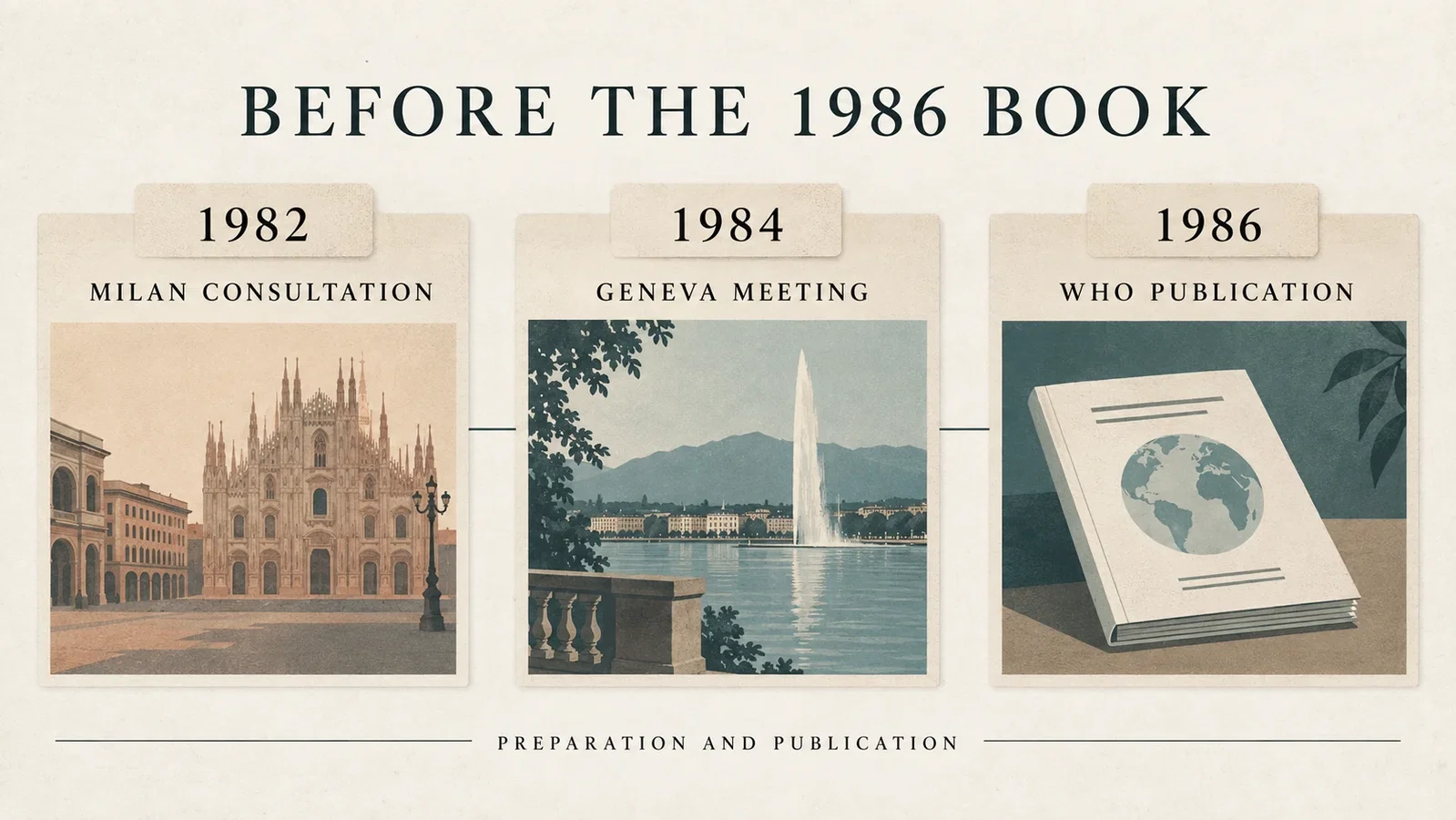
In 1986, the World Health Organization published Cancer pain relief in Geneva. Its familiar three-step diagram had a longer preparation. The preface traced the draft to a Milan consultation in 1982 and its completion to discussions in Geneva in 1984.[1, preface and Annex 2] A bibliographic record also identifies a 1985 article on WHO analgesic guidelines; that article’s full text is not covered here.[4] The date 1986 therefore anchors the book’s publication, rather than assigning the entire method a single year of invention.
The book organized teaching around a few familiar drugs. Its diagram progressed from non-opioids to weak opioids with non-opioids, then to strong opioids with or without non-opioids. Adjuvants could accompany each step. Aspirin, codeine and morphine illustrated the structure.[1, pp18–19,50–51] This was a framework for cancer pain in 1986. The diagram’s promise of freedom from cancer pain expressed a treatment goal, not an observed result of complete relief in every patient.
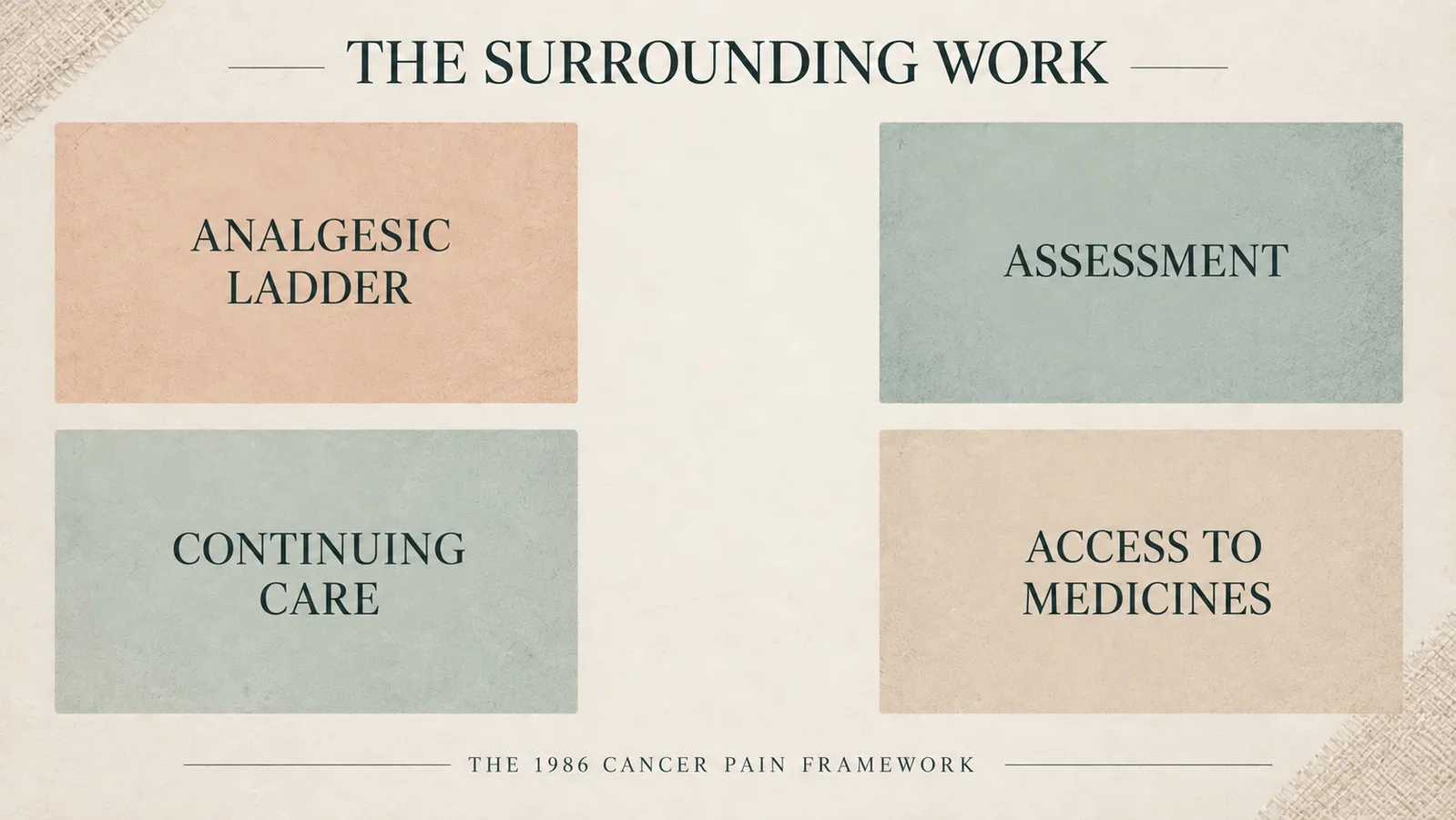
The surrounding chapters mattered. The annex paired regular administration with movement along the ladder. The main text placed assessment before treatment and continuing care, considering physical symptoms alongside psychological and social circumstances. Oral administration, individual adjustment, follow-up and management of adverse effects also had explicit roles.[1, pp14–23,50–51] Reducing those pages to three steps leaves out much of the work described in the book.
Access required organization as well as drugs. Chapters addressed professional education, medicine supply, coordination of regulatory arrangements, and care in hospitals and at home.[1, pp24–38] Those proposals are not evidence that every country implemented the approach in 1986. Some absolute statements about dependence risk also belong to the historical document; they cannot be carried forward as present-day risk assessments.
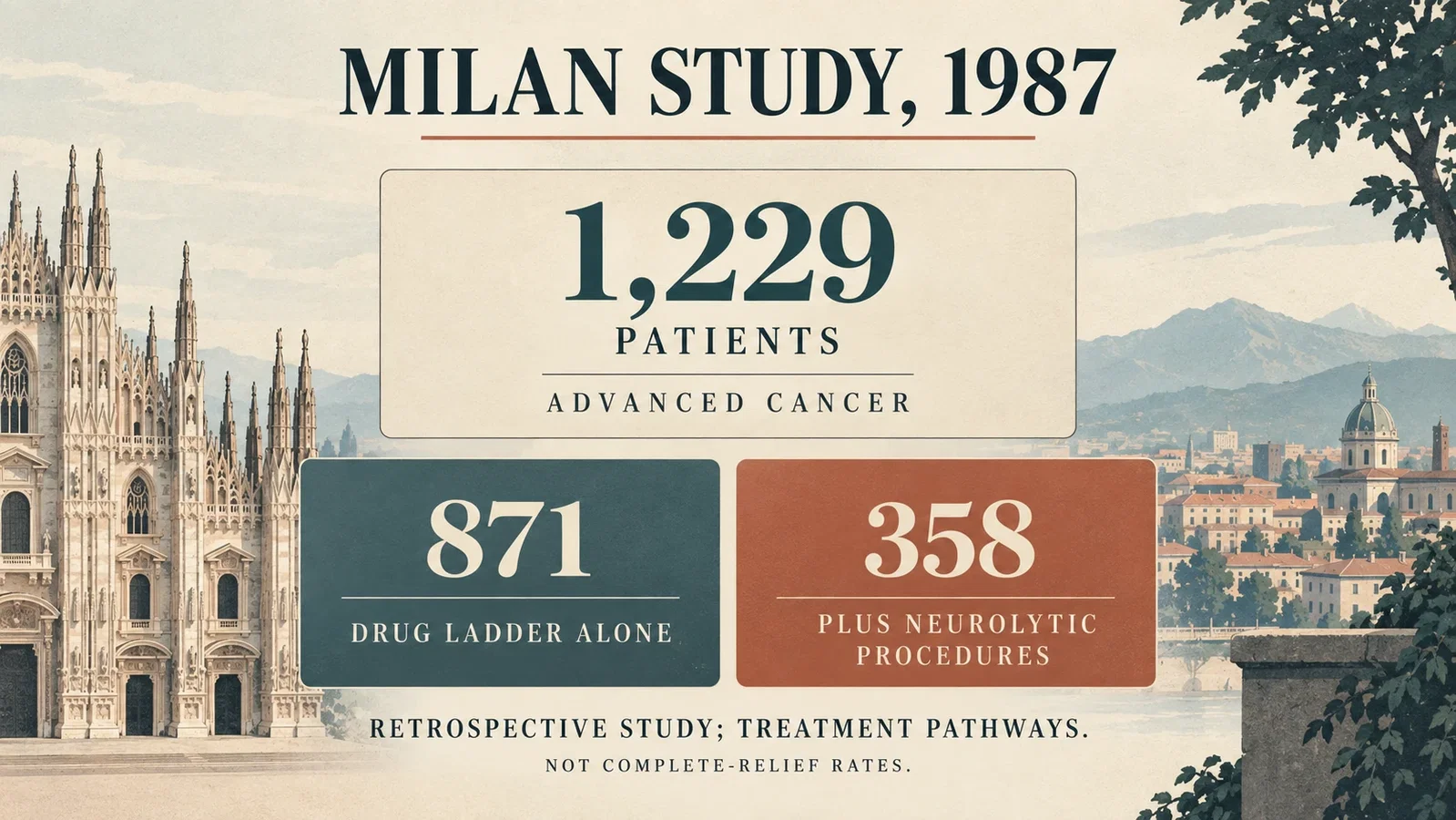
The following year, Ventafridda and colleagues published a retrospective study of 1,229 patients with advanced cancer treated at Milan’s National Cancer Institute from September 1983 to August 1985. They reported that 871 patients (70.9%) were treated with the drug ladder alone, while 358 (29.1%) also required neurolytic procedures.[2, pp851–852] These figures distinguish treatment pathways. The first percentage is not a rate of complete pain relief, which the discussion described as rarely achieved.[2, p855]
A detailed subgroup comprised 292 patients who received all three steps. Their integrated pain score later fell to about one-third of its initial value. The measure combined duration and intensity; it was not a simple 0-to-10 rating.[2, pp852–854 and Figure 3] This was follow-up in a particular subgroup, without randomized controls. Many patients were already receiving opioids and entered observation at Step II or III. The study does not support requiring everyone to begin at Step I.
The participant lists document an institutional connection. S. Andersson represented the International Association for the Study of Pain at the 1984 meeting; John J. Bonica was listed with IASP at the Milan consultation in 1982.[1, Annex 2, pp72–73] These entries connect this article with this site’s account of IASP’s founding. They establish participation in the preparation process, not sole authorship of the method by one association.
The introduction to WHO’s 2018 guideline edition later described the ladder as an educational tool rather than a strict treatment protocol, while noting changes in evidence appraisal and available interventions.[3, Introduction] The original book and early validation study record an attempt to organize drugs, assessment and continuing care. Its historical subject was cancer pain. Its results require their original populations and denominators, rather than direct translation into prescriptions for all chronic pain today.
Image note: modern editorial concepts, not original book pages or meeting photographs. The steps are not a prescription; study counts describe treatment pathways, not rates of complete pain relief.
Sources and reading limits
- World Health Organization. Cancer pain relief. Geneva: WHO; 1986. ISBN 9241561009. Official original PDF record. Selected sections read: title/copyright/contents/preface; printed pp14–38,45–51,70–74. Seventeen original pages visually inspected, including one blank; not the entire book.
- Ventafridda V, Tamburini M, Caraceni A, De Conno F, Naldi F. A validation study of the WHO method for cancer pain relief. Cancer. 1987;59(4):850–856. DOI: 10.1002/1097-0142(19870215)59:4<850::AID-CNCR2820590432>
3.0.CO;2-1. University repository, original article. All seven pages read in text and original images. Retrospective study; unresolved subgroup-count and abstract/body discrepancies are not used for the numerical claims here. - World Health Organization. WHO Guidelines for the Pharmacological and Radiotherapeutic Management of Cancer Pain in Adults and Adolescents. 2018 edition. Chapter 1: Introduction. Complete chapter web text read; not the entire guideline.
- Ventafridda V, Saita L, Ripamonti C, De Conno F. WHO guidelines for the use of analgesics in cancer pain. Int J Tissue React. 1985;7(1):93–96. PubMed PMID 2409039. Bibliographic chronology only; full article not covered.
Continue exploring
Related reading connects shared questions and contexts; it does not by itself establish historical influence.
- 1973–1974: Founding the International Association for the Study of Pain
- 2019: Chronic Pain Enters ICD-11, Not All as Disease
The Source Room · About & Editorial Method
Sources and reading limits are stated above. Illustrations are labelled as original source images or AI-made. Historical accounts are educational; they are not current treatment instructions.