Two women among its three officers, and a resolution that only physicians should give anesthetics.
Reading Library · Anesthesia Epochs · 中文版
Watch the education video (for clinicians)
1922: Yosemite — The Pacific Coast Anesthetists' First Meeting · Anesthesia Epochs Education Series
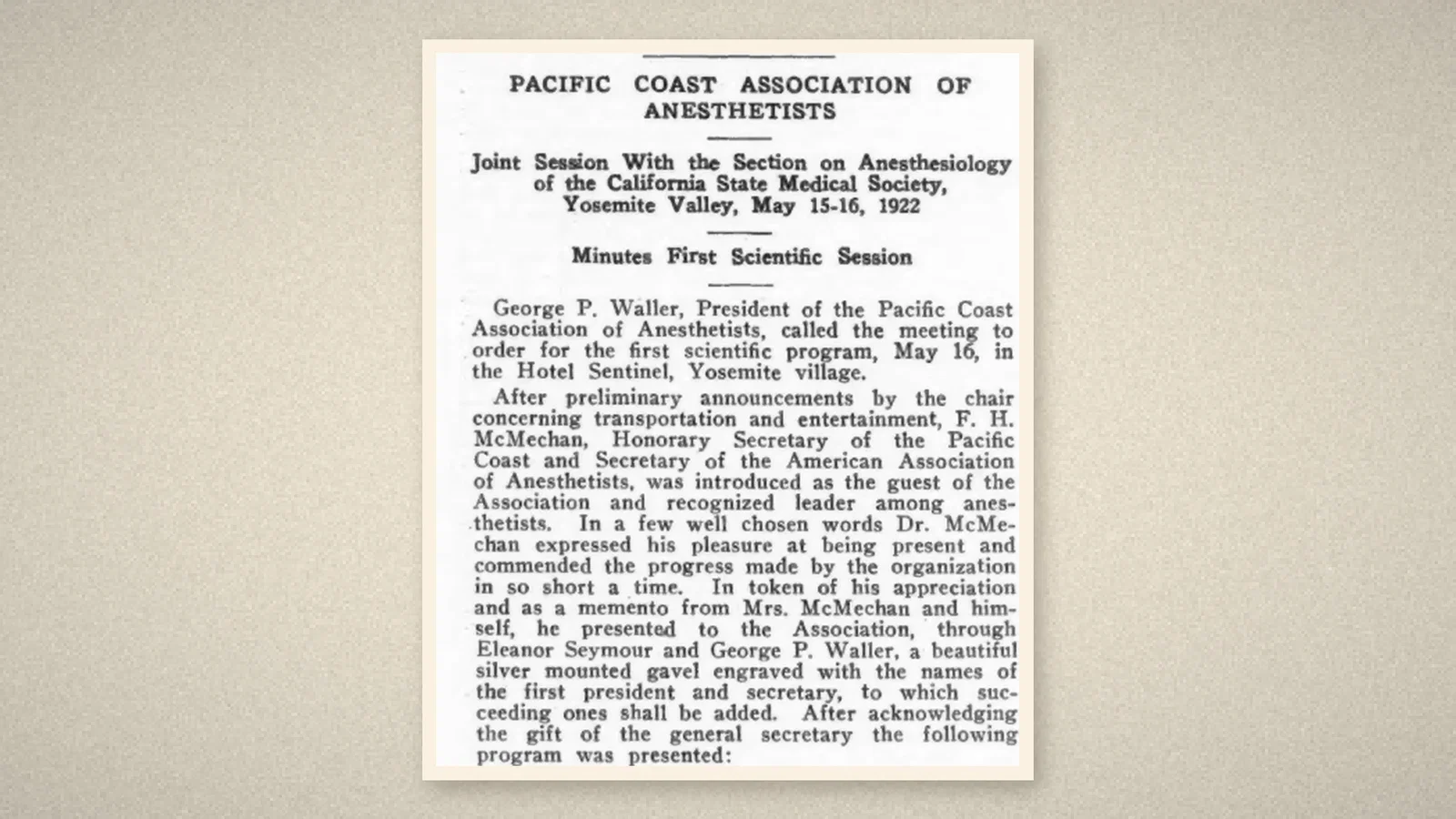
In May 1922 the Medical Society of the State of California met in Yosemite Valley, and its Section on Anesthesiology met there jointly with a young regional society. [3, p. 323] That society held its first scientific meeting, and its minutes, printed that September, give a clear picture of what organized anaesthesia on the American west coast looked like and what it wanted. [3]
An invitation in February
The California State Journal of Medicine announced the plan in February. The Pacific Coast Association of Anesthetists, wrote its secretary-treasurer Eleanor Seymour of Los Angeles, "will hold its first Scientific Meeting at Yosemite Park", on Monday and Tuesday, May 15–16, 1922, in conjunction with the Section on Anesthesiology. [1, p. 72] The association "was founded at Coronado in May, 1921" through the efforts of the Southern and Northern California societies of anesthetists. [1, p. 72] Membership was open "to all licensed and qualified members of the medical and dental professions", and to research workers with doctorates; annual dues were five dollars. [1, p. 72]
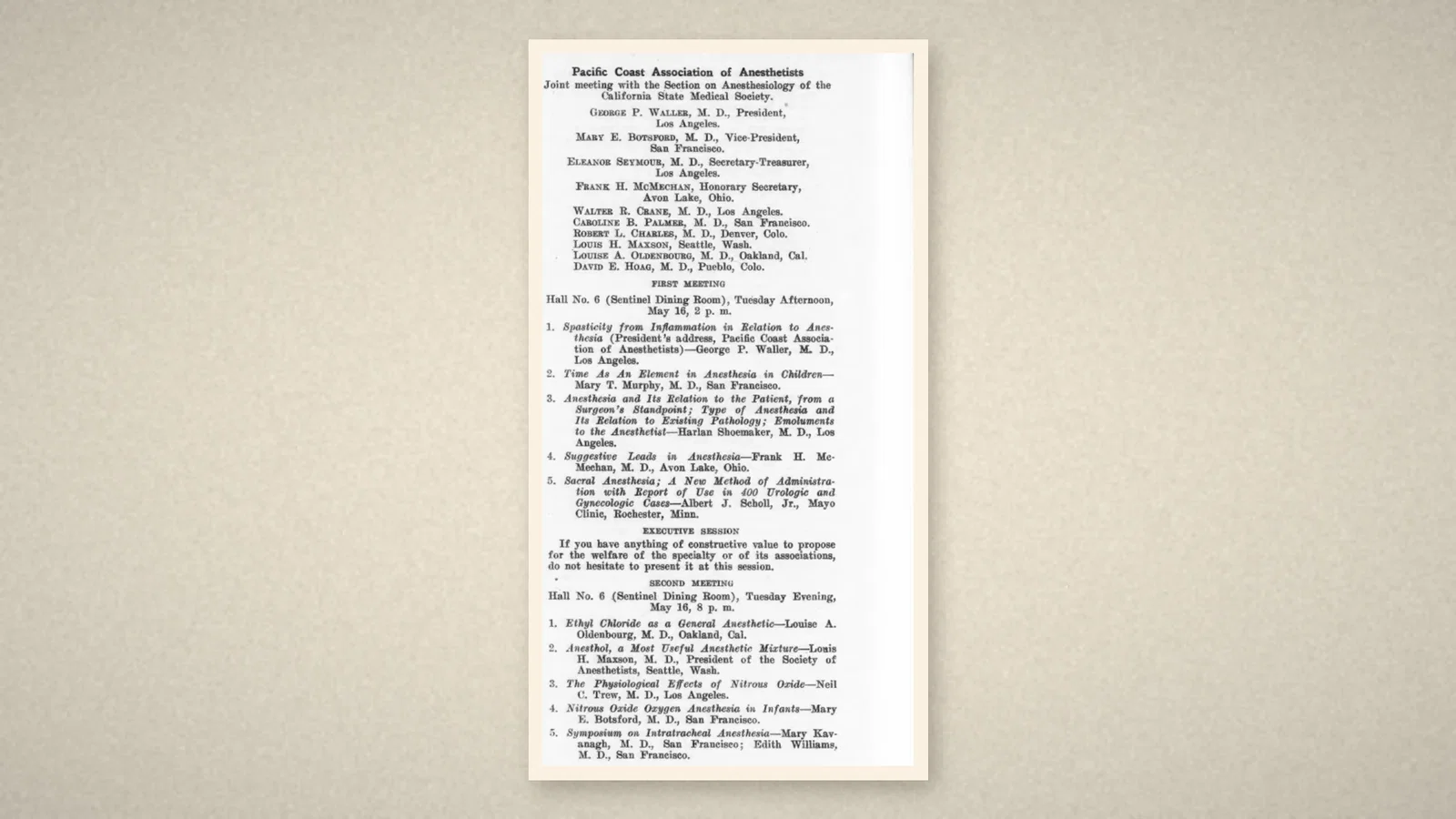
The officers in charge were George P. Waller, president, Mary E. Botsford, vice-president, and Seymour, secretary-treasurer. [1, p. 73] Two of the three were women.
The program
The May program shows the Section on Anaesthesiology, chaired by Botsford of San Francisco with Seymour as secretary, meeting in "Hall No. 6 (Sentinel Dining Room), Monday, May 15, 8 p. m." [2, p. 170] Botsford spoke on "Post-Tonsillectomy Pulmonary Abscesses"; Caroline B. Palmer, on the "Organization of Hospital Anaesthesiology Department", a talk whose outline included "instruction of students and training of anaesthetists". [2, p. 170] The association's own meetings followed on Tuesday, May 16.
The minutes
Waller opened the first scientific session on May 16 "in the Hotel Sentinel, Yosemite village". [3, p. 323] F. H. McMechan, honorary secretary of the association, "was introduced as the guest of the Association", and on behalf of the McMechans presented "a beautiful silver mounted gavel engraved with the names of the first president and secretary". [3, p. 323] Papers followed, among them Albert J. Scholl of the Mayo Clinic on sacral anesthesia with a "Report of Use in Four Hundred Urologic and Gynecologic Cases". [3, p. 323]
At the business meeting "a charter roll of sixty names was read". [3, p. 323] Then came seven resolutions. The first thanked the State Board of Medical Examiners for its efforts in limiting the administration of anesthetics "to legally qualified physicians". The third urged the Health Department of San Francisco "to eliminate nursing anesthesia and the dangers attaching thereto" by bringing medical anesthetists into the City and County Hospital. The sixth appointed Botsford "as official representative" to the anesthesia section of the International Congress of Medicine in London in 1923. The seventh urged the American College of Surgeons "to eliminate the nurse technician and to confine the administration of anesthetics exclusively to physicians". [3, p. 323]
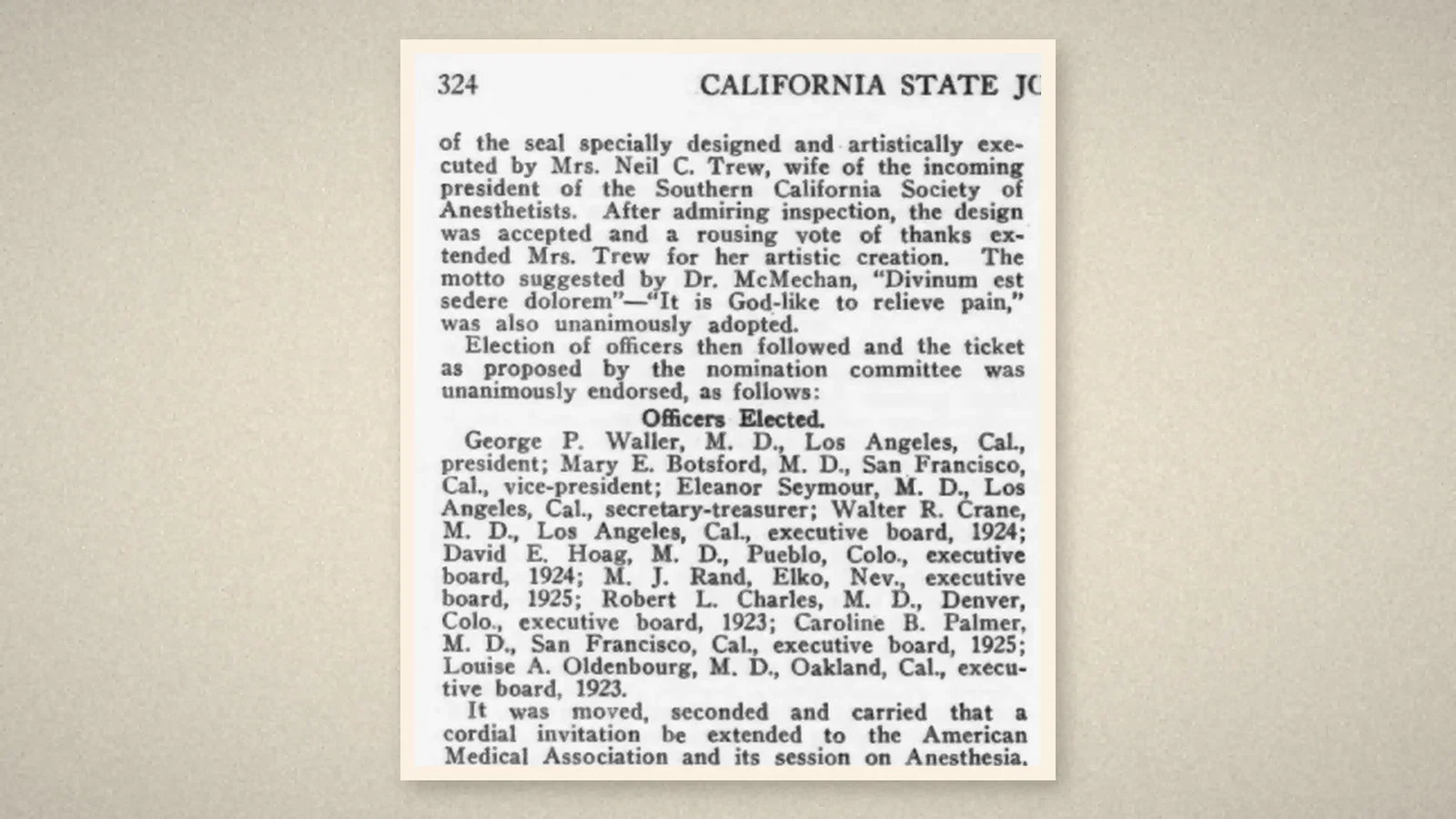
A seal designed by Mrs. Neil C. Trew was accepted, and so was a motto suggested by McMechan: "Divinum est sedere dolorem", "It is God-like to relieve pain". [3, p. 324] Waller, Botsford and Seymour were re-elected to their offices. [3, p. 324]
A surgeon's address
To the Section on May 16 the San Francisco surgeon Saxton Pope read "The Relation of the Surgeon to the Anesthetist". [4, p. 385] "The anesthetist is entitled to that courtesy offered a consultant," Pope said. "She or he is an equal." [4, p. 386] The anaesthetist "must choose the anesthetic, because he is responsible for the outcome", and during the operation watches a score of indicators "like an engineer in a great steamship". When trauma shows on those indicators, "here the dictatorship of the surgeon ceases". Pope ended: "On behalf of surgeons, I want to pay homage to our co-partners in service to humanity." [4, p. 386]
Kavanagh on intratracheal insufflation
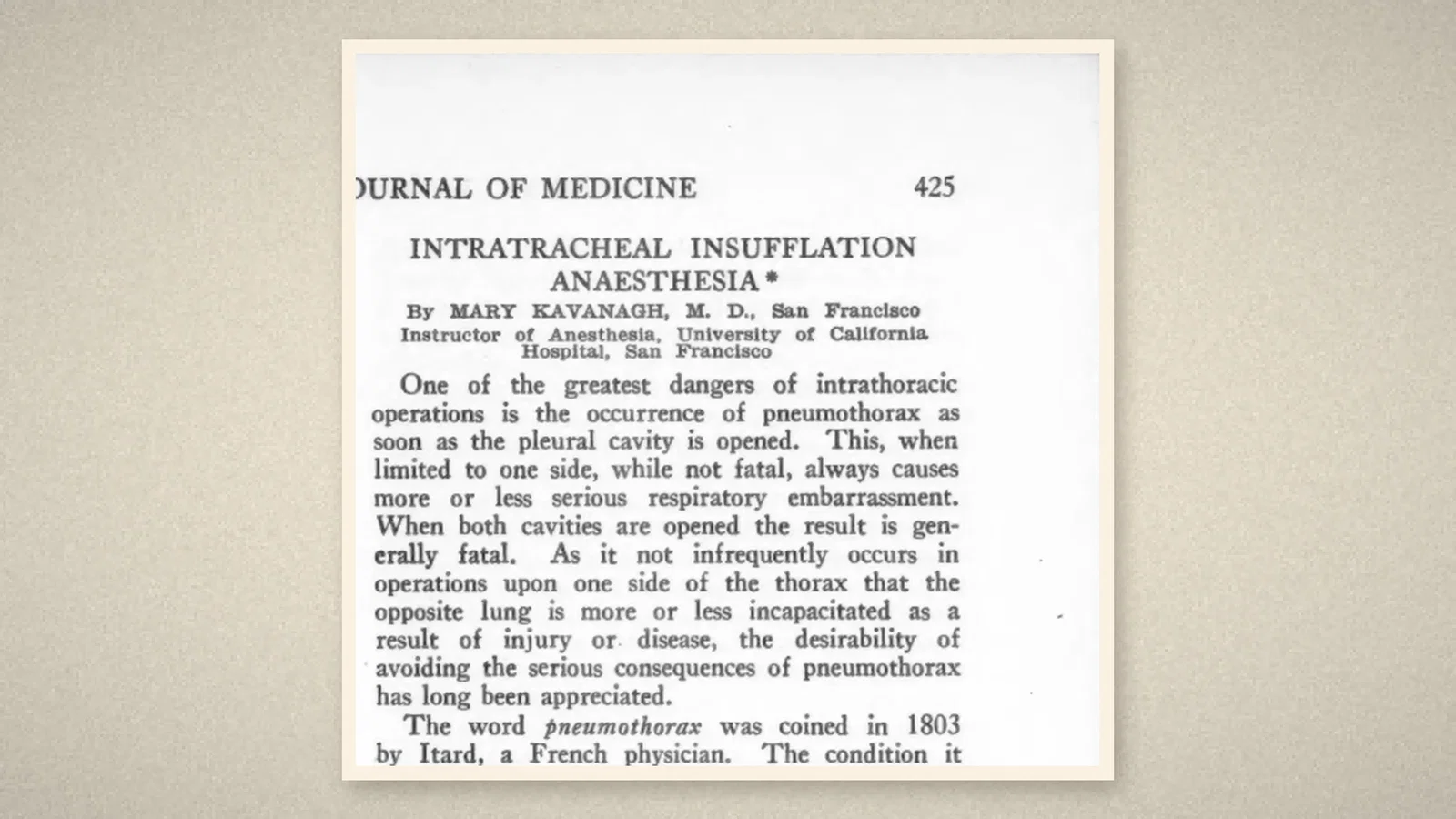
Among the last items of the program was a symposium on intratracheal anesthesia by Mary Kavanagh and Edith Williams, with a demonstration of apparatus. [3, p. 324] Kavanagh, instructor of anesthesia at the University of California Hospital, published the paper in December. [5, p. 425] Kavanagh described the apparatus Saxton Pope had built in San Francisco in 1912 on the Auer and Meltzer principle, and a series of intratracheal anaesthetics Kavanagh gave "in 1913 to forty-two cases in general surgery", followed by cases of mediastinal tumour and cancers of mouth, larynx and oesophagus. [5, p. 427] Passing the catheter was not easy: it "may be inserted in the esophagus more readily than into the trachea", and the laryngoscope was "a far better method". No case developed pneumonia. [5, p. 427] Yet Kavanagh also wrote that "the Meltzer method has been supplanted by the pharyngeal method of Connell" in most operations. [5, p. 427]
What the record shows
The Yosemite meeting of 1922 shows a specialty organizing itself: a charter roll, a gavel, a seal and a motto; resolutions that anaesthesia belonged to physicians; women physicians as officers and speakers; and a surgeon telling anaesthetists they were equals. The resolutions against nurse anaesthesia also show the professional conflict of the time, recorded here as the association stated it.
Sources and reading limits
Read: the California State Journal of Medicine vol. 20 (1922): Seymour's February notice (pp. 72–73); the May program (p. 170); the minutes of the joint session (pp. 323–324); Saxton Pope's address (pp. 385–386); Mary Kavanagh's paper (pp. 425–427).
Not covered: Calmes (1989) and the CSA history archives are not covered. Botsford's later presidency of the American Association of Anesthetists and the founding of the California Society of Anesthesiologists in 1948 are not in what was read and are not told. Kavanagh's paper does not set a standard for airway safety; it reports Kavanagh's own cases and writes that the pharyngeal method had largely replaced Meltzer's. "California's first statewide anesthesia congress" is not the sources' phrase; the minutes call it the association's first scientific meeting.
All four illustrations are crops of pages from the 1922 journal.
- Seymour E. Section on Anesthesiology of the California State Medical Society and the Pacific Coast Association of Anesthetists. Cal State J Med. 1922;20(2):72-3. Internet Archive
- Program: Anaesthesiology Section; Pacific Coast Association of Anesthetists. Cal State J Med. 1922;20(5):170. Internet Archive
- Seymour E. Pacific Coast Association of Anesthetists. Joint session with the Section on Anesthesiology of the California State Medical Society, Yosemite Valley, May 15-16, 1922. Minutes. Cal State J Med. 1922;20(9):323-4. Internet Archive
- Pope S. The relation of the surgeon to the anesthetist. Cal State J Med. 1922;20(11):385-6. Internet Archive
- Kavanagh M. Intratracheal insufflation anaesthesia. Cal State J Med. 1922;20(12):425-7. Internet Archive
Continue exploring
Related reading connects shared questions and contexts; it does not by itself establish historical influence.
- 1914: McMechan's Quarterly Supplement of Anesthesia and Analgesia Begins
- 1922: Haines Asks What Happened After the Child Left
Anesthesia Epochs · The Source Room · About & Editorial Method
Published November 2, 2026. Sources and reading limits are stated above. Illustrations are labelled as original source images or AI-made. Historical accounts are educational; they are not current treatment instructions.