ITL-34e659e9f9f8
Juan Li, MD · 更新于2026年11月18日
核心要点
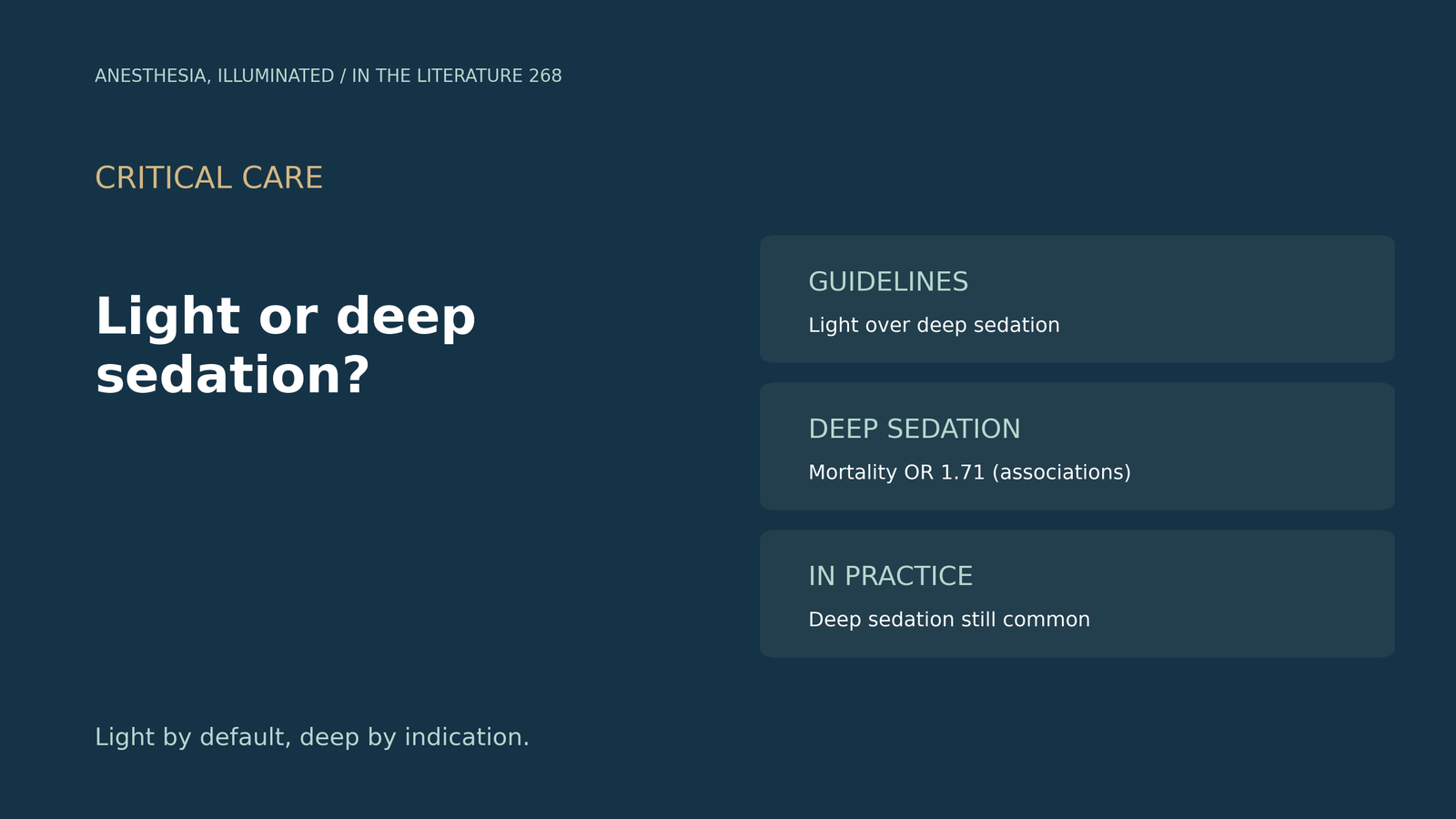
- 默认轻镇静。SCCM 指南建议机械通气成人采用轻镇静而非深镇静。[1]
- 药物选择跟随目标。以轻镇静或减少谵妄为优先时,建议右美托咪定优于丙泊酚,但心动过缓更多。[2]
- 深镇静与不良结局相关。它与更高死亡率相关(OR 1.71),主要来自观察性数据。[3]
- 目标难以达到。SPICE III 中尽管以轻镇静为目标,深镇静仍很常见。[4]
- 仍常需要深镇静。A2B 中临床医生在 25–30% 的天数要求深镇静。[5]
一位肺炎患者在 ICU 第 2 天插管机械通气。这位患者应该镇静到多深?
指南的推荐
SCCM 指南(Devlin 等,Crit Care Med 2018)建议重症机械通气成人采用轻镇静而非深镇静。在 8 项 RCT 中,轻镇静与 90 天死亡率无关(RR 1.01,95% CI 0.80–1.27),但与较低的气管切开率相关(RR 0.57,0.41–0.80);轻镇静没有公认的统一定义,也没有 RCT 评估其对认知或躯体功能的影响。[1] 指南的聚焦更新(Lewis 等,Crit Care Med 2025)建议在以轻镇静或减少谵妄为优先时使用右美托咪定而非丙泊酚;右美托咪定可能增加心动过缓(RR 1.65),如果患者需要深镇静或心动过缓风险高,应考虑其他镇静药。[2]
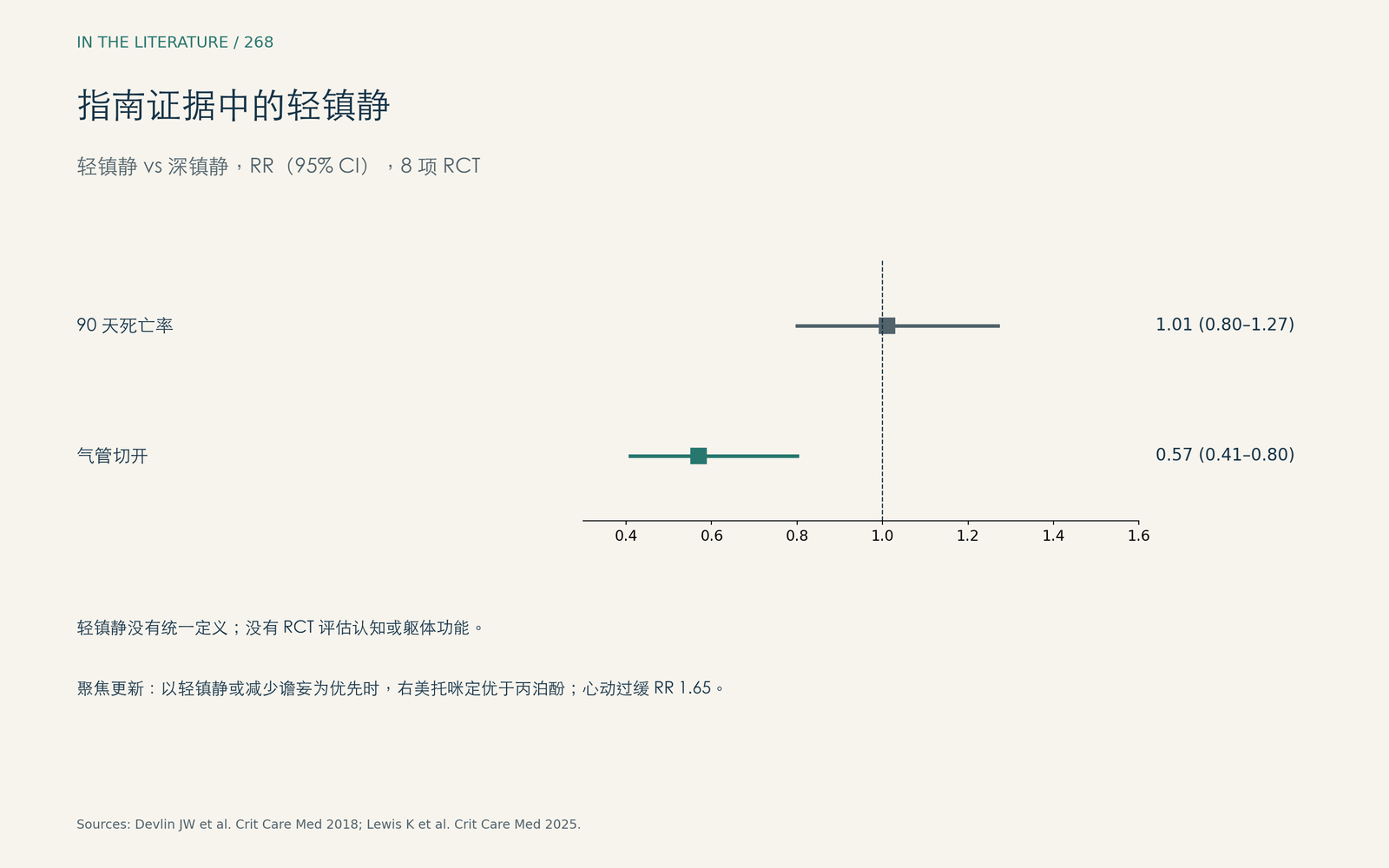
图 1. 轻镇静不改变死亡率,但减少气管切开。数据来自 SCCM 指南及其聚焦更新。[1], [2] 查看大图。

深镇静与结局
一项荟萃分析(Zheng 等,Front Med 2026)汇总了 11 项研究(6 项 RCT、5 项队列研究)、3,466 例患者。深镇静与更多谵妄相关(OR 1.34),但这一关联只在非随机研究中有统计学意义,RCT 中的 OR 为 1.25(0.94–1.65)。深镇静还与更高死亡率(OR 1.71,95% CI 1.32–2.21)和更长 ICU 住院时间(均数差 1.17 天)相关,但作者指出这些关联不能证明因果。[3]
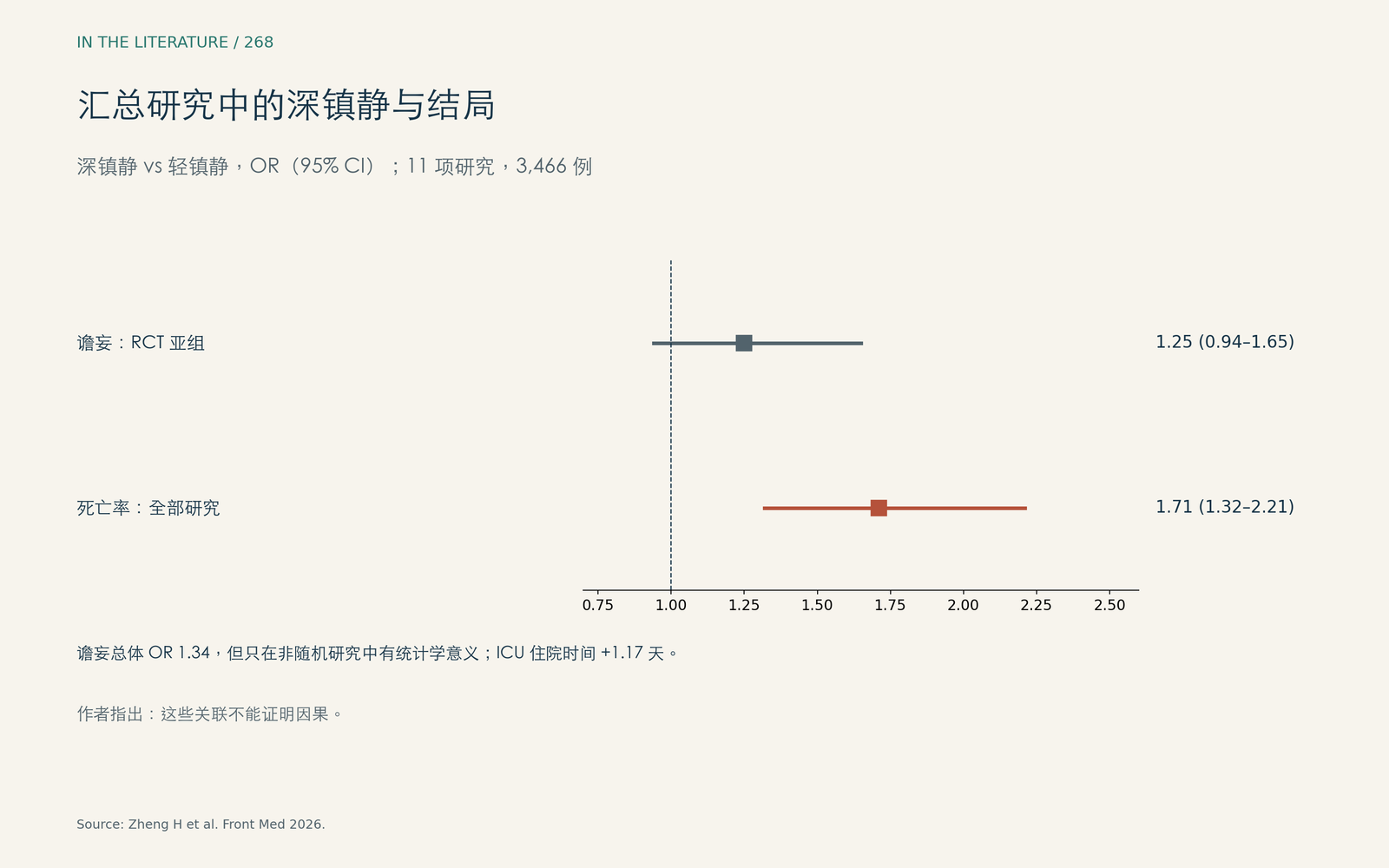
图 2. 深镇静与较差结局相关;随机试验中谵妄信号无统计学意义。数据来自 Zheng 等。[3] 查看大图。

轻镇静相关试验的结果
SPICE III(Shehabi 等,N Engl J Med 2019)纳入 4000 例机械通气患者,以轻镇静为目标,比较早期右美托咪定与常规治疗:90 天死亡率未降低,两组都经常出现深镇静,右美托咪定组心动过缓和低血压更常见。[4] A2B(Walsh 等,JAMA 2025;1437 例成人)中,算法以 RASS −2 到 +1 为目标,除非临床医生要求更深镇静,而这种要求出现在 25–30% 的天数;右美托咪定组躁动比丙泊酚组更常见(RR 1.54)。[5] ABCDEF 集束措施与谵妄减少相关(RR 0.57),证据确定性低(Sosnowski 等,Int J Nurs Stud 2023)。[6] TEAM(Hodgson 等,N Engl J Med 2022;750 例机械通气成人)中,早期活动加镇静最小化与不良事件增加相关。[7] 一项队列研究(Iwatani 和 Morimoto,Nurs Crit Care 2026)中,ICU 期间任何躁动都与之后的心理障碍相关(校正 OR 2.61),作者认为单靠更轻的镇静可能不够。[8]
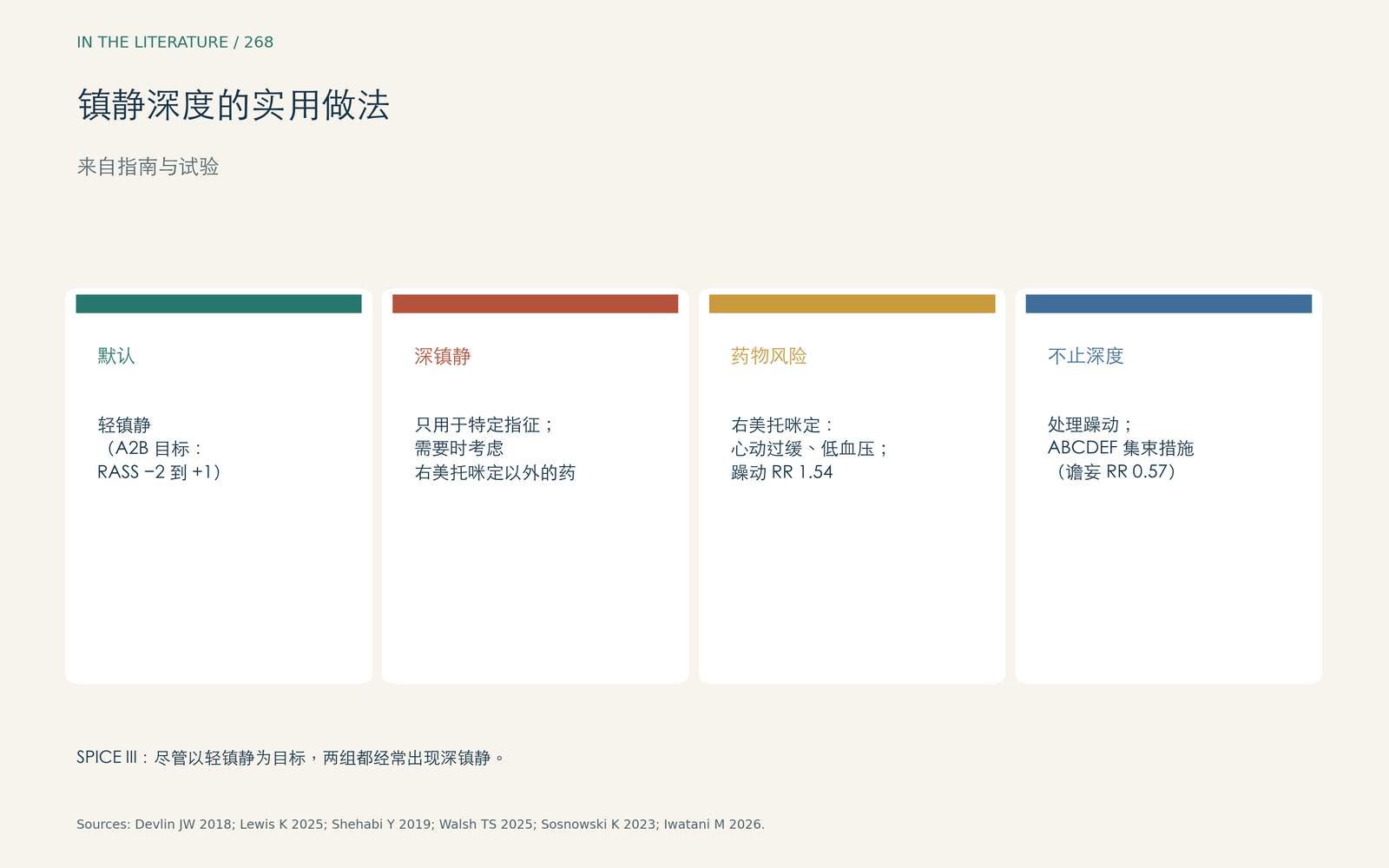
图 3. 默认轻镇静,同时处理躁动并按风险选择药物。综合自 SCCM 指南、SPICE III、A2B 及 Iwatani 和 Morimoto。[1], [2], [4], [5], [8] 查看大图。

临床带走的三点
- 机械通气成人以轻镇静为目标,除非有深镇静的特定理由。[1], [3]
- 镇静容易逐渐加深,应经常评估;用于轻镇静的药物有心动过缓、低血压或躁动风险。[2], [4], [5]
- 只做轻镇静还不够:要处理躁动,使用 ABCDEF 集束措施,并谨慎活动。[6], [7], [8]
参考文献
- Devlin JW, Skrobik Y, Gélinas C, et al. Clinical practice guidelines for the prevention and management of pain, agitation/sedation, delirium, immobility, and sleep disruption in adult patients in the ICU. Crit Care Med. 2018;46(9):e825–e873. doi:10.1097/CCM.0000000000003299
- Lewis K, Balas MC, Stollings JL, et al. A focused update to the clinical practice guidelines for the prevention and management of pain, anxiety, agitation/sedation, delirium, immobility, and sleep disruption in adult patients in the ICU. Crit Care Med. 2025;53(3):e711–e727. doi:10.1097/CCM.0000000000006574
- Zheng H, Yin Z, Zhang Q. The impact of sedation depth on the occurrence of delirium and prognosis in intensive care unit patients: a meta-analysis. Front Med (Lausanne). 2026;13:1823354. doi:10.3389/fmed.2026.1823354
- Shehabi Y, Howe BD, Bellomo R, et al. Early sedation with dexmedetomidine in critically ill patients. N Engl J Med. 2019;380(26):2506–2517. doi:10.1056/NEJMoa1904710
- Walsh TS, Parker RA, Aitken LM, et al. Dexmedetomidine- or clonidine-based sedation compared with propofol in critically ill patients: the A2B randomized clinical trial. JAMA. 2025;334(1):32–45. doi:10.1001/jama.2025.7200
- Sosnowski K, Lin F, Chaboyer W, et al. The effect of the ABCDE/ABCDEF bundle on delirium, functional outcomes, and quality of life in critically ill patients: a systematic review and meta-analysis. Int J Nurs Stud. 2023;138:104410. doi:10.1016/j.ijnurstu.2022.104410
- TEAM Study Investigators and the ANZICS Clinical Trials Group; Hodgson CL, Bailey M, Bellomo R, et al. Early active mobilization during mechanical ventilation in the ICU. N Engl J Med. 2022;387(19):1747–1758. doi:10.1056/NEJMoa2209083
- Iwatani M, Morimoto M. Early sedation intensity and psychological outcomes in critically ill adults. Nurs Crit Care. 2026;31:e70500. doi:10.1111/nicc.70500