ITL-916b2e472b96
Juan Li, MD · 更新于2026年11月18日
核心要点
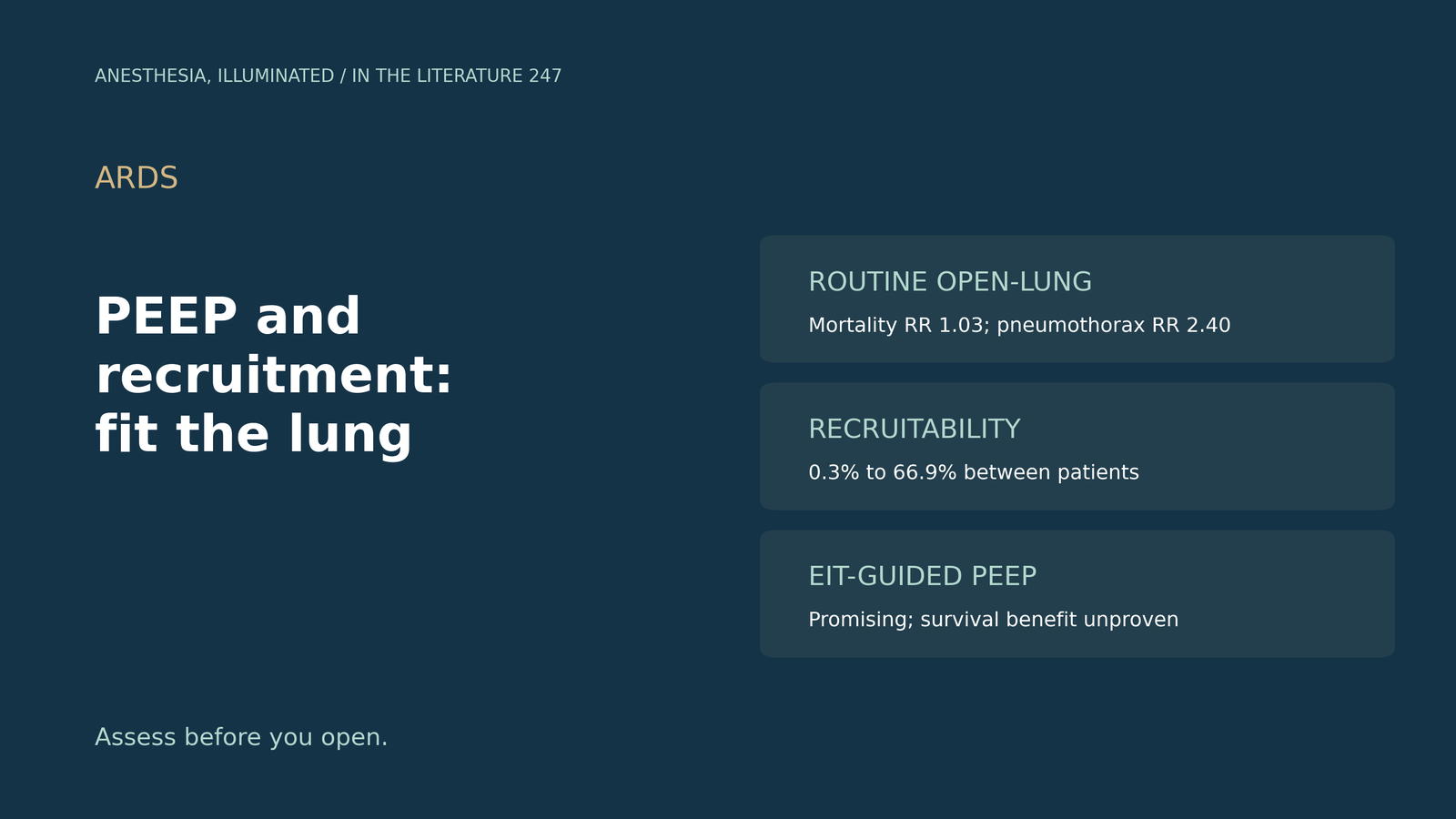
- 常规开肺策略没有帮助。7项试验中死亡率无变化(RR 1.03),需引流的气胸增加(RR 2.40)。[1]
- 肺各不相同。108例患者的可复张性从0.3%到66.9%不等。[2]
- 表格可能误导。PEEP/FiO2表格倾向于给无反应者最高的PEEP。[2]
- 先评估。未评估可复张性就复张和使用高PEEP可能带来不良影响。[1]
- EIT有前景,但未经证实。EIT指导PEEP的死亡率证据确定性低。[3]
一位中度ARDS患者PEEP为10。团队在讨论:是做阶梯式肺复张并将PEEP提高到18,还是按表格设置?证据支持哪种做法?[1], [2]
常规复张显示了什么
在一项纳入7项开肺试验、1545名受试者的荟萃分析中(Zeng等,J Anesth Transl Med 2025),开肺通气在第1、3、7天改善了氧合指数,但未降低死亡率(RR 1.03),并增加了需引流的气胸(RR 2.40)和1小时内低血压。[1] 作者认为ART试验中许多患者可复张性低,却承受了不必要的高压力;CT显示约24%的患者肺组织几乎不可复张。[1] 更早的Cochrane综述(Hodgson等,2016)显示28天死亡率无显著变化(RR 0.86),气压伤也无差异(RR 1.09)。[4] ART原始试验(Cavalcanti等,JAMA 2017)中,肺复张加滴定PEEP使28天死亡率升高(55.3%对49.3%),作者认为结果不支持常规进行肺复张加PEEP滴定。[5]
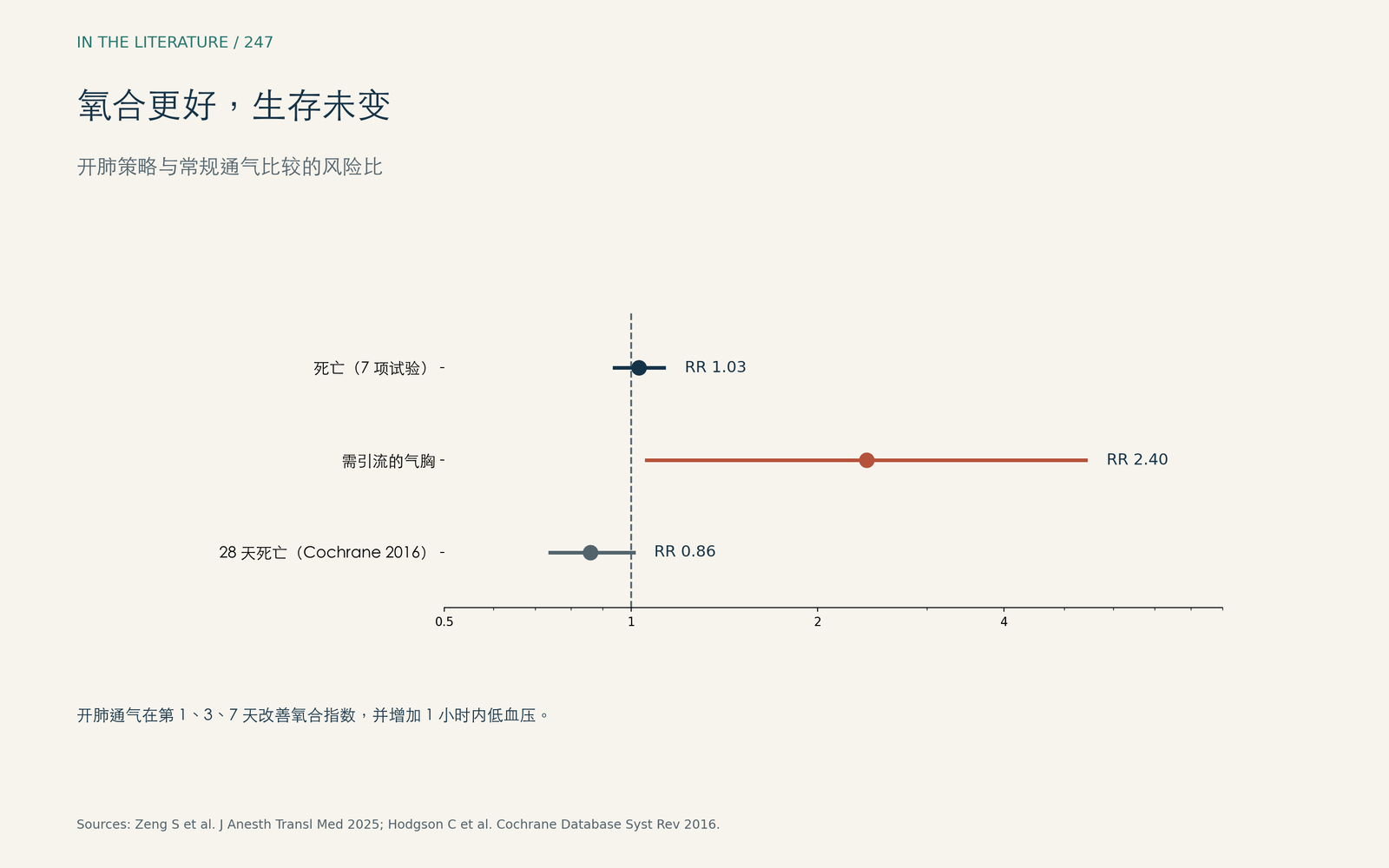
图1. 氧合更好并不意味着生存更好。数据来自Zeng等与Hodgson等。[1], [4] 查看大图。

可复张性各不相同
在RECRUIT研究中(Jonkman等,Am J Respir Crit Care Med 2023),108例COVID ARDS患者的可复张性从0.3%到66.9%不等;EIT方法在81%的患者中给出的PEEP不同于最佳顺应性法;PEEP/FiO2表格倾向于给无反应者最高的PEEP;这种做法能否改善结局需要前瞻性验证。[2] 目前仍没有确定个体最佳PEEP的理想方法,一个中心因缺乏疗效而不常规进行肺复张。[6]

图2. 同样的PEEP可能使一个肺复张,却使另一个肺过度膨胀(示意)。数据来自Jonkman等与Zeng等。[2], [1] 查看大图。

用EIT个体化设置PEEP
Rauseo等(Ann Intensive Care 2026)汇总了9项研究、356例患者:死亡率证据确定性低,可复张性越高的患者可能获益越大。[3] 在一项纳入117例患者的单中心试验中(He等,Crit Care 2021),EIT指导PEEP组死亡率绝对下降6%,但无统计学意义。[7] Franchineau等(Am J Respir Crit Care Med 2024)提醒,不能仅凭通气均匀性设置PEEP,EIT策略改善结局的证据仍然缺乏。[8] 围术期与动物数据与此一致:在损伤的猪肺中,不做复张的表格PEEP导致的肺塌陷最多(Muders等,Anesthesiology 2020);[9] 在肥胖手术患者中,个体化PEEP的益处在拔管后消失(Simon等,Anesthesiology 2021);[10] 一项小型试验中,个体化与固定PEEP组的术后肺部并发症均为20例中4例(Li等,Anesthesiology 2023)。[11]

图3. 以生理为导向,结局获益未经证实。数据来自Rauseo等、He等与Franchineau等。[3], [7], [8] 查看大图。

临床带走的三点
- 不要常规进行阶梯式复张和一律高PEEP;它们未降低死亡率且增加危害。[1]
- 提高PEEP前先评估可复张性,对无反应者慎用表格。[1], [2]
- 有条件时用EIT或呼吸力学个体化设置PEEP,但要知道其生存获益尚未证实。[3], [8]
参考文献
- Zeng S, Yao Z, Guan C, et al. Open lung ventilation with low tidal volumes, staircase recruitment maneuvers, high PEEP and decremental PEEP titration vs ARDSNet in ARDS: a systematic review and meta-analysis. J Anesth Transl Med. 2025;4(3):148–160. doi:10.1016/j.jatmed.2025.08.001
- Jonkman AH, Alcala GC, Pavlovsky B, et al. Lung recruitment assessed by electrical impedance tomography (RECRUIT): a multicenter study of COVID-19 acute respiratory distress syndrome. Am J Respir Crit Care Med. 2023;208(1):25–38. doi:10.1164/rccm.202212-2300OC
- Rauseo M, Azzolina D, Scaramuzzo G, et al. Personalized positive-end expiratory pressure using electrical impedance tomography in ARDS patients: a systematic review and meta-analysis. Ann Intensive Care. 2026;16:100049. doi:10.1016/j.aicoj.2026.100049
- Hodgson C, Goligher EC, Young ME, et al. Recruitment manoeuvres for adults with acute respiratory distress syndrome receiving mechanical ventilation. Cochrane Database Syst Rev. 2016;11:CD006667. doi:10.1002/14651858.CD006667.pub3
- Writing Group for the Alveolar Recruitment for Acute Respiratory Distress Syndrome Trial (ART) Investigators; Cavalcanti AB, Suzumura EA, Laranjeira LN, et al. Effect of lung recruitment and titrated positive end-expiratory pressure (PEEP) vs low PEEP on mortality in patients with acute respiratory distress syndrome: a randomized clinical trial. JAMA. 2017;318(14):1335–1345. doi:10.1001/jama.2017.14171
- Wang CJ, Wang IT, Chen CH, et al. Recruitment-potential-oriented mechanical ventilation protocol and narrative review for patients with acute respiratory distress syndrome. J Pers Med. 2024;14(8):779. doi:10.3390/jpm14080779
- He H, Chi Y, Yang Y, et al. Early individualized positive end-expiratory pressure guided by electrical impedance tomography in acute respiratory distress syndrome: a randomized controlled clinical trial. Crit Care. 2021;25(1):230. doi:10.1186/s13054-021-03645-y
- Franchineau G, Jonkman AH, Piquilloud L, et al. Electrical impedance tomography to monitor hypoxemic respiratory failure. Am J Respir Crit Care Med. 2024;209(6):670–682. doi:10.1164/rccm.202306-1118CI
- Muders T, Luepschen H, Meier T, et al. Individualized positive end-expiratory pressure and regional gas exchange in porcine lung injury. Anesthesiology. 2020;132(4):808–824. doi:10.1097/ALN.0000000000003151
- Simon P, Girrbach F, Petroff D, et al. Individualized versus fixed positive end-expiratory pressure for intraoperative mechanical ventilation in obese patients: a secondary analysis. Anesthesiology. 2021;134(6):887–900. doi:10.1097/ALN.0000000000003762
- Li X, Liu H, Wang J, et al. Individualized positive end-expiratory pressure on postoperative atelectasis in patients with obesity: a randomized controlled clinical trial. Anesthesiology. 2023;139(3):262–273. doi:10.1097/ALN.0000000000004603