US Patent 3,998,834, 'N-(4-piperidinyl)-N-phenylamides and -carbamates', names Paul Adriaan Jan Janssen and Georges Henri Paul Van Daele of Belgium as inventors and Janssen Pharmaceutica as assignee. Filed on 13 January 1976 as a continuation-in-part of an application of 14 March 1975, it was granted on 21 December 1976. The compounds had 'very potent analgesic activity'; they differed from earlier ones mainly in the substituent at the 4-position of the piperidine ring, and the closest prior art listed was the fentanyl patent, US 3,164,600. Claim 2 is 4-(methoxymethyl)-1-[2-(2-thienyl)ethyl]-4-piperidinyl-N-phenylpropanamide; claim 3 a methyl 4-piperidinecarboxylate. In 1979 Eginhardt Dick's thesis from Doenicke's department in Munich gave sufentanil (R 30730) the chemical name of claim 2 and compared it with fentanyl in 15 male student volunteers, in random order with the subjects unaware of the drug: sufentanil was more hypnotic and affected breathing more, with more frequent apnoeic periods that external stimulation could interrupt.
Reading Library · Anesthesia Epochs · 中文版
Watch the education video (for clinicians)
1976: Sufentanil — Which Effect Was Measured? · Anesthesia Epochs Education Series
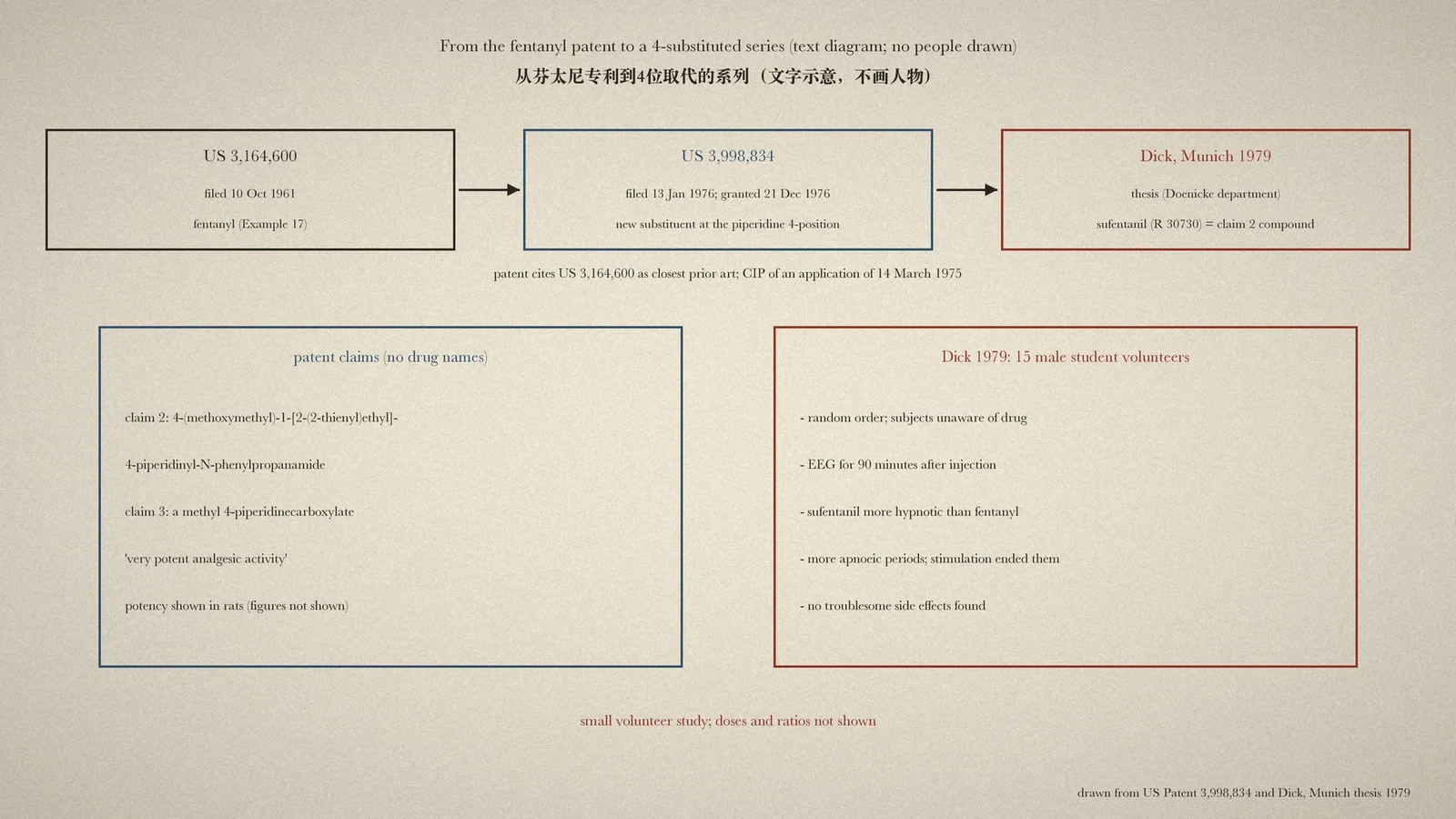
Fifteen years after the fentanyl patent, another patent came from Beerse, where the fentanyl patent's assignee had also been based. This time the change was a single position on the piperidine ring. The new patent named the fentanyl patent as its closest prior art and claimed, among many compounds, the one later called sufentanil. A Munich thesis of 1979 then put sufentanil and fentanyl side by side in healthy volunteers. [1, col. 1][2, p. 2]
The patent
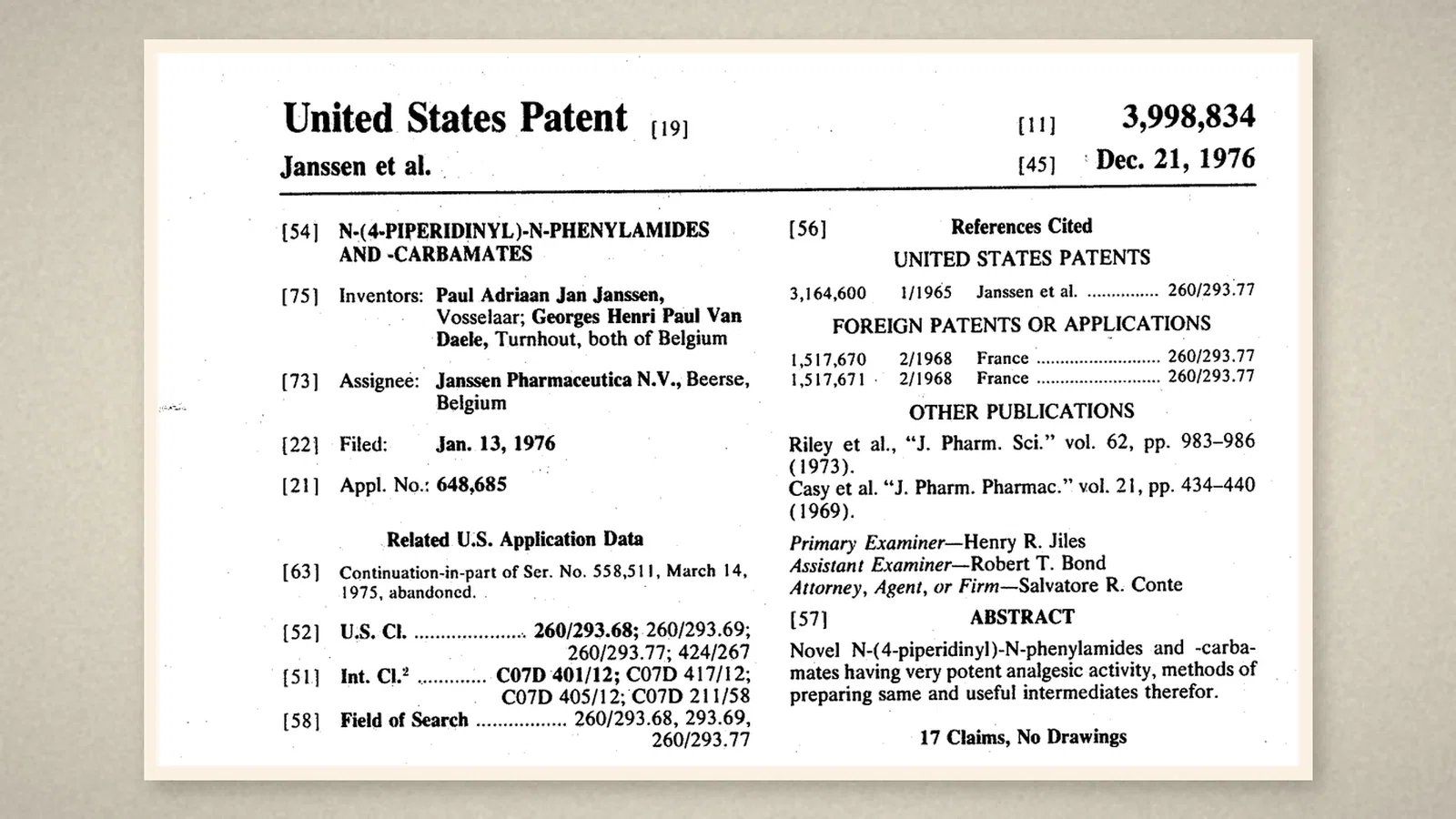
US Patent 3,998,834, "N-(4-piperidinyl)-N-phenylamides and -carbamates", names as inventors Paul Adriaan Jan Janssen of Vosselaar and Georges Henri Paul Van Daele of Turnhout, Belgium. The assignee is Janssen Pharmaceutica N.V. of Beerse. It was filed on 13 January 1976 as a continuation-in-part of an application of 14 March 1975, and it was granted on 21 December 1976. [1, front page]
The abstract describes the compounds as having "very potent analgesic activity". [1, front page] The background explains what was new. Compounds of this kind with analgesic activity were already known. The new ones differed chiefly in "the nature of the R'-substituent, present in the 4-position of the piperidine ring". The first item in the list of closest prior art is US Patent 3,164,600. [1, col. 1] That is the patent filed in October 1961 whose Example 17 is the compound later called fentanyl.
The patent calls the compounds "highly potent analgesics, as demonstrated, for example, in experimental animals". It supports this with a table from the rat tail-withdrawal test, which is not repeated here. [1, PDF p. 17]
Two claims
Among the 17 claims, claim 2 is 4-(methoxymethyl)-1-[2-(2-thienyl)ethyl]-4-piperidinyl-N-phenylpropanamide and its salts. Compared with fentanyl, it has a thiophene ring where fentanyl has a benzene ring on the side chain, and a methoxymethyl group at the 4-position. Claim 3 is a methyl ester at the same position: methyl 4-[(1-oxopropyl)phenylamino]-1-(2-phenylethyl)-4-piperidinecarboxylate. The patent gives no drug names. [1, claims]
The name, and a comparison

In 1979 Eginhardt Dick submitted a doctoral thesis from the anaesthesia department of A. Doenicke at the surgical outpatient clinic of the University of Munich. Its title was "Fentanyl und Sufentanil im elektroenzephalographischen Vergleich". [2, title page] It gives sufentanil, code R 30730, the chemical name N-[4-methoxymethyl-1-[2-(2-thienyl)ethyl]-4-piperidinyl]-N-phenylpropanamide. That is the compound of claim 2. [2, p. 2]
The thesis explains why the comparison was needed. Animal work had reported sufentanil to be stronger than fentanyl, with a much wider safety margin. But "first clinical observations in patients" at a fixed dose ratio had shown no decisive difference. [2, p. 1]
The subjects were 15 randomly chosen male students. The order of the two drugs was randomised, and the subjects did not know which drug, or which dose, they were given. The EEG was recorded for 90 minutes after each injection, with blood pressure, heart rate and breathing alongside. [2, p. 3]
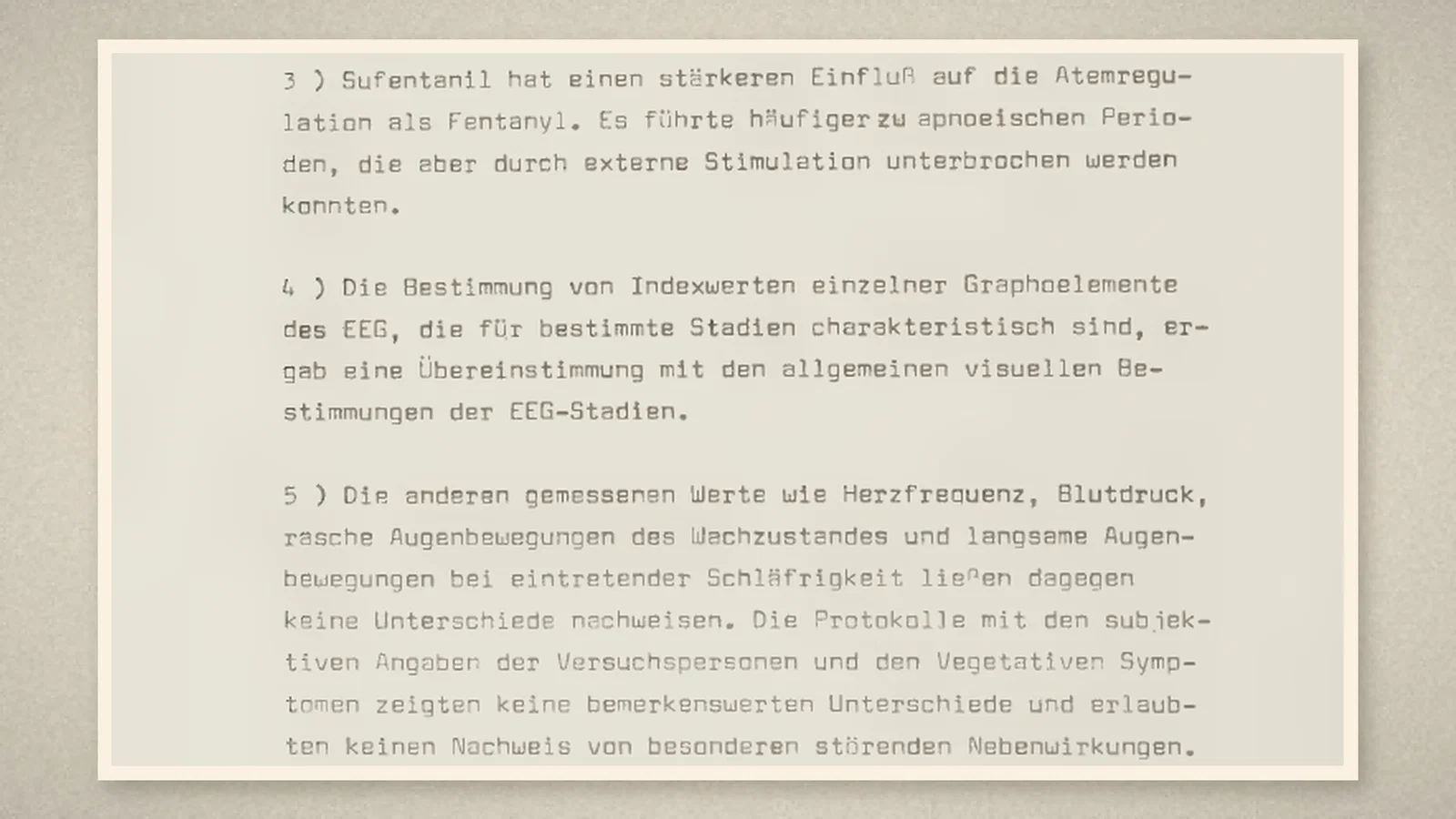
The summary reports the results. At the ratios used, sufentanil "acts more strongly hypnotically than fentanyl". It had a greater effect on the regulation of breathing and led more often to apnoeic periods, which could be interrupted by external stimulation. Heart rate, blood pressure, eye movements and the subjects' own reports showed no differences, and no particular troublesome side effects were found. [2, p. 19]
What the record shows
A small change at one position on the molecule, made in Beerse fifteen years after fentanyl, produced a compound that the 1976 patent describes only by its chemical name. When anaesthetists in Munich compared it with fentanyl in volunteers, they found it more sedating and more likely to stop breathing for a while.
Sources and reading limits
Read: US Patent 3,998,834. This covered the front page, background and general formula, the statement of potency (PDF p. 17) and the claims (PDF pp. 46-47). The examples were skimmed. Also read: Eginhardt Dick's Munich thesis of 1979, including the title page, introduction, pharmaka, design and summary; the results were skimmed (Internet Archive text, with page images checked for the pages cited).
Not covered: the abandoned application of March 1975; Janssen's research reports on R 30730; the published pharmacology of sufentanil; the alfentanil patent and papers; and any source that names the claim 3 ester.
Limits: some timelines date this series to 1976 and name alfentanil and carfentanil. This article covers only the 1976 patent and sufentanil. Claim 3's ester is not given a drug name because no source read here names it. The volunteer study is small, and its judgements are the author's. The thesis's doses and ratios and the patent's animal figures are not repeated, and page crops stop before them. No patients are identified. German quotations are translated for this article.
Three illustrations are crops of the patent's front page and of the thesis (pp. 2 and 19). One is a text diagram drawn from both, with no people drawn and no doses shown.
- Janssen PAJ, Van Daele GHP, inventors; Janssen Pharmaceutica N.V., assignee. N-(4-piperidinyl)-N-phenylamides and -carbamates. US patent 3,998,834. Filed 1976 Jan 13; granted 1976 Dec 21. Google Patents
- Dick E. Fentanyl und Sufentanil im elektroenzephalographischen Vergleich [dissertation]. München: Ludwig-Maximilians-Universität; 1979. Internet Archive
Continue exploring
Related reading connects shared questions and contexts; it does not by itself establish historical influence.
- 1961: Janssen Files the Patent That Contains Fentanyl
- 1974: Sufentanil's Developers Consider the Length of Surgery
- 1996: Remifentanil Brings Rapid Offset to Analgesia
Anesthesia Epochs · The Source Room · About & Editorial Method
Published November 3, 2026. Sources and reading limits are stated above. Illustrations are labelled as original source images or AI-made. Historical accounts are educational; they are not current treatment instructions.