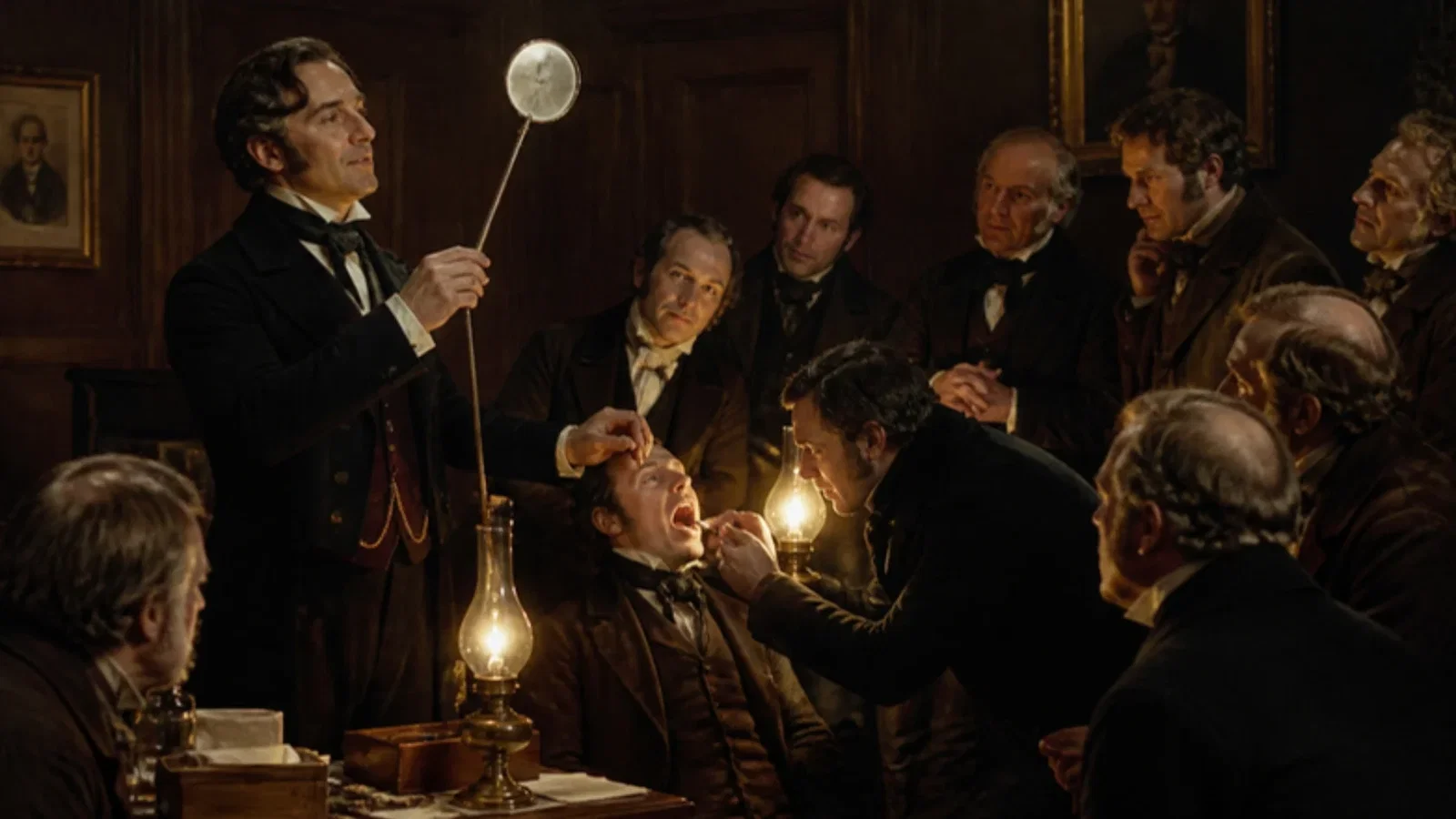
Babington showed the Hunterian Society a small mirror on a long shank that, held against the palate, revealed the epiglottis and upper larynx; Babington called it the glottiscope.
Reading Library · Anesthesia Epochs · 中文版
Watch the education video (for clinicians)
1829: Babington's Glottiscope — A Looking-Glass for the Larynx · Anesthesia Epochs Education Series
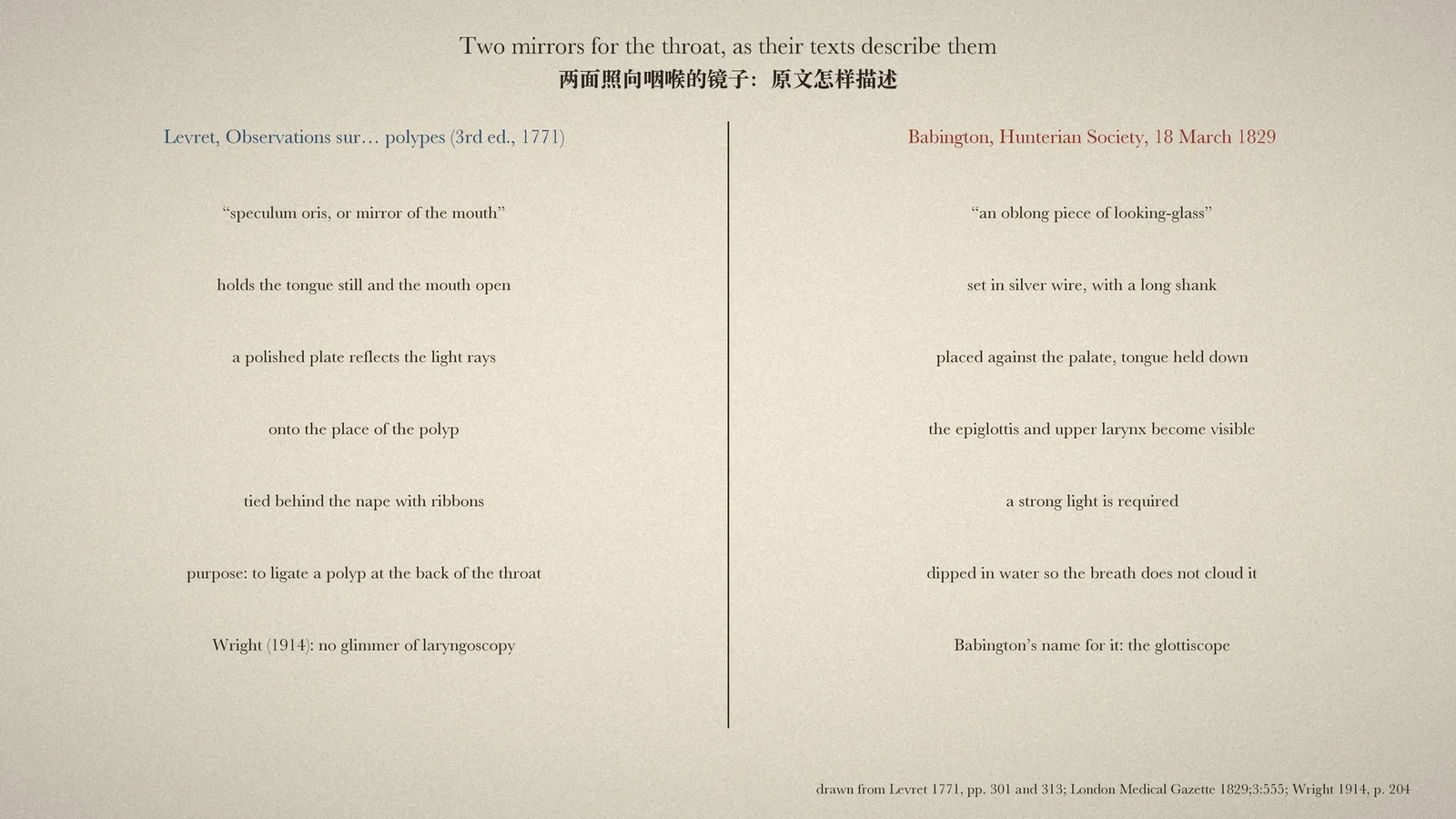
Every look at the larynx, whether with a curved blade, a fibrescope or a video screen, solves the same problem: the glottis lies around a corner, out of the direct line of sight. Before García's famous self-examination and long before Kirstein's direct laryngoscope, people were already putting small mirrors into the throat. The timeline of the Australian Society of Anaesthetists begins this story in 1743 with "a French accoucher named Leveret" and a reflective spatula, and marks Benjamin Babington's demonstration in London in 1829. This article reads what the two men's texts actually say. [1][2][3][4]
Levret's mirror of the mouth
André Levret was an obstetrician in Paris, described on the title page of the third edition (1771) of the book read here as "Accoucheur de Madame la Dauphine". The book is about the radical cure of polyps "of the womb, the throat and the nose" by newly invented means, chiefly snares and ligatures. In Observation XXXI, Levret describes a patient with polyps of the nose and throat, one of them hanging behind the uvula. To operate at the back of the throat, Levret wrote, one has to master the movements of the lower jaw and the tongue. The various speculum oris, "or mirrors of the mouth", offered until then had seemed very awkward and painful, so Levret designed a new one, shown in figure 15 of plate 4. In this article's translation: "This instrument makes the tongue immobile; it keeps the mouth open so that it cannot close; and by means of a polished plate that forms its body, it reflects the rays of light catoptrically onto the place occupied by the polyp." It is easy to put in place and is held by ribbons tied behind the nape. [1]
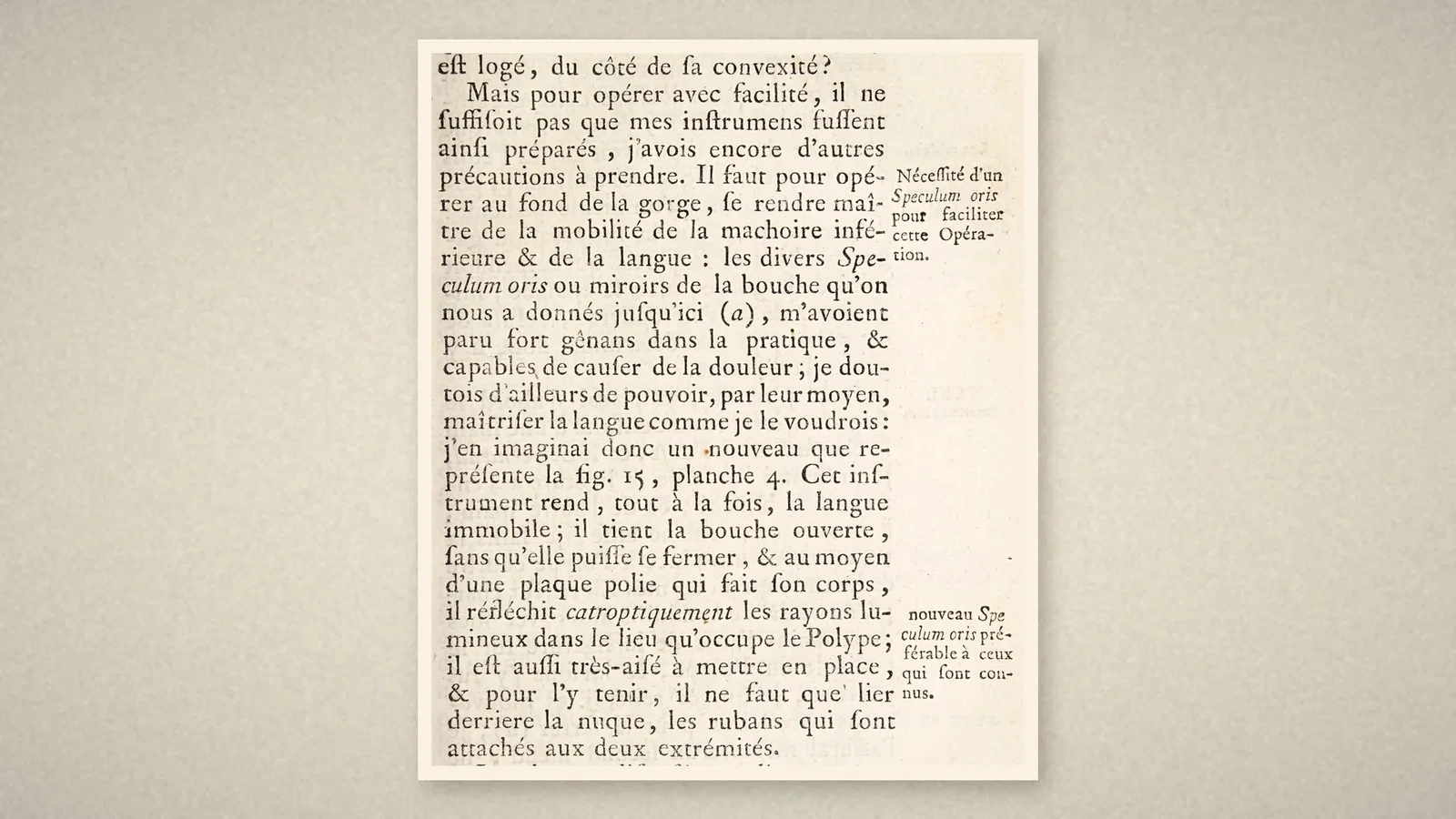
On page 313 Levret returns to it: the usual gag, the glossocatoche, needs an assistant and grips the jaw "like pincers", whereas "our speculum oris or mirror of the mouth" is simpler, needs no one to hold it, and sits between the teeth; "there is none more useful for cases where one has to operate at the back of the throat". [1]
This is a lighted tongue retractor for surgery on the pharynx. It reflects light onto the operating field; it does not show the larynx. Jonathan Wright, in the History of Laryngology and Rhinology of 1914, made the same point: Morell Mackenzie had been wrong "in supposing that Levret, in the eighteenth century, had any glimmer of the possibilities of the idea of laryngoscopy in recommending a polished steel tongue depressor". Wright cites the first edition of Levret's book as Paris, 1749. [3]
Babington's glottiscope
The London Medical Gazette for 1829 carries the report. At the Hunterian Society on 18 March 1829, with Dr Billing in the chair, "Dr. Benjamin Babington submitted to the meeting an ingenious instrument for the examination of parts within the fauces not admitting of inspection by unaided sight. It consisted of an oblong piece of looking-glass set in silver-wire, with a long shank. The reflecting portion is placed against the palate whilst the tongue is held down by a spatula, when the epiglottis and upper part of the larynx become visible in the glass. A strong light is required, and the instrument should be dipped in water so as to have a film of the fluid upon it when used, or the halitus of the breath renders it cloudy. The doctor proposed to call it the glottiscope." [2]
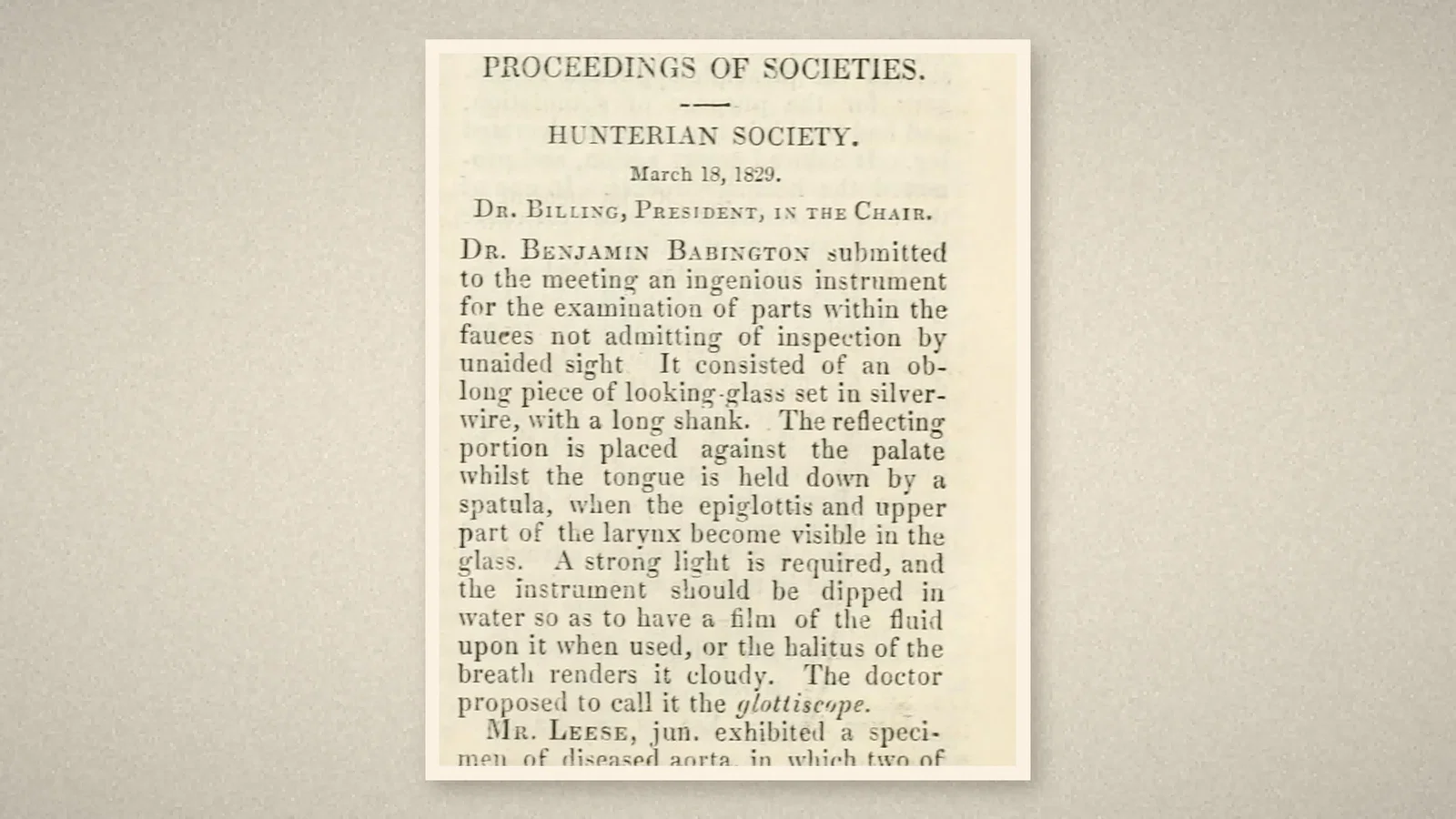
In a single paragraph the report contains the working parts of indirect laryngoscopy: a mirror angled behind the palate, the tongue displaced, strong illumination, and a trick against fogging that is still used, warming or wetting the mirror. What it lacks is a good light source directed along the line of sight; the report says only that "a strong light is required". [2]
Before and after
Wright's chapter on the laryngoscope sets Babington among several near-misses. Philipp Bozzini had published in Weimar in 1807 a pamphlet on the Lichtleiter, a double tube with a mirror and a candle meant to light the body's cavities, including the larynx; Wright knew it only through Mackenzie. Babington's instrument, and a similar attempt by Cagniard de la Tour, were "practically the present instrument", Wright wrote, yet it was "singular, but instructive" that they attracted so little notice compared with García's a generation later. [3]
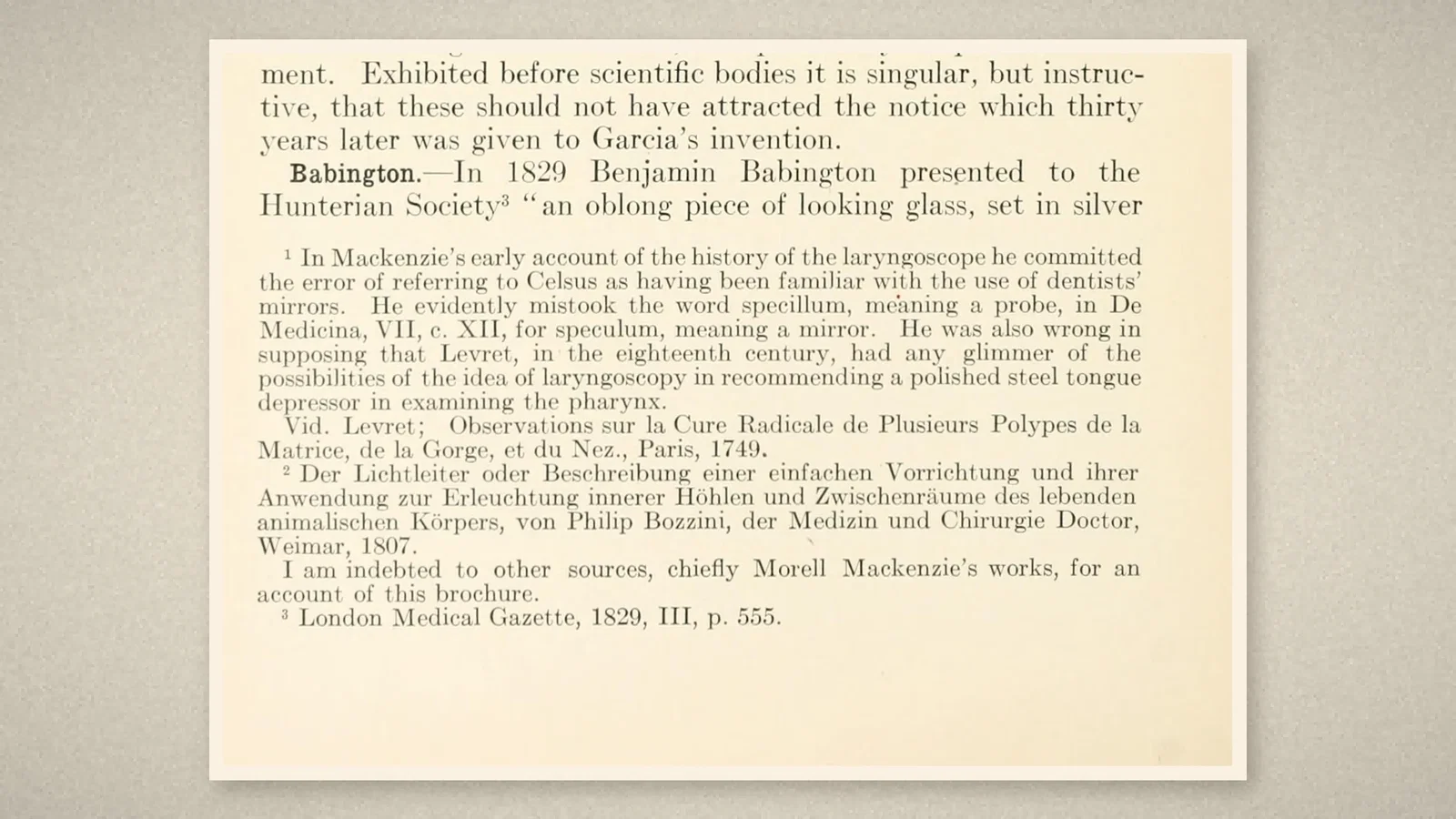
What the record shows
Two mirrors, two purposes. Levret's polished plate lit the back of the throat so that a polyp could be snared; Babington's looking-glass turned the line of sight downwards so that the epiglottis and larynx could be seen. The second is the true ancestor of laryngoscopy, and its practical details, the palate as a fulcrum, the depressed tongue, the strong light and the anti-fog film, are the ones every airway operator still manages.
Sources and reading limits
Read: the London Medical Gazette report of the Hunterian Society meeting of 18 March 1829 (vol. 3, p. 555); Levret's book in the 1771 third edition, title page and pp. 301-302 and 313; Wright's history of 1914, pp. 204-205; the 2024 ASA timeline entries.
Not covered: Levret's first edition (1749, per Wright) and any source for the timeline's date of 1743, which the article does not adopt; the plate showing Levret's instrument, not located in the scan; Bozzini's pamphlet, known here only through Wright; Babington's later writings; García and Kirstein, who belong to other articles. Translations from the French are this article's own.
Three illustrations are page crops from the 1771, 1829 and 1914 texts; one is drawn from them.
- Levret A. Observations sur la cure radicale de plusieurs polypes de la matrice, de la gorge et du nez. 3e éd. Paris: P. Fr. Didot le jeune; 1771. pp. 301-302, 313. Internet Archive
- Hunterian Society, March 18, 1829. London Medical Gazette. 1829;3:555. Internet Archive
- Wright J. A history of laryngology and rhinology. 2nd ed. Philadelphia: Lea & Febiger; 1914. pp. 204-205. Internet Archive
- Australian Society of Anaesthetists. Anaesthesia history timeline. 2024. ASA
Continue exploring
Related reading connects shared questions and contexts; it does not by itself establish historical influence.
- 1855: Garcia Uses a Small Mirror to Watch the Singing Glottis
- 1895: Kirstein Looks at the Vocal Cords Without a Mirror
Anesthesia Epochs · The Source Room · About & Editorial Method
Published November 2, 2026. Sources and reading limits are stated above. Illustrations are labelled as original source images or AI-made. Historical accounts are educational; they are not current treatment instructions.