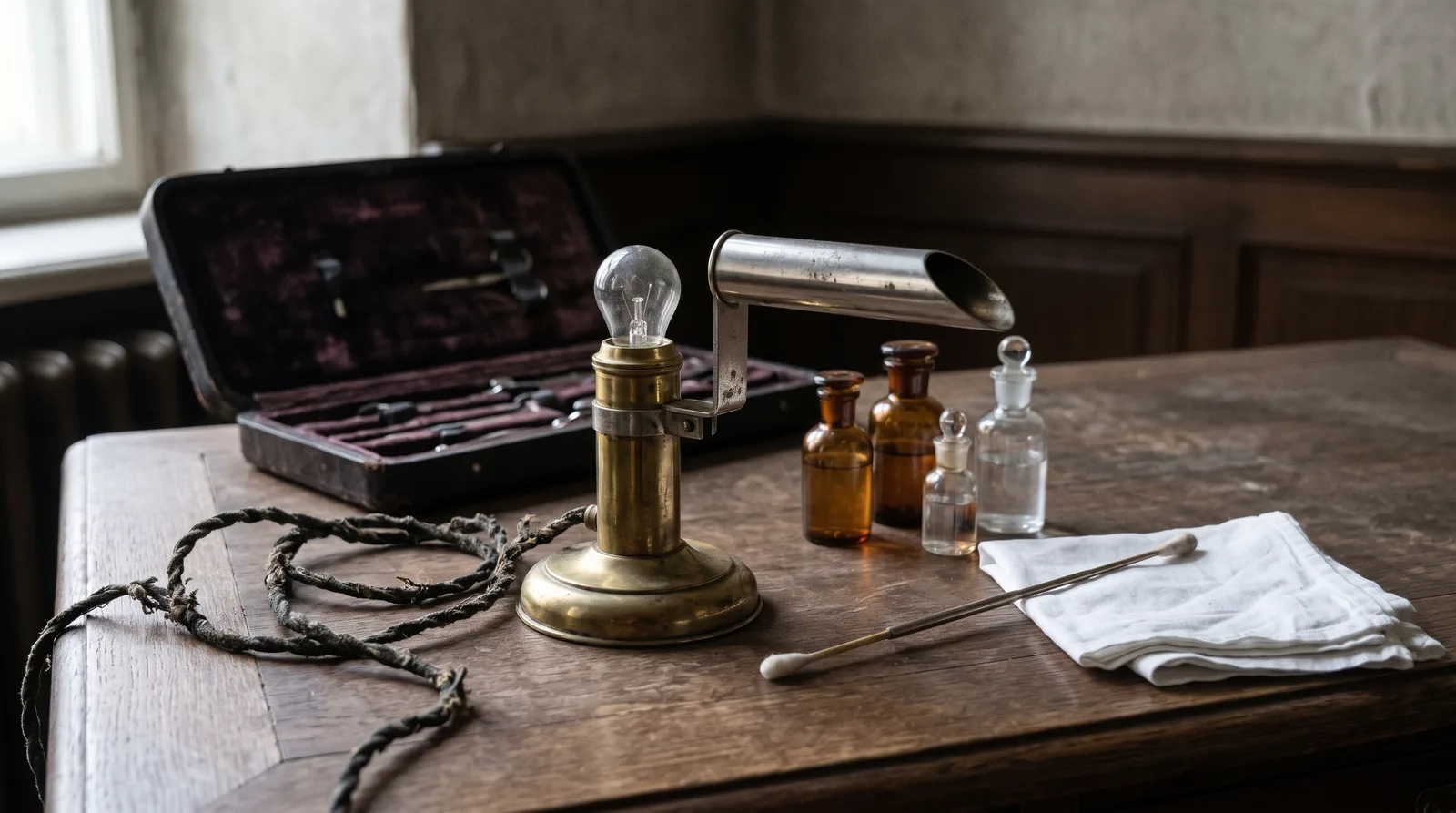
On 15 May 1895 Alfred Kirstein of Berlin lectured to the Berlin Medical Society and demonstrated autoscopy of the larynx: with the head bent back to bring the axes of mouth and trachea into line, a short thick half-channel tube on an electric handle pressed the base of the tongue forward and lifted the epiglottis, so that the cords and tracheal rings were seen with the naked eye; the lecture was printed on 3 June.
Reading Library · Anesthesia Epochs · 中文版
Watch the education video (for clinicians)
1895: Kirstein's Autoscopy — Seeing the Larynx Without a Mirror · Anesthesia Epochs Education Series
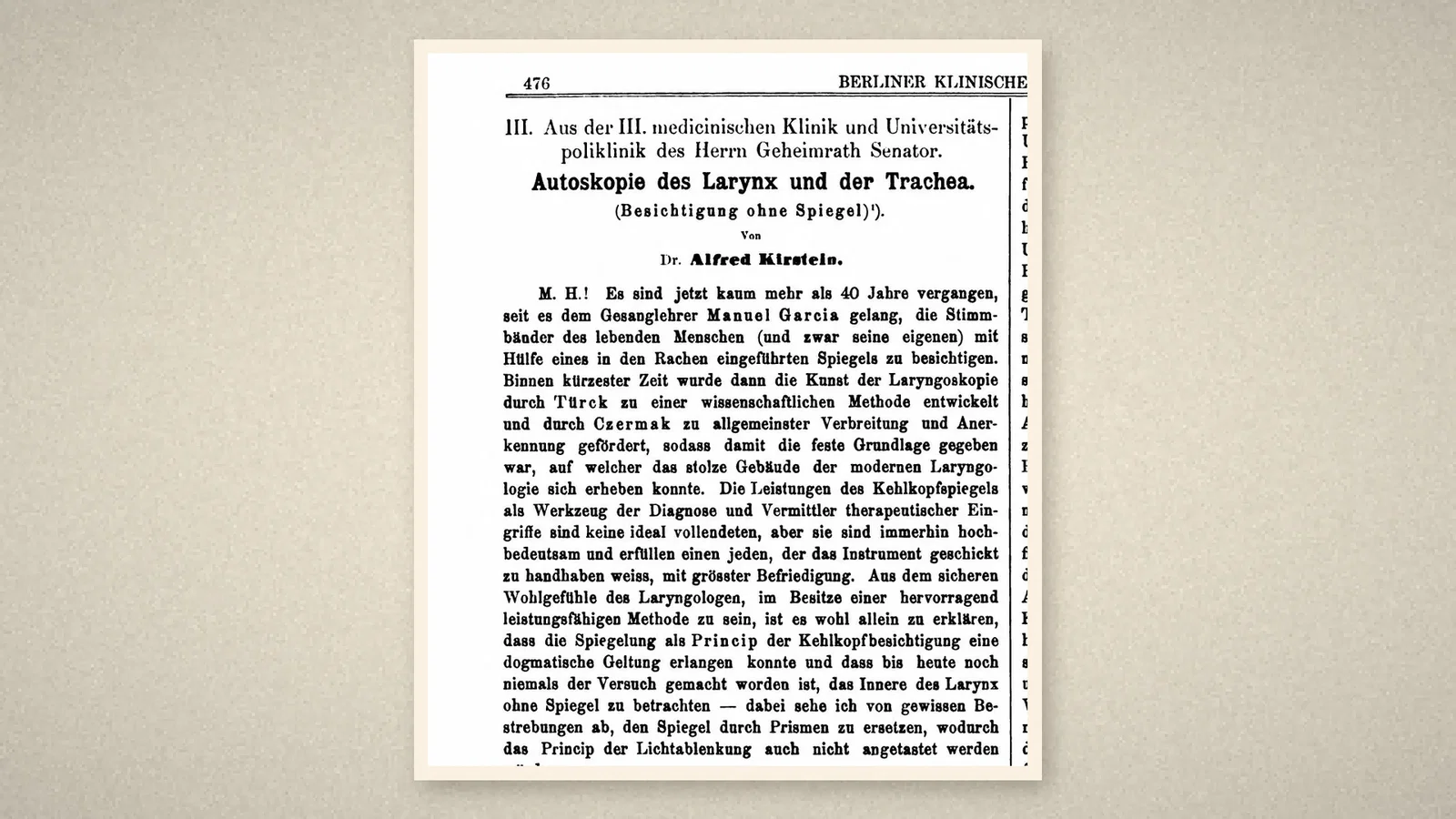
Every direct laryngoscopy, from a Macintosh blade to a hyperangulated video blade, depends on one idea: line up the airway, move the tongue out of the way, and look. The History of Anaesthesia Society timeline records that "Alfred Kirstein of Berlin pioneered direct laryngoscopy" in 1895. This article reads Kirstein's lecture "Autoscopy of the larynx and the trachea (inspection without a mirror)", given with a live demonstration to the Berlin Medical Society on 15 May 1895 and printed in the Berliner klinische Wochenschrift on 3 June. [1][3]
Forty years of mirrors
Kirstein, working in Senator's medical clinic, began with history. Barely forty years had passed since the singing teacher Manuel Garcia saw the vocal cords of a living person, Garcia's own, in a mirror placed in the throat. Türck and Czermak had made the mirror the foundation of laryngology, and its success had given it a "dogmatic" standing: "to this day no attempt has ever been made to look at the inside of the larynx without a mirror". Yet, Kirstein argued, the larynx is not so hidden that it would be rash to look at it directly. It should be enough "to cancel the angle which the axis of the mouth forms with the axis of the windpipe by bending the head backwards, and to press the tongue forwards out of the way". Earlier attempts had failed; Kirstein saw no more than part of the epiglottis. [1]
By way of the oesophagus
The breakthrough came from oesophagoscopy. Kirstein had examined about fifty people with Rosenheim's straight, rigid oesophagoscope. In one cocainised patient with that tube in the oesophagus, Kirstein passed a second, identical tube deep into the mouth beside it, levered the base of the tongue forward, pushed the end behind the epiglottis, shone a light in, and "for the first time" enjoyed a direct view of the vocal cords and of all the tracheal rings down to the bifurcation. A short note called this laryngoscopia directa; in the lecture Kirstein proposed the name autoscopy, "self-viewing, in contrast to mirror-viewing". [1]
The technique
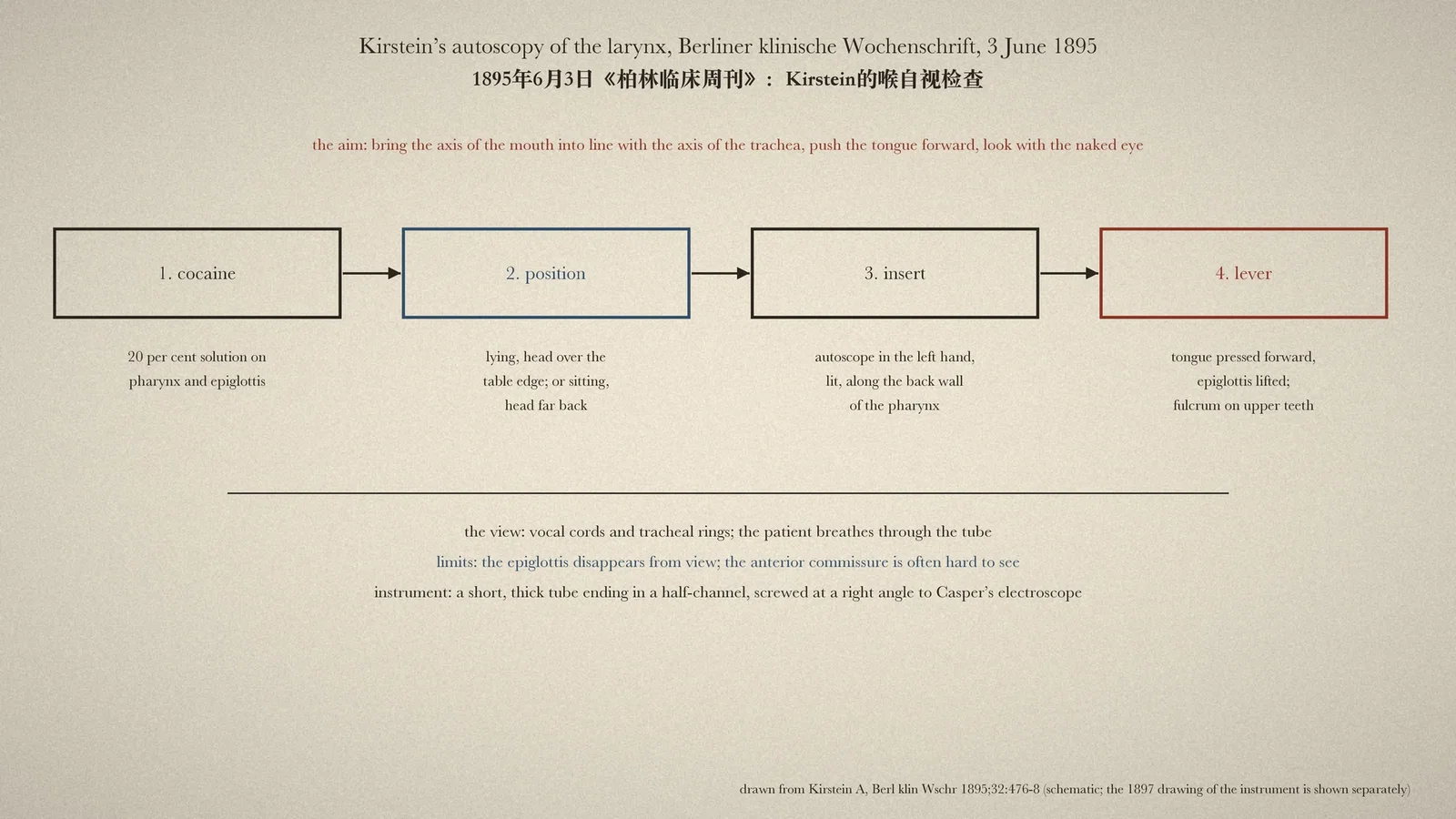
By May 1895 the oesophagus was left alone and one instrument was enough. The pharynx and the back of the epiglottis were painted with 20 per cent cocaine. The patient lay on the back with the head hanging over the edge of the table, or sat upright with the head bent far back. The autoscope, "a short, thick tube ending in a half-channel", was screwed at a right angle to Casper's electroscope, an electric hand lamp, so that it was lit from the moment it entered the mouth. Kirstein held the electroscope "firmly in the left hand" as a handle, slid the blade-shaped end of the half-channel, convex side to the tongue, down the back wall of the pharynx as far as the corniculate cartilages, and then made "a powerful lever movement, by which the tongue is pressed forward and the epiglottis lifted". Kirstein warned that the insertion was an art to be learned, and that beginners should not be discouraged by early failures. [1]
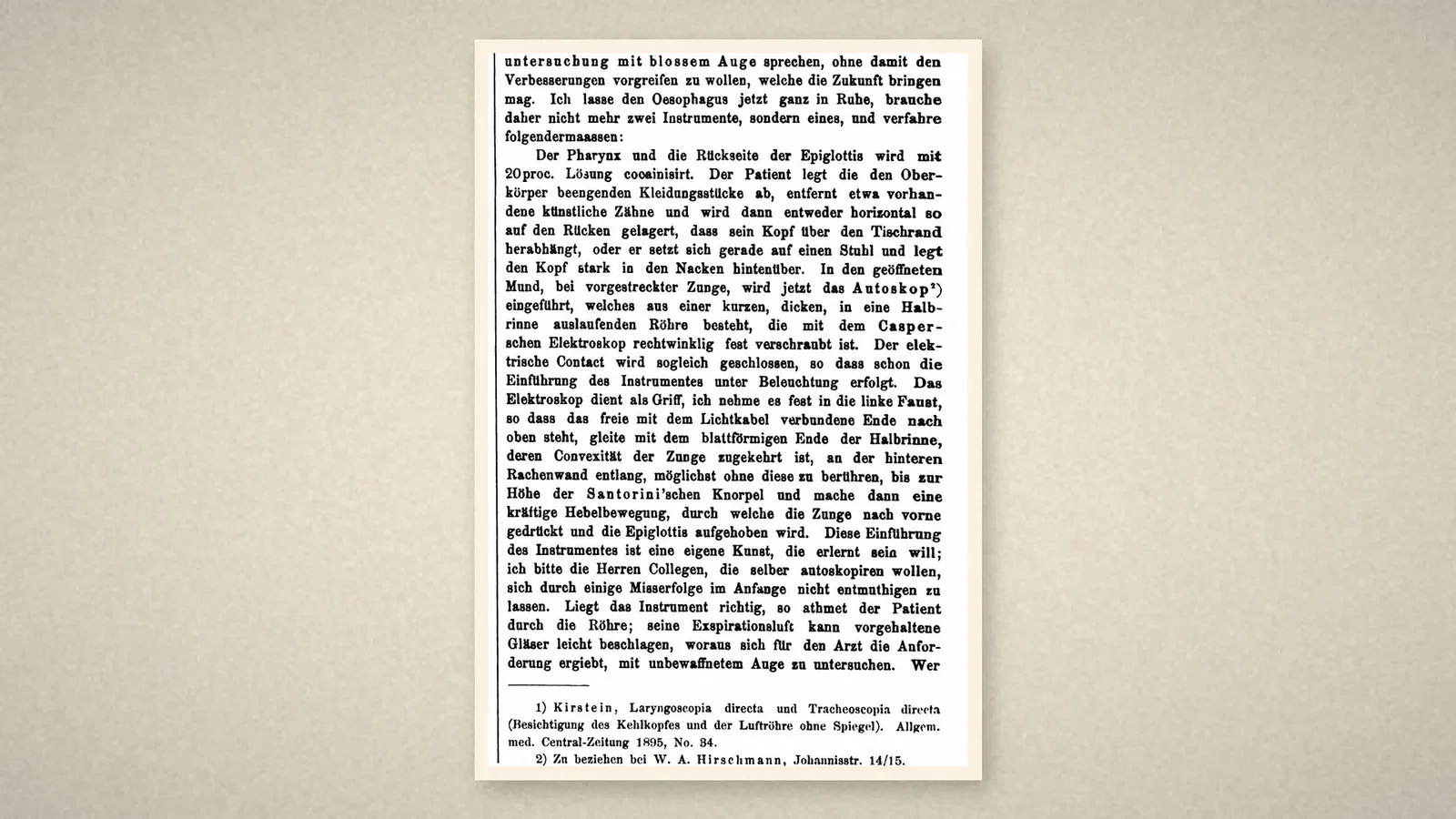
When the instrument lay correctly, the patient breathed through the tube, and the breath fogged any spectacles held in front, so the examiner had to look with the naked eye. The autoscope was a lever with its fulcrum on the upper front teeth; the pressure was too slight to endanger sound teeth, but loose or painful front teeth were a contraindication, and the upper lip must not be caught between tube and teeth. [1]
What could be seen
Because the instrument was barely 20 cm long, the eye came almost as close to the cords as a mirror would be, and the picture, without any optics and under electric light, was so superior in clarity that the mirror image, Kirstein wrote, sank to "a surrogate". The back wall of the larynx could be seen in full breadth, the whole tracheal mucosa could be surveyed, and foreign bodies might be removed through the tube. Kirstein also listed two limits that every laryngoscopist still knows: the epiglottis itself disappears from view, and "the most anterior angle of the glottis" is often not well seen. [1]
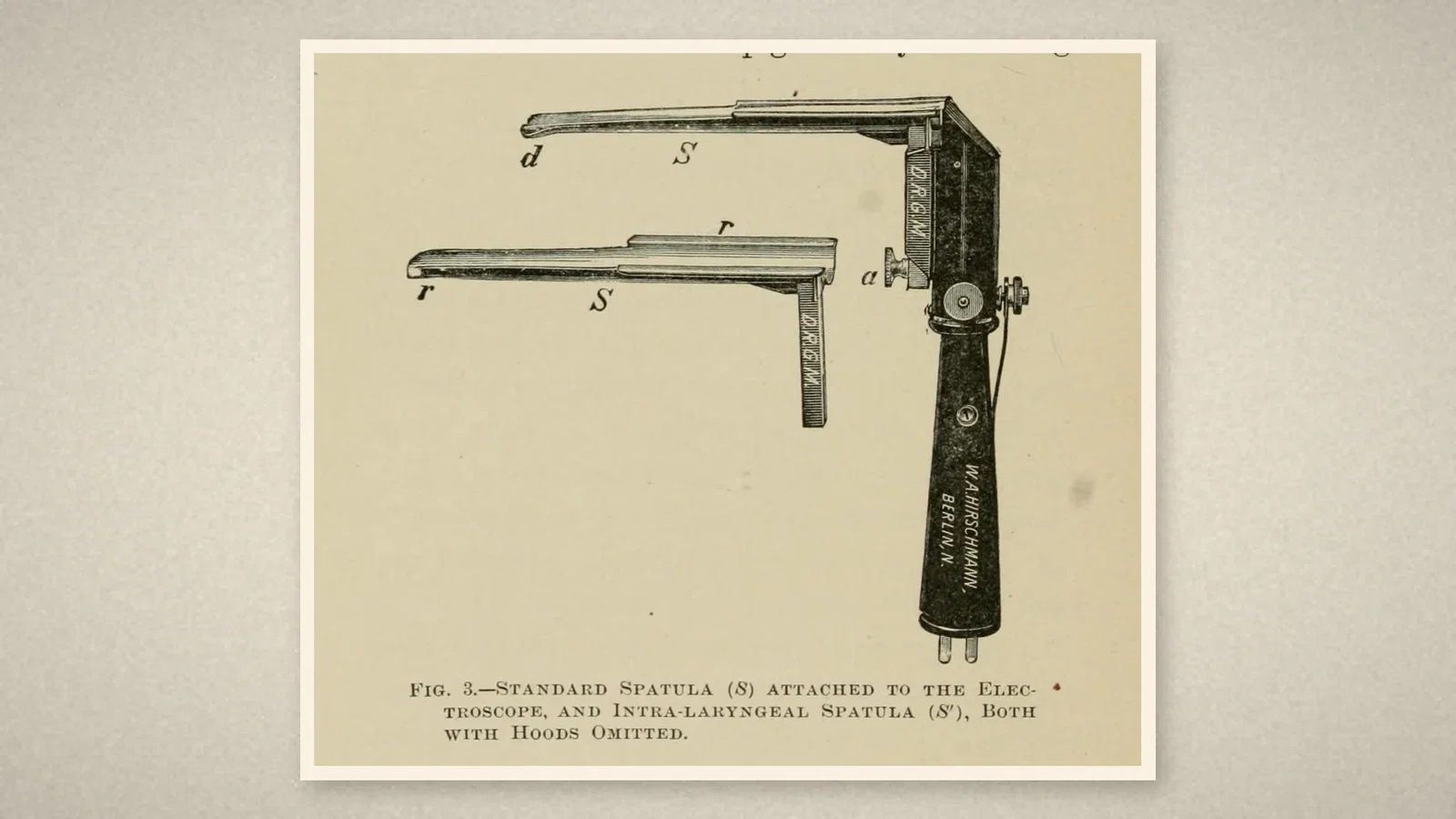
The lecture has no illustration. The English translation of 1897, altered and enlarged by Kirstein, shows the instrument as it had developed: a grooved spatula 14 cm long for adults, attached at a right angle to the electroscope handle, with a second, straighter spatula for passing behind the epiglottis. [2]
What the record shows
Kirstein's lecture was about diagnosis and laryngeal surgery in awake, cocainised patients, not about intubation; anaesthesia appears in a single sentence suggesting that small children under chloroform should be easy to examine. But the method contains the mechanics of every later rigid laryngoscope: alignment of the axes by head position, a lit blade held in the left hand, a lever movement that displaces the tongue forward and lifts the epiglottis, and the warning about the upper teeth. The two limitations Kirstein named, the hidden epiglottis and the poorly seen anterior commissure, are still the ones that grading scales of laryngeal view describe.
Sources and reading limits
Read: Kirstein’s lecture in the Berliner klinische Wochenschrift of 3 June 1895, pp. 476–478, in full with its page images; the 1897 English translation, p. 16 with Fig. 3; the HAS timeline entry for 1895.
Not covered: Kirstein’s first short note of 1895 in the Allgemeine medicinische Central-Zeitung; the 1896 German monograph; any use of the method for intubation. The instrument drawing comes from the 1897 translation and shows the later form. The statement that nobody had tried before is Kirstein’s own. Quotations from the German are translated here.
- Kirstein A. Autoskopie des Larynx und der Trachea (Besichtigung ohne Spiegel). Berl Klin Wochenschr. 1895;32:476-8. Internet Archive
- Kirstein A. Autoscopy of the larynx and the trachea (direct examination without mirror). Thorner M, translator. Philadelphia: F.A. Davis; 1897. Internet Archive
- History of Anaesthesia Society. Timeline. HAS
Continue exploring
Related reading connects shared questions and contexts; it does not by itself establish historical influence.
- 1855: Garcia Uses a Small Mirror to Watch the Singing Glottis
- 1943: The Macintosh Laryngoscope Exposes the Larynx a Different Way
- 1984: Cormack and Lehane Grade the Laryngoscopic View in Four Levels
Anesthesia Epochs · The Source Room · About & Editorial Method
Published November 2, 2026. Sources and reading limits are stated above. Illustrations are labelled as original source images or AI-made. Historical accounts are educational; they are not current treatment instructions.