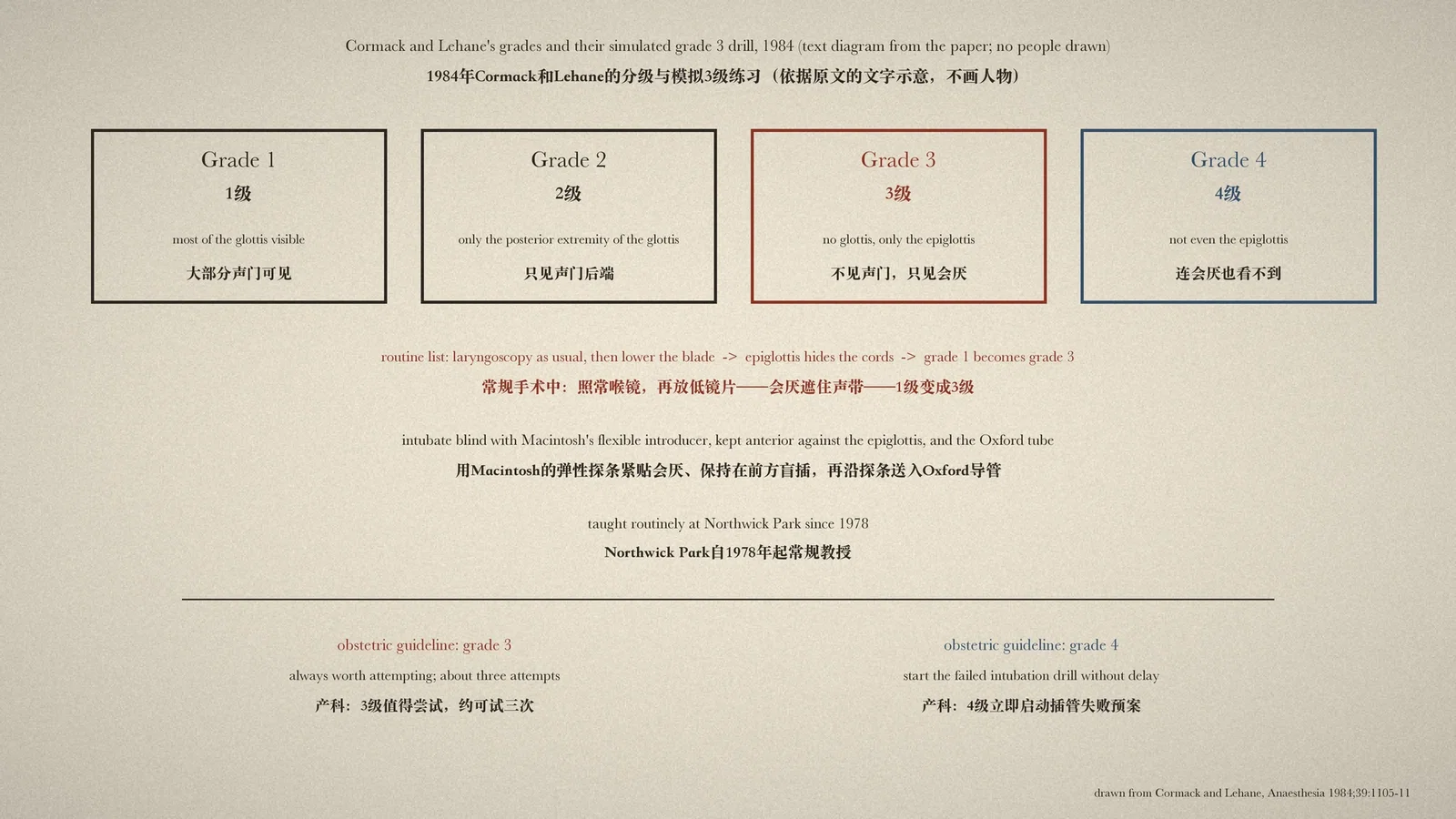
In November 1984 Anaesthesia (vol. 39, no. 11, pp. 1105-11) printed 'Difficult tracheal intubation in obstetrics' by R. S. Cormack and J. Lehane, consultant anaesthetists at Northwick Park Hospital and Clinical Research Centre, Harrow. Obstetric anaesthesia caused about 14 maternal deaths a year in the UK, difficulty with intubation was the factor most often involved, and no textbook analysed difficult intubation systematically. Because the tongue blocks the view and its size and mobility cannot be seen, difficult cases are often unexpected. The authors graded the best laryngoscopic view: grade 1, most of the glottis visible; grade 2, only its posterior extremity; grade 3, no glottis, only the epiglottis; grade 4, not even the epiglottis. In obstetrics grade 3 was the main cause of trouble, and so rare that, by a Poisson argument, some anaesthetists would never meet it before working in obstetrics. It could be simulated on routine lists by lowering the blade until the epiglottis hid the cords and intubating blind with Macintosh's flexible introducer and the Oxford tube, a drill taught at Northwick Park since 1978. Grade 3 was always worth attempting in obstetrics; grade 4 meant starting the failed intubation drill.
Reading Library · Anesthesia Epochs · 中文版
Watch the education video (for clinicians)
1984: Cormack-Lehane Grades — Grade 3, Rehearsed · Anesthesia Epochs Education Series
"Laryngoscopy grade 2" on an anaesthetic chart is understood almost everywhere today. The phrase comes from a 1984 paper about obstetrics. Its two authors cared less about classification for its own sake than about a more urgent question: why were mothers still dying of difficult intubation, and how could young anaesthetists rehearse a situation they would rarely meet but could not afford to get wrong? [1, p. 1105]
Deaths in obstetrics
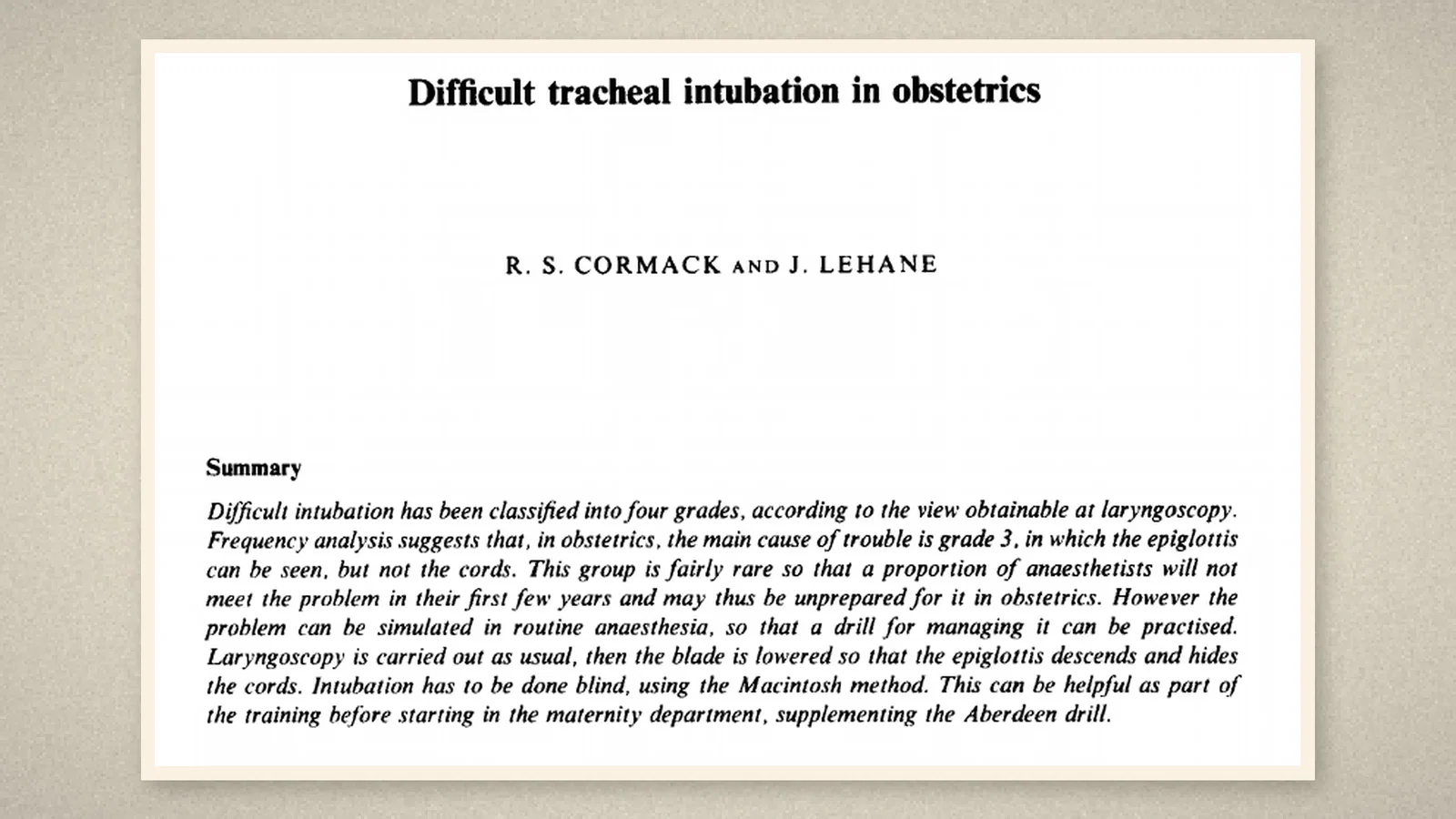
In November 1984 Anaesthesia (vol. 39, no. 11) printed "Difficult tracheal intubation in obstetrics" by R. S. Cormack and J. Lehane, both consultant anaesthetists at Northwick Park Hospital and Clinical Research Centre, Harrow. [1, p. 1105]
Obstetric anaesthesia, they began, caused about 14 maternal deaths each year in the UK, with no improvement in ten years, and difficulty with intubation was the factor most commonly associated with disaster in Britain and the USA. Yet no textbook had a systematic analysis of difficult intubation. [1, p. 1105]
They started from the line of sight. Normally the tongue blocks the view of the cords, and lifting it forward clears it. Three main factors can therefore cause difficulty: forward displacement of the larynx, the upper teeth, or backward displacement of the tongue, with limited mouth opening or head extension adding to the problem. This explains why the difficult case may be far from obvious: a short, thick neck, a receding jaw or prominent teeth are easy to see, but "what is not easy to see is the size and mobility of the tongue". It followed, the authors said, that a rule that consultants should do all such cases was not practicable. [1, p. 1105]
Grading by what can be seen
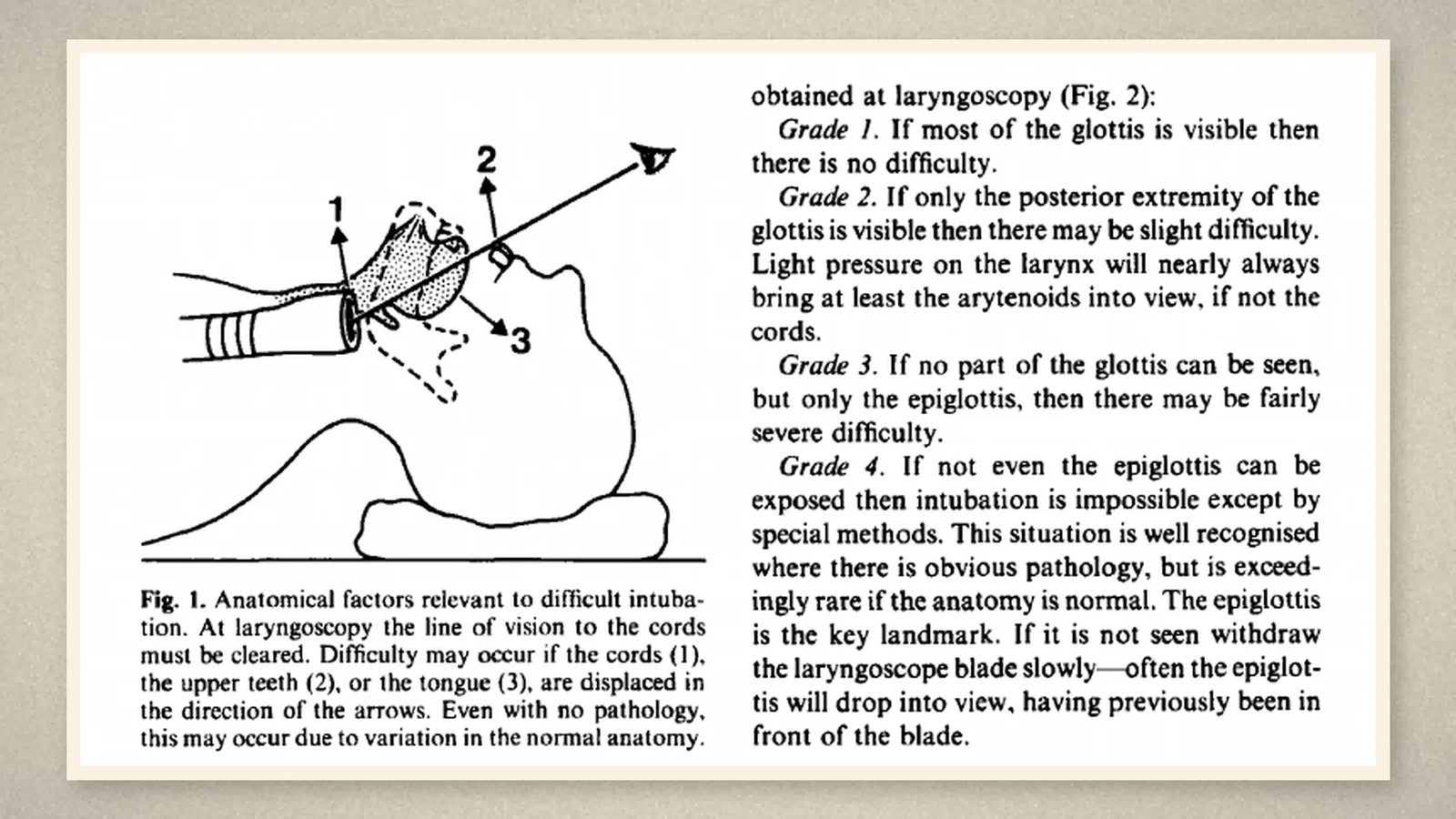
The same picture suggested a logical classification according to the view obtained at laryngoscopy. Grade 1: most of the glottis is visible, and there is no difficulty. Grade 2: only the posterior extremity of the glottis is visible, and there may be slight difficulty; light pressure on the larynx nearly always brings at least the arytenoids into view. Grade 3: no part of the glottis can be seen, only the epiglottis, and there may be fairly severe difficulty. Grade 4: not even the epiglottis can be exposed, and intubation is impossible except by special methods; this is well recognised with obvious pathology but exceedingly rare with normal anatomy. The epiglottis, they stressed, is "the key landmark": if it is not seen, withdraw the blade slowly and it will often drop into view. [1, p. 1106]
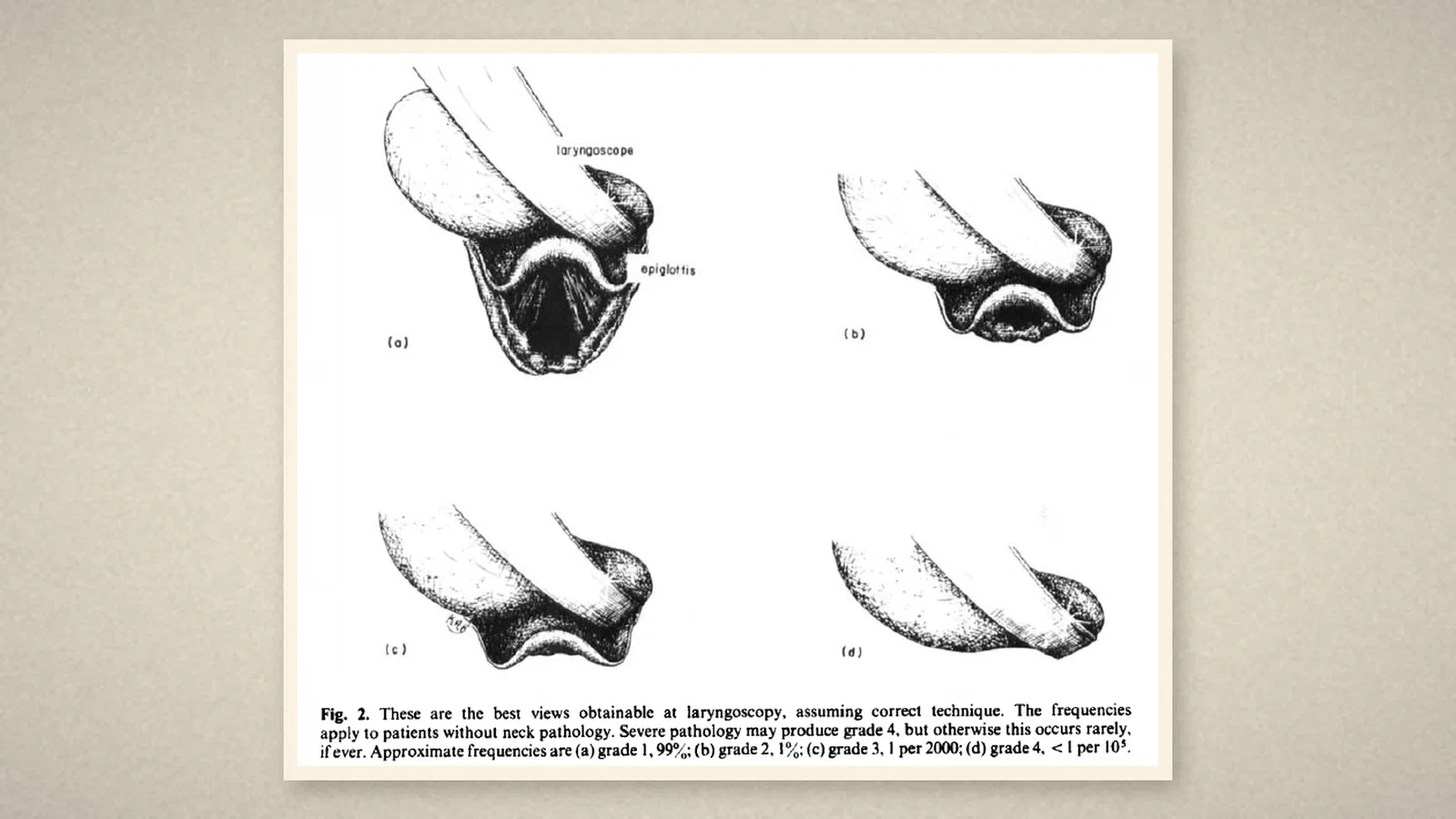
Grade 4, the authors argued, was probably not an appreciable cause of maternal deaths: severe neck pathology is rare in obstetric patients and such cases are obvious in advance, whereas disaster seems to come from unexpected difficulty. That left grade 3, often far from obvious and also quite rare. A Poisson calculation showed that most anaesthetists would meet it three or four times in eight years of training, some ten or eleven times, but about 2% would become consultants without ever having met it. [1, p. 1106][1, p. 1107]
Turning grade 1 into grade 3
A rare problem cannot be learned by waiting for it. Tunstall's failed intubation drill, the authors wrote, was one of the most promising suggestions of recent years and could be posted in every maternity theatre; and since a cuffed tube in the trachea was the only certain way of preventing aspiration, it would help to reduce the number of failed intubations. [1, p. 1107]
Their answer was to simulate grade 3 deliberately on any routine list. Laryngoscopy is done as usual, then the blade is lowered so that the epiglottis descends and hides the cords; the view changes from grade 1 to grade 3, and intubation has to be done blind. They recommended a method deriving from Macintosh, who had not described it but had designed the equipment: a flexible introducer and a tube with an anterior bevel, the Oxford tube. Kept well anterior, up against the epiglottis, the introducer cannot enter the oesophagus; it can only go into the trachea or one of the pyriform fossae, from which it is withdrawn and moved to the left or right. [1, p. 1107][1, p. 1108]
The drill, the authors wrote, had been taught routinely at Northwick Park since 1978, starting as soon as a trainee was confident with routine intubation. There was no risk to the patient, and it took about as long as a standard intubation. Trainees said that after practising it they had little difficulty when faced with a real problem; genuine grade 3 cases intubated included Hurler's and Hunter's syndromes, Still's disease and adult rheumatoid arthritis, as well as patients with no pathology. But the authors admitted that it was not yet possible to prove the scheme reduced failed intubations: the event was so rare that a single unit would take decades to gather the data, and multicentre testing was needed. [1, p. 1108]
Guidelines and reminders
In discussion the authors explained that the frequencies in Fig. 2 were approximate, those for grades 3 and 4 resting on the testimony of five senior anaesthetists at the hospital and so subject to the limits of recall. [1, p. 1109] Guidelines for the fairly inexperienced, they said, should be clear-cut. In obstetrics it is always worth attempting to intubate a grade 3 case, which should usually succeed if the Macintosh method has been practised, with about three attempts before the failed intubation routine; it is never worth it for grade 4, where the failed intubation drill should start without delay. [1, p. 1109]
Cricoid pressure, even if not always completely effective, "will convert a flood into a trickle". The conclusions named three drills, for difficult intubation, failed intubation and the correct use of cricoid pressure, that deserved as much attention as the cardiac arrest drill. They compared the grade 3 case to rare emergencies in air travel, for which pilots train in simulators, and quoted T. C. Gray in 1982: using an unfamiliar method in an emergency is a recipe for disaster. [1, p. 1110]
What the record shows
The grading began as a teaching tool: say clearly what can be seen, pick out the grade that is both the most dangerous and the rarest, and then create it on routine lists where it can be practised safely. The authors also stated its limits: the frequencies rested on recall, and the benefit could not yet be proved.
Sources and reading limits
Read: Cormack and Lehane, "Difficult tracheal intubation in obstetrics", Anaesthesia 1984;39:1105-11 (the whole paper: summary, analysis, grades with Figs 1 and 2, the Poisson estimate, possible solutions, results, discussion, guidelines and conclusions). Obtained through institutional access.
Not covered: Tunstall's failed intubation drill and photographs; the Aberdeen drill; Magill's 1930 paper; the prediction studies and the Cardiff survey the authors cite; later validation and revisions of the grading. The History of Anaesthesia Society timeline entry was used only as a lead.
Limits: the frequencies in Fig. 2 are the authors' approximations, grades 3 and 4 resting on the recollection of five senior anaesthetists, as the authors themselves say; their trainees' success is reported without numbers, and the authors state that a reduction in failed intubation could not yet be proved. Introducer dimensions are not repeated. Patients are not identified; Figs 1 and 2 are drawings, not patient images.
Three illustrations are crops of Anaesthesia 1984 pp. 1105 and 1106 (title and summary, Fig. 1 with the grade definitions, Fig. 2). One is a text diagram drawn from the paper, with no people drawn.
- Cormack RS, Lehane J. Difficult tracheal intubation in obstetrics. Anaesthesia. 1984;39:1105-11. DOI
Continue exploring
Related reading connects shared questions and contexts; it does not by itself establish historical influence.
- 1978: Finucane and Kupshik Exchange a Leaking Tracheal Tube over a Stilette
- 1949: Macintosh Threads the Tracheal Tube over a Gum-Elastic Catheter
Anesthesia Epochs · The Source Room · About & Editorial Method
Published November 3, 2026. Sources and reading limits are stated above. Illustrations are labelled as original source images or AI-made. Historical accounts are educational; they are not current treatment instructions.