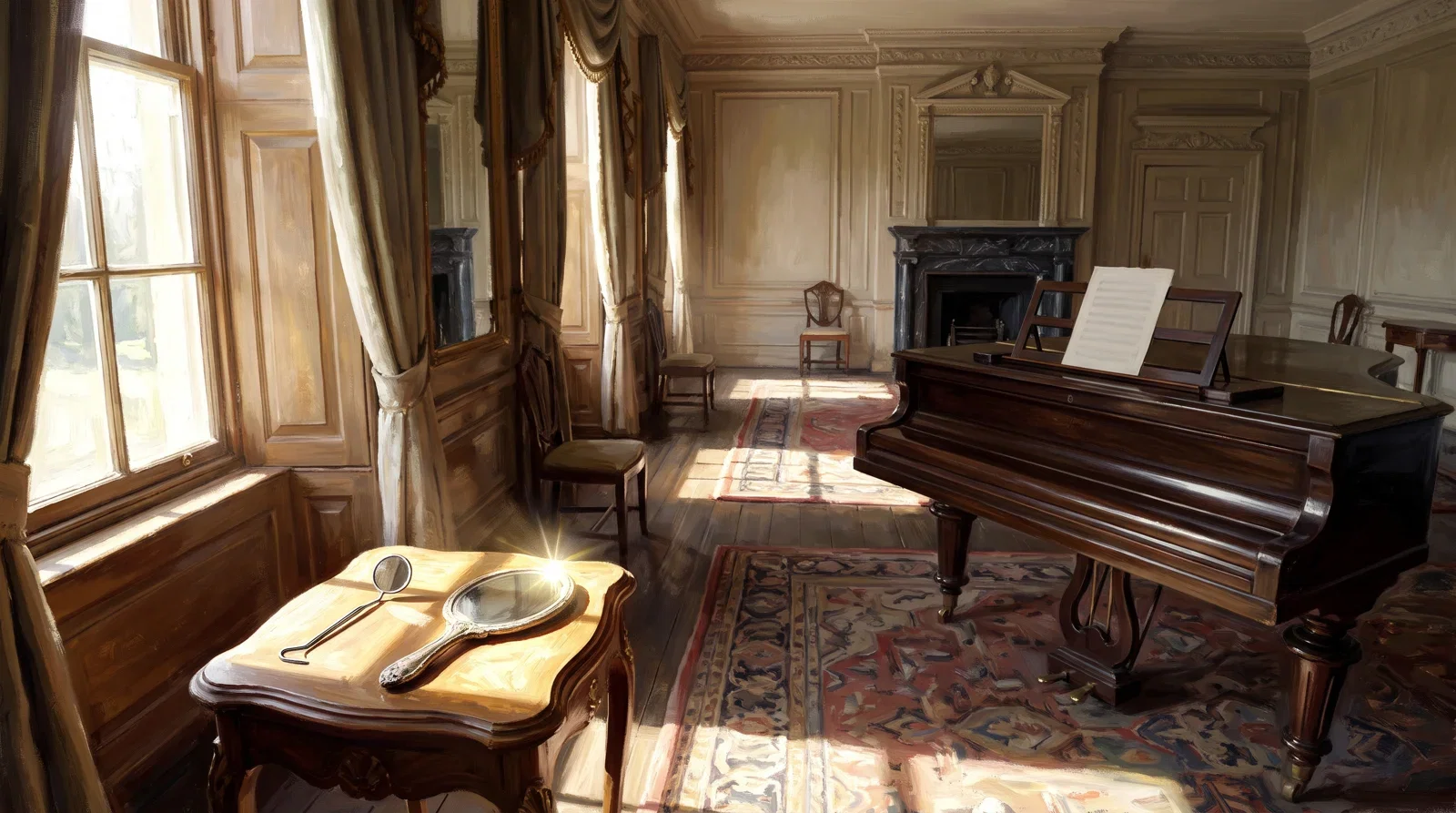
The singing teacher Manuel Garcia reflected sunlight off a small mirror held against the soft palate and saw the glottis open on a deep breath.
Reading Library · Anesthesia Epochs · 中文版
Watch the education video (for clinicians)
1855: Garcia's Laryngeal Mirror — Watching the Singing Glottis · Anesthesia Epochs Education Series
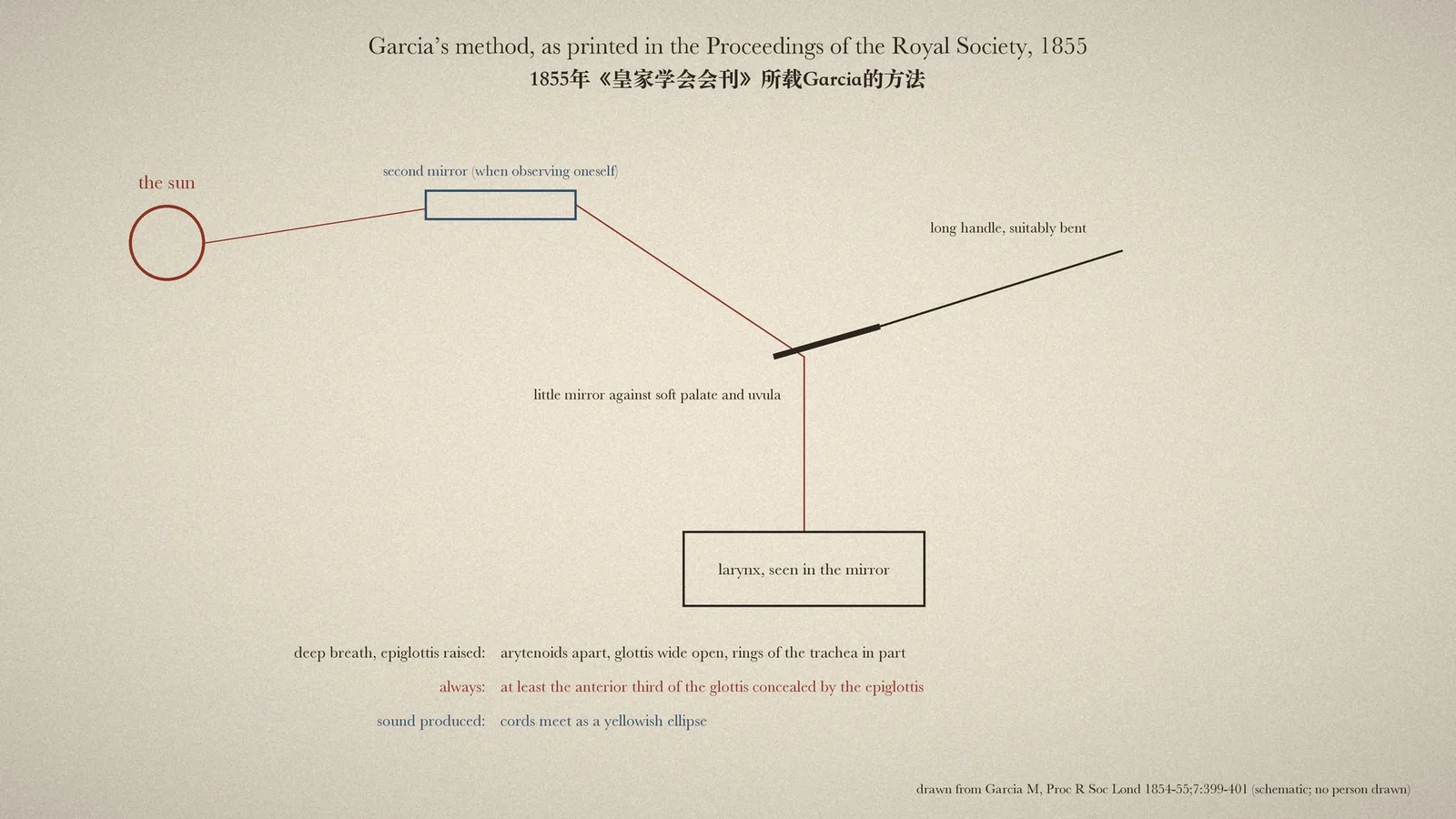
The laryngeal mirror entered medicine through a singing teacher. Manuel Garcia was interested in how the voice is made, not in disease, and the paper received by the Royal Society on 22 March 1855 describes the inside of the larynx "during the act of singing". It also records, in plain words, the view that every anaesthetist who has used a laryngoscope knows: a glottis that opens wide, and an epiglottis that hides the front of it. This article reads the paper in the Proceedings of the Royal Society. [1][2]
The method
"Observations on the Human Voice. By Manuel Garcia, Esq.", communicated by Dr Sharpey, Secretary of the Royal Society, begins with the method, which "is very simple. It consists in placing a little mirror, fixed on a long handle suitably bent, in the throat of the person experimented on against the soft palate and uvula." The subject faces the sun, "so that the luminous rays falling on the little mirror, may be reflected on the larynx". To observe one's own larynx, a second mirror is used to catch the sunlight and direct it onto the first. [1]
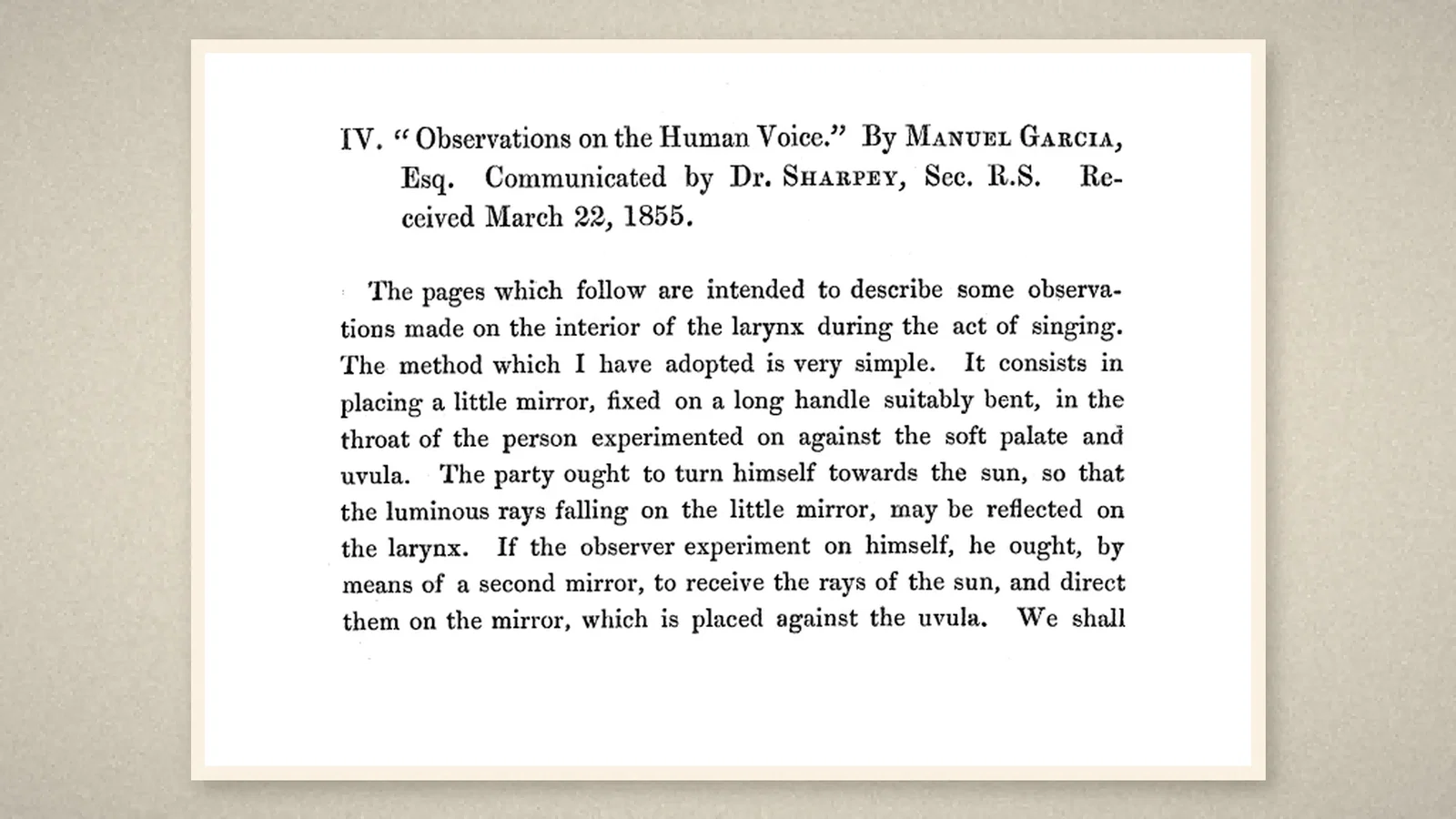
The arrangement is close to the one Benjamin Babington had shown in London in 1829 (see that article): a mirror behind the palate. What Garcia added was a long series of careful observations, made by looking.
What the mirror showed
"At the moment when the person draws a deep breath, the epiglottis being raised, we are able to see the following series of movements": the arytenoid cartilages move apart, the ligaments draw back, "and the glottis, large and wide open, is exhibited so as to show in part the rings of the trachea". Then comes the limitation: "however dexterous we may be in disposing these organs, and even when we are most successful, at least the third part of the anterior of the glottis remains concealed by the epiglottis." [1]
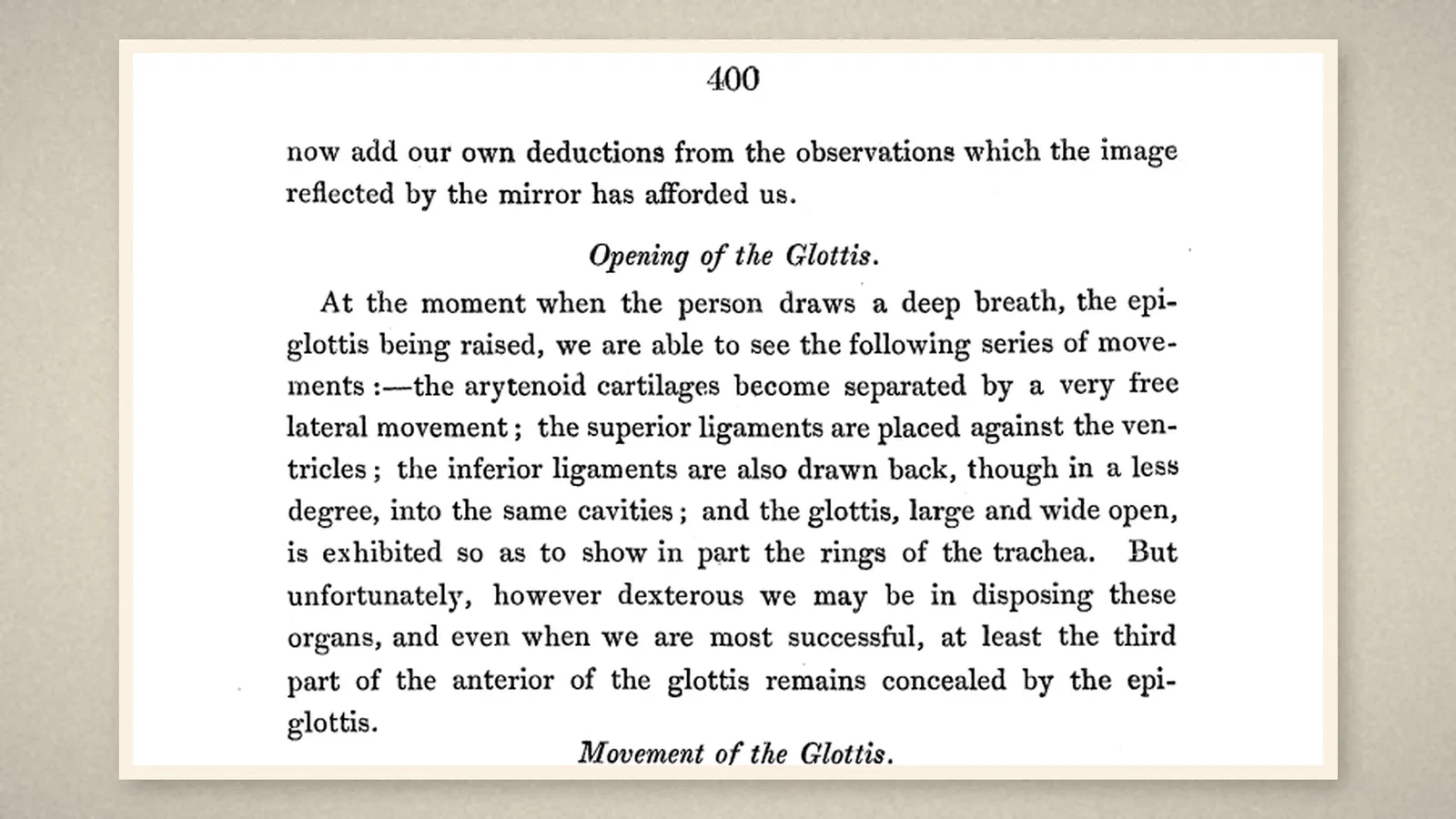
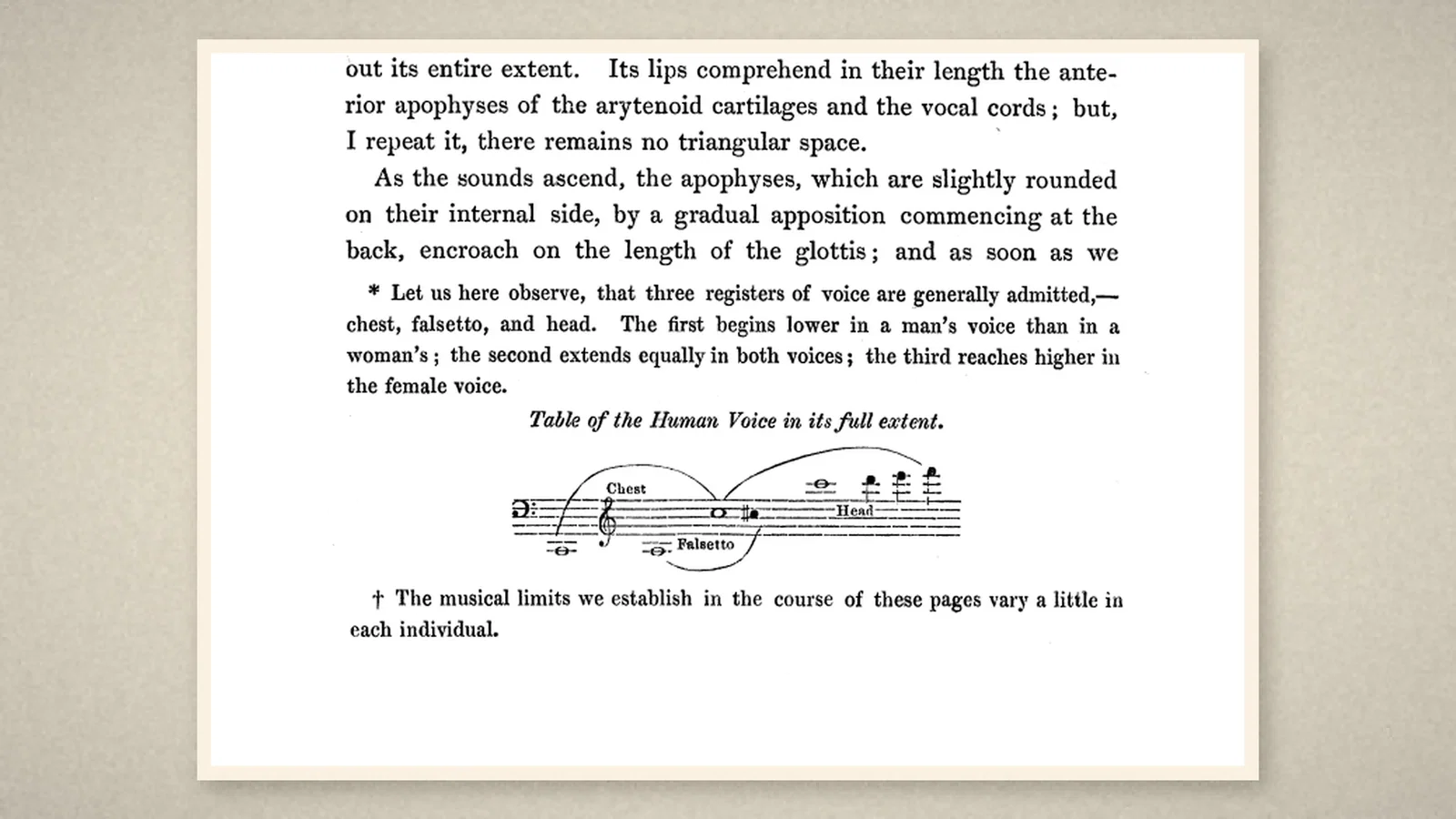
When a sound is prepared, the arytenoids come together and the vocal ligaments meet, appearing "at the bottom of the larynx under the form of an ellipse of a yellowish colour". After some trials, Garcia noted that this inner view "is only visible when the epiglottis remains raised", and that loud chest notes narrow the larynx and close its opening further. The rest of the paper works through the registers of the voice, chest, falsetto and head, with a table of their ranges. [1]
In its closing pages the paper returns to the epiglottis from the singer's side. The pitch of the voice, Garcia argued, depends on the tension of the lips of the glottis, the pressure of the air from the lungs and the number of "explosions" of air through the glottis; and the epiglottis "also plays a very important part, for every time that it lowers itself, and nearly closes the orifice of the larynx, the voice gains in brilliancy", while when it is drawn up "the voice immediately becomes veiled". [1]
Why this matters for the airway
Garcia's interest was music, and the paper makes no medical claims. But it describes, as an observer, two things that remain central to every look at the larynx. The glottis is widest on deep inspiration, and the epiglottis is the obstacle: even in the best view, its free edge can hide the front of the cords. Indirect mirror laryngoscopy became a medical technique in the hands of others; the logic of lifting or getting around the epiglottis to see the anterior glottis runs through every later laryngoscope.
Sources and reading limits
Read: Garcia's paper in the Proceedings of the Royal Society of London, vol. 7, pp. 399-410, in full; the History of Anaesthesia Society and ASA timeline entries, which date it to 1854.
Not covered: other printings of the paper; Garcia's later recollections of how the idea came, which are not in this paper; the physicians who adopted the mirror in medicine. The timelines give 1854; the Proceedings record the paper as received on 22 March 1855, in the volume for 1854-55, and the article uses that date.
Three illustrations are page crops from the 1855 paper; one is drawn from it.
- Garcia M. Observations on the human voice. Proc R Soc Lond. 1854-55;7:399-410. Internet Archive
- Australian Society of Anaesthetists. Anaesthesia history timeline. 2024. ASA
Continue exploring
Related reading connects shared questions and contexts; it does not by itself establish historical influence.
- 1829: Babington Shows the Larynx in a Looking-Glass
- 1895: Kirstein Looks at the Vocal Cords Without a Mirror
Anesthesia Epochs · The Source Room · About & Editorial Method
Published November 2, 2026. Sources and reading limits are stated above. Illustrations are labelled as original source images or AI-made. Historical accounts are educational; they are not current treatment instructions.