
Guthrie of Sackett's Harbor distilled chloride of lime with alcohol to make a sweet chloric ether, freely drunk in the laboratory; the journal's editor sent it to physicians.
Reading Library · Anesthesia Epochs · 中文版
Watch the education video (for clinicians)
1832: Samuel Guthrie's Chloric Ether — Sackett's Harbor · Anesthesia Epochs Education Series
In 1832 an American scientific journal printed a letter from a country chemist describing a cheap, simple way to make a "sweet and aromatic" ethereal spirit. Many people in the laboratory drank it, the writer said, often until drunk. The editor sent it to physicians, and a professor of medicine reported a few cases, one patient having "inhaled" it. Nowhere in these pages is it connected with surgery or with relieving the pain of an operation. [1, p. 64][1, p. 65][2, p. 406]
Guthrie's letter
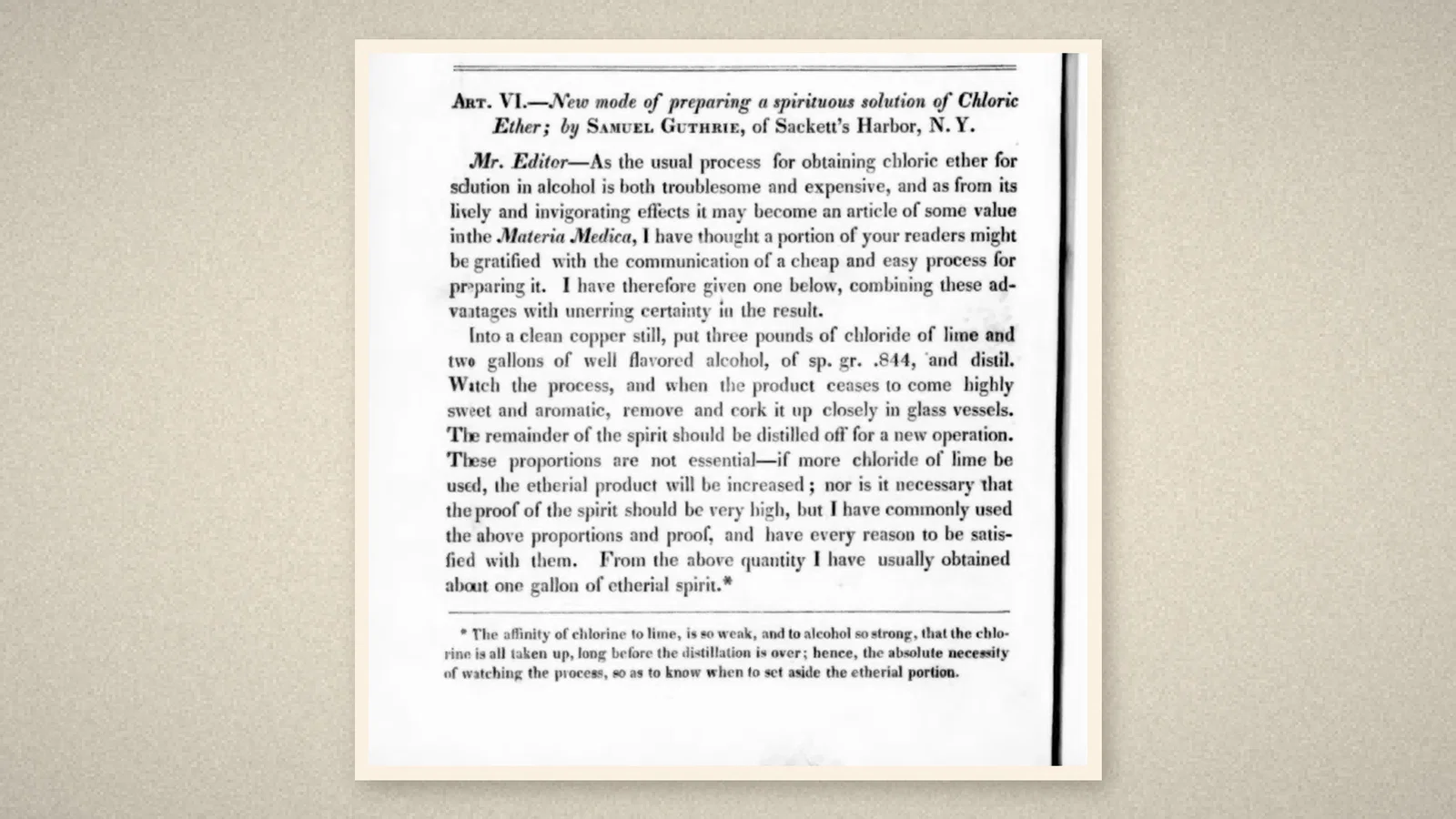
The American Journal of Science and Arts, vol. 21 (1832), pp. 64-65, printed "New mode of preparing a spirituous solution of chloric ether" by Samuel Guthrie of Sackett's Harbor, New York. The usual way of obtaining chloric ether for solution in alcohol, Guthrie wrote, was troublesome and expensive, and "from its lively and invigorating effects it may become an article of some value in the Materia Medica", so readers might welcome a cheap and easy process with certain results. [1, p. 64]
Chloride of lime and well-flavoured alcohol went into a clean copper still and were distilled; once the product stopped coming over "highly sweet and aromatic", it was set aside and corked closely in glass. Redistilled from a great excess of chloride of lime in a glass retort in a water bath, it gave a far more concentrated solution, "caustic, and intensely sweet and aromatic". [1, p. 64][1, p. 65]
"Frequently to the point of intoxication"
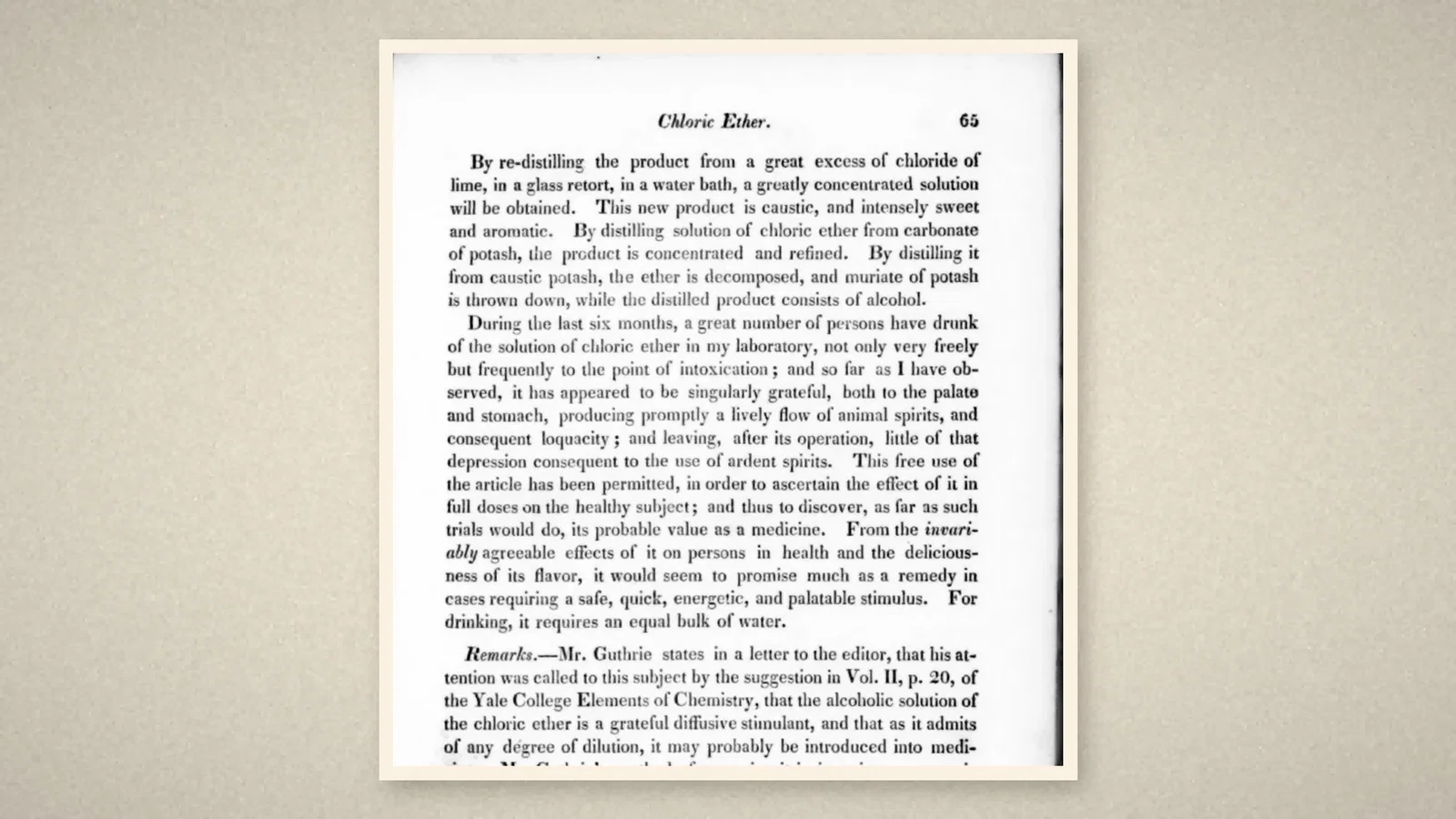
"During the last six months," Guthrie wrote, "a great number of persons have drunk of the solution of chloric ether in my laboratory, not only very freely but frequently to the point of intoxication." As far as Guthrie had seen, it was singularly grateful to palate and stomach, promptly producing "a lively flow of animal spirits, and consequent loquacity", and leaving little of the depression that follows ardent spirits. This free use had been allowed in order to learn its effect in full doses on healthy people, and so its probable value as a medicine; it seemed to promise much as a safe, quick, energetic and palatable stimulant. [1, p. 65]
The editor: try it, but not as a drink
In remarks after the letter, the editor explained that Guthrie had been prompted by a suggestion in the Yale College Elements of Chemistry, vol. II, p. 20, that the alcoholic solution of chloric ether is a grateful diffusive stimulant. The editor called Guthrie's method "ingenious, economical and original", found the sample identical in its sensible properties to the solution made by the book's method, and promised portions to medical friends for experiment, since chlorine's peculiar powers might make the compound curative beyond mere stimulation. [1, p. 65]
In that respect, the editor added, Guthrie's experiments had "certainly been quite sufficient", and any but a medical use should be discouraged, since whoever added "a new attraction to intoxicating spirit" would be no benefactor of humankind. [1, p. 65]
In another letter, dated September 12, 1831, and printed in the same volume, Guthrie sent a bottle and a phial of the alcoholic solution of chloric ether, "a lively spirited preparation". [3, p. 295]
The appendix: a professor's report
In an appendix on p. 405 the editor quoted the passage from the Elements of Chemistry and explained that for many years the editor had prepared and diluted such a solution and shown medical students "its remarkably grateful properties as a cordial", suggesting that it might prove a valuable medicine, though no trial was known. The editor had repeated Guthrie's process that day, obtained a solution exactly like Guthrie's, and distributed several bottles among medical friends, with reports "highly satisfactory". [2, p. 405]
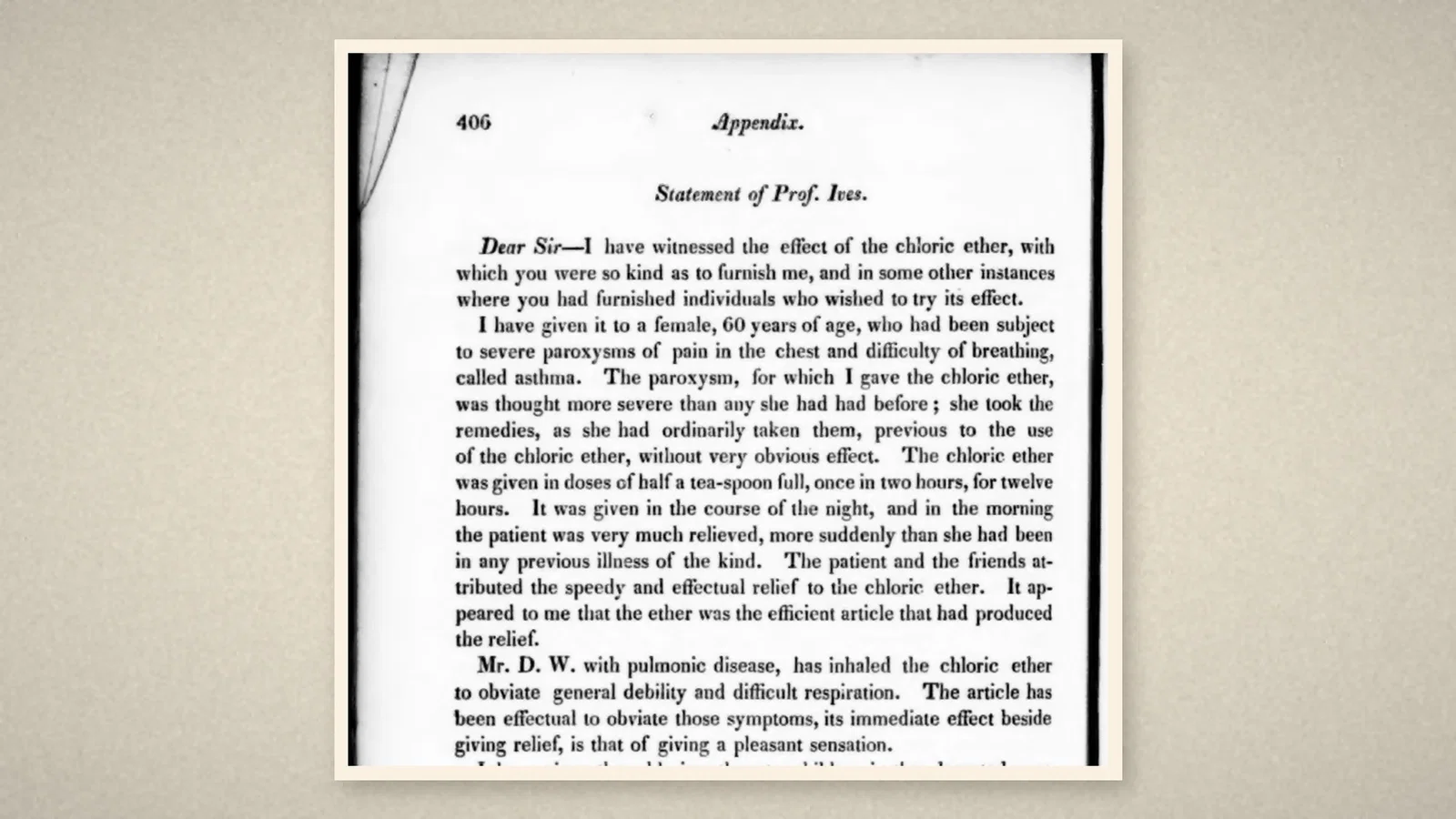
Eli Ives, professor of the theory and practice of medicine in the Medical Institution of Yale College, sent a statement at the editor's request. A woman of 60, subject to severe paroxysms of chest pain and difficult breathing, called asthma, was in an attack thought worse than any before; the usual remedies had little effect, the chloric ether was given in the night, and by morning the relief was greater and quicker than in any previous illness, which patient and friends put down to the chloric ether. Mr D. W., with lung disease, "has inhaled the chloric ether" against general debility and difficult breathing, with relief and a pleasant sensation. Ives had also given it to children and adults with ulcerated sore throat (scarlet fever), finding that it seemed to allay nervous irritation and the heat of the skin. [2, p. 406]
The appendix runs on for two more pages. Ives's letter is dated January 2, 1832; a postscript adds another woman with long-standing asthma and cases of spasmodic cough. His son, Nathan B. Ives, reported a man with quinsy who could not swallow; the ether was first "injected by means of a syringe", after which he could take it by mouth. The editor added that patients kept sending for more, since it was not to be had in the shops, and quoted Guthrie's reply of December 24, 1831, promising a further supply. The editor now judged its moral risk as a medicine no greater than that of other medicines given in alcohol, and admitted that no accurate examination had yet been made of what happens in the still. The appendix is signed "Editor, Yale College, January 6, 1832." [2, pp. 407-408]
What the record shows
How a substance later bound up with the history of anesthesia appeared in an American journal in 1832: a country chemist's cheap method, treated as a drink, a stimulant and a cordial; an editor worried it would be drunk for pleasure; physicians tried it for asthma and fever. Someone even inhaled it. No one proposed it for the pain of surgery.
Sources and reading limits
Read: Samuel Guthrie, "New mode of preparing a spirituous solution of chloric ether", American Journal of Science and Arts 1832;21:64-5, with the editor's remarks; the passage on chloric ether in Guthrie's further letter at p. 295; the appendix "Chloric ether" with Eli Ives's statement, pp. 405-408.
Not covered: Soubeiran's 1831 paper in the Annales de chimie et de physique; Liebig's 1832 paper (treated in another article); the passage in the Yale College Elements of Chemistry in its own edition; any chemical analysis showing what Guthrie's product was.
Limits: these pages call the substance "chloric ether" and do not analyse it; whether it was chloroform is not established here and is not claimed. The drinking "to the point of intoxication" and the cases are reported by Guthrie and by Ives without numbers or controls. The appendix is signed "Editor"; the journal was conducted by Benjamin Silliman, to whom the Ives letters are addressed. Quantities and doses are not repeated.
The three illustrations are crops of the American Journal of Science and Arts, vol. 21 (pp. 64, 65 and 406).
- Guthrie S. New mode of preparing a spirituous solution of chloric ether. Am J Sci Arts. 1832;21(1):64-5. Internet Archive
- Chloric ether [appendix, with statements of Eli Ives and Nathan B. Ives]. Am J Sci Arts. 1832;21:405-8. Internet Archive
- Guthrie S. Remarks on various chemical preparations [letter to the editor, Sept. 12, 1831]. Am J Sci Arts. 1832;21:288-95. Internet Archive
Continue exploring
Related reading connects shared questions and contexts; it does not by itself establish historical influence.
- 1730: Frobenius Shows the Royal Society an Ethereal Spirit of Wine
- 1847: Chloroform, from Self-Experiment to a Public Report
- 1832: Liebig's Observations and Questions on Chloral
Anesthesia Epochs · The Source Room · About & Editorial Method
Published November 3, 2026. Sources and reading limits are stated above. Illustrations are labelled as original source images or AI-made. Historical accounts are educational; they are not current treatment instructions.