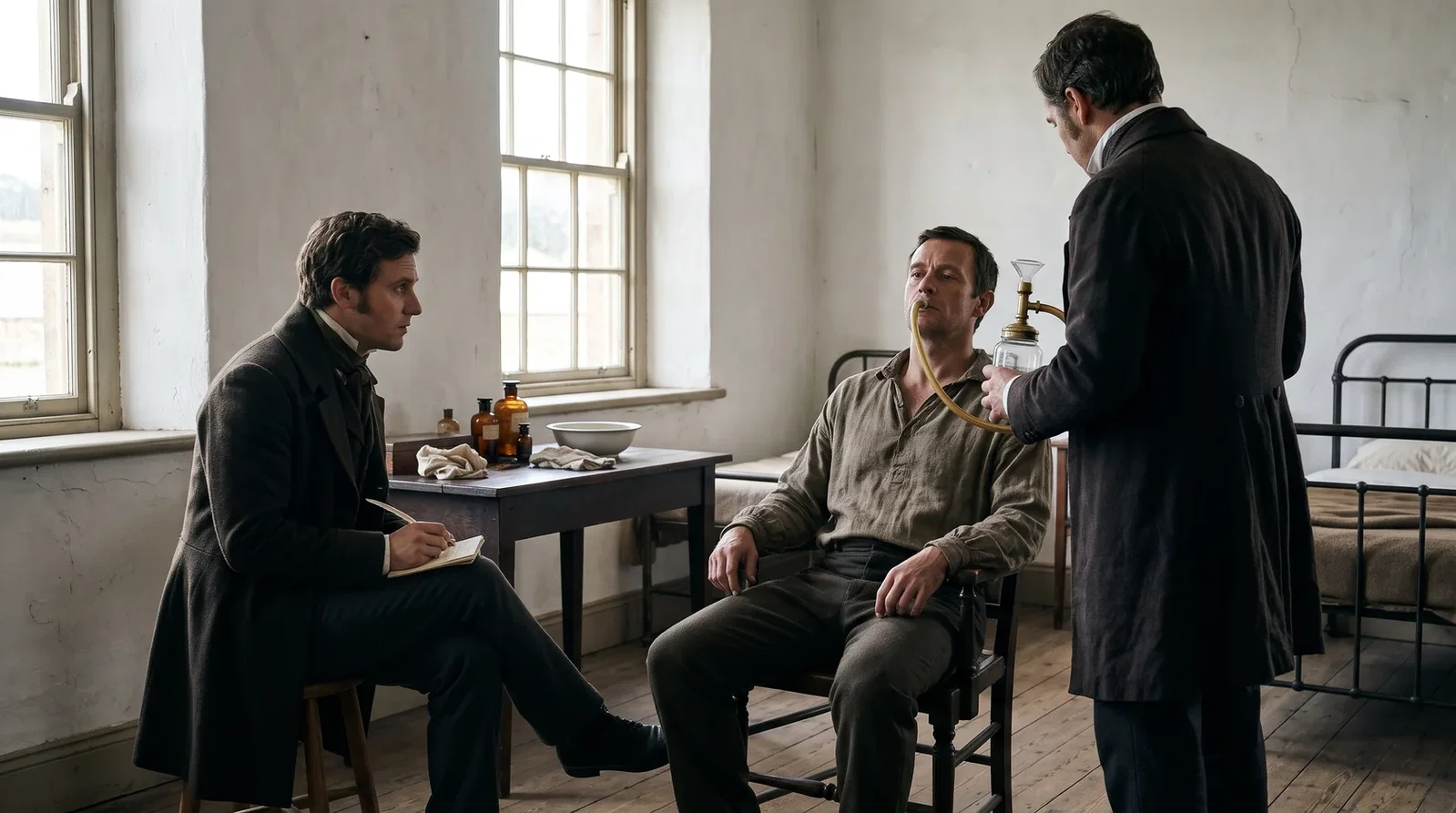
The Launceston Examiner described two operations under ether at St John's Hospital on 7 June 1847; Hobart and Sydney papers reprinted or matched it within a fortnight.
Reading Library · Anesthesia Epochs · 中文版
Watch the education video (for clinicians)
1847: How Ether News Reached the Australian Colonies · Anesthesia Epochs Education Series
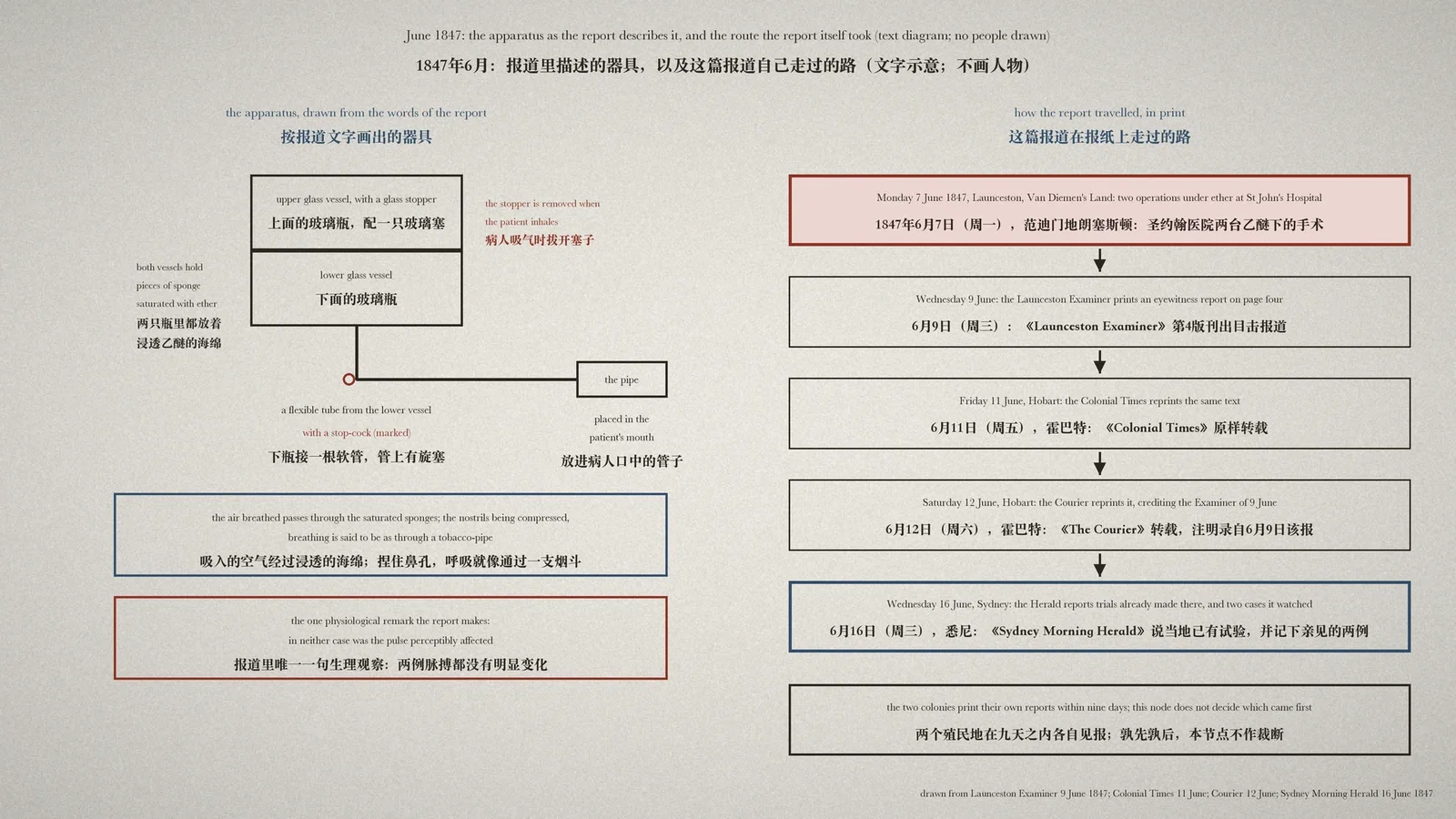
Histories of anaesthesia usually travel by way of journals and letters. In Australia in 1847 the record is a newspaper record. What survives of the first months of ether at the far end of the world is what reporters wrote for the general reader, and the dates on which other papers reprinted it. This article reads four of those pages: the Launceston paper that first described two operations under ether, the two Hobart papers that reprinted it within three days, and the Sydney paper that, in the same fortnight, printed an account of its own. [1, p. 4][2][3][4]
A hospital report, written by someone standing in the room
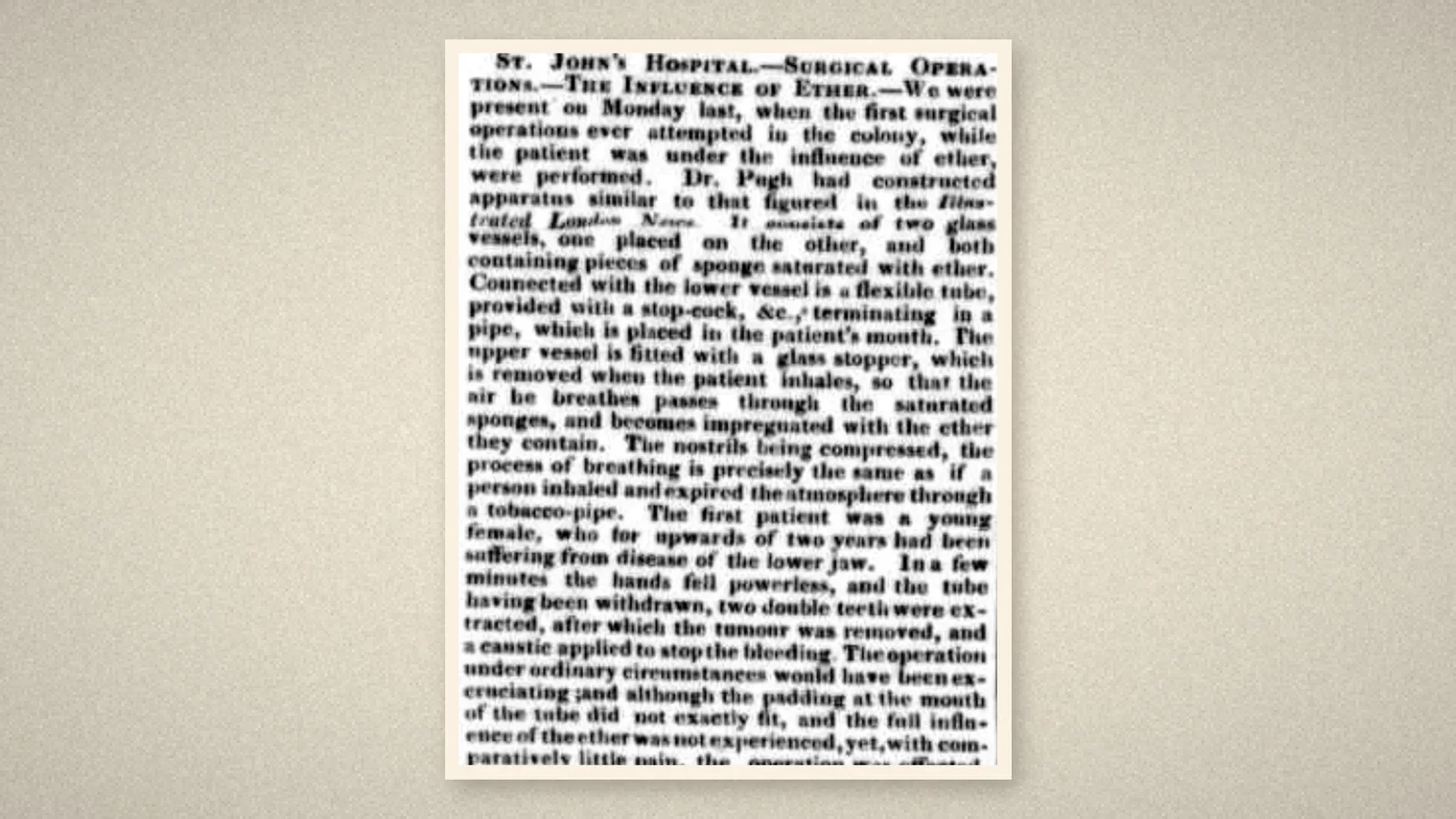
The Launceston Examiner of Wednesday 9 June 1847 carried, on its fourth page, a paragraph headed "St. John's Hospital.—Surgical Operations.—The Influence of Ether". The writer begins in the room: "We were present on Monday last" — that is, on 7 June — when operations were performed with the patient under ether. [1, p. 4][3]
The paper says that Dr Pugh "had constructed" the apparatus used, and that it was built "similar to that figured in" a London illustrated paper. [1, p. 4] The description that follows is the kind of description a newspaper gives: not a drawing, not a specification, but enough words to picture the thing. Two glass vessels, one standing on the other, both holding pieces of sponge soaked in ether; from the lower vessel a flexible tube with a stop-cock, ending in a pipe that is "placed in the patient's mouth"; the upper vessel closed with a glass stopper that is lifted when the patient breathes in, so that the air drawn down passes through the soaked sponges. With the nostrils held shut, the report says, breathing is as it would be through a tobacco-pipe. [2][3]
Two patients
The first was a young woman who had been ill in the lower jaw for more than two years. The patient's hand fell slack; the tube was taken away; two teeth were removed and then the growth, and bleeding was stopped. [3] What the paper says next is the part worth pausing over. The operation would ordinarily have been agonising; the padding at the mouth of the tube had not fitted exactly, so the full effect was not reached; and yet it was done with comparatively little pain. Then the patient's own words are reported: the patient "described herself as falling asleep", and said the pain "was not near so great as" had been expected. The patient walked home. [3]
The second patient was a man with "cataract in both eyes". [2] While the patient was insensible, the motionless hand was pinched without any sign of feeling. A knife and then a hook were used on the eye. On coming round the patient was asked about pain, and the exchange is printed as dialogue: some was only now beginning to be felt; yes, the operation had been felt; no, it had not been painful. [3]
The report ends with the one physiological observation in the whole account — in neither case "was the pulse perceptibly affected" — and with the names: Pugh was "assisted by Dr. Benison in the performance" of the operations, and those present "expressed themselves highly gratified with the result". The writer's own conclusion is that the recent discovery "will save an incalculable amount of pain to the human family". [3]
How fast it moved
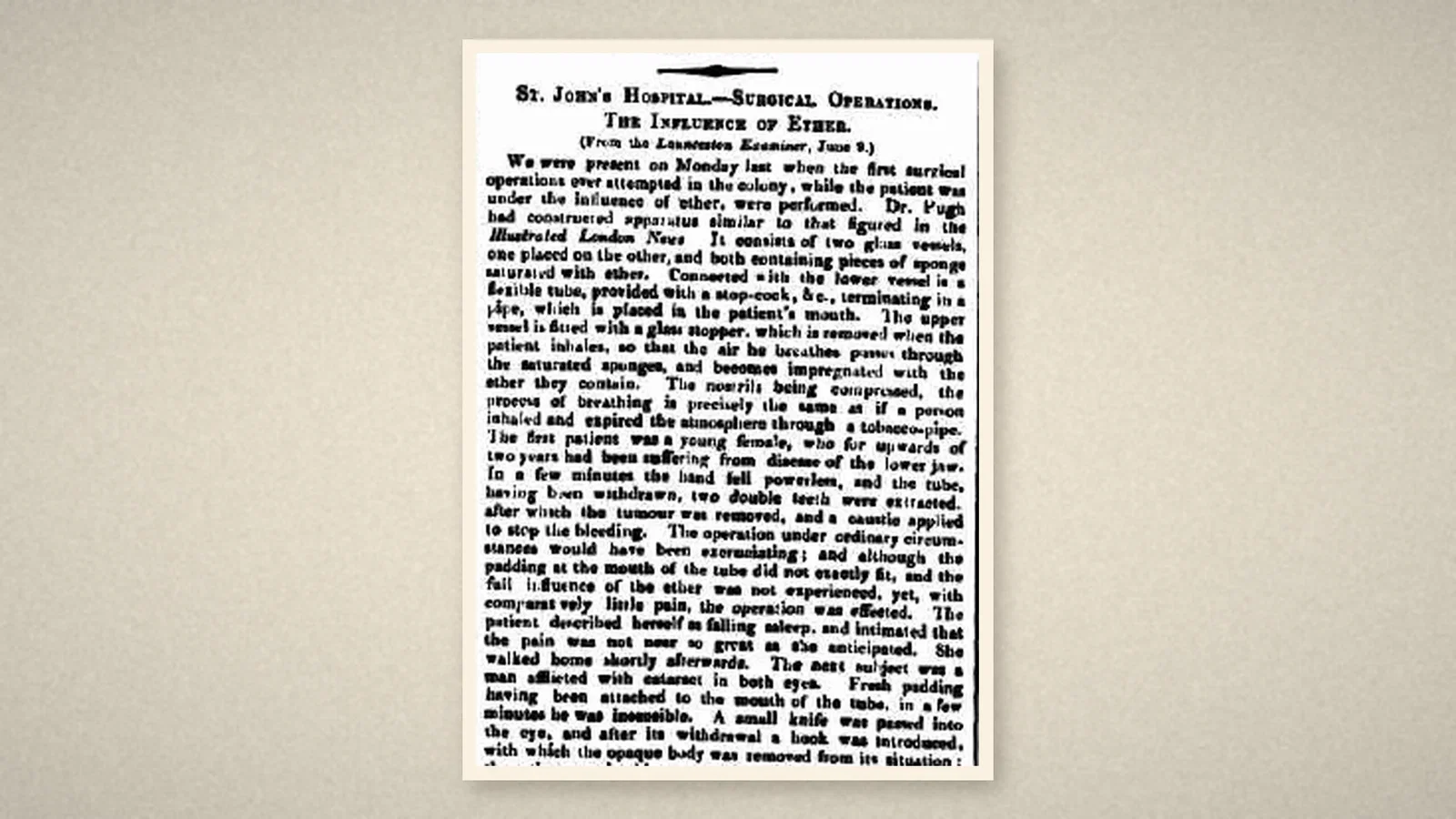
Two days after the Launceston paper, on Friday 11 June, the Colonial Times in Hobart printed the same text. [2] On Saturday, 12 June, The Courier, also of Hobart, printed it again — and, unlike its neighbour, said where it came from, setting under the heading the line "(From the Launceston Examiner, June 9.)". [3] That single line of small type is the most useful thing on the page for anyone trying to trace how the account travelled. Without it the three printings would look like three reports; with it they are one report, moving.
Sydney, in the same fortnight
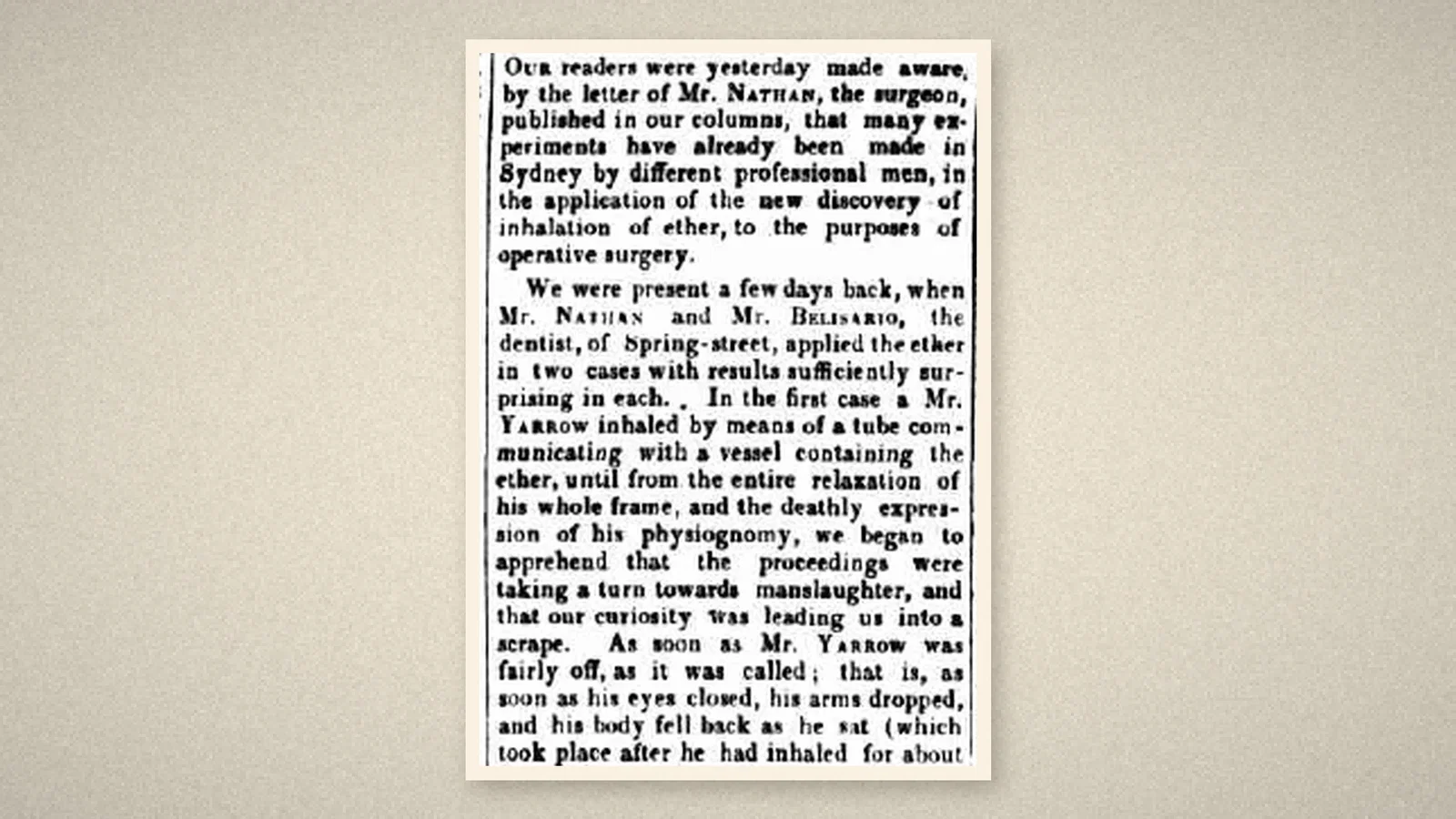
On Wednesday 16 June the Sydney Morning Herald opened a paragraph by reminding readers of a "letter of Mr. NATHAN, the surgeon," published in its own columns the day before, which had told them that trials "have already been made in" Sydney by a number of practitioners, in "the application of the new discovery" of ether inhalation to "operative surgery". [4] There is no sign in this paragraph of the Launceston report, and no sign in the Tasmanian papers of Sydney. The two colonies were reading their own newspapers.
The Herald's writer then describes two cases the writer watched, given by Mr Nathan together with Mr Belisario, "dentist, of Spring-street". [4] The passage is remarkable for its candour. The first patient inhaled "until from the entire relaxation of" the whole frame "and the deathly" expression of the face the onlookers began to fear that the proceedings were turning towards manslaughter and that their curiosity was leading them into a scrape. [4] A few minutes later the same man "up, rubbed his eyes, and smiled". [4]
What this article keeps, and what it refuses to settle
Three things are worth taking from these four pages. The first is how ether reached the colonies at all: not through a society or a journal, but through a picture in an illustrated paper, copied by a doctor into glassware and tubing, and through reporters who stood in the room and wrote it up for everyone. The second is the tone. These are not cautious clinical communications; they are enthusiastic, and in Sydney frightened, and they print the patient's own sentences alongside the writer's.
The third is a boundary. Both colonies' papers describe operations in the same June, the Launceston report calling its two the first such "operations ever attempted" in that colony [1, p. 4], the Sydney paper saying that trials there had already been made by several men [4]. Neither paper knew what the other was printing, and neither is evidence about the other. This article does not decide which came first, and nothing here should be read as deciding it.
Sources and reading limits
Read: four whole newspaper pages from Trove (National Library of Australia) — the Launceston Examiner of 9 June 1847, p. 4; the Colonial Times (Hobart) of 11 June 1847; The Courier (Hobart) of 12 June 1847; and The Sydney Morning Herald of 16 June 1847. The Courier's impression is the cleanest of the three Tasmanian printings and quotations mostly follow it, compared with the Examiner's own page as the original.
Not covered: anything Pugh wrote; the issue of the illustrated London paper whose engraving the apparatus was said to copy; Mr Nathan's letter, which the Herald of 16 June refers to as having appeared the day before; and any hospital or official record of either set of operations.
Limits: these are newspapers, not case reports, and this article treats them as such. No inhaled strengths, quantities or timings are reproduced, the two Launceston patients and the Sydney patients are described only as the papers describe them, and the surname of Pugh's assistant is given as the Courier prints it, "Benison", which other printings of the same report spell differently. Where a paper says something was a first, that is reported as the paper's wording. The question of priority between the colonies is outside what these four pages can settle.
Three of the four illustrations are crops of the original page images (Launceston Examiner, 9 June 1847, p. 4; The Courier, 12 June 1847; Sydney Morning Herald, 16 June 1847). The fourth is a diagram drawn from the four texts, with no people drawn and no clinical values shown.
- St. John's Hospital.—Surgical Operations.—The Influence of Ether. Launceston Examiner (Launceston, Tas.), 9 June 1847, p. 4. trove.nla.gov.au/newspaper/article/36252255
- St. John's Hospital.—Surgical Operations.—The Influence of Ether. Colonial Times (Hobart, Tas.), 11 June 1847. trove.nla.gov.au/newspaper/article/8760772
- St. John's Hospital.—Surgical Operations. The Influence of Ether. (From the Launceston Examiner, June 9.) The Courier (Hobart, Tas.), 12 June 1847. trove.nla.gov.au/newspaper/article/2971672
- [Ether in Sydney: the cases of Mr Nathan and Mr Belisario]. The Sydney Morning Herald, 16 June 1847. trove.nla.gov.au/newspaper/article/12897244
Continue exploring
Related reading connects shared questions and contexts; it does not by itself establish historical influence.
- 1847: Atherstone Amputates a Thigh Under Ether in Grahamstown
- 1847: Ether in Wellington, After the Third Incision
Anesthesia Epochs · The Source Room · About & Editorial Method
Published November 5, 2026. Sources and reading limits are stated above. Illustrations are labelled as original source images or AI-made. Historical accounts are educational; they are not current treatment instructions.
Continue this reading route
Stop 1 of 3 · Back to route · How anesthesia became local practice
Next · 1954: Japan's Anesthesia Society Is Founded and Holds Its Opening Meeting
The Hobart reprint names its source. The Japanese case turns to different records: a decision to organize a society and the date its members first assembled.