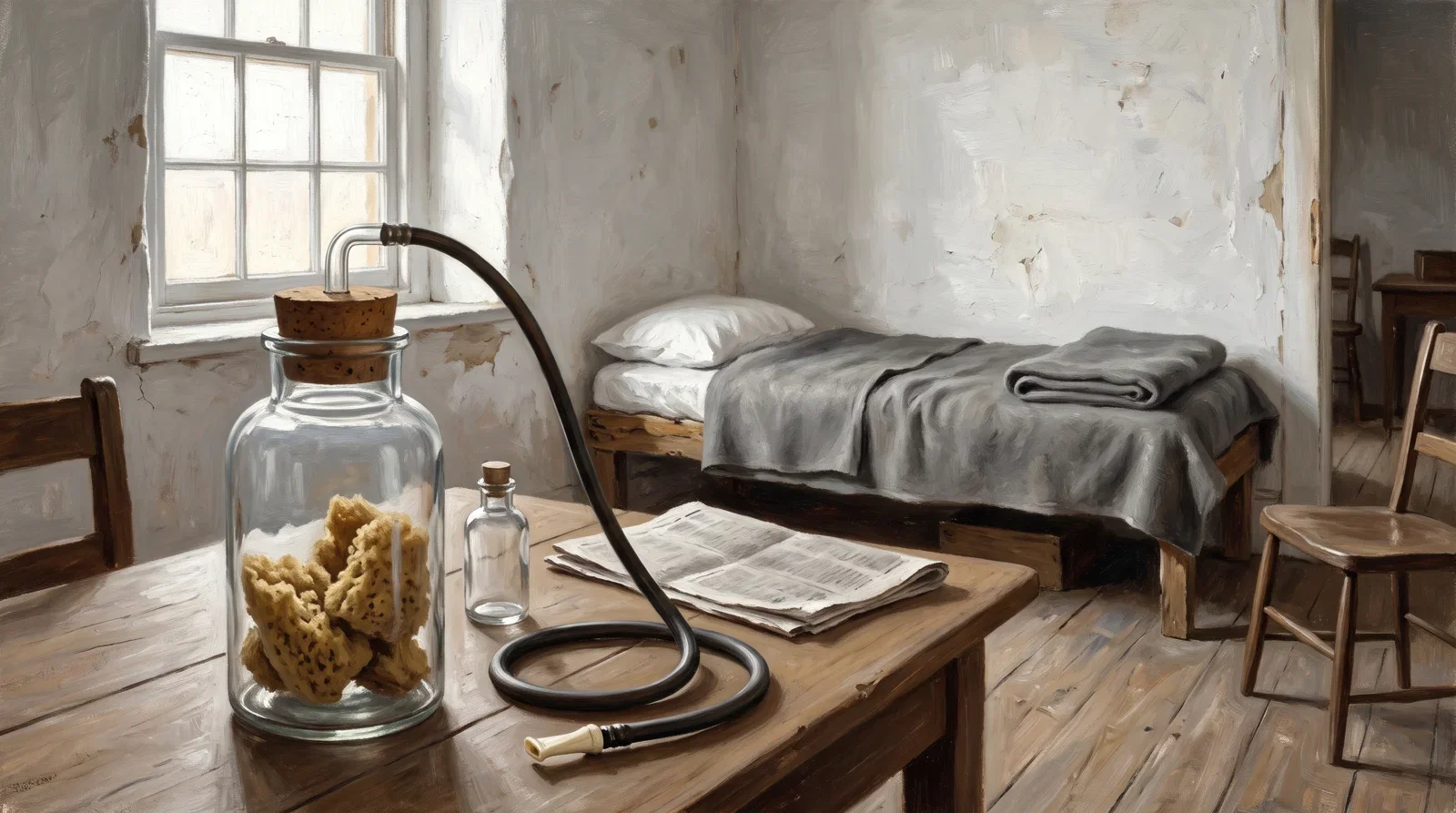
The Grahamstown Journal printed Atherstone's own report of a thigh amputation on a patient who inhaled ether from a wide-mouthed bottle.
Reading Library · Anesthesia Epochs · 中文版
Watch the education video (for clinicians)
1847: Atherstone's Ether Amputation — Grahamstown · Anesthesia Epochs Education Series
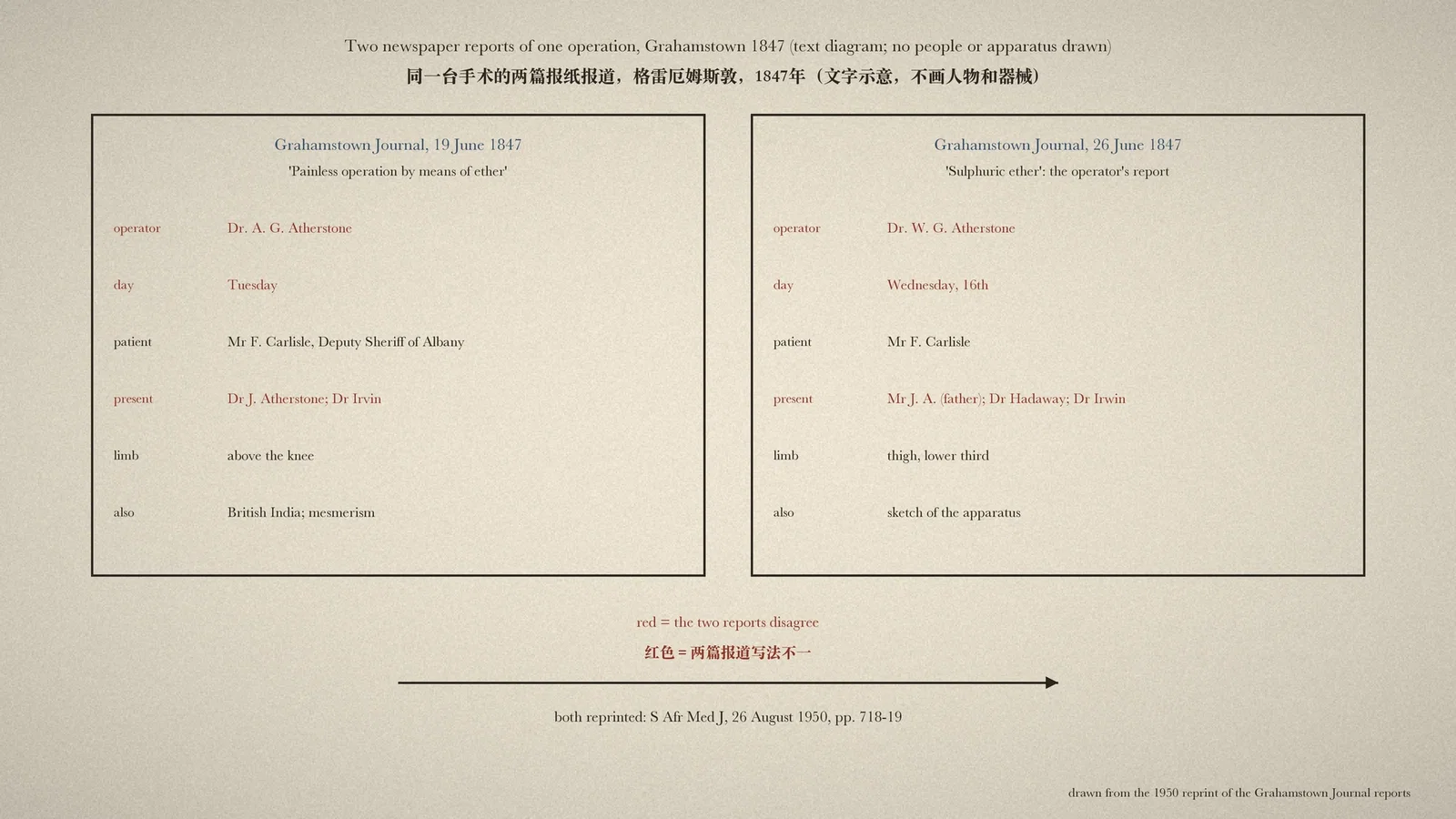
In June 1847 the news of ether from Boston reached Grahamstown, a small town in the east of the Cape Colony. A local doctor amputated a thigh under ether, and the town paper reported it twice, a week apart; the second report was the operator's own account. More than a century later both reports were reprinted in the South African Medical Journal. That reprint is what this article reads. [1, p. 718]
The reprint
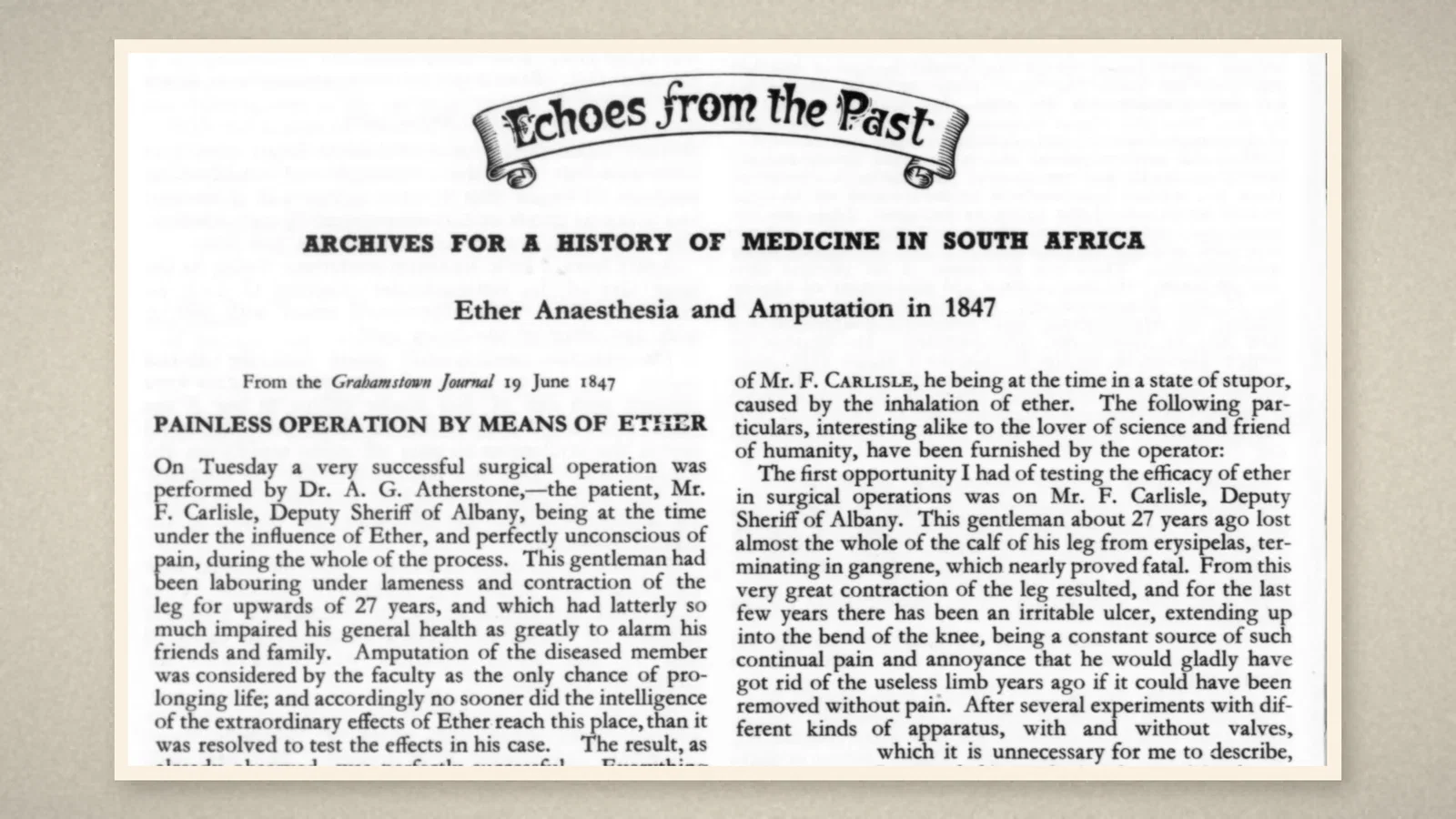
On 26 August 1950 the South African Medical Journal, under the banner "Echoes from the Past" and the heading "Archives for a history of medicine in South Africa", printed "Ether anaesthesia and amputation in 1847", reproducing two pieces from the Grahamstown Journal of 19 June and 26 June 1847. [1, p. 718]
The first report: 19 June
The first piece is headed "Painless operation by means of ether". "On Tuesday", it says, a very successful operation was performed by Dr A. G. Atherstone. The patient, Mr F. Carlisle, Deputy Sheriff of Albany, was under the influence of ether and "perfectly unconscious of pain, during the whole of the process". The leg had been lame and contracted for upwards of twenty-seven years and had lately undermined the patient's health so much as to alarm friends and family. The faculty considered amputation the only chance of prolonging life, and as soon as news of ether reached the town it was decided to test it in this case. [1, p. 718]
On Tuesday morning, the report goes on, the patient was quickly thrown into a state of stupor, partly aware of what was going on but with the sense of pain entirely absent. The limb was amputated in the presence of Dr J. Atherstone and Dr Irvin, described as "medical staff", "without the smallest indication of suffering". The paper added that, according to recent papers, the same process had been introduced into medical practice in British India, where mesmerism had earlier attracted attention. [1, p. 718]
The second report: the operator's account
A week later, on 26 June, the Grahamstown Journal kept its promise under the heading "Sulphuric ether" and printed particulars furnished by the operator. This time the operator is named as "Dr. W. G. Atherstone". [1, p. 718]
The operator explains that about twenty-seven years earlier the patient had nearly died of erysipelas ending in gangrene, losing almost the whole of the calf; the leg then contracted badly, and for some years an irritable ulcer had extended into the bend of the knee, a constant source of pain. The patient would gladly have parted with the useless limb if it could have been removed without pain. After experiments with several kinds of apparatus, with and without valves, the operator produced the needed insensibility "by means of a simple contrivance", shown in a sketch. [1, p. 718]
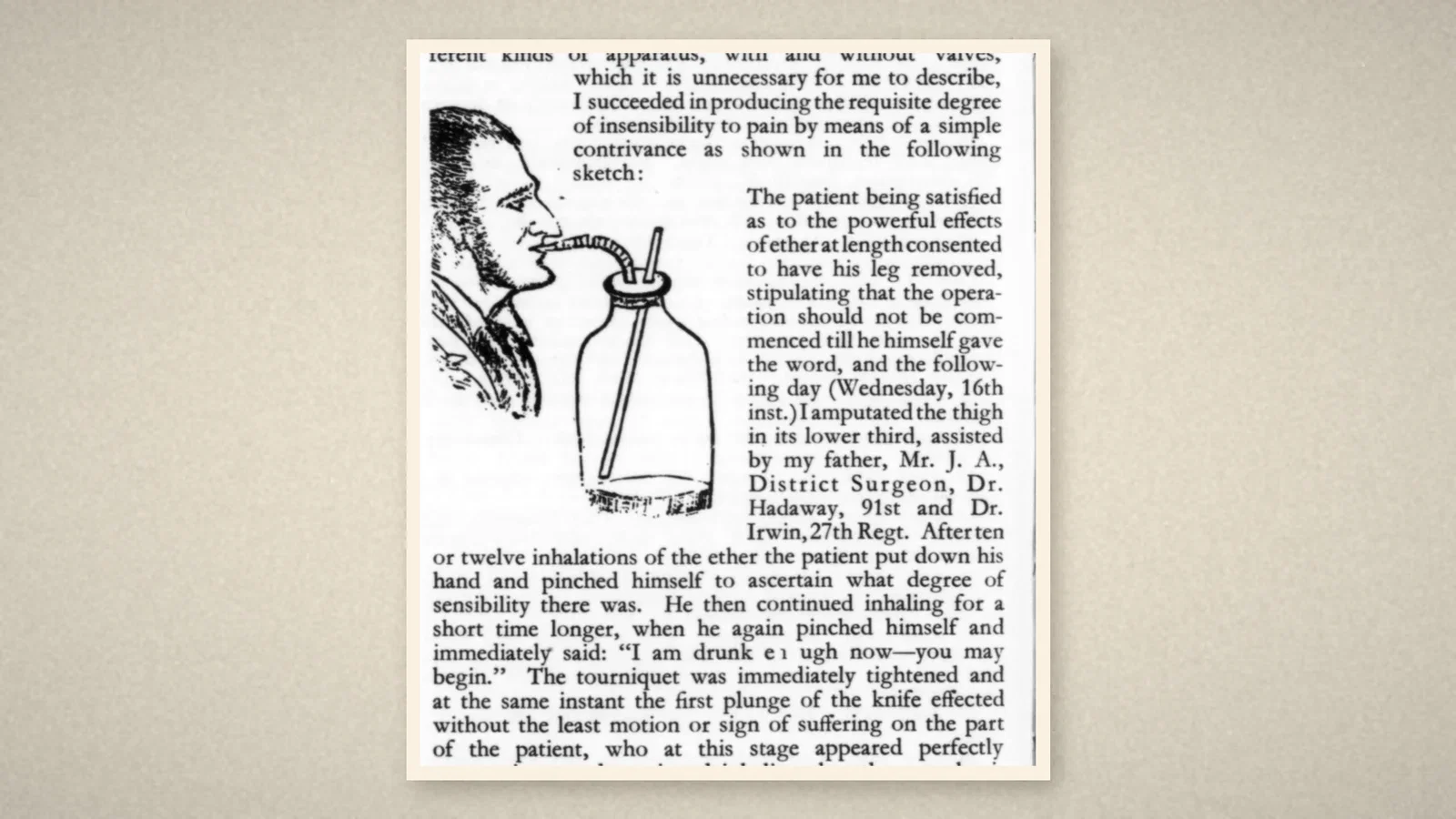
Satisfied of the effects of ether, the patient consented to the amputation on one condition: it was not to begin until the patient gave the word. On "the following day (Wednesday, 16th inst.)" the thigh was amputated in its lower third, with the operator's father, Mr J. A., district surgeon, Dr Hadaway, and Dr Irwin of the 27th Regiment assisting. [1, p. 718]
"You may begin"
After ten or twelve inhalations the patient put a hand down and pinched to test what sensibility was left, inhaled a little longer, pinched again, and said at once: "I am drunk enough now—you may begin." The tourniquet was tightened and the first incision made "without the least motion or sign of suffering". [1, p. 718]
Dr Irwin, who had been holding the patient's arm, found no resistance and let go; so did an assistant holding the leg. For the rest of the operation the patient lay still. At the division of the large nerves and vessels came an involuntary shriek, but no movement and no other sign of pain. [1, p. 719]
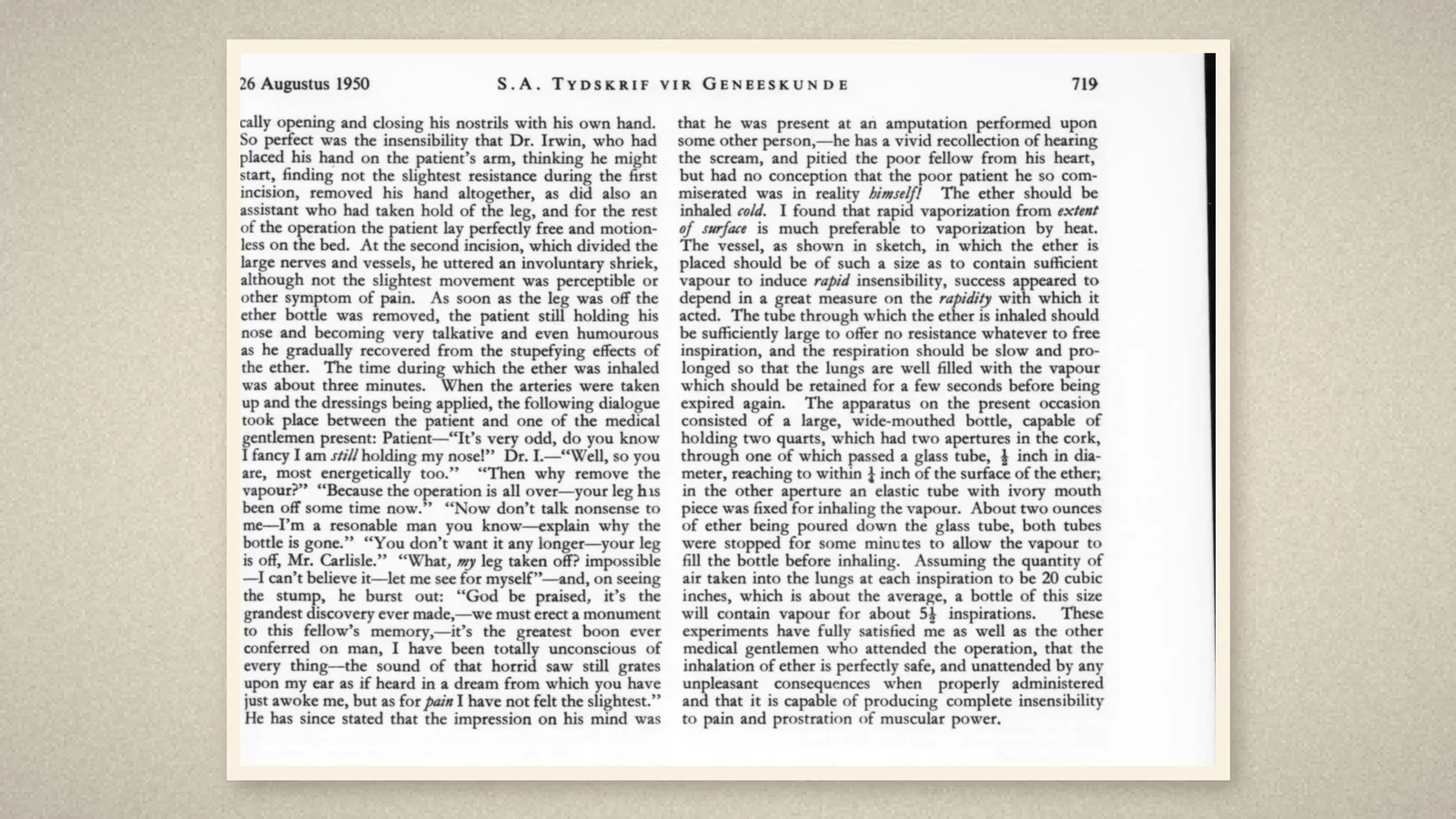
As soon as the leg was off, the ether bottle was taken away. The ether had been inhaled for about three minutes, the operator records. The patient came round talkative and even humorous: while the dressings were applied, the patient remarked on still seeming to hold the nose, would not believe the leg was off, and on seeing the stump burst out: "God be praised, it's the grandest discovery ever made." Later the patient said that the sound of the saw had come as if in a dream, "but as for pain I have not felt the slightest". [1, p. 719]
The operator's conclusions
The report ends with lessons. Ether should be "inhaled cold"; quick vaporisation from a large surface works better than vaporisation by heat. The vessel should be large enough to hold sufficient vapour, and the tube wide enough "to offer no resistance whatever to free inspiration". The apparatus was a large wide-mouthed bottle with two holes in the cork, a glass tube through one and an elastic tube with an ivory mouthpiece through the other. The experiments, the operator wrote, had satisfied the operator and the other medical men present that inhaling ether was "perfectly safe" when properly given, and could produce complete insensibility to pain and relaxation of the muscles. [1, p. 719]
What the record shows
How news became an operation within months: in a colonial town far from Boston and London, a doctor tested apparatus, wrote up the case personally, and the patient set a condition and gave the order to start. The newspaper printed all of it, and the record keeps its own inconsistencies.
Sources and reading limits
Read: "Ether anaesthesia and amputation in 1847", South African Medical Journal 26 August 1950;24:718-19, in full, including the reprinted Grahamstown Journal reports of 19 and 26 June 1847 and the operator's sketch.
Not covered: the original 1847 issues of the Grahamstown Journal; later historical articles on this operation; Atherstone's own papers.
Limits: this is a 1950 reprint, not the 1847 newspaper itself. The two reports disagree: the first gives "A. G. Atherstone" and "Tuesday", the operator's report "W. G. Atherstone" and "Wednesday, 16th"; the Dr Irvin of the first report is Dr Irwin in the second. The patient's later course is not reported beyond the first days. The patient's words are given as the paper printed them. Ether quantities and apparatus sizes are not repeated.
Three illustrations are crops of the 1950 reprint (two from p. 718, one from p. 719); the sketch is the one printed there. One is a text comparison drawn from the reprint, with no people or apparatus drawn.
- Ether anaesthesia and amputation in 1847 [reprint of Grahamstown Journal, 19 and 26 June 1847]. S Afr Med J. 1950;24(34):718-9. Internet Archive
Continue exploring
Related reading connects shared questions and contexts; it does not by itself establish historical influence.
- 1846: Fisher's Ether Fails in Paris Before a Boston Inhaler Succeeds
- 1846: Morton Extracts a Tooth for Eben Frost Under an Ether Preparation
- 1846: Squire Assembles an Ether Inhaler for Liston's Thigh Amputation
Anesthesia Epochs · The Source Room · About & Editorial Method
Published November 3, 2026. Sources and reading limits are stated above. Illustrations are labelled as original source images or AI-made. Historical accounts are educational; they are not current treatment instructions.