
Pirogoff wrote from St Petersburg to the Paris Academy proposing rectal ether vapour for surgery, while animal reports that year disagreed about its safety.
Reading Library · Anesthesia Epochs · 中文版
Watch the education video (for clinicians)
1847: Pirogoff's Rectal Ether — Three Reports, Five Weeks · Anesthesia Epochs Education Series
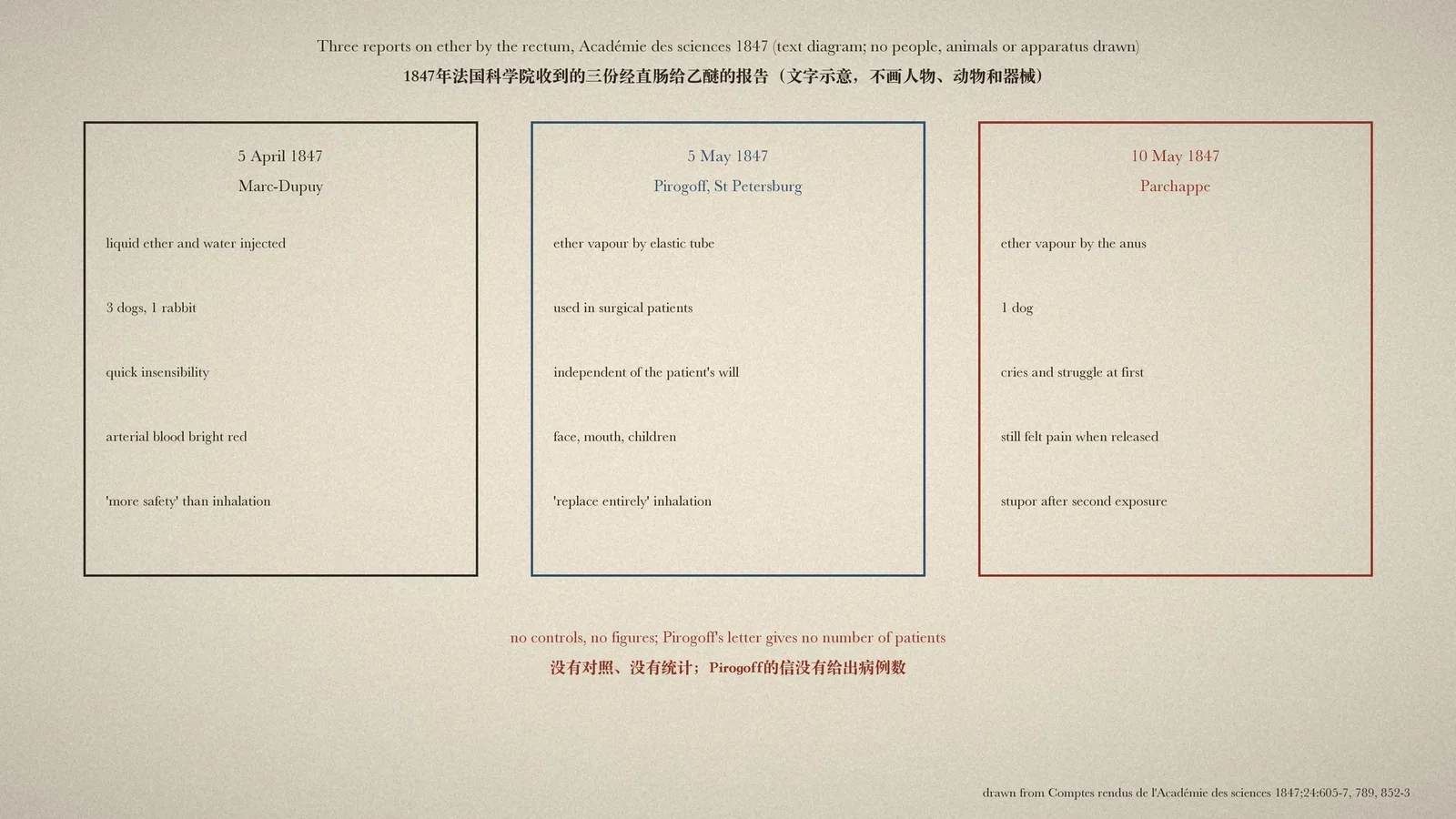
Inhaled ether had been in use for only a few months when people began looking for another route: not the lungs but the rectum. In the spring of 1847 the Paris Academy of Sciences received three such reports within five weeks, one from a surgical professor in St Petersburg and two from animal experiments in Paris. Their conclusions did not agree, and what supported them was a handful of animals and an unstated number of patients. [1, p. 605][2, p. 789][3, p. 852]
5 April: Marc-Dupuy's dogs and rabbit
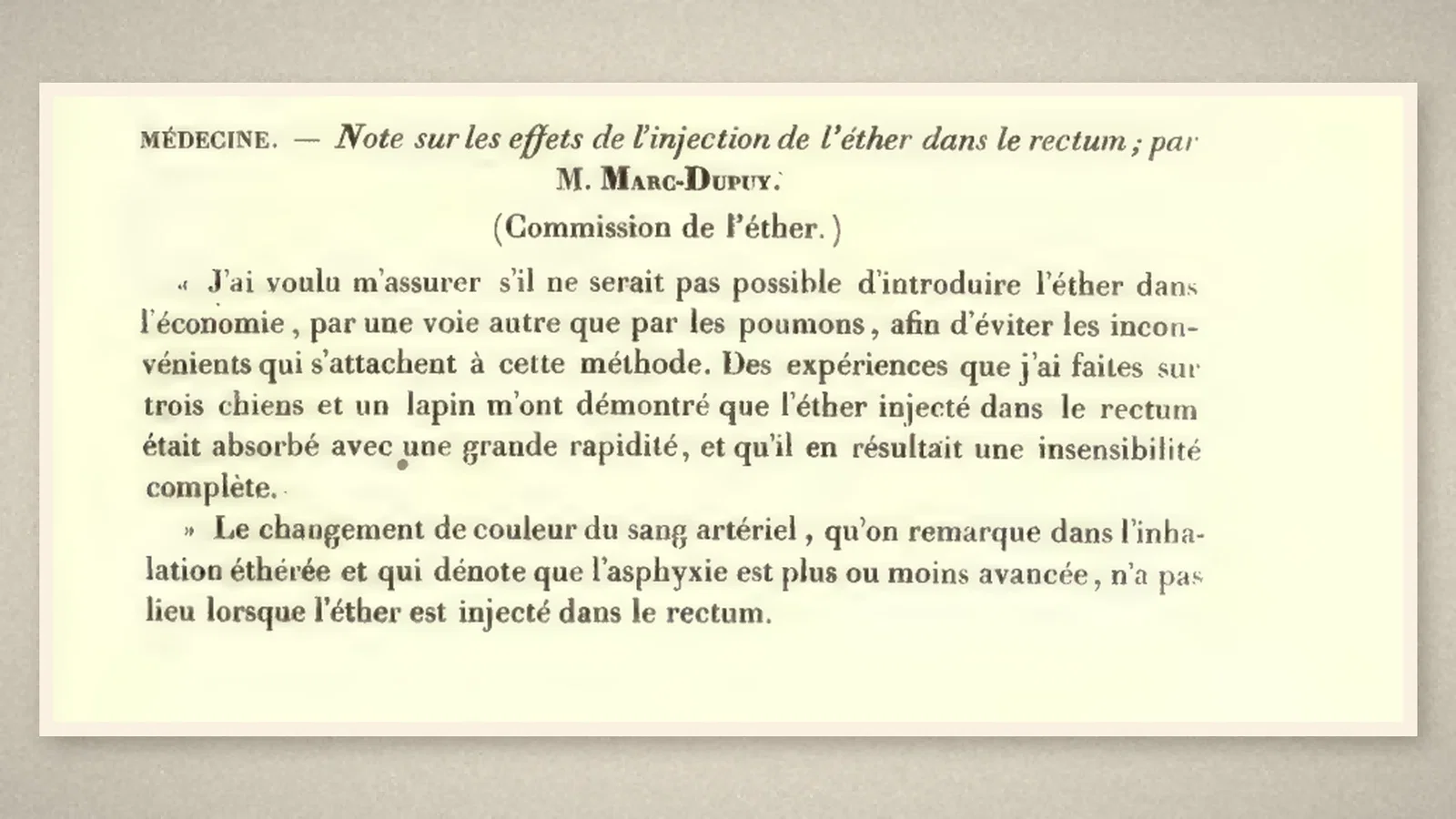
At the sitting of 5 April 1847 Marc-Dupuy presented a "Note on the effects of injecting ether into the rectum". The aim, the author wrote, was to see whether ether could enter the body by a route other than the lungs, to avoid the drawbacks of inhalation. In three dogs and a rabbit a mixture of ether and water was injected into the rectum; the ether was absorbed very quickly and the animals became completely insensible. [1, p. 605]
A small dog was drunk within a few minutes and showed no pain when pins were passed through the skin or the skin was cut with a bistoury; after a little over twenty minutes sensation returned, the dog walked steadily, and when offered food it ate with appetite. In the rabbit the femoral arteries were cut and the blood ran bright red; the abdomen was opened and the aorta cut, and the blood was still bright red, the lungs free of congestion. [1, p. 606][1, p. 607]
From this the author argued that insensibility was "by no means" a necessary result of asphyxia, and drew four conclusions: ether injected into the rectum abolishes sensation; it acts as quickly as through the lungs; there is no sign of asphyxia; and the method can be used "with more safety" than breathing ether vapour. Lallemand added that Dupuytren had observed opiates given the same way acting more quickly and strongly than by the stomach. [1, p. 607]
5 May: Pirogoff's letter
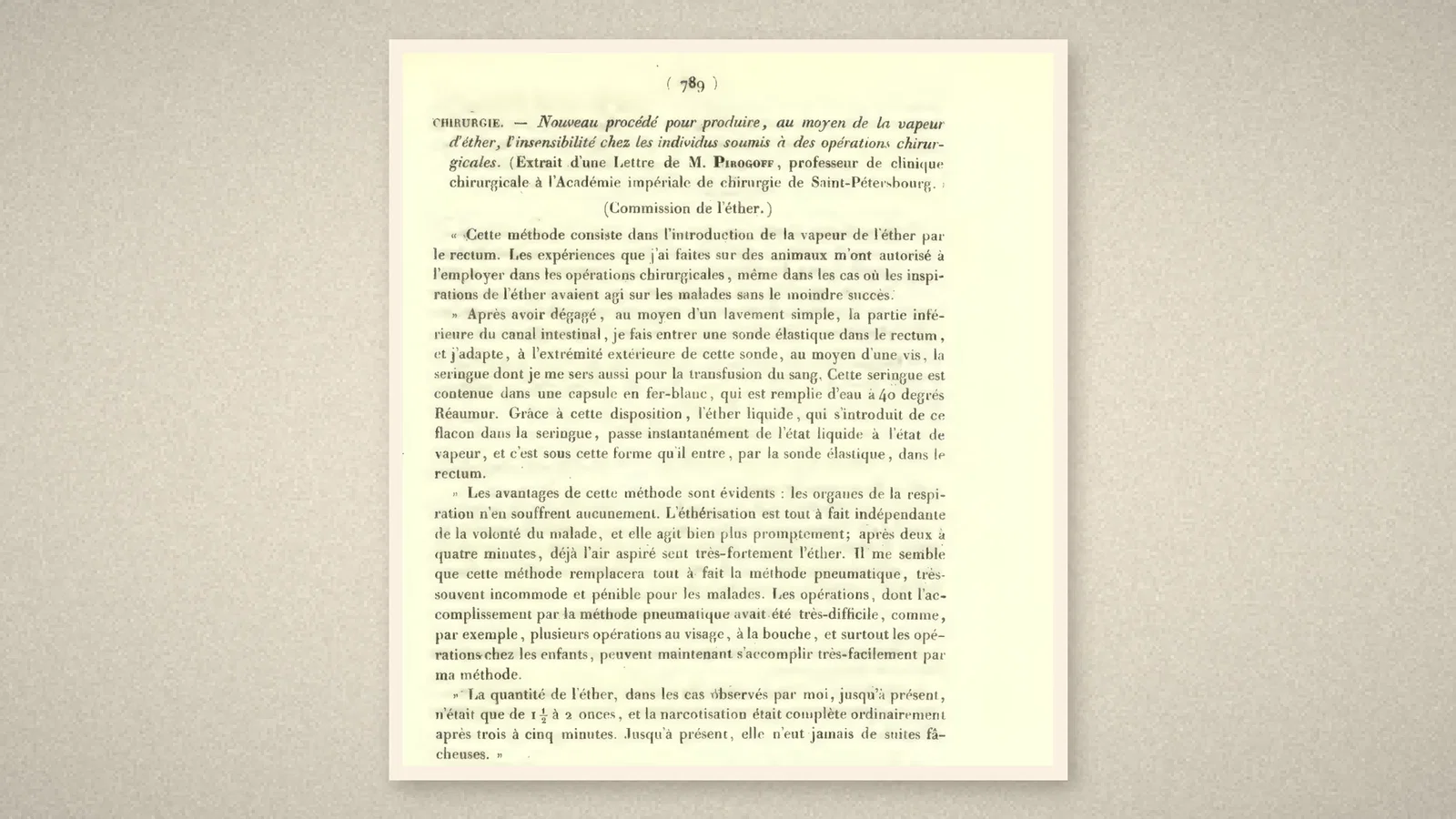
A month later, at the sitting of Wednesday 5 May, an extract from a letter was read under the title "A new procedure for producing insensibility, by means of ether vapour, in persons undergoing surgical operations". The writer, Pirogoff, was professor of clinical surgery at the Imperial Academy of Surgery in St Petersburg. [2, p. 789]
The method, Pirogoff wrote, consisted in introducing ether vapour by the rectum. Experiments on animals had justified its use in surgical operations, even in patients on whom inhaled ether had acted "without the least success". The lower bowel was first emptied with a simple enema; an elastic tube was passed into the rectum and its outer end screwed to a syringe, the same one Pirogoff used for blood transfusion. The syringe sat in a tin case filled with warm water, so that liquid ether turned to vapour as it entered and passed in that form through the tube into the rectum. [2, p. 789]
Pirogoff listed the advantages plainly. The respiratory organs did not suffer at all. Etherization was "wholly independent of the patient's will", and it acted much more quickly; after two to four minutes the patient's breath smelt strongly of ether. Operations that had been very difficult by inhalation, such as several on the face and mouth and above all those on children, could now be done easily. Pirogoff expected the method to "replace entirely" the pneumatic method, and reported that so far it had never had any unfortunate consequences. [2, p. 789]
The printed extract does not say how many patients were treated and mentions no failures.
10 May: Parchappe's dog
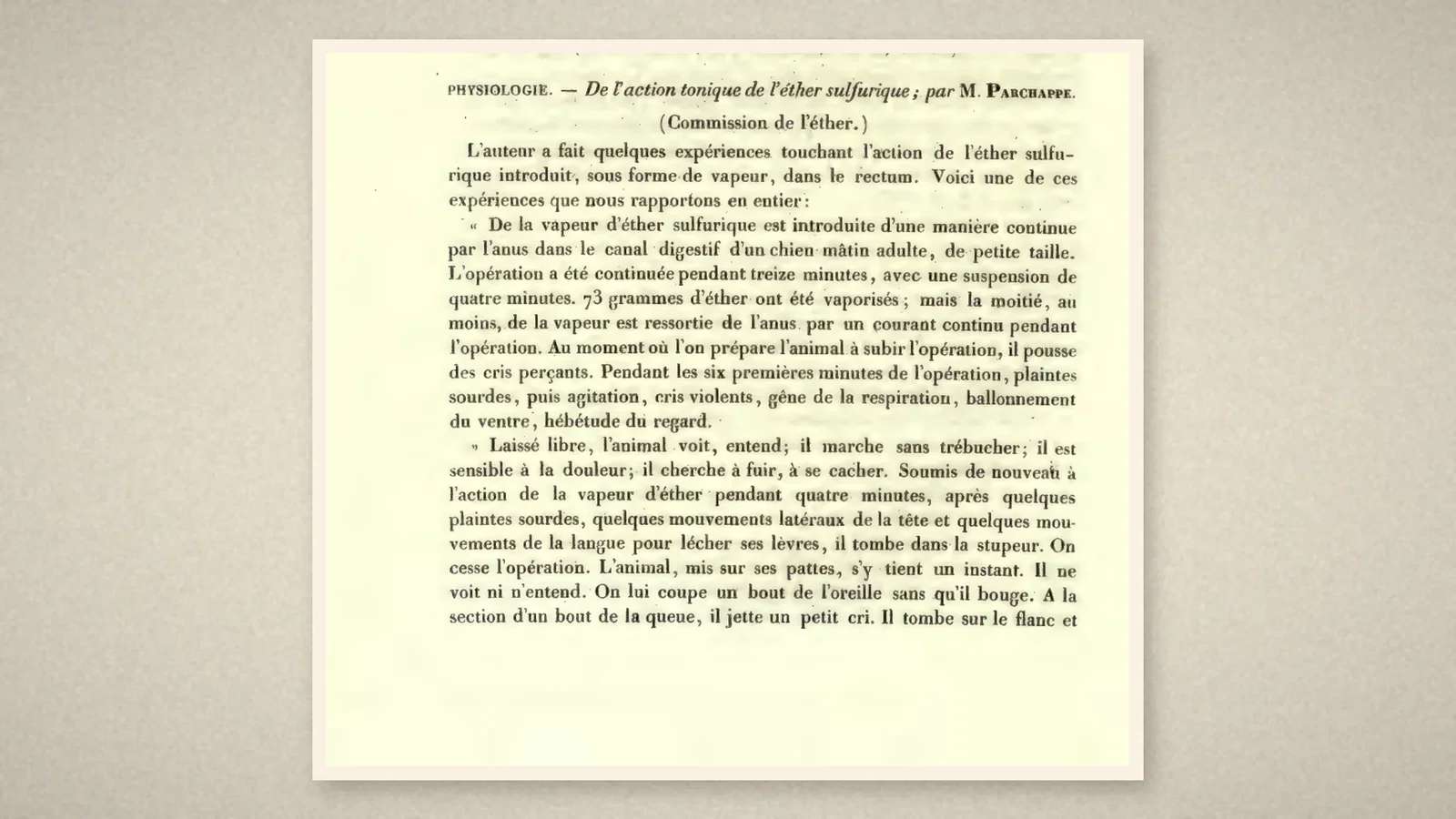
Five days later, at the sitting of 10 May, the record summarized Parchappe's note "On the tonic action of sulphuric ether" and quoted in full one experiment with ether vapour given by the rectum. A small adult dog received ether vapour continuously through the anus, with a pause of a few minutes. It cried out sharply while being prepared; during the first six minutes it moaned, then struggled, cried violently, breathed with difficulty, became bloated and stared dully. [3, p. 852]
Released, the dog could see and hear, walked without stumbling, was still sensitive to pain, and tried to run and hide. Only after a further four minutes of vapour did it fall into stupor; a piece of ear was then cut without movement, and a cut to the tail drew only a small cry. A few minutes later the stupor was deeper and several pieces of tail were cut without cry or movement; breathing was like sleep, the blood from the wounds bright red, and the stupor lasted about half an hour. [3, p. 852][3, p. 853]
What the record shows
Read together, the three reports show what a new method looked like as it first appeared: a surgical professor said it would replace inhalation, one experimenter said it was safer, and another experimenter's dog suffered for several minutes first. None of the three had controls or figures, and the conclusions ran ahead of the evidence.
Sources and reading limits
Read: Marc-Dupuy, "Note sur les effets de l'injection de l'éther dans le rectum", Comptes rendus de l'Académie des sciences 1847;24:605-7 (sitting of 5 April 1847), with Lallemand's remark; the extract of Pirogoff's letter, same volume, p. 789 (sitting of Wednesday 5 May 1847); Parchappe, "De l'action tonique de l'éther sulfurique", same volume, pp. 852-3 (sitting of 10 May 1847), the part on rectal vapour.
Not covered: Pirogoff's 1847 book on etherization and any Russian reports; the full text of Pirogoff's letter, of which the Academy printed only an extract; a Canadian Anesthesiologists' Society article; the later history of rectal ether.
Limits: Pirogoff's letter is an extract that gives no number of patients and reports no failures; Marc-Dupuy's claim of greater safety rests on three dogs and a rabbit; Parchappe's one dog suffered and remained sensitive at first. None of the three has controls. The source prints only "Pirogoff", with no first name, and none is added here. Quantities of ether and water temperatures are not repeated.
Three illustrations are crops of the Comptes rendus, vol. 24 (pp. 605, 789 and 852); one is a text comparison drawn from them, with no people, animals or apparatus drawn.
- Marc-Dupuy. Note sur les effets de l'injection de l'éther dans le rectum. C R Hebd Seances Acad Sci. 1847;24:605-7. Internet Archive
- Pirogoff. Nouveau procédé pour produire, au moyen de la vapeur d'éther, l'insensibilité chez les individus soumis à des opérations chirurgicales. C R Hebd Seances Acad Sci. 1847;24:789. Internet Archive
- Parchappe. De l'action tonique de l'éther sulfurique. C R Hebd Seances Acad Sci. 1847;24:852-3. Internet Archive
Continue exploring
Related reading connects shared questions and contexts; it does not by itself establish historical influence.
- 1847: Flourens Tracks Ether's Action Through the Nervous System
- 1914: Gwathmey and Baskerville Publish Anesthesia
Anesthesia Epochs · The Source Room · About & Editorial Method
Published November 3, 2026. Sources and reading limits are stated above. Illustrations are labelled as original source images or AI-made. Historical accounts are educational; they are not current treatment instructions.