
In dogs, Flourens found ether abolished brain function, then spinal sensation and movement, while the medulla held out last; Flourens also tried chloroform.
Reading Library · Anesthesia Epochs · 中文版
Watch the education video (for clinicians)
1847: Flourens and the Order of the Descent · Anesthesia Epochs Education Series
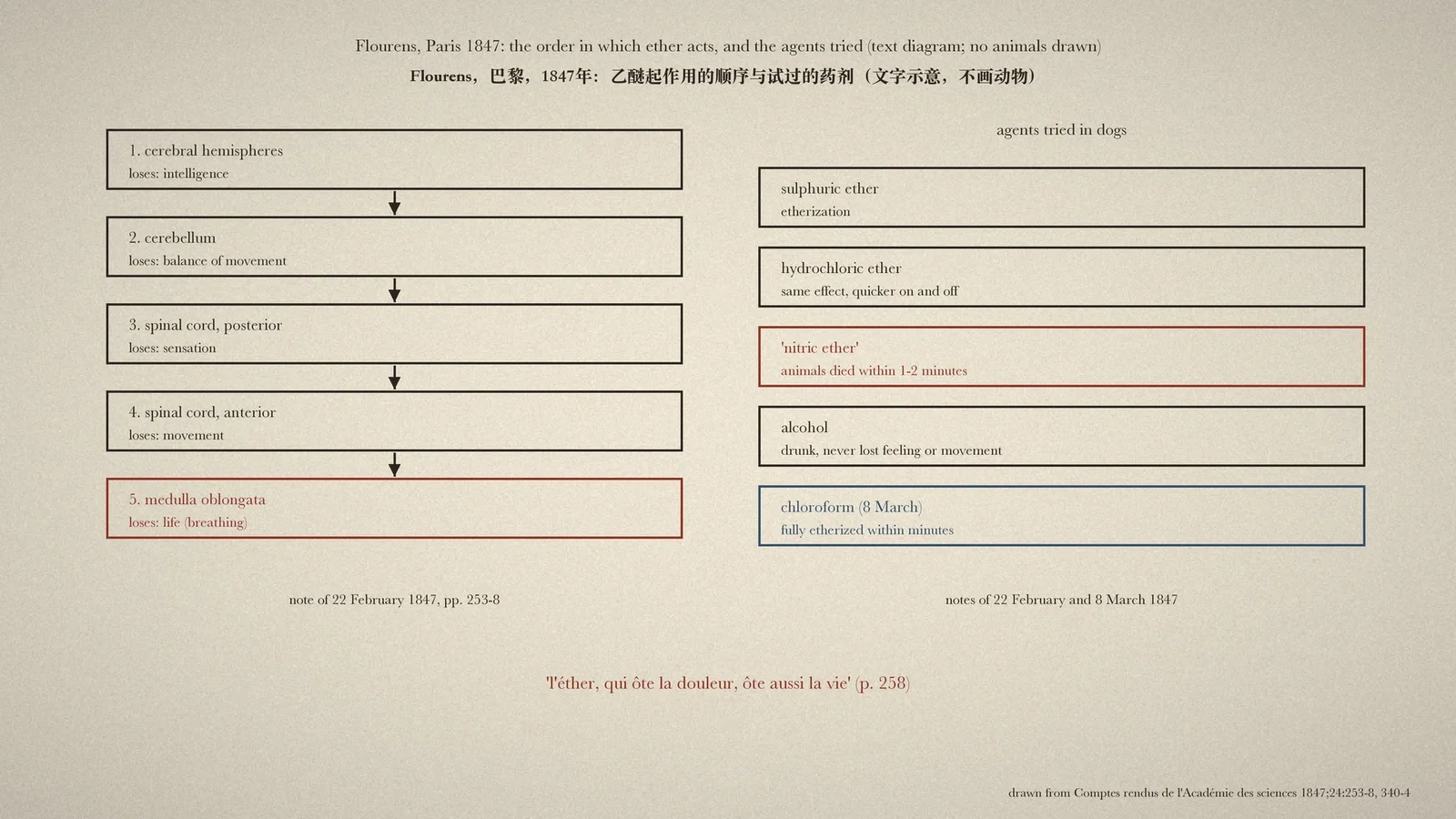
Early in 1847, while ether was only just establishing itself in the operating rooms of Paris, the physiologist Flourens took it into the laboratory. The question was not whether it stopped pain but what it actually did to the nervous system. In two notes read to the Academy of Sciences, Flourens proposed an order, issued a warning, and in passing tried a substance few people had yet noticed: chloroform. [1, p. 253][2, p. 342]
22 February: an order

On Monday 22 February 1847 Flourens read to the Académie des sciences a "Note on the effects of the inhalation of ether on the medulla oblongata". It began from earlier findings: under ether the spinal cord loses sensation and then movement, and "always" loses sensation first. [1, p. 253]
Why, then, was an animal whose cord had lost both still alive and still breathing? Flourens exposed the spinal cord and medulla in dogs to find out. Under ether, pinching and cutting the posterior roots drew no response; after a few more minutes of inhalation, the anterior roots and columns gave no movement either. When the medulla was touched, the dog cried out and the neck muscles contracted. Flourens then cut the medulla at the point called the "vital knot", and the result was the same as in an animal not under ether: all breathing movements stopped at once, and the animal died. [1, p. 255][1, p. 256]
The conclusion was an order. Ether acts in turn on the cerebral hemispheres, the cerebellum, the spinal cord and the medulla, so the animal loses intelligence, then the balance of its movements, then sensation and movement; the medulla holds out last, which is why the animal survives; when the medulla fails, life ends. [1, p. 256]
Other ethers, and alcohol
Flourens then tried other ethers. With two assistants at the Muséum, Aug. Duméril and Philipeaux, hydrochloric ether was tried first: its effect was "absolutely the same" as that of sulphuric ether, with the same loss of sensation in the posterior cord and of movement in the anterior, but it acted much more quickly and wore off much more quickly too. In three trials with "nitric ether" the animal died within one or two minutes. Inhaled alcohol made the animal drunk but never took away sensation or movement. [1, p. 256][1, p. 257]
The note ended with a sentence for surgeons. From now on they must always keep in mind that "ether, which takes away pain, also takes away life", and that the new agent surgery had just acquired was "at once marvellous and terrible". [1, p. 258]
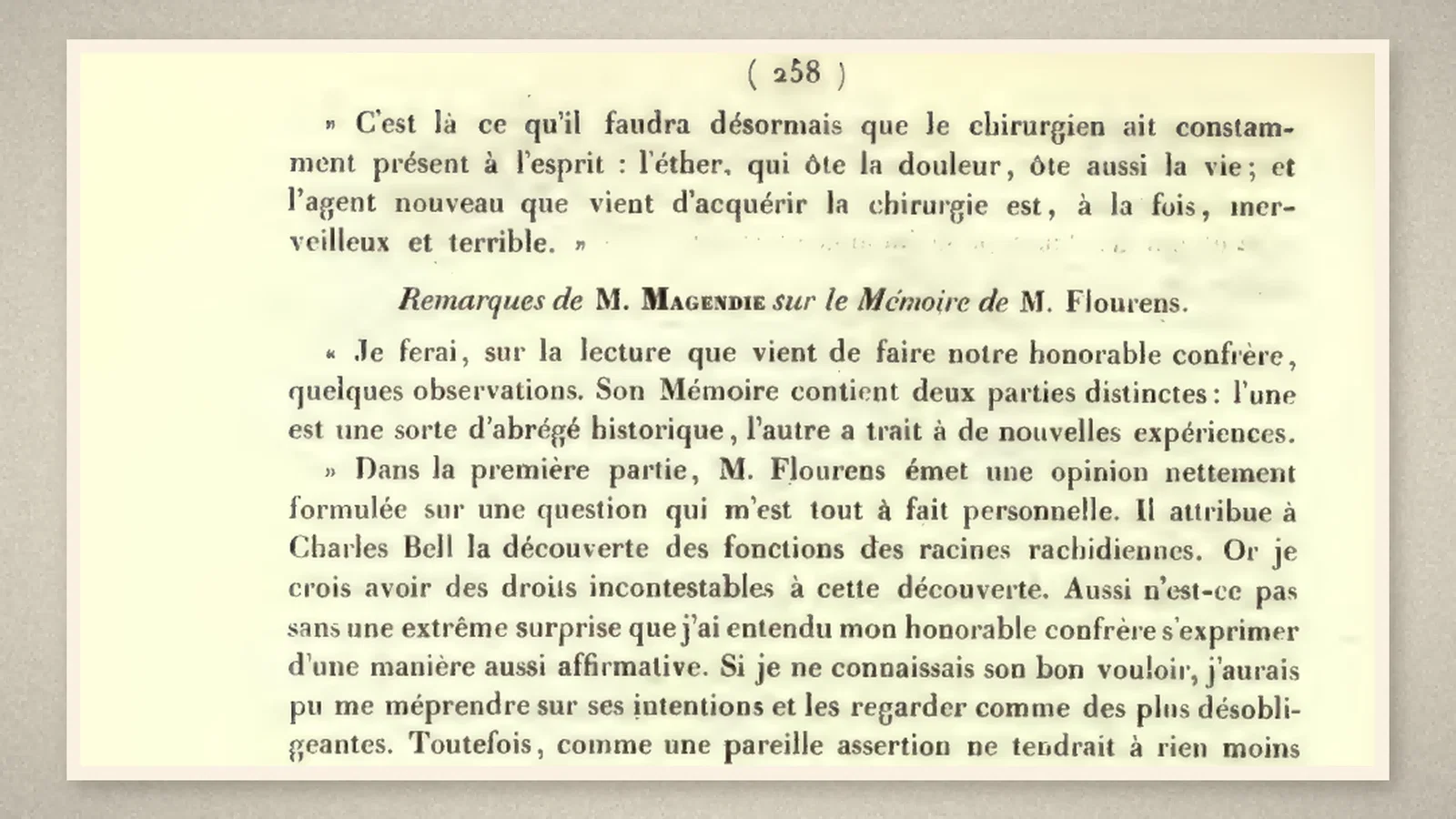
Not all of the discussion was about ether. Magendie objected sharply to the note's attribution of the functions of the spinal roots to Charles Bell, and the two exchanged replies. The chemist Balard commented on the chemical make-up of "nitric ether" and hydrochloric ether. [1, p. 258][1, p. 259]
8 March: chloroform
Two weeks later, on 8 March, Flourens read a "Note on the action of ether on the nerve centres", carrying the experiments through to the death of the animal. A footnote describes the apparatus: a two-necked vessel with a flexible tube carrying inspiratory and expiratory valves, ending in a rubber bottle fitted over the animal's muzzle and held by a steel spring and straps, a modification made by the assistants Aug. Duméril, Philipeaux and Alf. Vulpian. [2, p. 340][2, p. 341]
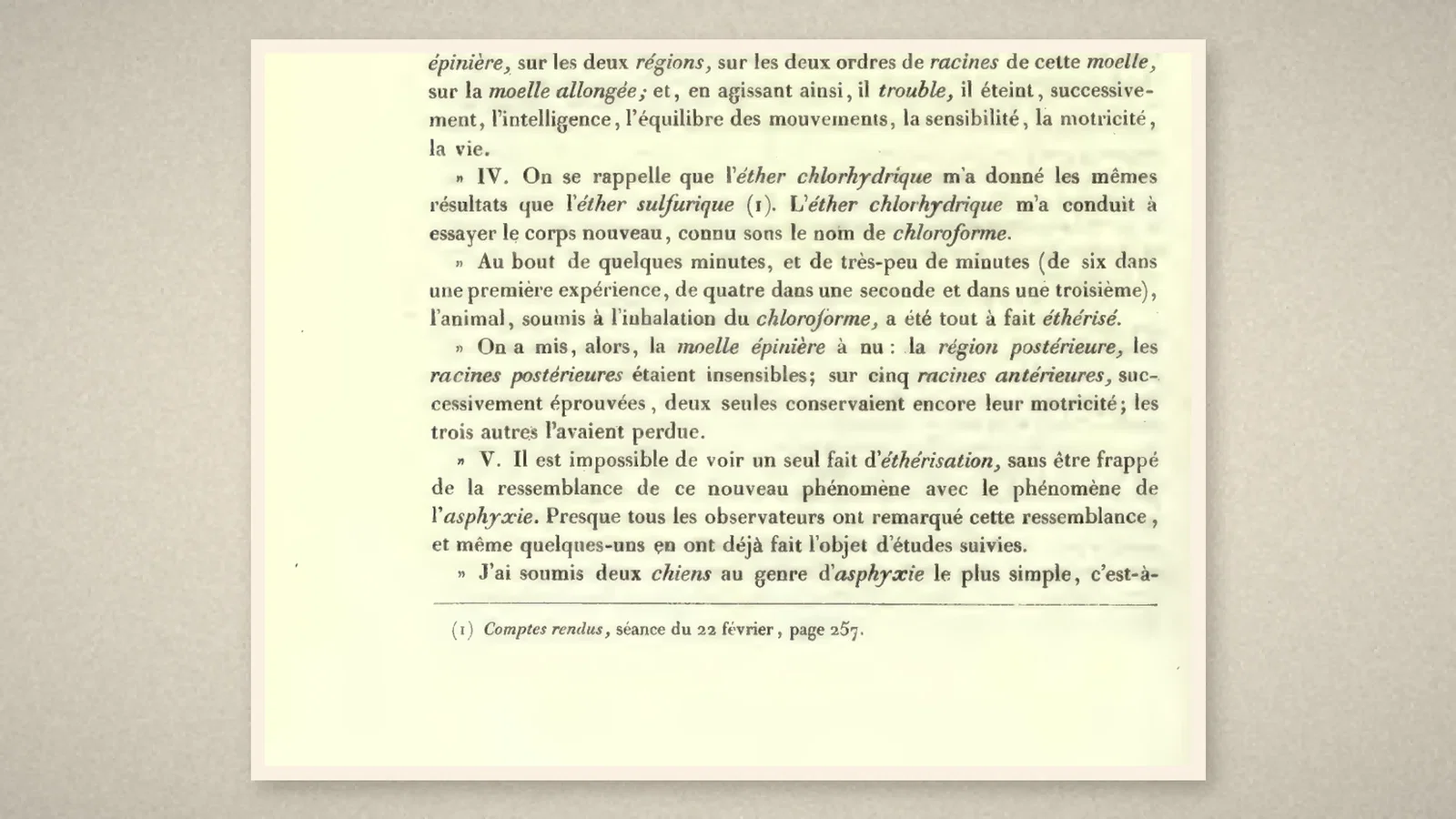
Section IV is only a few lines long. Hydrochloric ether, Flourens writes, had given the same results as sulphuric ether, and had led to a trial of "the new substance known by the name of chloroform". Within a few minutes, about six in a first experiment and four in a second and a third, the animal was "completely etherized". With the spinal cord exposed, the posterior region and posterior roots were insensible; of five anterior roots tested one after another, only two still gave movement, and the other three had lost it. [2, p. 342]
Flourens went straight on to compare etherization with asphyxia. Two dogs were made asphyxial by rebreathing a fixed volume of air, and their spinal cords too lost sensation. The two states were alike, in Flourens's view, but in asphyxia the nervous system fails under the action of dark, oxygen-poor blood, while in etherization it fails under the direct action of the agent itself. [2, p. 342][2, p. 343]
Roux replies
The surgeon Roux spoke at once. Roux granted the value of the experiments but would not accept all their conclusions. In patients, the signs of etherization sometimes appeared together, and more often the patient stayed aware, able to follow questions and answer with gestures, right up to the moment insensibility set in. As for asphyxia, Roux did not want the public to hear the comparison, for fear of reviving fears that had been hard to dispel; to Roux, etherization was "much closer to drunkenness than to asphyxia". [2, p. 344][2, p. 345]
What the record shows
Outside the operating room, ether was being asked "why" in a systematic way. Flourens's answer was an order running from top to bottom, and a warning. Chloroform takes up only a few lines of this record, reached by way of hydrochloric ether. The same record keeps a surgeon's dissent: what is seen in animals is not necessarily what happens in patients.
Sources and reading limits
Read: Flourens, "Note touchant les effets de l'inhalation de l'éther sur la moelle allongée", Comptes rendus de l'Académie des sciences 1847;24:253-8 (sitting of 22 February 1847), with Magendie's remarks, the replies and Balard's remarks (pp. 258-9); Flourens, "Note touchant l'action de l'éther sur les centres nerveux", same volume, pp. 340-4 (sitting of 8 March 1847), and Roux's reply (pp. 344-6).
Not covered: Flourens's note of 8 February 1847 (p. 161); Flourens's later books; laboratory records.
Limits: these are Flourens's own summaries, read aloud and then printed in the Academy's weekly record; the number of animals and the preparations used are given only in outline. The text groups the second and third chloroform experiments together. This record says nothing about how Simpson later came to chloroform, and no link between the two is claimed here. No amounts are given.
Three illustrations are crops of the Comptes rendus, vol. 24 (pp. 253, 258 and 342); one is a text diagram drawn from them, with no animals or apparatus drawn.
- Flourens. Note touchant les effets de l'inhalation de l'éther sur la moelle allongée. C R Hebd Seances Acad Sci. 1847;24:253-8. Internet Archive
- Flourens. Note touchant l'action de l'éther sur les centres nerveux. C R Hebd Seances Acad Sci. 1847;24:340-4. Internet Archive
Continue exploring
Related reading connects shared questions and contexts; it does not by itself establish historical influence.
- 1846: Fisher's Ether Fails in Paris Before a Boston Inhaler Succeeds
- 1847: Chloroform, from Self-Experiment to a Public Report
- 1847: Charrière Prints an Illustrated Leaflet on Ether Inhalers
Anesthesia Epochs · The Source Room · About & Editorial Method
Published November 3, 2026. Sources and reading limits are stated above. Illustrations are labelled as original source images or AI-made. Historical accounts are educational; they are not current treatment instructions.