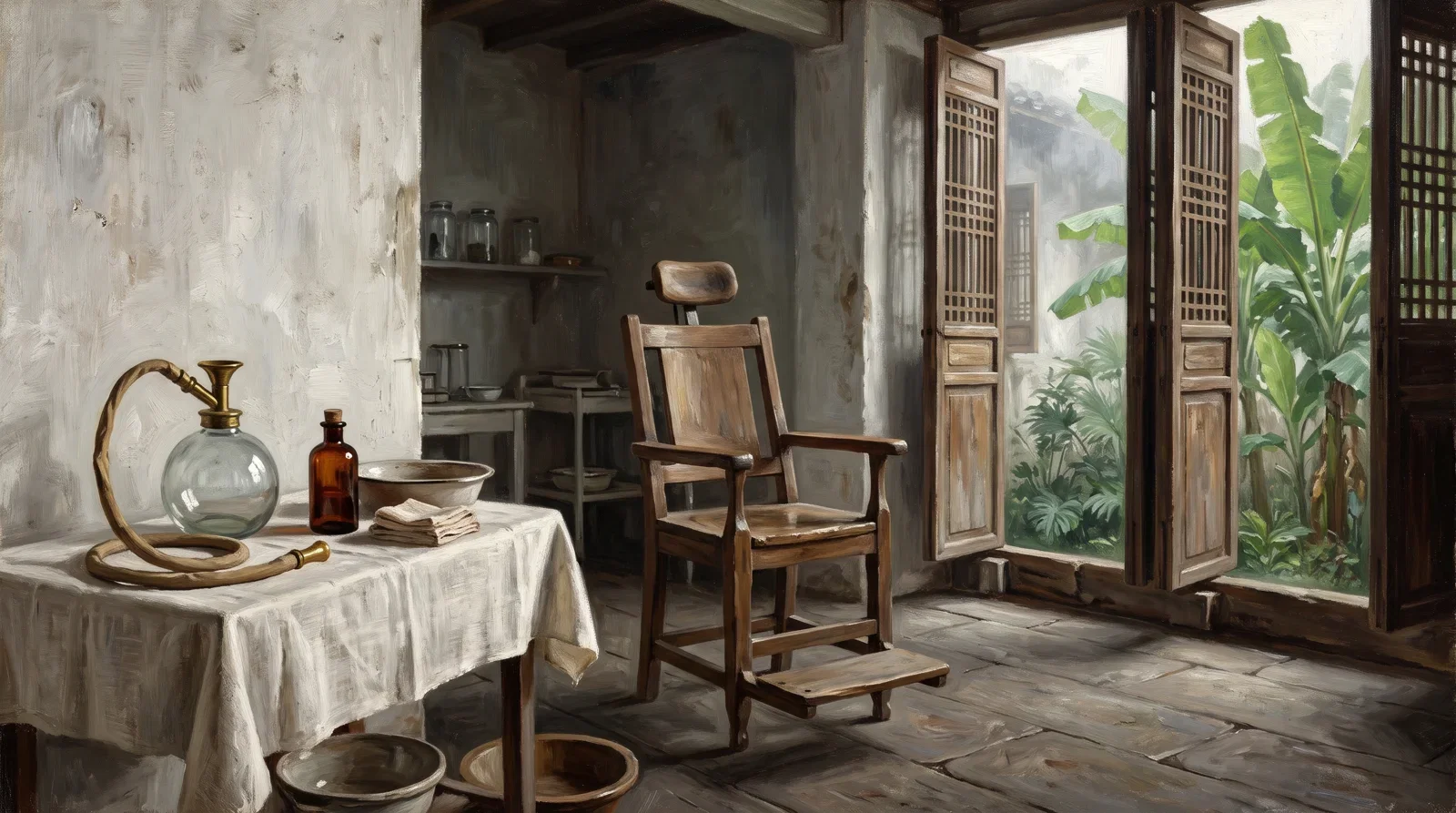
Parker's fourteenth report of the Canton Ophthalmic Hospital, printed in The Chinese Repository, records ether given to Chinese patients during 1847.
Reading Library · Anesthesia Epochs · 中文版
Watch the education video (for clinicians)
1848: Peter Parker's Ether in Canton · Anesthesia Epochs Education Series
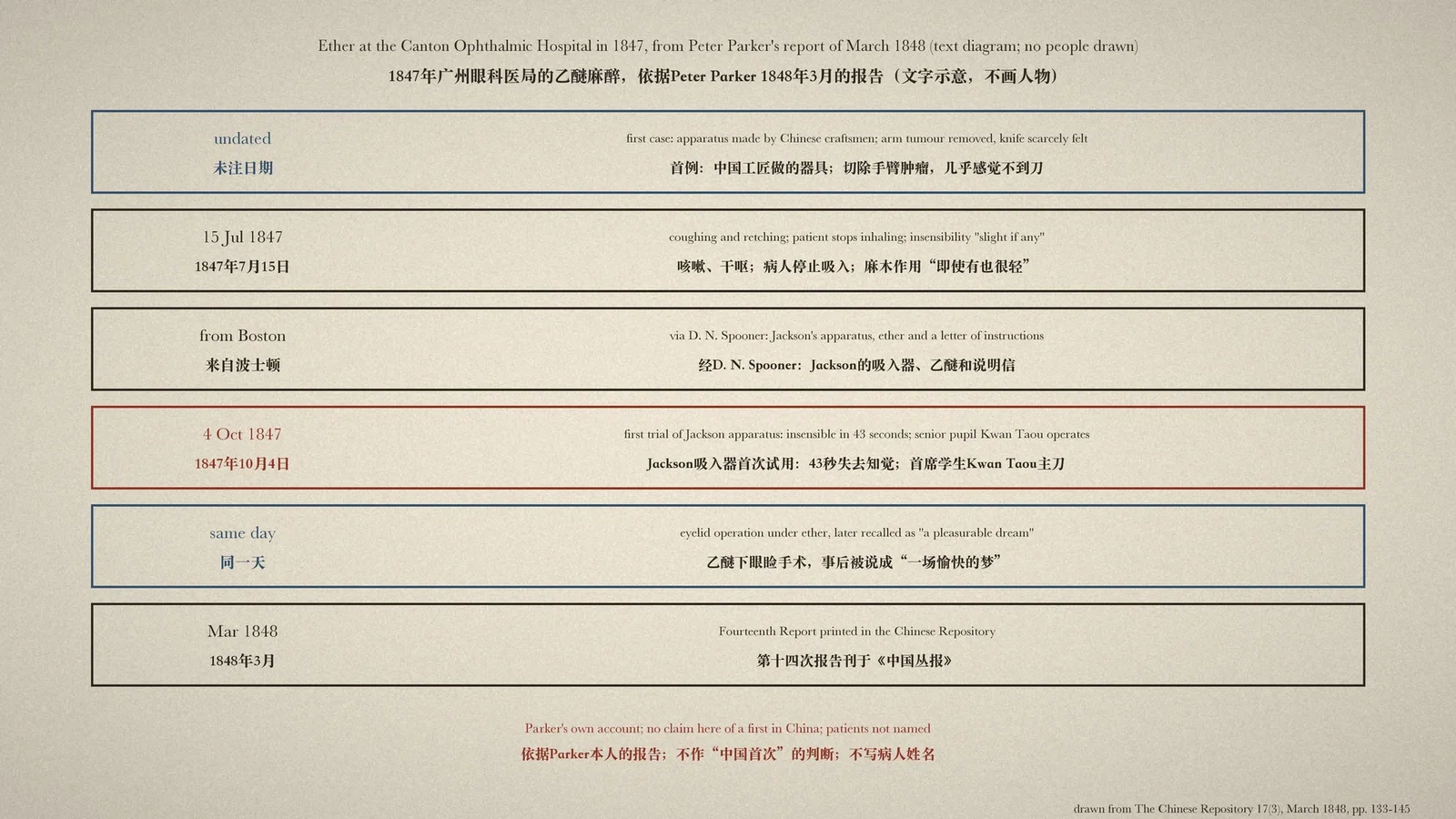
After the ether demonstration in Boston in October 1846, the news had to cross oceans to reach China. In March 1848 The Chinese Repository, an English-language journal published in Canton, printed the Fourteenth Report of the Ophthalmic Hospital, Canton, by the American medical missionary Peter Parker. One section records how Parker gave ether to Chinese patients in Canton during 1847. This article reads that report itself. [1, p. 133][1, p. 142]
A late report
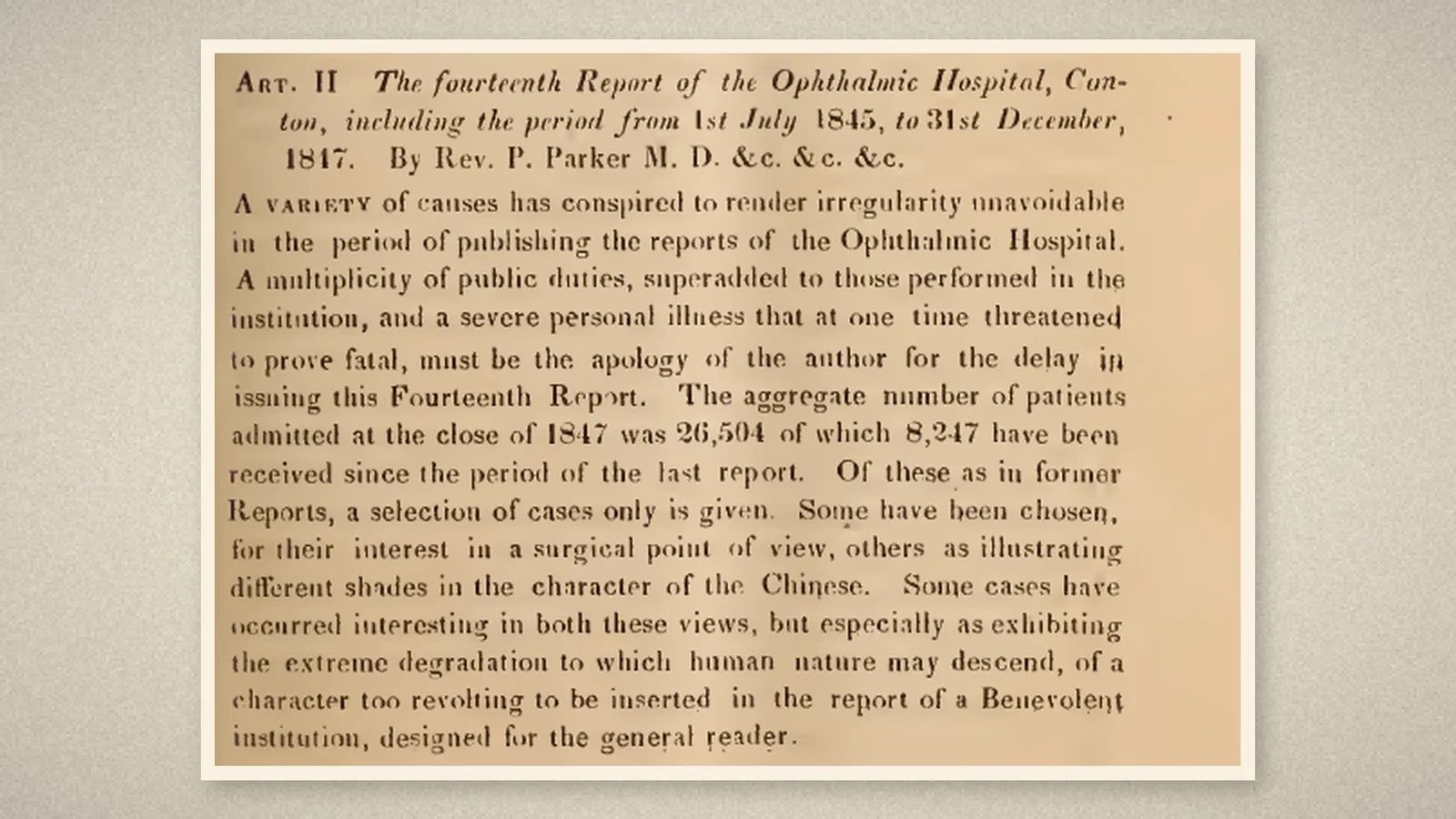
The report covers 1 July 1845 to 31 December 1847 and is signed by the Rev. P. Parker, M.D. Parker opened with an apology for the delay, citing many public duties and a severe illness that had "threatened to prove fatal", and explained that only a selection of cases was given, some for their surgical interest and some for what they showed of Chinese character. [1, p. 133]
At first: an apparatus made by Chinese craftsmen
A section headed "Operations performed on patients under the influence of Sulphuric Ether" begins with Parker hearing of the success of the new application of ether and giving it, "with such an apparatus as the Chinese were able to make", furnished by a friend, to a man of about thirty-five with a fatty tumour on the right arm. After three minutes of inhalation, though still able to answer questions, the patient had the tumour removed without feeling the knife or the needle; there was less bleeding than usual and the blood was very dark. The patient said that the operation, though known to be happening, was scarcely felt, walked about the room that afternoon, and was discharged within a week. [1, p. 142][1, p. 143]
Not every attempt went well. On 15 July 1847 a woman with molluscum coughed and then retched on inhaling the ether, declined after two or three minutes to take any more, asked for the operation to go ahead and bore it with fortitude; the insensibility, Parker noted, "was slight if any". [1, p. 143]
An inhaler from Boston
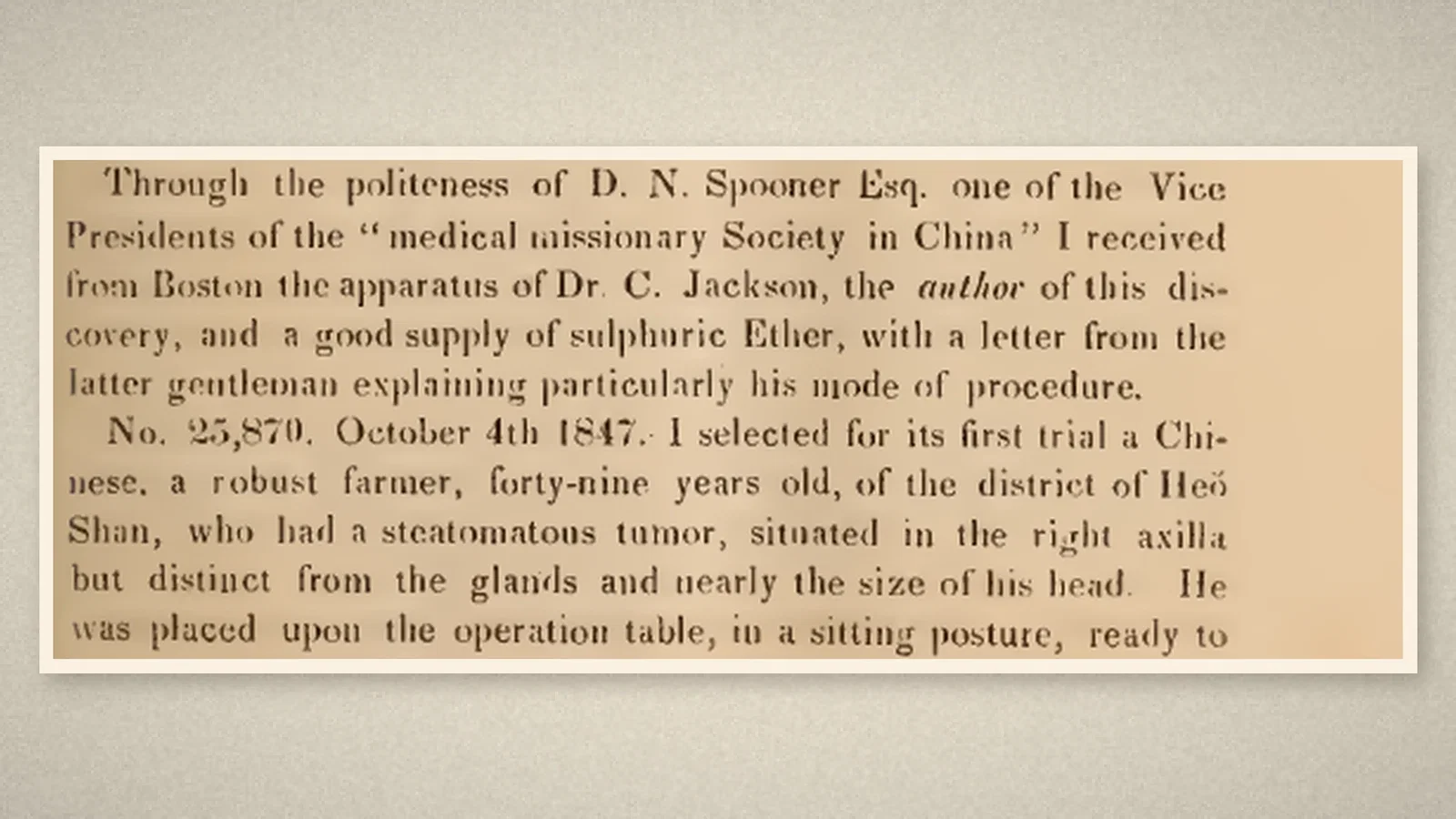
Then, "through the politeness of D. N. Spooner", a vice-president of the Medical Missionary Society in China, Parker received from Boston "the apparatus of Dr. C. Jackson, the author of this discovery", a good supply of sulphuric ether, and a letter from Jackson explaining the procedure. Calling Jackson the author of the discovery was one side of the dispute then raging over who had discovered ether anaesthesia. [1, p. 143]
On 4 October 1847 Parker chose a robust farmer of forty-nine with a fatty tumour in the right axilla nearly the size of the head for the apparatus's "first trial". Seated on the operating table, the patient inhaled deeply from Jackson's apparatus while Parker held the right arm and supported the back, ready to lay the patient down. In forty-three seconds the arm muscles suddenly relaxed, inhalation stopped, and the patient was laid back on the table insensible. [1, p. 143][1, p. 144]
The pupil operates
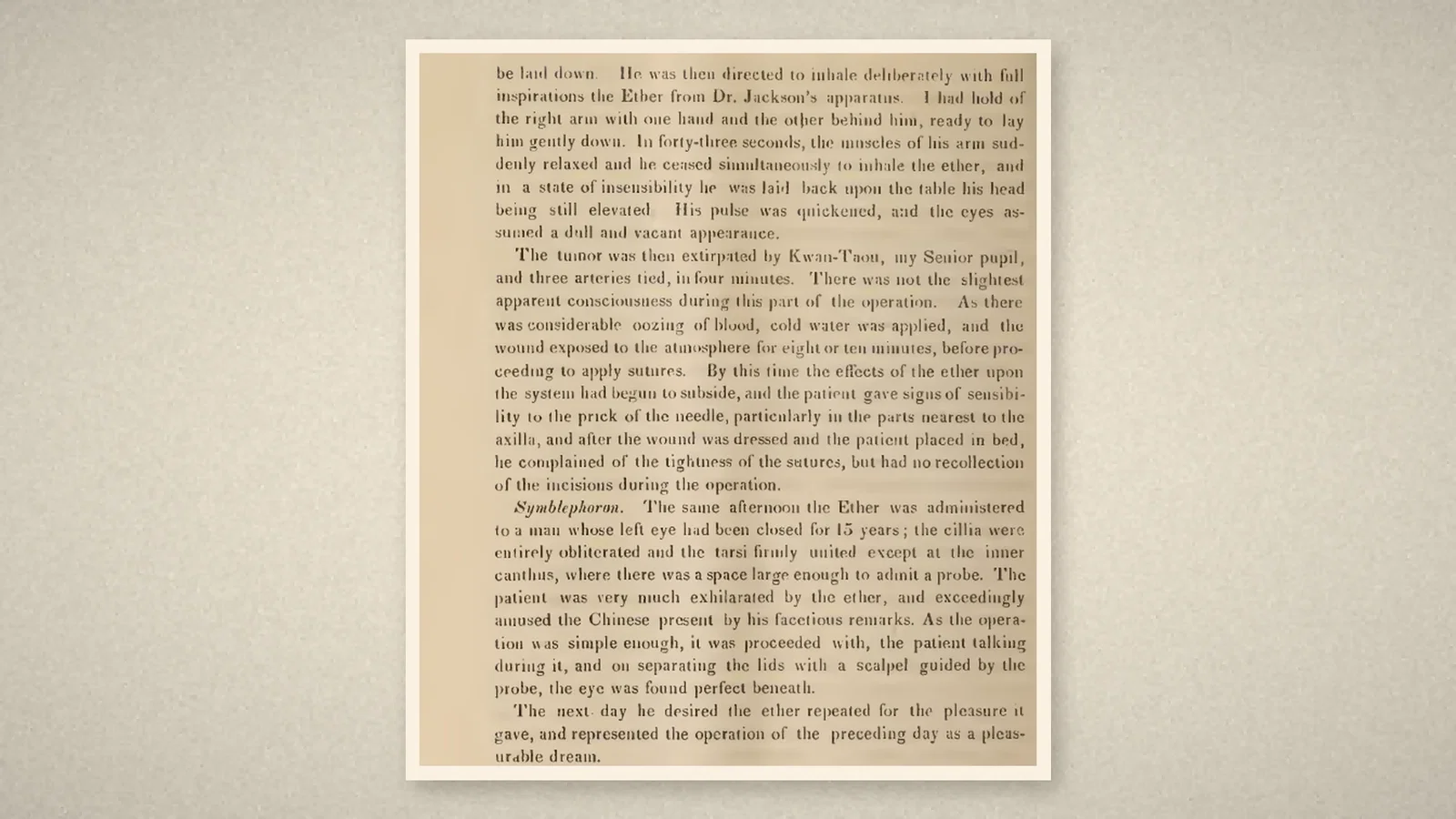
The tumour was removed by Parker's senior pupil, Kwan Taou (the report's spelling), with three arteries tied, in four minutes, without "the slightest apparent consciousness". Because of oozing, cold water was applied and the wound left open for eight or ten minutes before suturing, by which time the ether was wearing off and the needle was felt. After dressing, the patient complained of tight sutures but did not remember the incisions. [1, p. 144]
The same afternoon a man whose left eyelids had been fused for fifteen years inhaled ether, became very exhilarated and amused the Chinese present with jokes; the lids were separated and the eye found perfect beneath. The next day the patient asked for ether again for the pleasure of it, and described the operation of the day before as "a pleasurable dream". Many more cases could be given, Parker wrote, "did leisure permit". The report also noted that four pupils were still under instruction and that the senior pupil, Kwan Taou, could now give important help in the hospital. [1, p. 144][1, p. 145]
What the record shows
The report shows ether arriving in China: first tried with an apparatus made by local craftsmen, with mixed results; then, once the Boston inhaler came, clean and rapid anaesthesia; and the hand holding the knife belonged to a Chinese student.
Sources and reading limits
Read: Parker, "The fourteenth Report of the Ophthalmic Hospital, Canton, including the period from 1st July 1845 to 31st December 1847", The Chinese Repository vol. 17, no. 3 (March 1848), pp. 133-145, including the selected cases, the section on operations under sulphuric ether, and the notes on pupils and the hospital building (Princeton Theological Seminary Library copy on the Internet Archive).
Not covered: the Wood Library-Museum article on Peter Parker; Parker's later reports, including the 1848 chloroform record mentioned in some timelines; Jackson's letter to Parker; Chinese-language sources on Parker's pupils; the appendix and the rest of the issue.
Limits: a short article cannot establish an absolute first in China; this article rests on Parker's own report, and Parker's "first trial" refers only to Jackson's apparatus. Parker's description of Jackson as "the author of this discovery" represents one side of the priority dispute. Patients named in the report are not named here and are described only by the age and condition the report gives. The 1848 chloroform date given in some timelines was not found in this report. The pupil's name is given in the report's spelling; the source gives no Chinese characters, and none are supplied here.
Three illustrations are crops of The Chinese Repository, March 1848, pp. 133, 143 and 144 (the title and opening of the report, the passage on receiving Jackson's apparatus, and the pupil's operation and "a pleasurable dream"). One is a text diagram drawn from the report, with no people drawn and no patients named.
- Parker P. The fourteenth report of the Ophthalmic Hospital, Canton, including the period from 1st July 1845 to 31st December 1847. The Chinese Repository. 1848;17(3):133-45. Internet Archive
Continue exploring
Related reading connects shared questions and contexts; it does not by itself establish historical influence.
Anesthesia Epochs · The Source Room · About & Editorial Method
Published November 4, 2026. Sources and reading limits are stated above. Illustrations are labelled as original source images or AI-made. Historical accounts are educational; they are not current treatment instructions.