Morton's printed statement to a Senate select committee argued for a national reward for etherization against the rival claims of Jackson and Wells.
Reading Library · Anesthesia Epochs · 中文版
Watch the education video (for clinicians)
1853: Morton Before the Senate — A Claim Submitted as Evidence · Anesthesia Epochs Education Series
After the ether operations at the Massachusetts General Hospital in October 1846, the question of who was the "discoverer" quickly became a long quarrel. More than six years later it had reached the United States Congress. In January 1853 W. T. G. Morton laid a thick volume, "Statements, supported by evidence", before a select committee of the Senate. This article reads only its opening: Morton's own address to the committee. It should be read for what it is, one party's case and not a verdict. [1, p. 5]
Before Congress
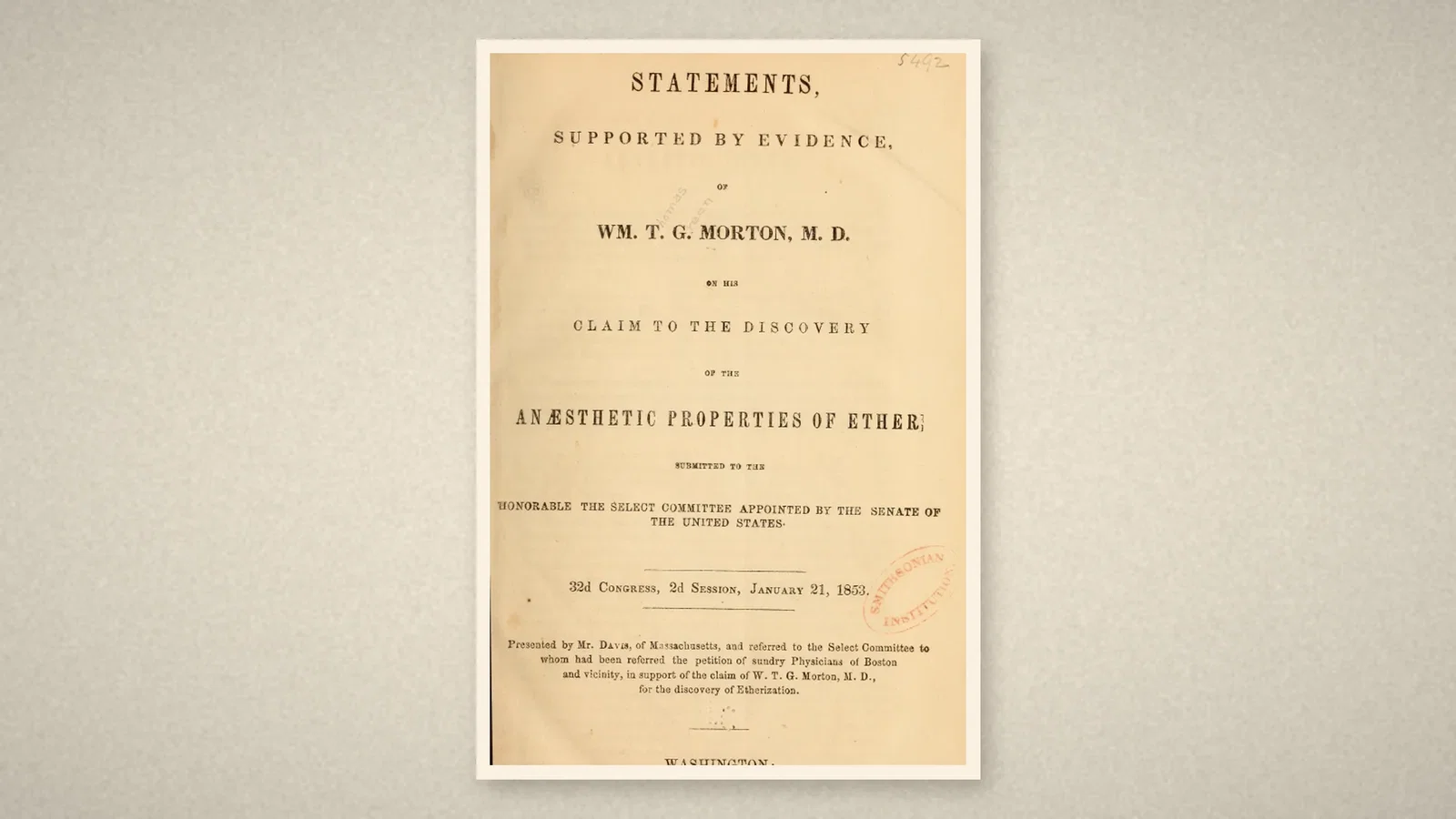
The title page records that the Statement was submitted to the select committee appointed by the Senate, 32nd Congress, 2nd session, January 21, 1853, presented by Mr Davis of Massachusetts and referred to the committee already considering "the petition of sundry Physicians of Boston and vicinity, in support of the claim of W. T. G. Morton, M. D., for the discovery of Etherization". An analytic index sorts the hundreds of pages of testimony behind it: evidence that Morton had the idea and was absorbed in proving it for months before 30 September 1846; evidence that Jackson ridiculed the discovery while it was being tried; evidence from the Boston surgeons that Jackson had no part in their experiments; and the obstacles Morton met in pressing the claim. [1, p. 5]
"I look to you for justice"
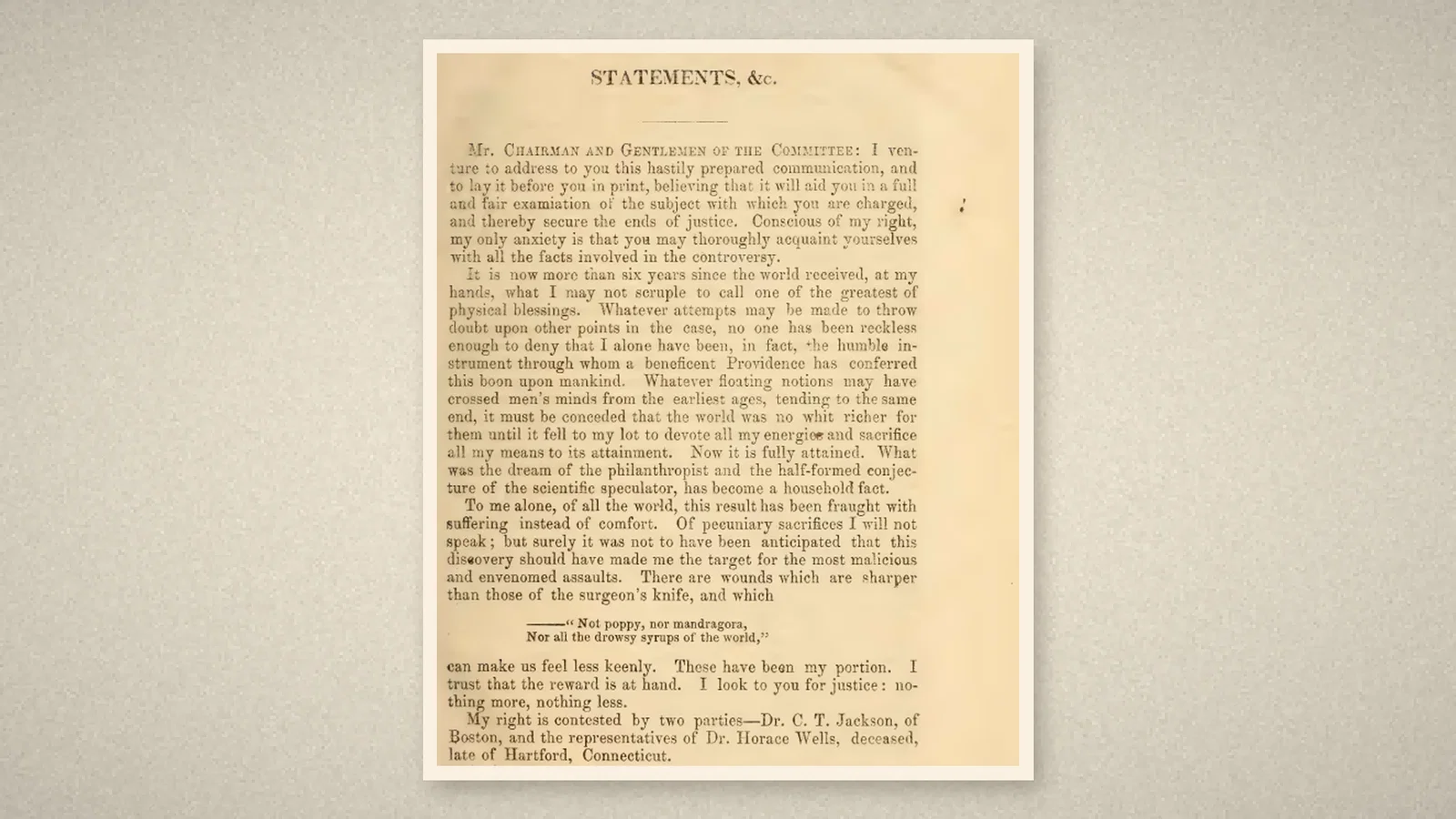
The address opens by calling itself "this hastily prepared communication", printed to aid a full and fair examination. More than six years had passed, it says, since the world received one of the greatest of physical blessings from Morton's hands, yet to Morton alone it had brought suffering, the target of "the most malicious and envenomed assaults". "There are wounds which are sharper than those of the surgeon's knife." It ends the paragraph: "I look to you for justice: nothing more, nothing less." [1, p. 5]
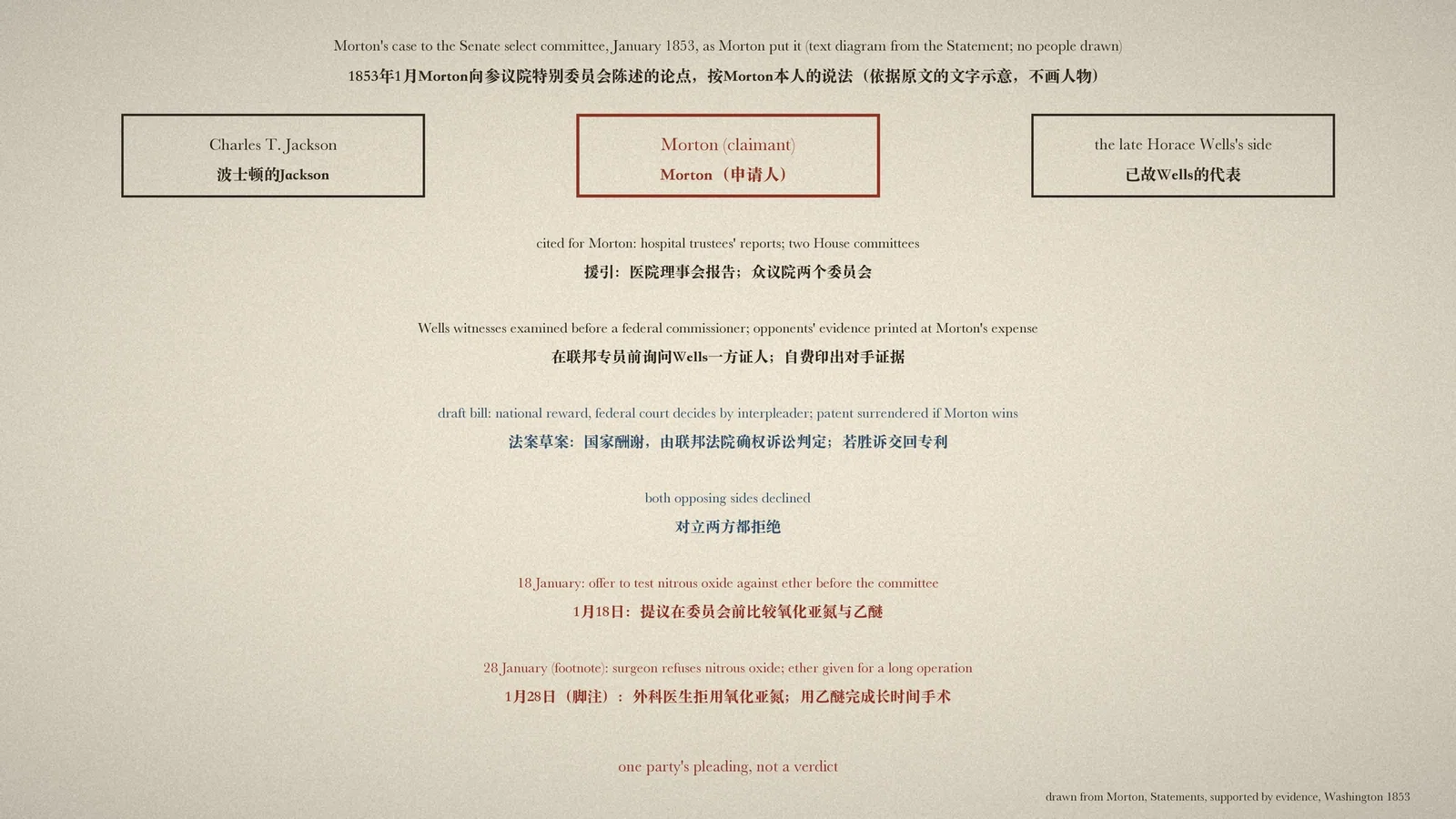
The right, the address continues, "is contested by two parties": Dr C. T. Jackson of Boston, and the representatives of Dr Horace Wells, the late dentist of Hartford. Between Jackson and Morton there had been repeated "adjudications": the reports of the trustees of the Massachusetts General Hospital had awarded the discovery to Morton, and two committees of the House of Representatives, one after a judicial examination with counsel on both sides, had come to the same conclusion. Morton had also gone into Connecticut and examined before a United States commissioner every witness relied on for Wells, and submitted the certified depositions. [1, p. 5][1, p. 6]
Against the French Academy committee report cited by Jackson's side, Morton submitted a full translation by the State Department's translator, argued that it conceded the original idea and the "completing" of the discovery, and said it had been made on Jackson's "ex parte showing", Morton's own pamphlets having lain at the French custom house for months. Calling the course taken "open, bold, courting investigation, defying controversy", Morton printed at personal expense all the evidence for the opponents, including two minority reports favouring Jackson and two pamphlets for Wells, and accused them of a strategy of "wearing out my life". [1, p. 6][1, p. 8][1, p. 9][1, p. 10]
A draft bill
At the end of the previous session, the address says, a coalition of the Wells and Jackson claims had suddenly blocked the claim. Morton therefore drafted a bill "to reward, by a national testimonial" the discovery. Congress would appropriate a sum; the district attorney for Massachusetts would file a bill of interpleader in the federal circuit court with the Secretary of the Treasury as stakeholder; Morton, Jackson and Wells's representatives would litigate their claims, with appeal to the Supreme Court; and if Morton won, the patent granted on 12 November 1846 would first be surrendered. Truman Smith, for Wells, declined on the ground that Mrs Wells could not bear the cost of litigation, even when Morton offered to advance or pay it; Jackson's counsel also declined. [1, p. 10][1, p. 11]
The claim, Morton went on, rested first "on a strict legal title": the United States patent, unchallenged for six years, while the army, navy and public used the discovery without compensation. Jackson had formally released all interest to Morton, and Wells's side disparaged ether and claimed nitrous oxide as the true agent, an idea, Morton argued, "as old at least as Davy and Beddoes" and never verified for surgery. [1, p. 12]
A demonstration before the committee
On 18 January 1853 Morton wrote from the National Hotel in Washington to the committee's chairman, J. P. Walker, proposing "that an actual demonstration shall be made before the committee of the two agents", nitrous oxide and ether, in operations that scientific men would accept as fair tests. [1, p. 12][1, p. 13]
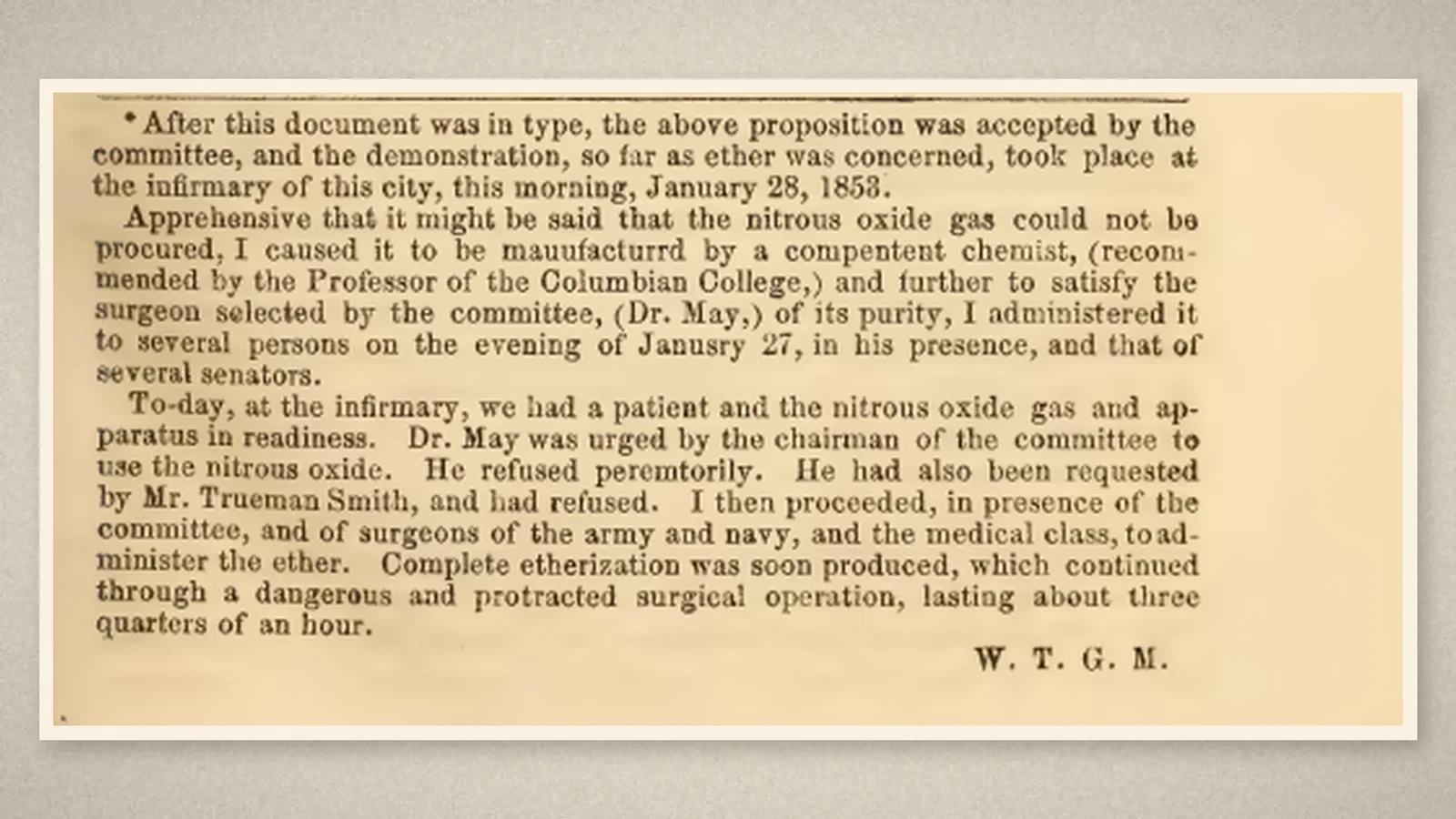
A footnote added after the document was in type says the proposal was accepted and the demonstration took place at the city's infirmary on the morning of 28 January 1853. To meet any objection that nitrous oxide could not be obtained, Morton had it made by a chemist and gave it to several people the evening before, in the presence of the committee's chosen surgeon, Dr May, and several senators. Next day, urged by the chairman to use the nitrous oxide, May "refused peremtorily". Morton then gave ether before the committee, surgeons of the army and navy and the medical class, and complete etherization lasted through "a dangerous and protracted surgical operation, lasting about three quarters of an hour". [1, p. 13]
After the address the volume prints Morton's letter to Wells of 19 October 1846 announcing "a preparation, by inhaling which, a person is thrown into sound sleep", Wells's reply of the next day, and a recollection by the patent agent R. H. Eddy of February 1847. [1, p. 14][1, p. 15]
What the record shows
The Statement shows how, within a few years, the discovery of ether anaesthesia had become a legal and reputational contest running through a hospital board, the House, the French Academy and the Senate. Morton's address is forceful and pointed, but it is one side's account; this article does not decide who the discoverer was.
Sources and reading limits
Read: Morton, "Statements, supported by evidence ... submitted to the honorable the Select Committee appointed by the Senate of the United States", 32nd Congress, 2nd session, January 21, 1853, Washington 1853, reading only the title page, the analytic index and Morton's address to the committee with the letters of October 1846 and February 1847 that follow it (printed pp. 5-15).
Not covered: the rest of the volume (hundreds of pages of depositions, the House majority and minority reports, the French Academy committee report, the physicians' memorial, the trustees' petition and the Senate debate); Jackson's and Wells's own publications; the committee's report and the outcome in Congress. The 1848 report of the Massachusetts General Hospital trustees is the source of a separate article on Morton and Frost and is not used here.
Limits: this is Morton's own pleading; everything said here about Jackson, Wells, the French Academy and the committee's proceedings is Morton's account, not a finding. The 28 January 1853 demonstration is known here only from Morton's footnote. The sum in the draft bill is not repeated. The article does not decide the priority question; "first discovered" is Morton's phrase. The patient in the demonstration is not identified.
Three illustrations are crops of Morton's 1853 Statement (title page, printed p. 5 and the footnote on p. 13). One is a text diagram drawn from the address, with no people and no sums.
- Morton WTG. Statements, supported by evidence, of Wm. T. G. Morton, M.D. ... submitted to the honorable the Select Committee appointed by the Senate of the United States. 32d Congress, 2d session, January 21, 1853. Washington; 1853. Internet Archive
Continue exploring
Related reading connects shared questions and contexts; it does not by itself establish historical influence.
- 1846: Morton Extracts a Tooth for Eben Frost Under an Ether Preparation
- 1846: Patent 4,848 and the Claim to Relieve Surgical Pain
Anesthesia Epochs · The Source Room · About & Editorial Method
Published November 3, 2026. Sources and reading limits are stated above. Illustrations are labelled as original source images or AI-made. Historical accounts are educational; they are not current treatment instructions.