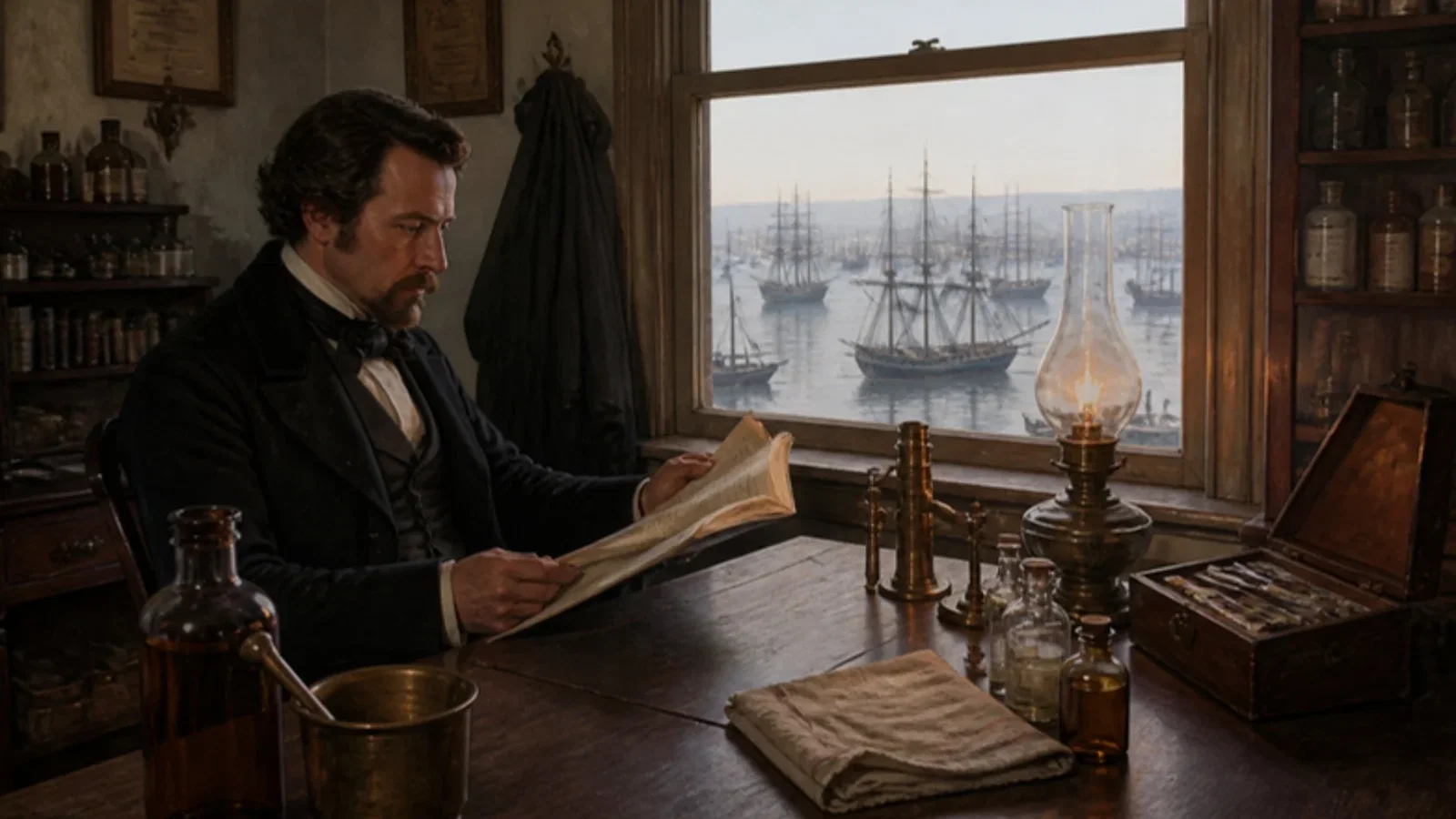
Writing in 1996, Calmes found that California's new state medical journal, in 1856, already reported anaesthesia in use and two anaesthetic deaths in its opening issue.
Reading Library · Anesthesia Epochs · 中文版
Watch the education video (for clinicians)
1856: Anaesthesia Reaches California — Calmes's Account · Anesthesia Epochs Education Series
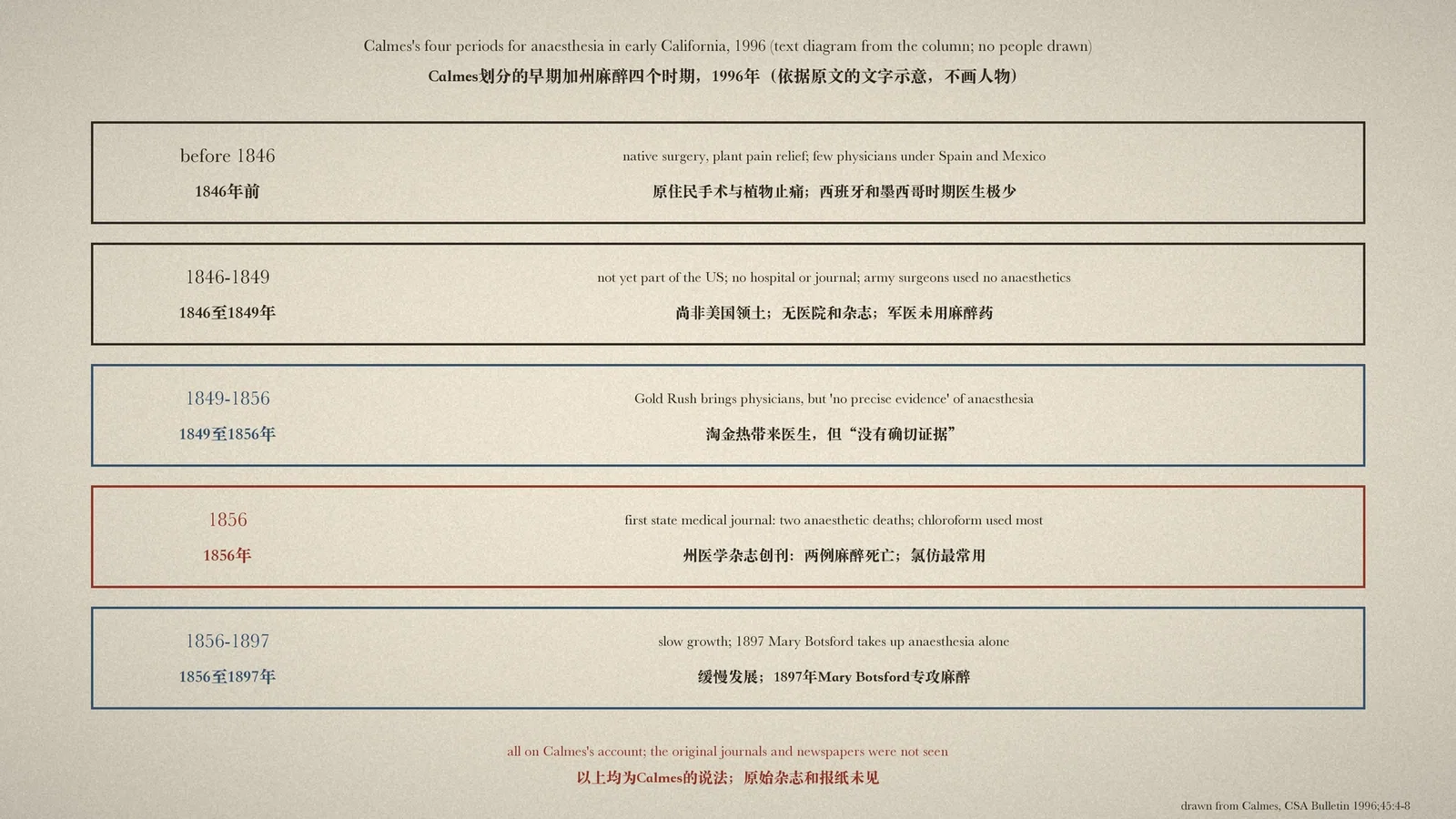
After the ether demonstration in Boston in 1846, the news reached Europe within weeks and the world's great cities within a year. On the far western edge of North America, the record begins much later. In 1996, for the 150th anniversary of the demonstration, the historian of anaesthesia Selma Harrison Calmes wrote a column for the California Society of Anesthesiologists asking how and when the news reached California. This article rests on that secondary column. [1, p. 4]
Four periods
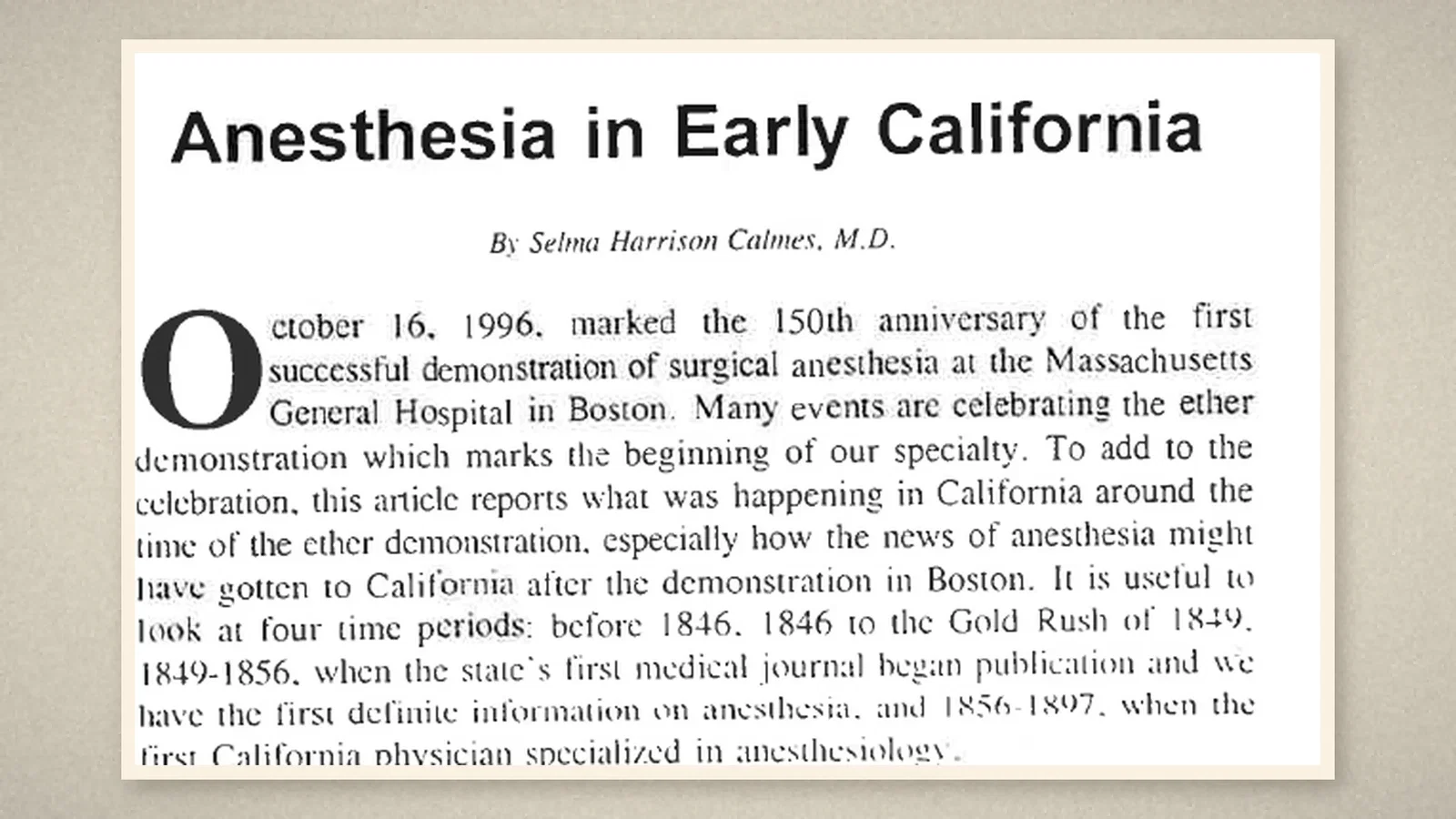
"Anesthesia in Early California" appeared in the Guedel Memorial Anesthesia Center column of the CSA Bulletin, vol. 45, November-December 1996. October 16, 1996, Calmes wrote, marked the 150th anniversary of the ether demonstration at the Massachusetts General Hospital, and the article would report what was happening in California at the time, "especially how the news of anesthesia might have gotten to California". Calmes divided the story into four periods: before 1846; 1846 to the Gold Rush of 1849; 1849 to 1856, when the state's medical journal began and, in Calmes's words, "we have the first definite information on anesthesia"; and 1856 to 1897. [1, p. 4]
Not yet part of the United States
Before 1846 California's native people performed some surgery, such as trephining and repair of battle wounds, and tried to relieve pain with plant preparations such as Jimson weed. Pedro Prat, a physician, arrived in 1769 as Spain began building its missions along the coast; afterwards Spanish surgeons general at the Monterey Presidio were the only physicians apart from occasional ships' doctors, and mission padres gave most medical care, even performing two Caesarean sections in which, Calmes noted, mothers and babies died. Mexico took over in 1821. The United States began the Mexican-American War in May 1846, and California surrendered in January 1847, two months after the ether demonstration: California, Calmes stressed, "was not even a part of the U.S., either geographically or politically" at the time. [1, p. 4][1, p. 5]
Between 1846 and 1849 the news spread through letters between physicians and mailed journals, reaching Europe in six weeks and the major cities within a year. And California? "Much later!" There were only five trained physicians and two army surgeons; no hospital, pharmacy, medical school, medical society or journal; a journey of at least six months; and no regular mail. The news could have arrived by April 1847, but the army surgeons' records show that anaesthetics were not ordered or used, and their medical supplies came from Hawaii. [1, p. 5][1, p. 6]
The Gold Rush: physicians, but no evidence
Gold was found near Sacramento in January 1848. When the news reached the East, the world rushed in; the forty-niners included, by Calmes's estimate, more than a thousand physicians, most of whom did not strike it rich and many of whom went back to practising. The route via Panama or Nicaragua cut the voyage from six months to six weeks, and medical journals began to arrive from the East Coast and Europe. [1, p. 6]
Yet "there is no precise evidence of use of anesthetics during this period". A Scottish physician trained in Edinburgh advertised in the Gold Rush town of Placerville: "sets bones, draws teeth painlessly", and may have brought anaesthetics too; the rest of the evidence is negative. The state's earliest hospital had no operating room, and the 1859 fee bill for Los Angeles physicians had no charge for anaesthesia. More important, in Calmes's view, California was then a largely male society, at a time when anaesthesia was often given selectively, to women, children and the wealthy. [1, p. 6][1, p. 7]
1856: two deaths in the opening issue
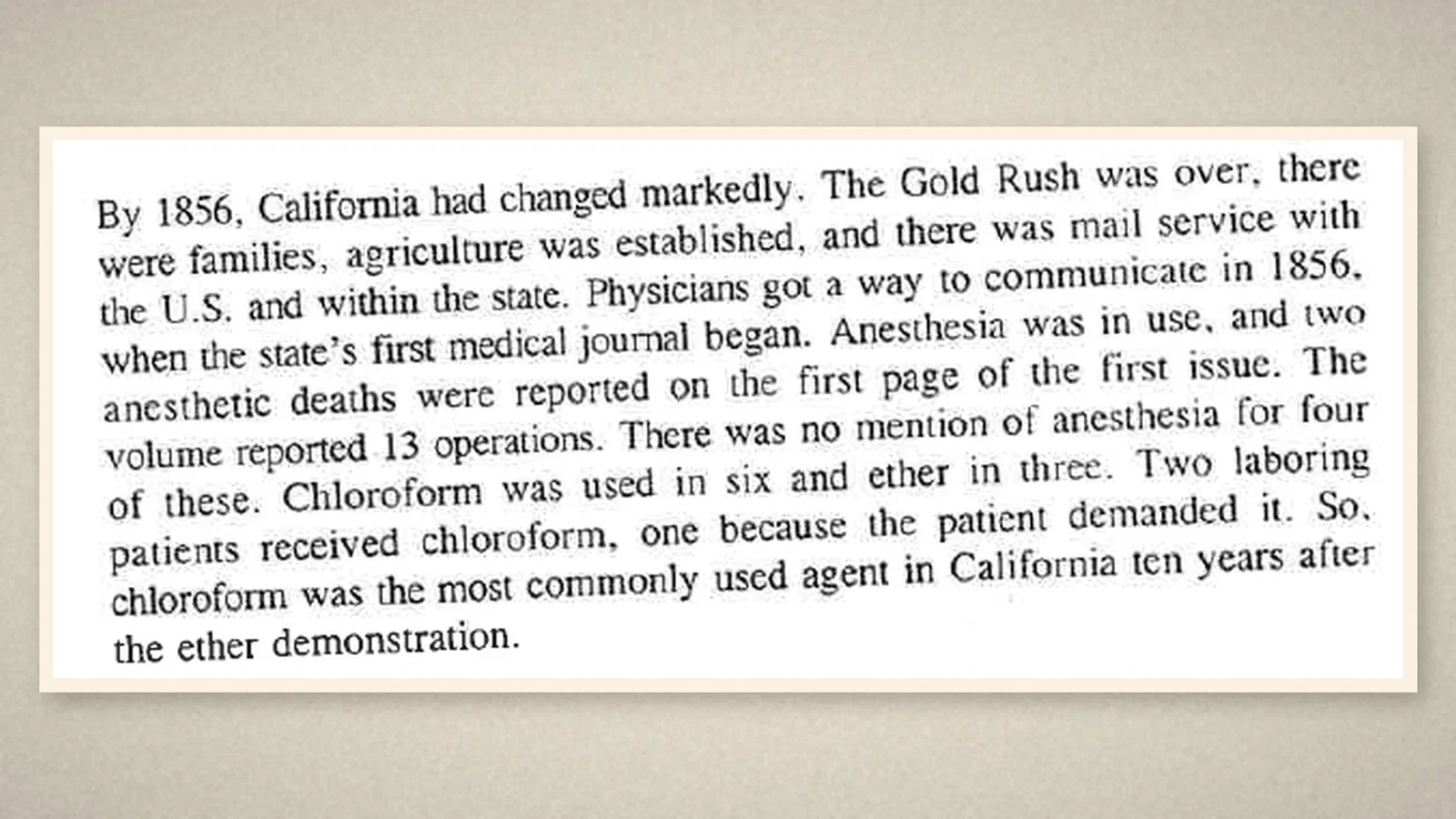
By 1856 California had changed: the Gold Rush was over, there were families and farms, and mail service ran within the state and to the rest of the country. That year the state's medical journal began, giving physicians a way to communicate. On Calmes's account anaesthesia was in use by then, and "two anesthetic deaths were reported on the first page of the first issue". The volume reported 13 operations: anaesthesia was not mentioned for four, chloroform was used in six and ether in three, and two women in labour received chloroform, one because the patient demanded it. Ten years after the ether demonstration, Calmes concluded, chloroform was the agent most used in California. [1, p. 7]
The next forty years
From 1856 to 1897 anaesthesia grew slowly, in California and nationally. The journal lasted only a year, and another began in 1858. An 1874 article described anaesthetising sleeping children without waking them; the same year the Alameda County Medical Society fee bill began to list charges for anaesthesia; and an 1883 article estimated anaesthetic mortality and pleaded for professional anaesthetists, citing Clover in London as the example. [1, p. 7]
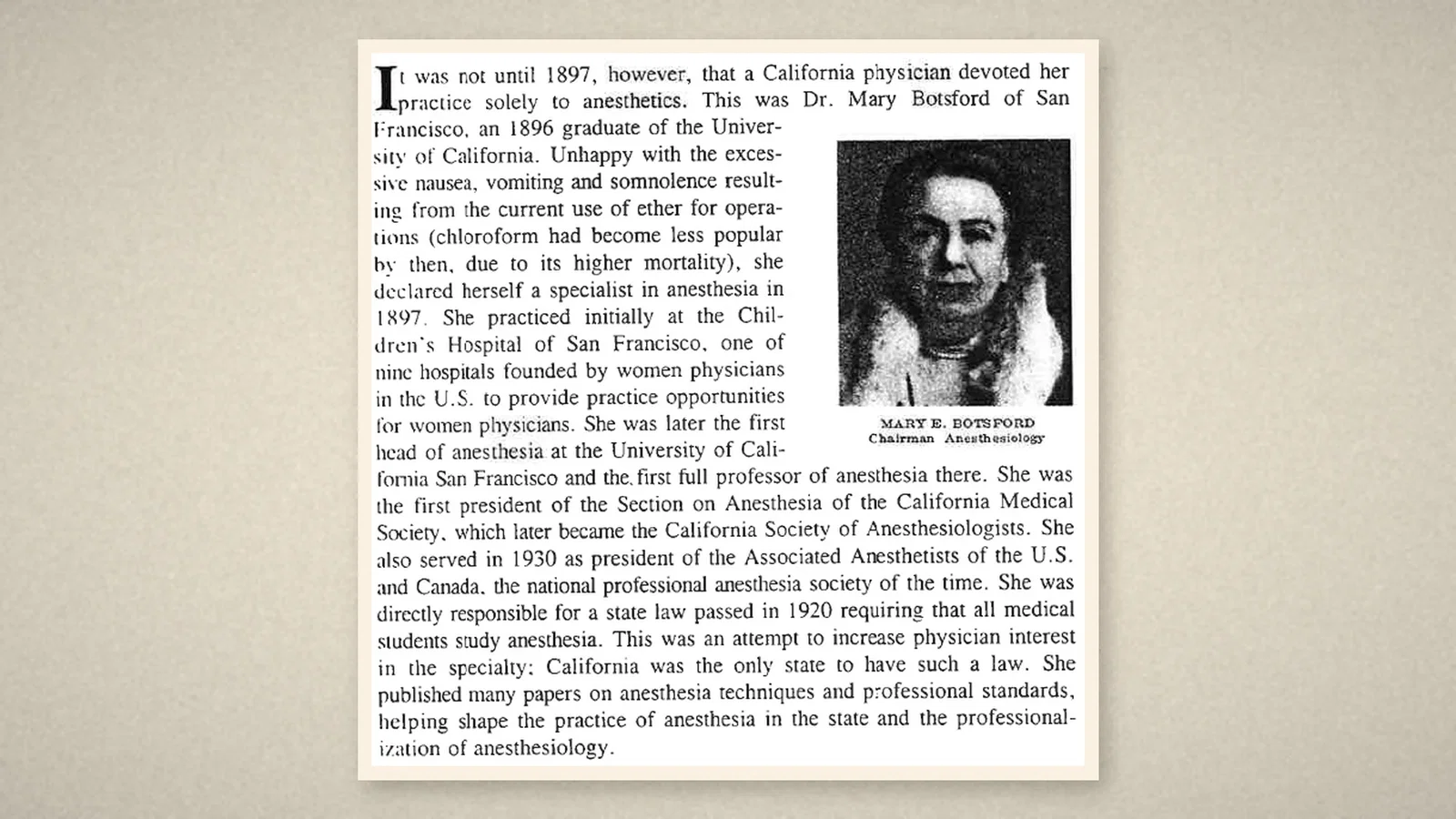
Not until 1897, Calmes wrote, did a California physician practise anaesthesia exclusively: Mary Botsford of San Francisco, a University of California graduate of 1896. Dissatisfied with the nausea, vomiting and somnolence that followed ether (chloroform had by then lost favour because of its higher mortality), Botsford declared a specialty in anaesthesia in 1897, worked first at the Children's Hospital of San Francisco, later headed anaesthesia and became professor of anaesthesia at the University of California San Francisco, presided over the anaesthesia section of the California Medical Society, served in 1930 as president of the Associated Anesthetists of the United States and Canada, and was responsible for a 1920 state law requiring all medical students to study anaesthesia; California, Calmes said, was the only state with such a law. [1, p. 8]
What the record shows
The column is a reminder that an invention said to have spread around the world could arrive a full ten years later where geography and society were different: without roads, mail, hospitals or journals, the news left no record, and once there was a journal, the first thing it recorded was death.
Sources and reading limits
Read: Calmes, "Anesthesia in Early California", CSA Bulletin November-December 1996;45:4-8, Guedel Center column, in full.
Not covered: the California newspapers of 1849-1852; California's medical journals of 1856 and 1858; the 1859 and 1874 fee bills; the 1874 and 1883 articles; Calmes's two 1989 chapters in The History of Anaesthesia, which hold the references.
Limits: this is a secondary historical column by Calmes, without footnotes; every fact here is reported on Calmes's account, and the original sources were not seen. No event year is fixed in the timelines; the article is dated to 1856, the year Calmes names for the first definite information in California. Every statement of a first, an earliest or an only in this article is Calmes's and is attributed to the column, not made in this article's own voice. Fees and mortality ratios are omitted. Patients are not identified.
Three illustrations are crops of the CSA Bulletin 1996 pp. 4, 7 and 8 (title and opening, the 1856 paragraph, the Botsford section with its archival portrait). One is a text diagram drawn from the column, with no people drawn.
- Calmes SH. Anesthesia in early California. CSA Bulletin. 1996;45(Nov-Dec):4-8. PDF
Continue exploring
Related reading connects shared questions and contexts; it does not by itself establish historical influence.
- 1928: Lynch Reads 'Anesthesia in Obstetrics' in California
- 1912: Nitrous Oxide Reaches Major Surgery in California, Slowly
Anesthesia Epochs · The Source Room · About & Editorial Method
Published November 3, 2026. Sources and reading limits are stated above. Illustrations are labelled as original source images or AI-made. Historical accounts are educational; they are not current treatment instructions.