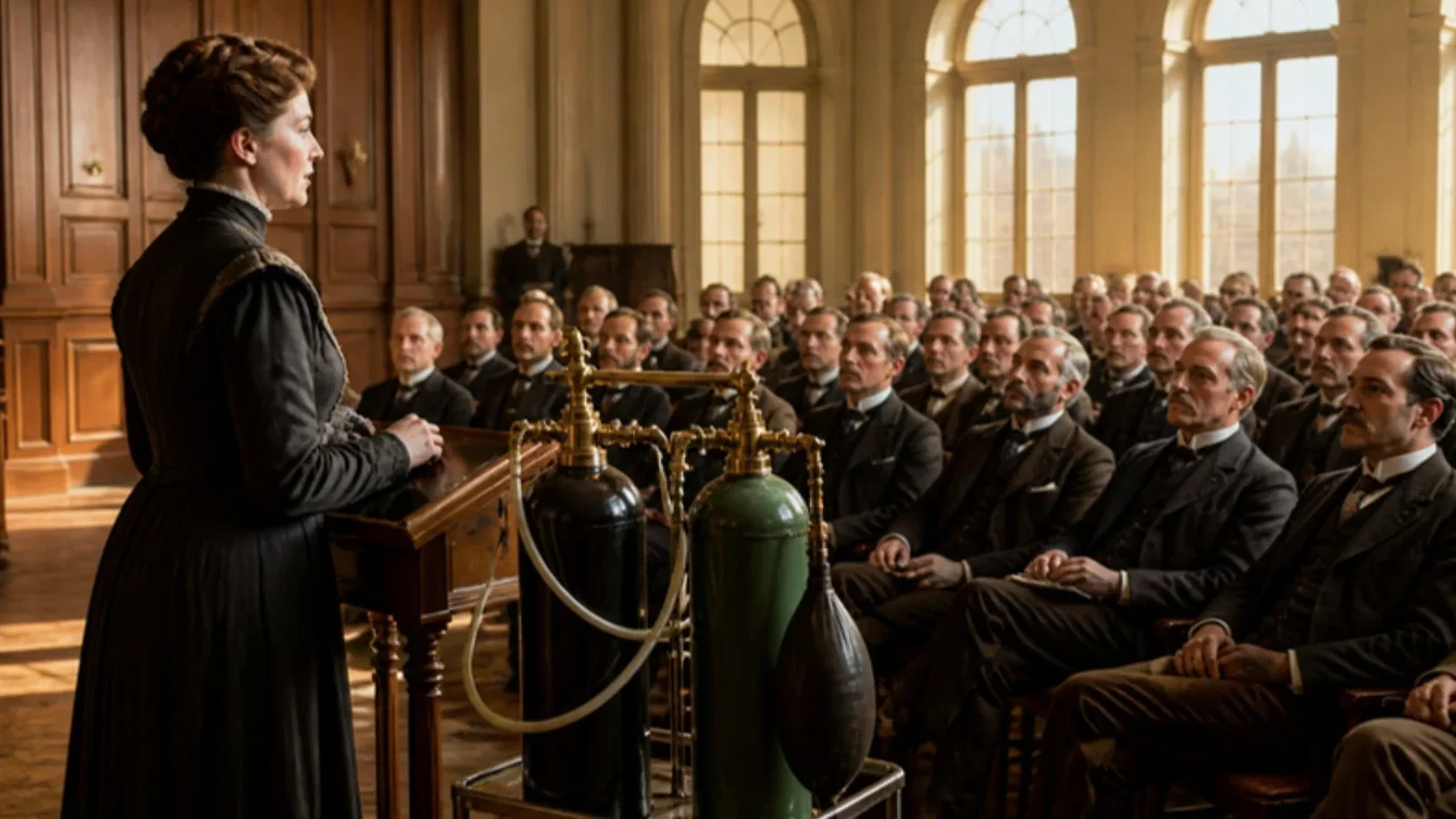
Californian physicians could read about nitrous oxide from 1877, but in 1912 a Los Angeles anaesthetist still called nitrous oxide-oxygen too costly and complicated for general use, while Mary Botsford spoke in San Francisco on its 'present status' in major surgery.
Reading Library · Anesthesia Epochs · 中文版
Watch the education video (for clinicians)
1912: Nitrous Oxide in California — The Cost of Major Surgery · Anesthesia Epochs Education Series
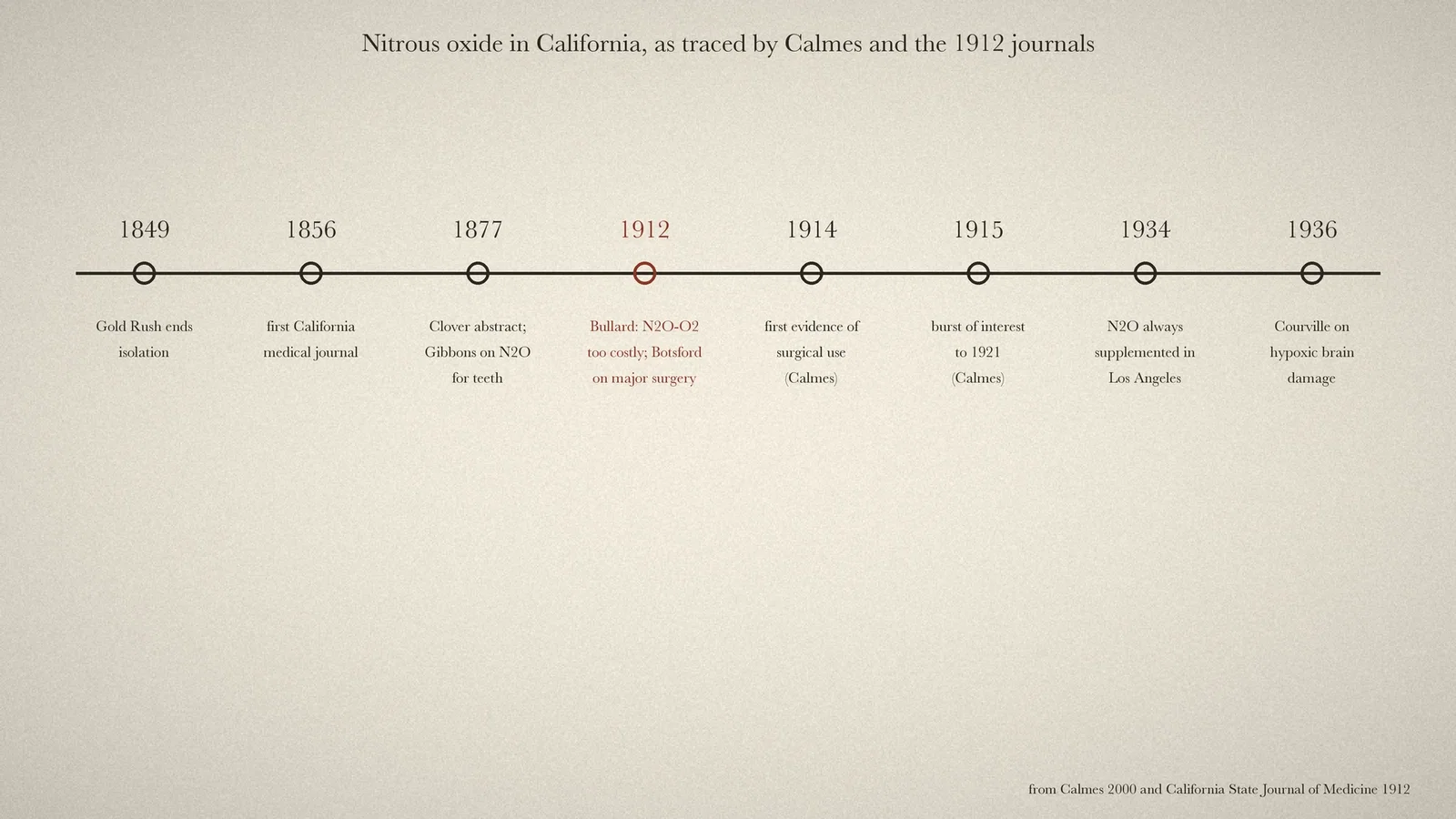
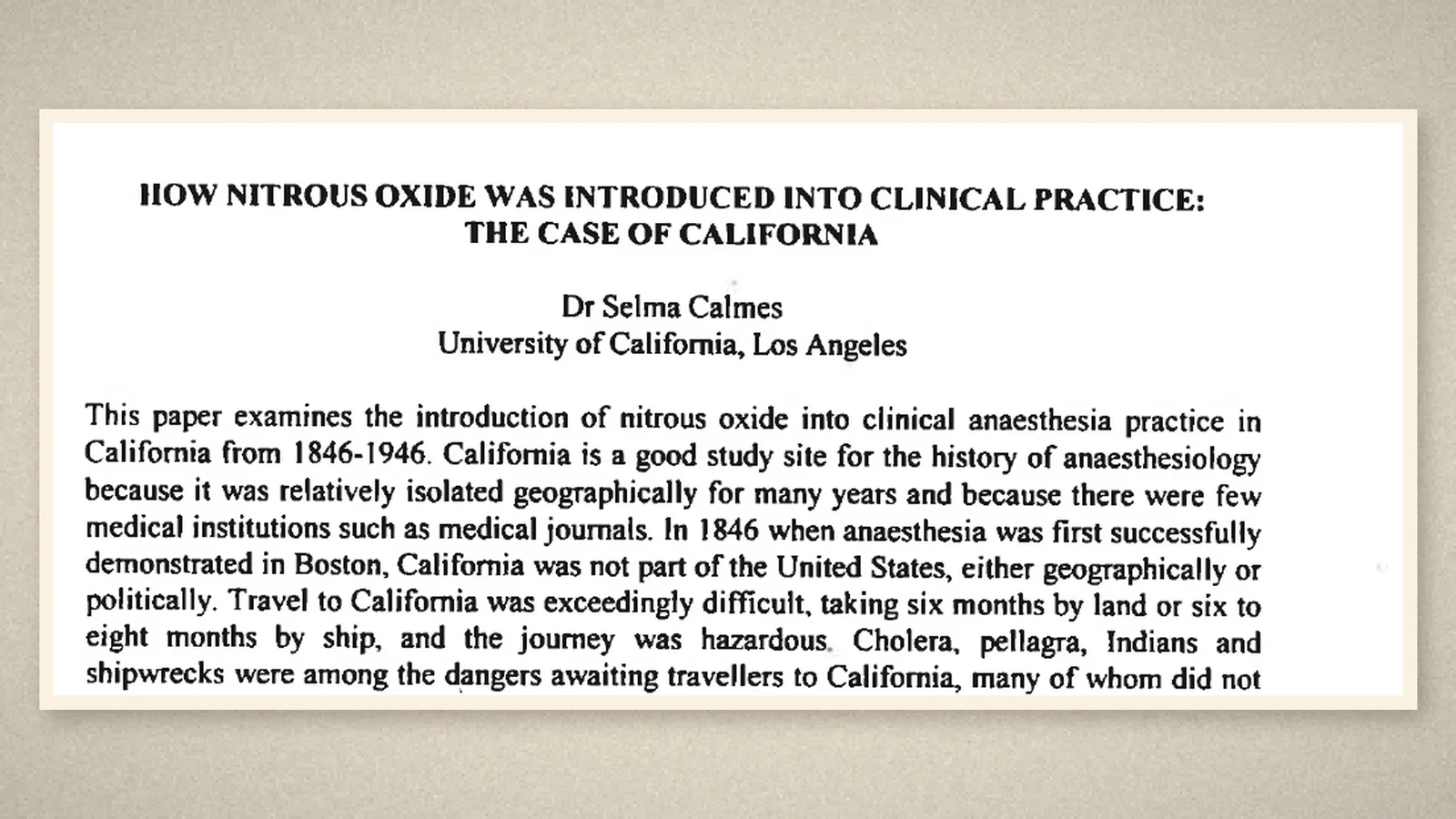
Gardner Colton, whose 1844 demonstration led Horace Wells to try nitrous oxide for dental work, spent several years in California during the Gold Rush. Selma Calmes notes that there is no evidence Colton gave nitrous oxide while there. [1] Calmes, of the University of California, Los Angeles, set out to answer when and how the gas entered anaesthetic practice in a state that, for decades after 1846, was hard to reach and had few medical institutions. This article follows Calmes's survey and two papers from 1912 that show the gas being argued over in Los Angeles and San Francisco.
News without use
Calmes read California's state medical journals from 1856 to 1944, together with the minutes of the Southern California Society of Anesthetists, a 1934 trial transcript and meeting programmes. [1] The first mention of nitrous oxide came in February 1877, 33 years after the gas was first used for surgical anaesthesia: an abstract of a report by the London anaesthetist Joseph Clover on combining the gas with ether. [1] Two months later Henry Gibbons, a prominent San Francisco physician, described having teeth pulled under nitrous oxide in Philadelphia, noting its short duration and the difficulty of keeping a supply. [1] After that, Calmes found 24 years with almost no mention of the gas. [1] Calmes's summary is direct: information on nitrous oxide was available in California by 1877, "but there is at present no evidence it was used for surgery until 1914". [1]
1912: praised and priced out
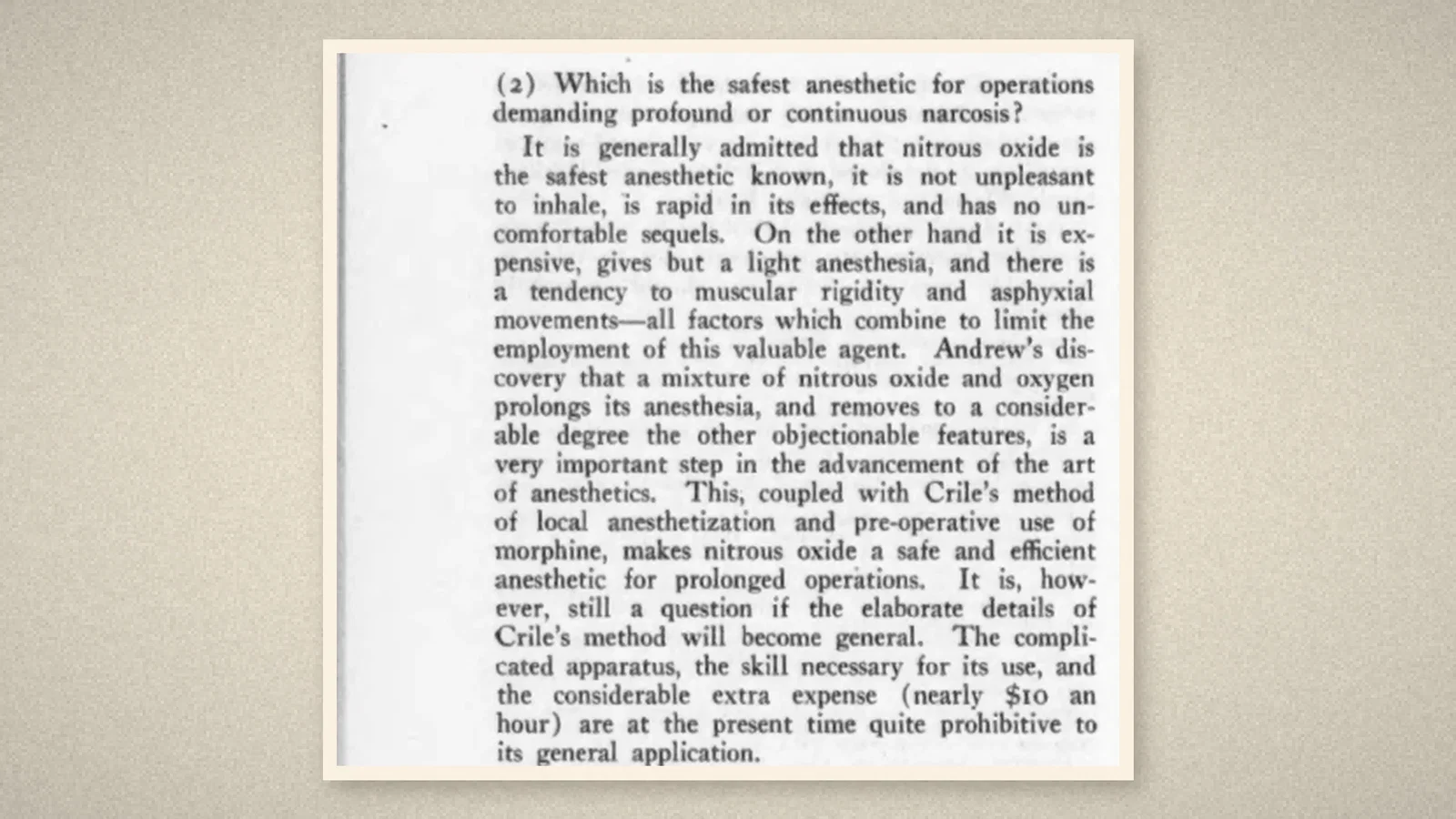
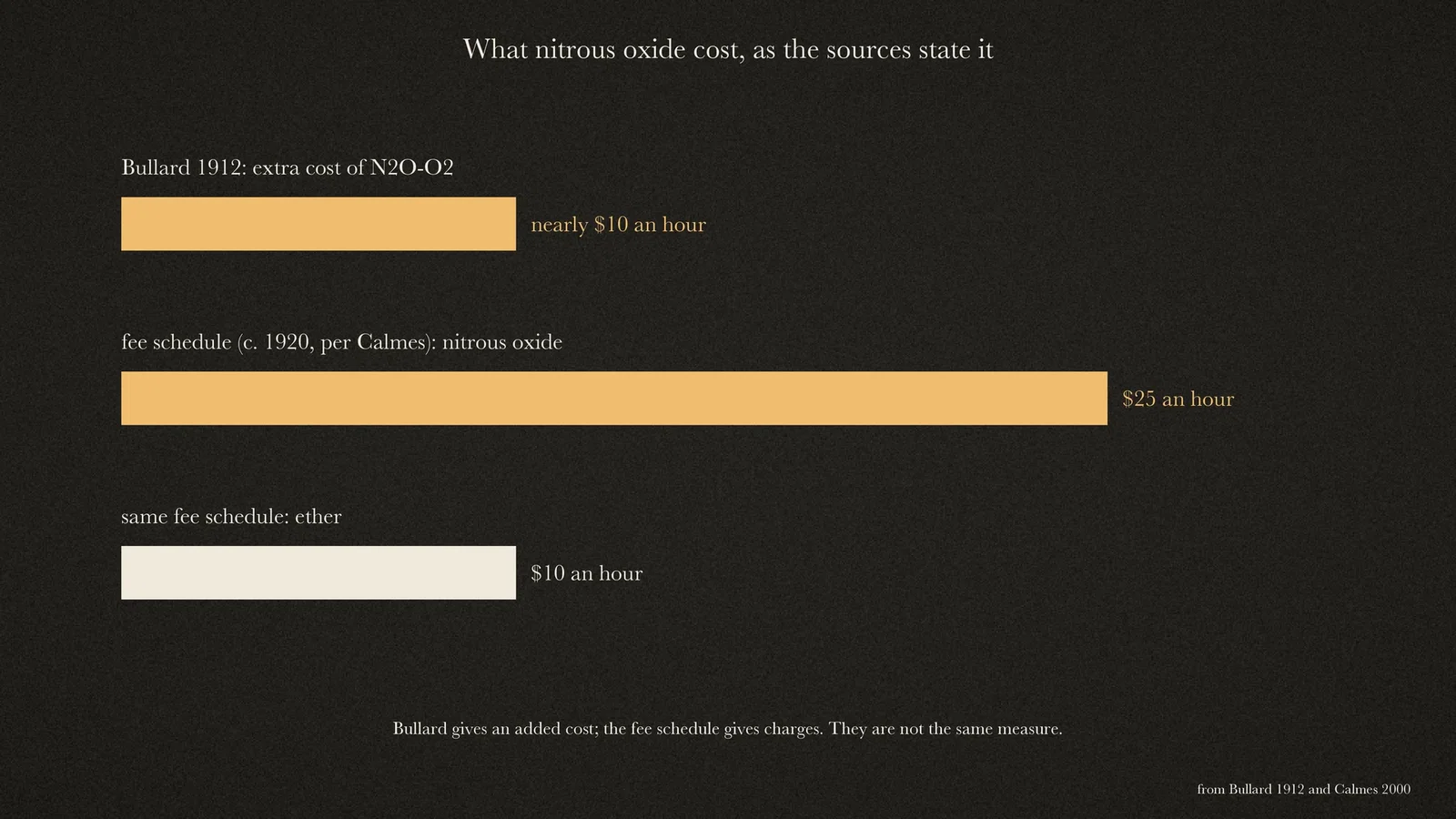
The California State Journal of Medicine for 1912 shows why. On 5 January 1912 Frank D. Bullard, who described an experience of nearly 9,000 anaesthetics, read "Anesthetics, Methods and Indications" to the Los Angeles County Medical Association. [2] Bullard limited the paper to four "fundamental substances": nitrous oxide, ether, chloroform and ethyl chloride. [2] Nitrous oxide, Bullard said, was generally admitted to be "the safest anesthetic known", pleasant and quick, but expensive, light, and liable to cause rigidity and asphyxial movements. [2] Andrews's discovery that adding oxygen prolonged its effect was "a very important step", and Crile's combination of local anaesthesia and preoperative morphine made nitrous oxide "a safe and efficient anesthetic for prolonged operations". [2] Yet "the complicated apparatus, the skill necessary for its use, and the considerable extra expense (nearly $10 an hour) are at the present time quite prohibitive to its general application". [2]
Six weeks later, on 20 February 1912, the Surgical Section of the San Francisco County Medical Society heard Caroline Palmer on "The Choice of Anesthetic" and Mary Botsford on "The Present Status of Nitrous Oxide in Major Surgery". [3] Calmes identifies Botsford, who began practice in 1897, as California's first physician anaesthetist, and credits Botsford and the many anaesthetists Botsford trained with much of the later literature. [1] Only the title of the 1912 paper survives in what was read here.
The rise and fall
Calmes describes an explosion of interest from 1915, with nine articles and presentations that year, lasting until 1921, and another cluster in 1925-1927, when "secondary saturation" was common and patients were thought to tolerate the hypoxia. [1] The cost never went away. A fee schedule recorded in the Southern California Society of Anesthetists' minutes listed $25 an hour for nitrous oxide and $10 for ether, and the 1934 trial transcript shows that in Los Angeles nitrous oxide was always supplemented with ether and carbon dioxide. [1] Ethylene, thiopentone and cyclopropane, introduced in the following years, offered alternatives, and the Los Angeles neuropathologist C. B. Courville documented hypoxic brain damage after 100% nitrous oxide, first in a 1936 article and then in a 1939 book. [1] Calmes concludes that the gas came into use "at a surprisingly late time" and declined as other agents arrived and its hazards became better known. [1]
What the record shows
California's story separates knowing about an anaesthetic from being able to use it. By 1912 Californian physicians knew that nitrous oxide with oxygen could serve for long operations, and some were speaking for it; what held it back was apparatus, skill and price. When those barriers fell, newer agents and the evidence of hypoxic injury were not far behind.
Sources and reading limits
Read: Calmes's four-page paper; Bullard's 1912 paper from the Internet Archive scan of the California State Journal of Medicine; the April 1912 proceedings page listing Botsford's presentation.
Not covered: the 1877 reports by Clover and Gibbons in the Pacific Medical and Surgical Journal (no open scan found; a HathiTrust copy could not be accessed); Botsford's 1912 paper itself; Wood and Botsford's 1921 paper; Courville's 1936 article and 1939 book; the society minutes, fee schedule and 1934 trial transcript, all of which are reported here only as Calmes describes them. The article is dated 1912 because the two 1912 items are the earliest primary sources read on the use of nitrous oxide in major surgery in California; they show discussion and advocacy, not routine use, and do not contradict Calmes's 1914 date for the first evidence of surgical use. Calmes's description of Botsford as the state's first physician anaesthetist is Calmes's own.
One illustration is a crop of Bullard's paper and one of Calmes's; two are drawn from the sources.
- Calmes S. How nitrous oxide was introduced into clinical practice: the case of California. In: Barr M, Drury P, eds. Proceedings of the Combined Meeting to mark the Bicentenary of Davy's Researches in Nitrous Oxide. Bristol: History of Anaesthesia Society; 2000. p. 60-3. Internet Archive PDF
- Bullard FD. Anesthetics, methods and indications. Cal State J Med. 1912;10(3):97-102. Internet Archive
- San Francisco County Medical Society. Proceedings. Cal State J Med. 1912;10(4). Internet Archive
Continue exploring
Related reading connects shared questions and contexts; it does not by itself establish historical influence.
- 1947: William Neff Takes the Hypoxia Out of Nitrous Oxide
- 1950: John Dillon Builds UCLA Anaesthesia Inside a Department of Surgery
Anesthesia Epochs · The Source Room · About & Editorial Method
Published November 2, 2026. Sources and reading limits are stated above. Illustrations are labelled as original source images or AI-made. Historical accounts are educational; they are not current treatment instructions.