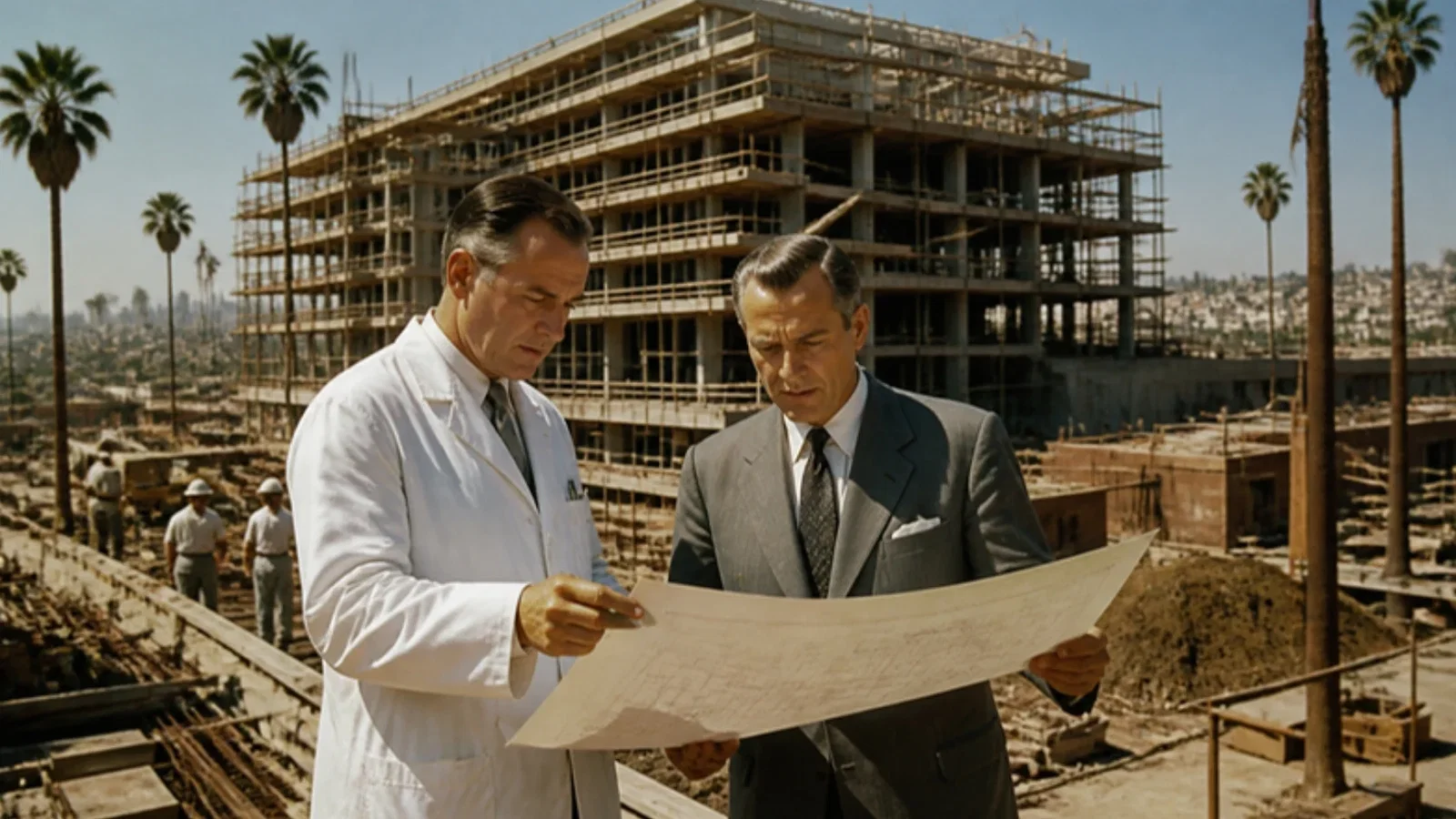
Recruited by surgeon William Longmire to a medical school that did not yet have a hospital, Dillon led UCLA anaesthesia as a division of surgery for two decades, opened an outpatient surgery unit in 1962 and saw the division become a department in 1971-1972.
Reading Library · Anesthesia Epochs · 中文版
Watch the education video (for clinicians)
1950: John Dillon at UCLA — Anaesthesia Inside Surgery · Anesthesia Epochs Education Series
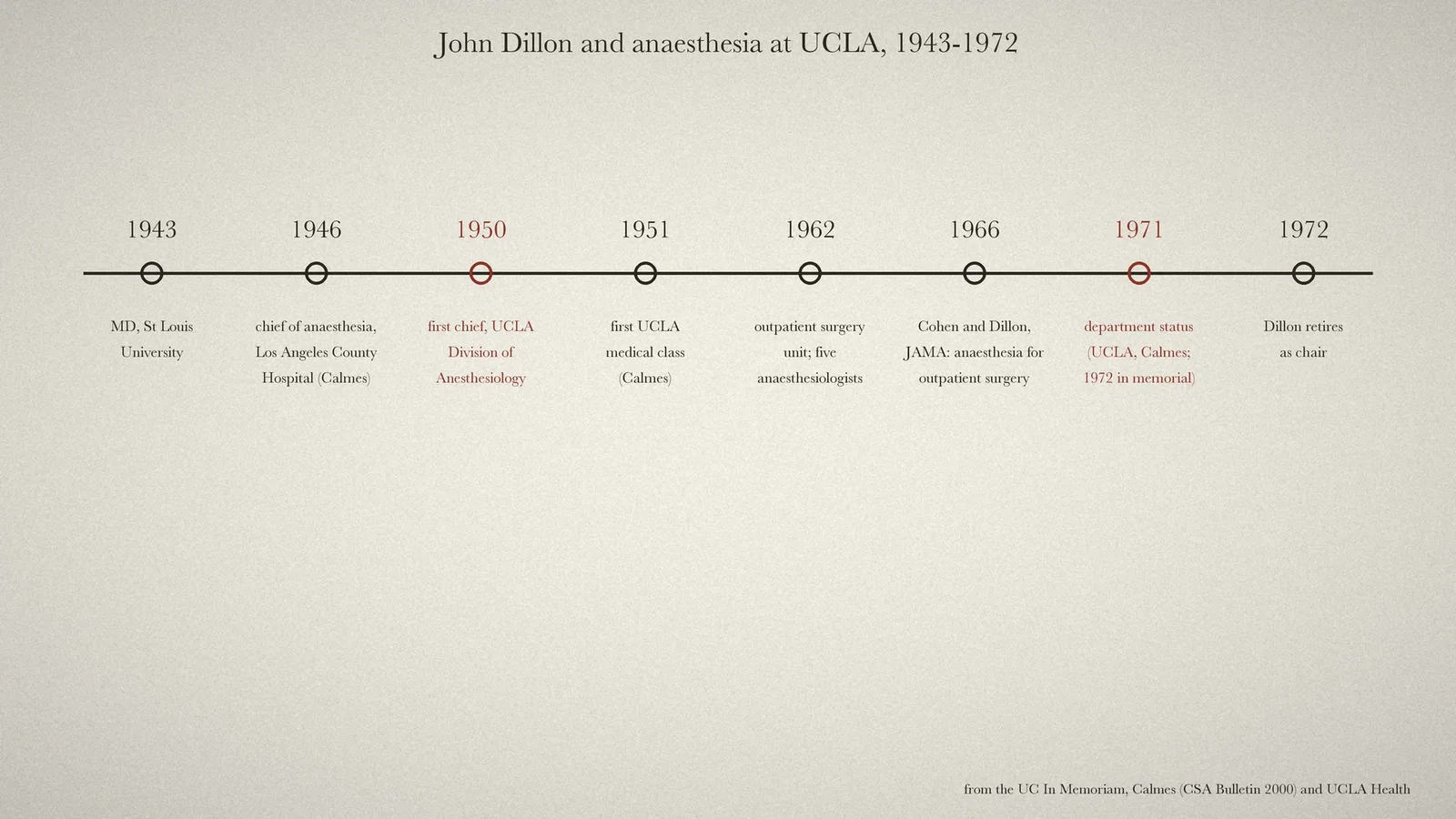
When the University of California founded a medical school in Los Angeles, it did not yet have a hospital. According to the University's memorial for John Bartley Dillon, Dillon "was appointed as the first Anesthesiology division chief in the newly created school in 1950, and became its first chair when Anesthesiology attained department status in 1972". [1] Selma Harrison Calmes, writing in the CSA Bulletin in 2000 from an interview with Dillon and the transcript of Dillon's Wood Library-Museum Living History interview, told the same story in more detail. [2] This article follows those two accounts, and a UCLA tribute to one of Dillon's early faculty, from a physiology laboratory to an independent department.
From physiology to anaesthesia
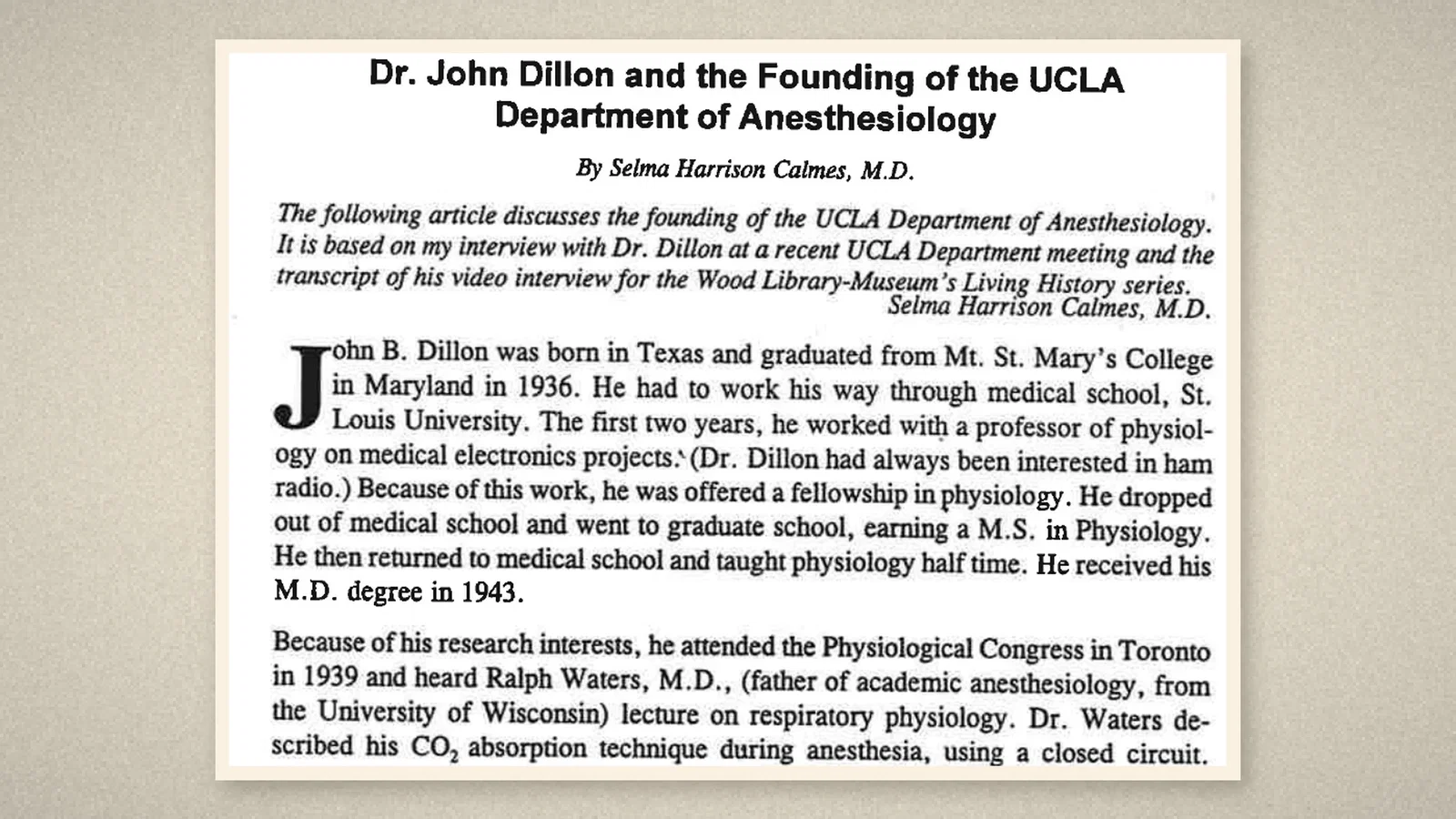
Both accounts begin with physiology. Dillon, a ham-radio enthusiast, had to work through medical school; Calmes writes that a fellowship in physiology led to a master's degree before Dillon returned to graduate from St Louis University in 1943. [1,2] The memorial adds that Dillon "built a photosensitive plethysmograph that recorded blood pulsation in the digits". [1] Calmes traces the turn to anaesthesia to the Physiological Congress in Toronto in 1939, where Dillon heard Ralph Waters describe carbon dioxide absorption in a closed circuit. [2]
During the war Dillon was posted to Letterman Army Hospital in San Francisco and moved to the anaesthesia service. The memorial says Dillon was soon promoted to chief of the service; Calmes names Charles McCuskey as chief, with Dillon running anaesthesia in the mornings and teaching physiology and pharmacology in the afternoons to the "90-day wonders" who were sent to combat areas after short training. [1,2] After the war Dillon became chief of anaesthesia at the Los Angeles County (General) Hospital, from July 1946 in Calmes's account. [1,2]
A division of surgery without a hospital
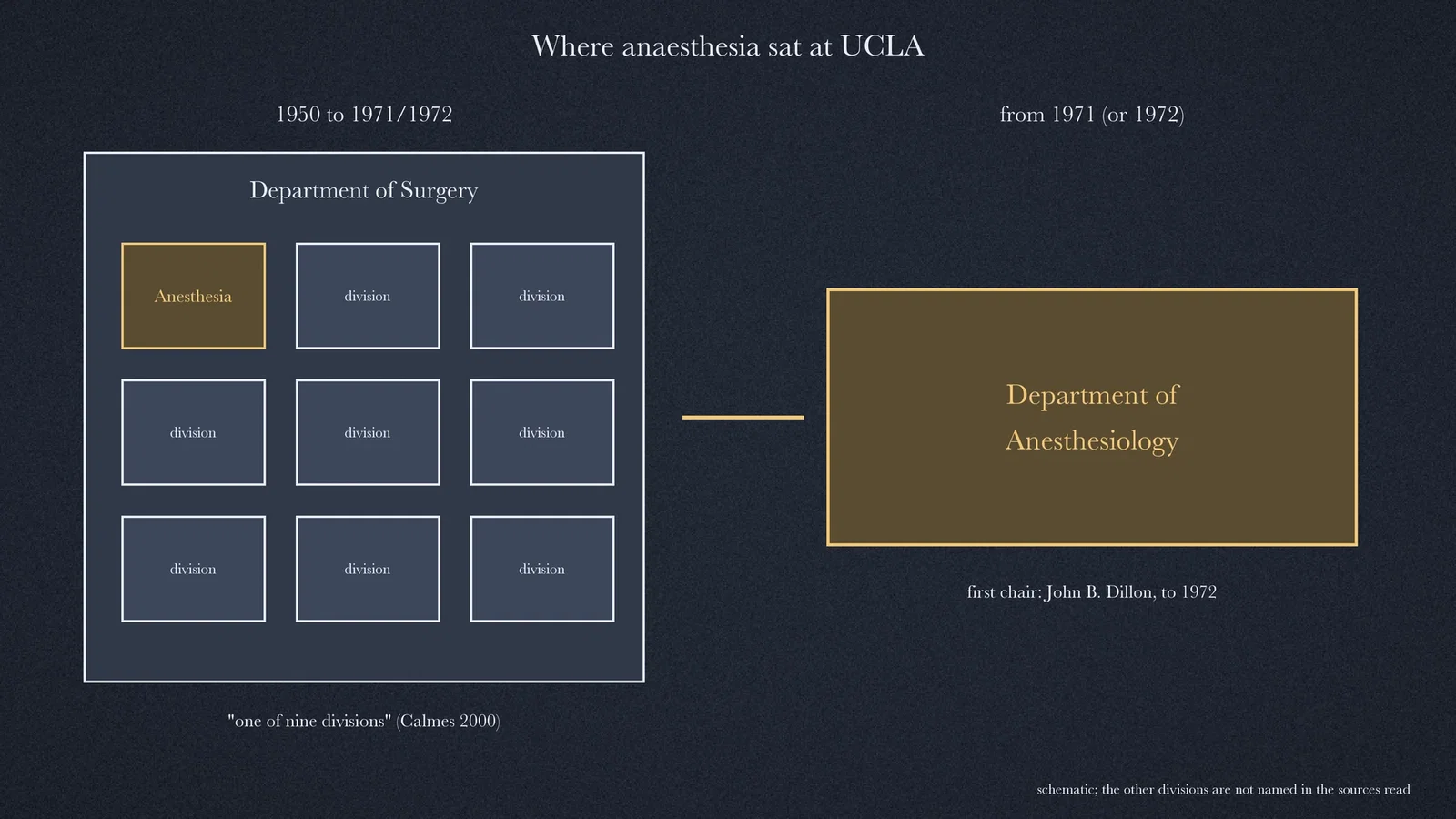
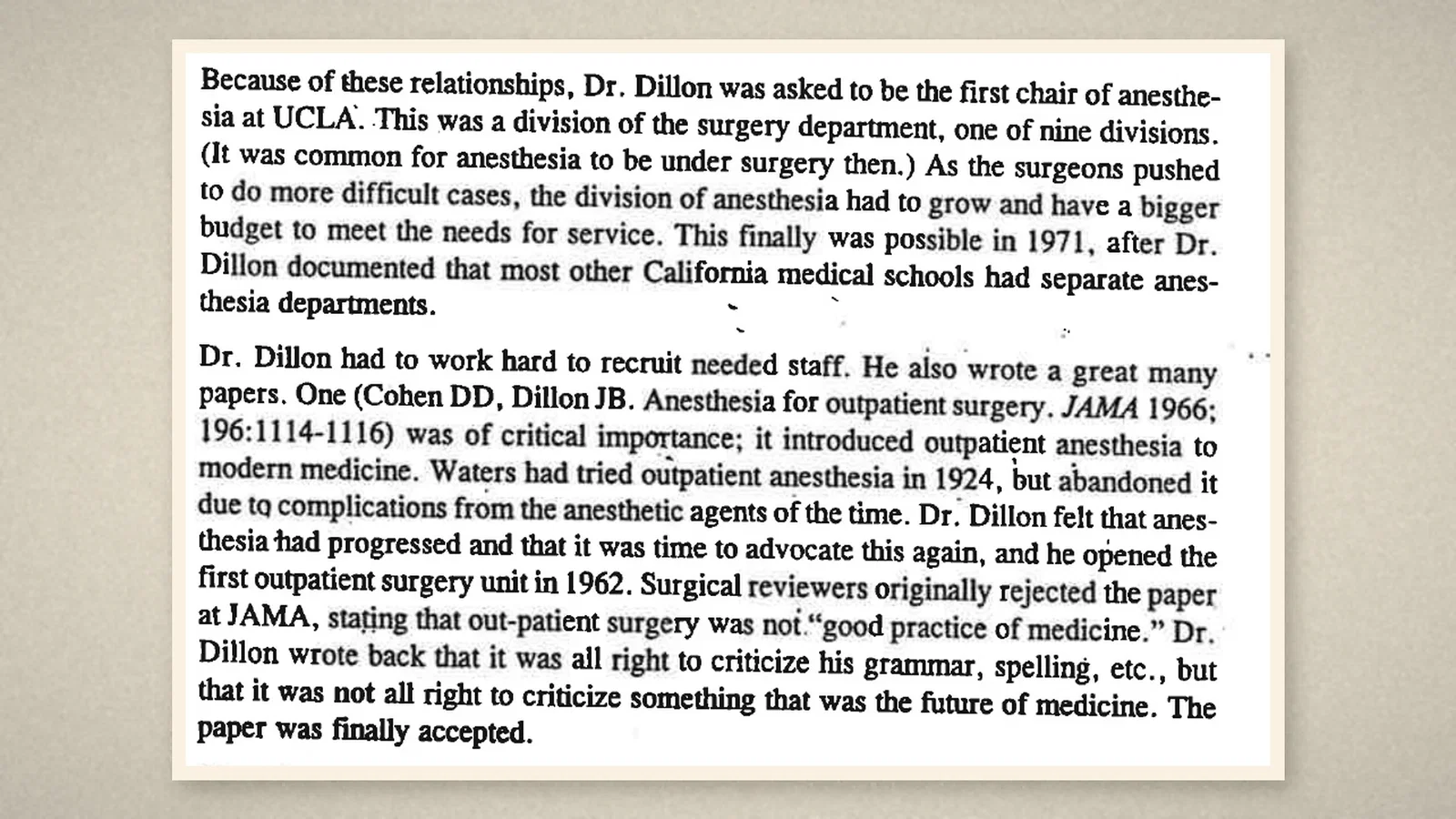
William Longmire, chair of surgery at the new school, recruited Dillon to head the UCLA Division of Anesthesiology. "At the time, there was no hospital on the Westwood campus", and operations were done mainly at Harbor General Hospital in Torrance. [1] Calmes gives the background: planning had begun in 1945, the first class was admitted in 1951, and the building was not finished until 1954; Longmire had to operate at the Wadsworth VA, Harbor General and Santa Monica Hospital, often with Dillon as anaesthesiologist. [2] Calmes describes anaesthesia at UCLA as "a division of the surgery department, one of nine divisions", and notes that it was common then for anaesthesia to sit under surgery. [2] Dillon became professor in 1953. [1] Growth was slow: when Leonard Walts joined in 1962, the division had "just five anesthesiologists on staff". [3] Under Dillon, the memorial says, the faculty eventually grew to more than 30, and hundreds of residents were trained. [1]
Outpatients and nonflammable agents
Two of Dillon's projects reached beyond UCLA. Calmes writes that Dillon opened the first outpatient surgery unit in 1962, and that a 1966 JAMA paper with David D. Cohen on anaesthesia for outpatient surgery was first rejected by surgical reviewers who said out-patient surgery was not "good practice of medicine". [2] The memorial credits Cohen and Dillon with popularising same-day surgery. [1] Calmes also describes Dillon's fight, against the American Board of Anesthesiology and the state fire marshal, to build the new UCLA operating rooms without explosion-proof construction, on the view that the time had come to move to nonflammable agents; it was, Calmes writes, the first major operating suite built without those measures. [2] Calmes adds that Dillon trained foreign residents under a Burroughs Wellcome programme and started an annual meeting that brought speakers such as Mushin, Nunn, Beecher and Cullen. [2]
Becoming a department
Calmes writes that the separation from surgery "finally was possible in 1971", after Dillon documented that most other California medical schools had separate anaesthesia departments. [2] UCLA's tribute to Walts also gives 1971. [3] The University memorial gives 1972, the year Dillon retired as chair and moved to Kauai. [1]
What the record shows
UCLA anaesthesia began, like many American university services of its time, as a division inside surgery, in a school whose hospital was still being built. Dillon's career shows what had to be argued for before independence came: budgets and staff to match surgical demand, operating rooms designed around safer agents, and the legitimacy of operating on patients who went home the same day.
Sources and reading limits
Read: the University of California In Memoriam for John Bartley Dillon; Calmes's three-page 2000 CSA Bulletin article, read as page images (the archived PDF is a scan without a text layer); UCLA Health's tribute to Leonard Walts.
Not covered: Cohen and Dillon's 1966 JAMA paper and their book; Dillon's own papers; the Wood Library-Museum Living History video and its transcript, on which Calmes relied; UCLA departmental records; any record of Dillon's dates of birth and death (the memorial says Dillon died at 96). The year of departmental independence is 1971 in two sources and 1972 in the memorial; both are given. The memorial and Calmes differ on who was chief of anaesthesia at Letterman; both are reported. Calmes's article is a society history based on the subject's own recollections.
Two illustrations are crops of Calmes's article; two are drawn from the sources.
- University of California Academic Senate. In Memoriam: John Bartley Dillon. Website
- Calmes SH. Dr. John Dillon and the founding of the UCLA Department of Anesthesiology. CSA Bull. 2000;49:52-4. Internet Archive PDF
- UCLA Health, Department of Anesthesiology & Perioperative Medicine. A Tribute to Leonard Walts, MD. Website
Continue exploring
Related reading connects shared questions and contexts; it does not by itself establish historical influence.
- 1938: Stuart Cullen's Iowa Division Tries Curare and Xenon
- 1947: William Neff Takes the Hypoxia Out of Nitrous Oxide
- 1985: Ambulatory Anaesthesia Gets Its Own Society
Anesthesia Epochs · The Source Room · About & Editorial Method
Published November 2, 2026. Sources and reading limits are stated above. Illustrations are labelled as original source images or AI-made. Historical accounts are educational; they are not current treatment instructions.