Skinner of Liverpool showed the Obstetrical Society a simple, economical chloroform apparatus for labour; Priestley found it ingenious but fragile.
Reading Library · Anesthesia Epochs · 中文版
Watch the education video (for clinicians)
1862: Skinner's Chloroform Apparatus — Made to Fit a Hat · Anesthesia Epochs Education Series
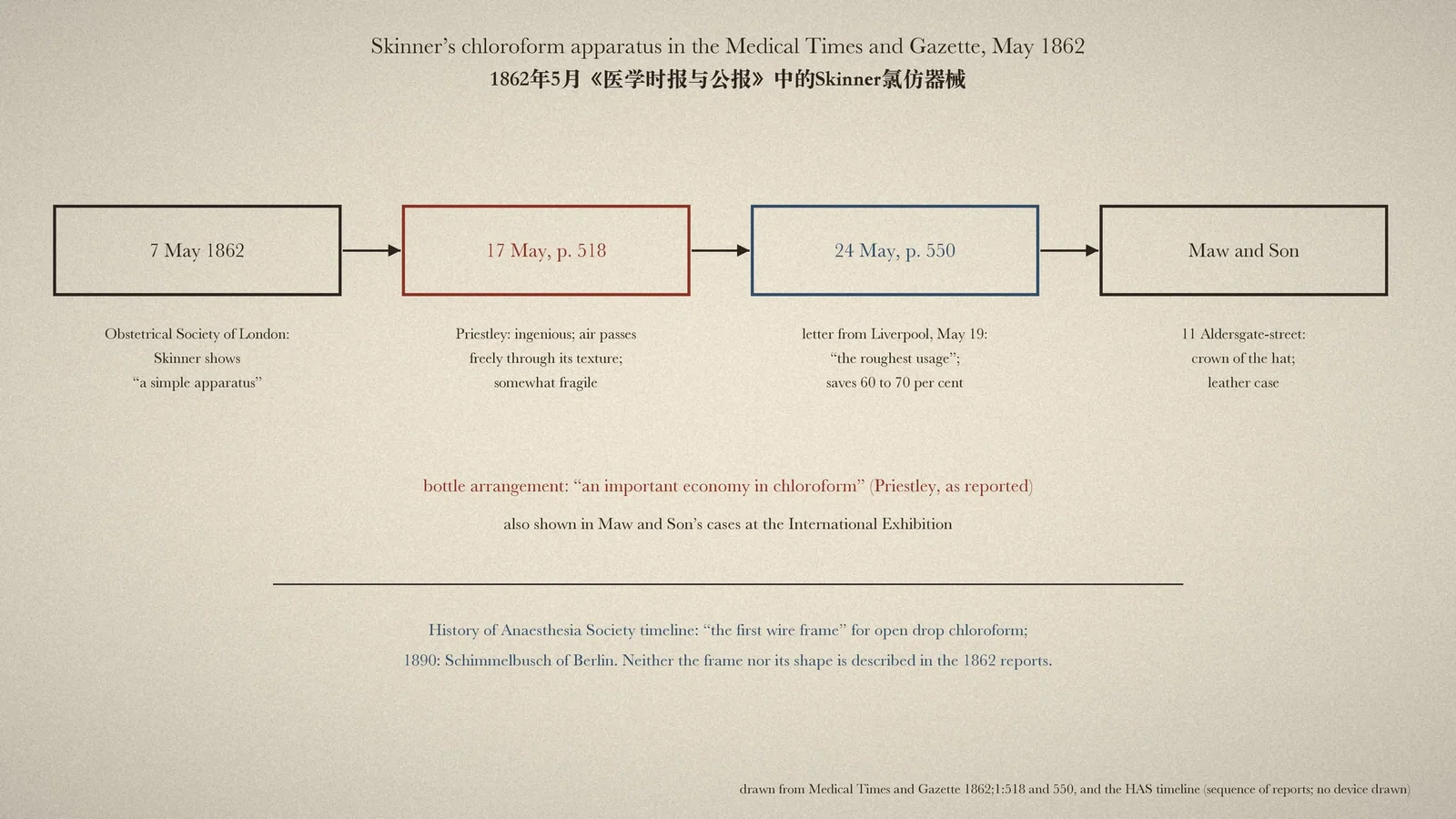
The open-drop chloroform mask, a light frame covered with cloth onto which the drug is dripped, is often traced back to a Liverpool doctor named Thomas Skinner and the year 1862. The History of Anaesthesia Society timeline says that Skinner, a general practitioner and obstetrician, designed "the first wire frame for administration of open drop chloroform", and that Curt Schimmelbusch of Berlin introduced the more familiar wire-framed mask in 1890. This article goes back to what was printed about Skinner's apparatus in London in May 1862, and finds a smaller, more practical story: a cheap, sturdy, portable device meant to save chloroform at the bedside of women in labour. [1][2][3]
The meeting of 7 May 1862
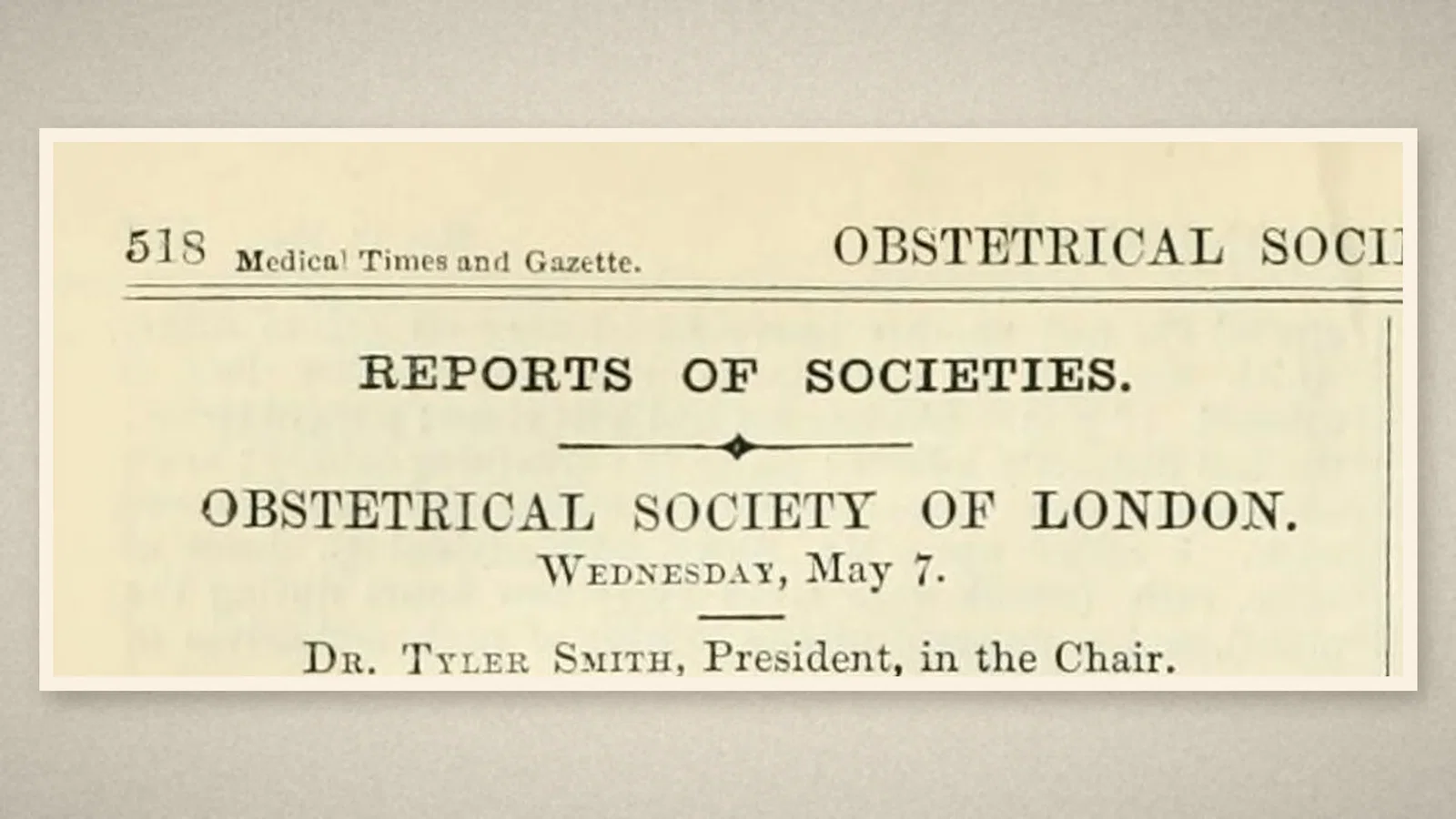
The Medical Times and Gazette of 17 May 1862 reported the Obstetrical Society of London's meeting of Wednesday, 7 May, with Dr Tyler Smith, the President, in the chair. After a paper on the lining of the womb after delivery and a case of unsuspected pregnancy, "Dr. Skinner made some brief remarks" on anaesthesia in midwifery. The object, the report says, was "to show the safety with which chloroform could be employed to relieve the pains of parturition, and to exhibit a simple apparatus by which anaesthetic agents might be economically administered". [1]
The report gives no drawing and no description of the apparatus itself. What it does give is the response in the room. Dr Priestley considered the apparatus ingenious, "and as it allowed air to pass freely through its texture, it was not open to the same objections as a mask or other instrument". In Priestley's view, however, it looked somewhat fragile, and "might be easily broken when clutched by partially insensible patients". The "bottle arrangement", Priestley thought, would prove useful, "and might effect an important economy in chloroform". [1]
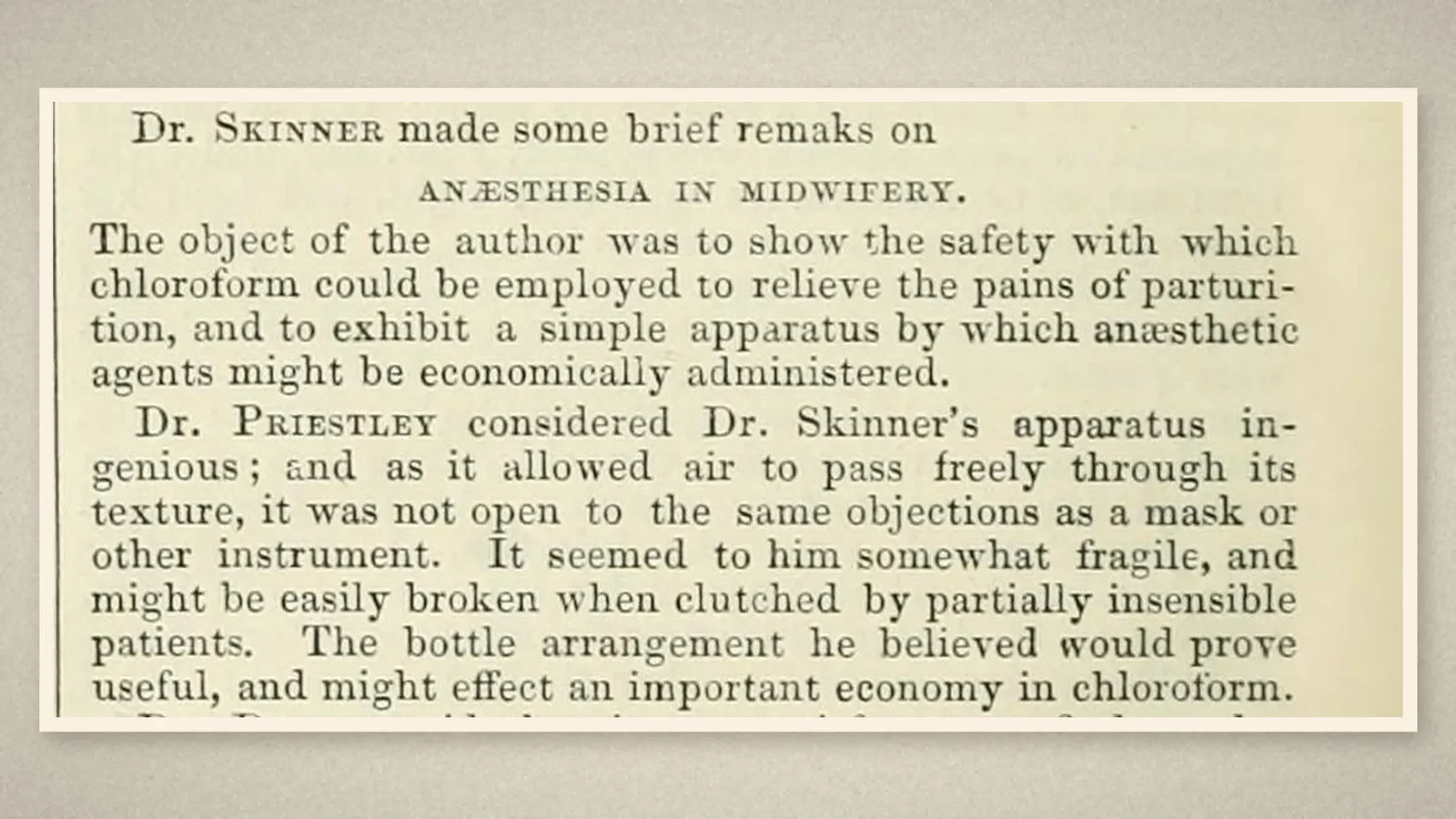
Those few lines contain most of what is known from the meeting. The apparatus let air through a fabric rather than closing over the face; it came with some bottle for giving the chloroform; and its point was economy. Dr Druitt then spoke, not about the device but about the drug, calling the relief of the pains of childbirth by chloroform "one of the greatest boons which modern science had given to humanity". [1]
Skinner's reply
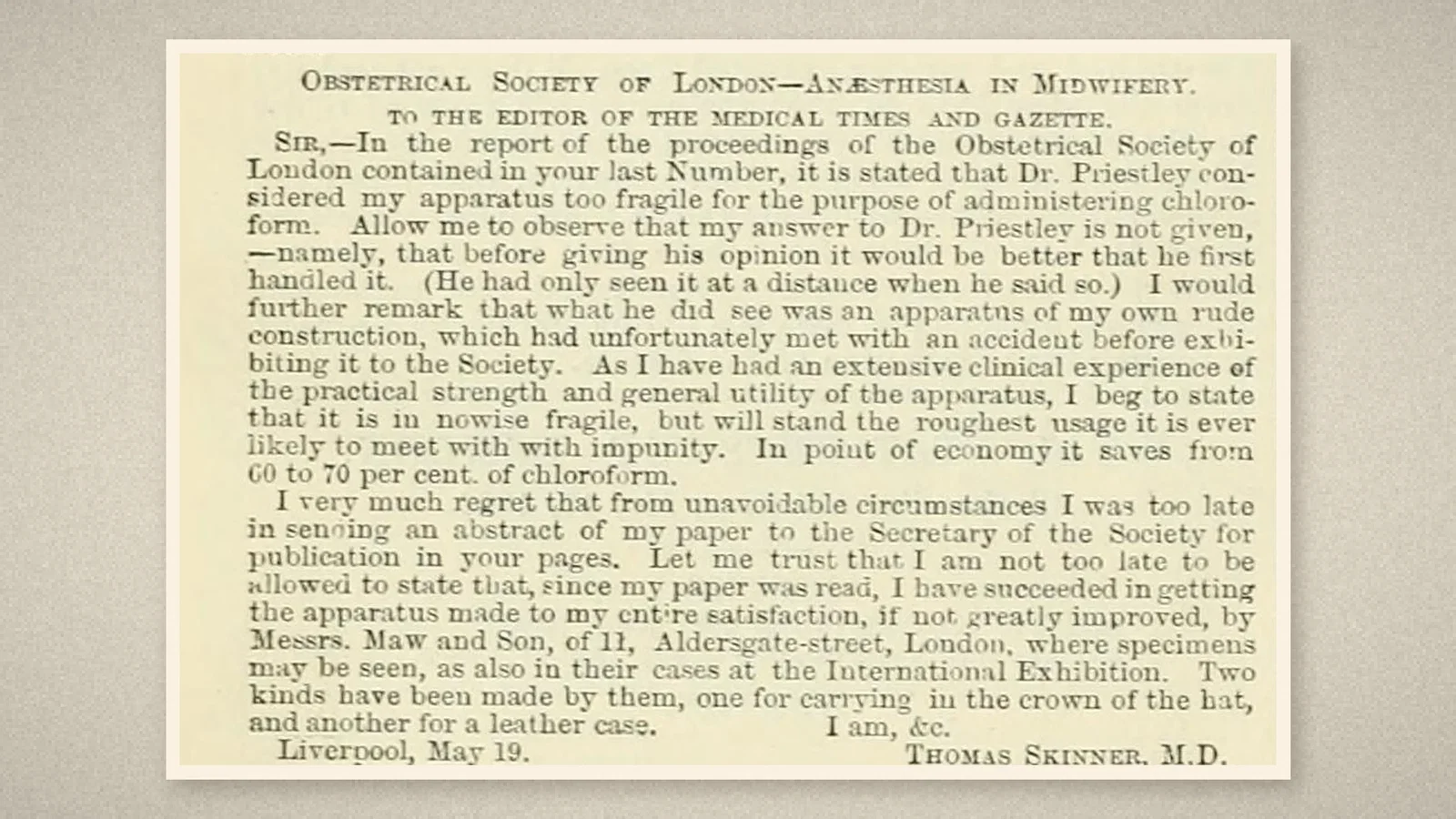
Skinner did not let the charge of fragility stand. A letter dated "Liverpool, May 19" and signed "Thomas Skinner, M.D." appeared in the next number, on 24 May 1862. It complained that the report had left out Skinner's answer to Priestley, namely that it would have been better to handle the apparatus before giving an opinion; according to the letter, Priestley had seen it only from a distance. The apparatus shown, the letter explains, was "of my own rude construction", and had "unfortunately met with an accident" before the meeting. [2]
The letter then makes two claims from what Skinner calls extensive clinical experience: that the apparatus "is in nowise fragile, but will stand the roughest usage it is ever likely to meet with with impunity", and that "in point of economy it saves from 60 to 70 per cent. of chloroform". [2]
Made in two kinds
The last paragraph of the letter is the one that gives the device its later identity. Skinner regretted having sent the abstract of the paper too late for the Society to print it, but reported that since the paper was read the apparatus had been made "to my entire satisfaction, if not greatly improved, by Messrs. Maw and Son, of 11, Aldersgate-street, London", where specimens could be seen, "as also in their cases at the International Exhibition". Then: "Two kinds have been made by them, one for carrying in the crown of the hat, and another for a leather case." [2]
The letter does not say how the hat version was built. Read alongside the rest of the letter, though, the phrase suggests why sturdiness mattered so much to Skinner: this was an apparatus meant to be carried about to patients, not kept on a hospital shelf. That is a reading of the letter, not something it states. The volume's own index lists the letter as "Dr. Skinner on an apparatus for administering" chloroform, page 550, and the meeting under the employment of chloroform in midwifery, page 518. [2]
What the record shows
The May 1862 reports describe an apparatus that was open to the air, cheap to run, sturdy enough to carry, and offered by a London instrument maker in a version for the hat. They do not describe a wire frame, its shape, the cloth used, or how the chloroform was dropped. The modern picture of a wire-framed mask covered with fabric, onto which chloroform is dripped from a bottle, fits these hints well, and the History of Anaesthesia Society states it directly; but it is not in these two pages. [3]
The comments in the room also set out a trade-off that open masks never escaped. Letting air pass freely made the device less objectionable than a closed mask, and saved chloroform; but it left the concentration the patient breathed unmeasured. The same year, in August 1862, Clover's bag at the International Exhibition was praised for the opposite quality: a fixed, measured percentage (see that article).
Sources and reading limits
Read: the report of the Obstetrical Society of London meeting of 7 May 1862 in the Medical Times and Gazette of 17 May 1862, p. 518, and Thomas Skinner's letter dated Liverpool, May 19, in the issue of 24 May 1862, p. 550; the volume index; the History of Anaesthesia Society timeline entry for 1862.
Not covered: Skinner's paper itself, whose abstract by the letter's account reached the Society too late to print; any drawing of the apparatus from 1862; Maw and Son's catalogue; the exhibition jury reports; Schimmelbusch's mask of 1890. The wire-frame description and the word "first" are the timeline's, not the 1862 reports'. The saving of 60 to 70 per cent is Skinner's own claim. Priestley's comments are given as reported in the journal. The use of chloroform in labour is recorded, not endorsed.
Three illustrations are crops of pages 518 and 550 of the 1862 journal; one is drawn from these reports and shows no reconstruction of the device.
- Obstetrical Society of London [meeting of 7 May 1862]. Medical Times and Gazette. 1862;1:518. Internet Archive
- Skinner T. Obstetrical Society of London: anaesthesia in midwifery [letter]. Medical Times and Gazette. 1862;1:550. Internet Archive
- History of Anaesthesia Society. Timeline. HAS
Continue exploring
Related reading connects shared questions and contexts; it does not by itself establish historical influence.
- 1862: Clover Bags Chloroform at Four and a Half Per Cent
- 1853: The Queen's Chloroform, Relief Without an End to Debate
Anesthesia Epochs · The Source Room · About & Editorial Method
Published November 2, 2026. Sources and reading limits are stated above. Illustrations are labelled as original source images or AI-made. Historical accounts are educational; they are not current treatment instructions.