Textbooks credit William Halsted with the first brachial plexus block, but Halsted’s 1885 cocaine paper and follow-up letter never mention the plexus; the claim reaches us through Matas, quoted in 1958.
Reading Library · Anesthesia Epochs · 中文版
Watch the education video (for clinicians)
1885: Halsted and the Brachial Plexus — Attribution Without a Paper · Anesthesia Epochs Education Series
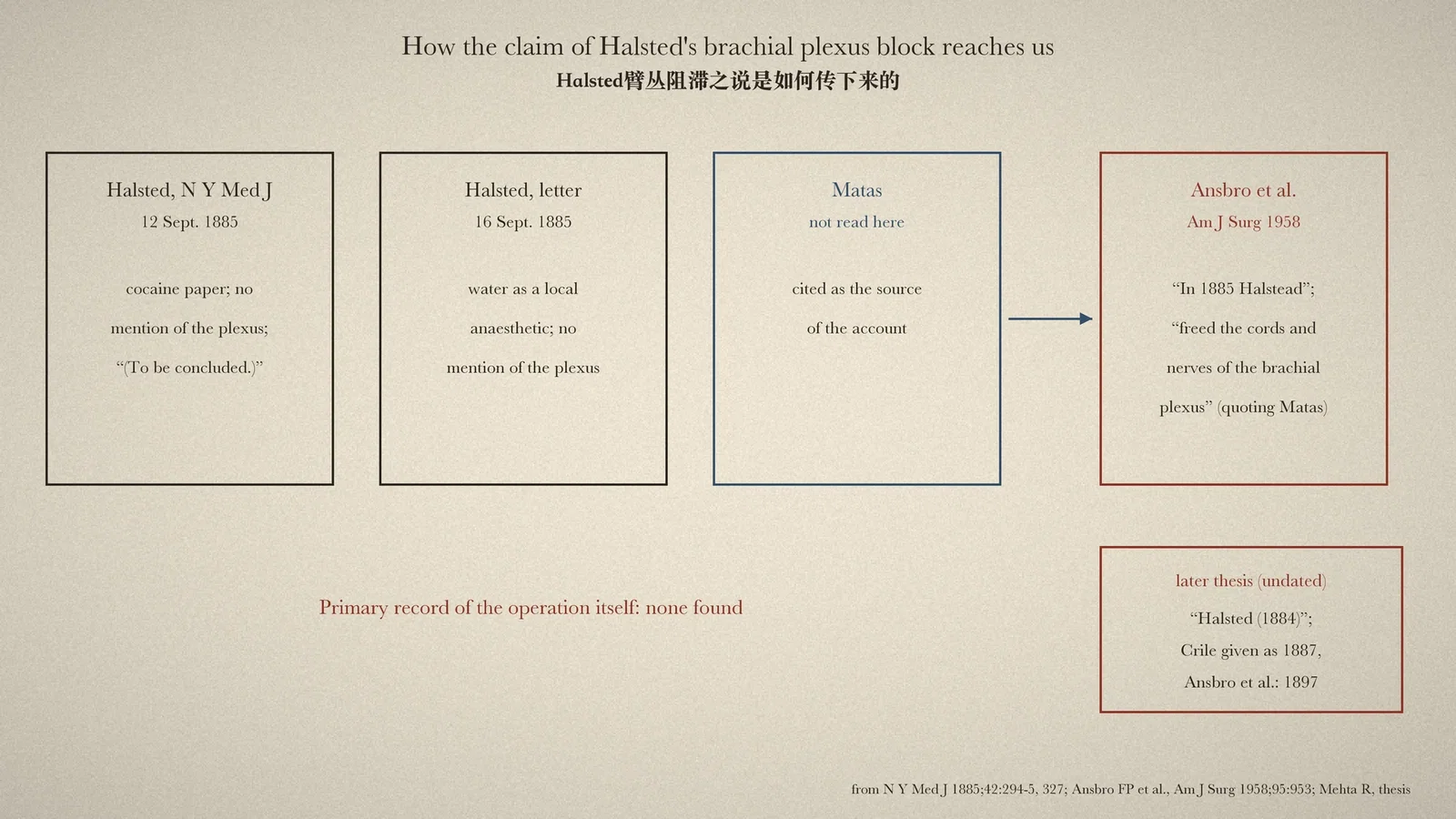
Ask where the brachial plexus block began and most histories give the same answer: William S. Halsted, in New York, in 1884 or 1885, who exposed the nerves in the neck and blocked them with cocaine. This article goes looking for the record of that operation. What it finds is Halsted's own writing on cocaine from 1885, which never mentions the plexus, and a later chain of citations that does. [1] [2] [3]
What Halsted published
On 12 September 1885 the New York Medical Journal printed "Practical comments on the use and abuse of cocaine; suggested by its invariably successful employment in more than a thousand minor surgical operations. By William S. Halsted, M. D." [1] The prose is notoriously hard going: the opening sentence alone fills most of a paragraph. The occasion was a short report by Henry J. Garrigues, "Failure of cocaine hydrochlorate to produce anaesthesia", published two weeks earlier, which Halsted took as typical of the inexperienced trials then appearing. [1]
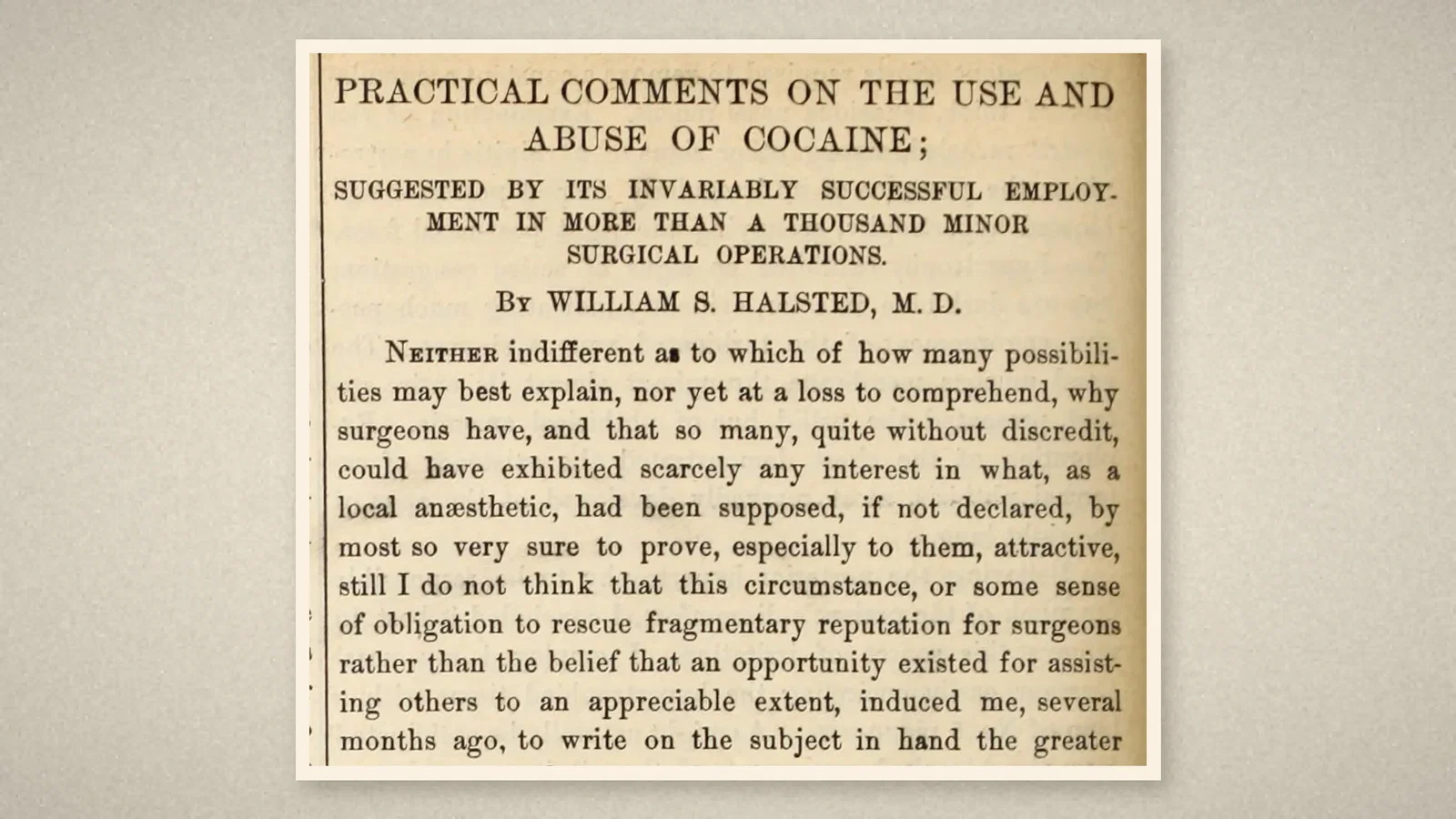
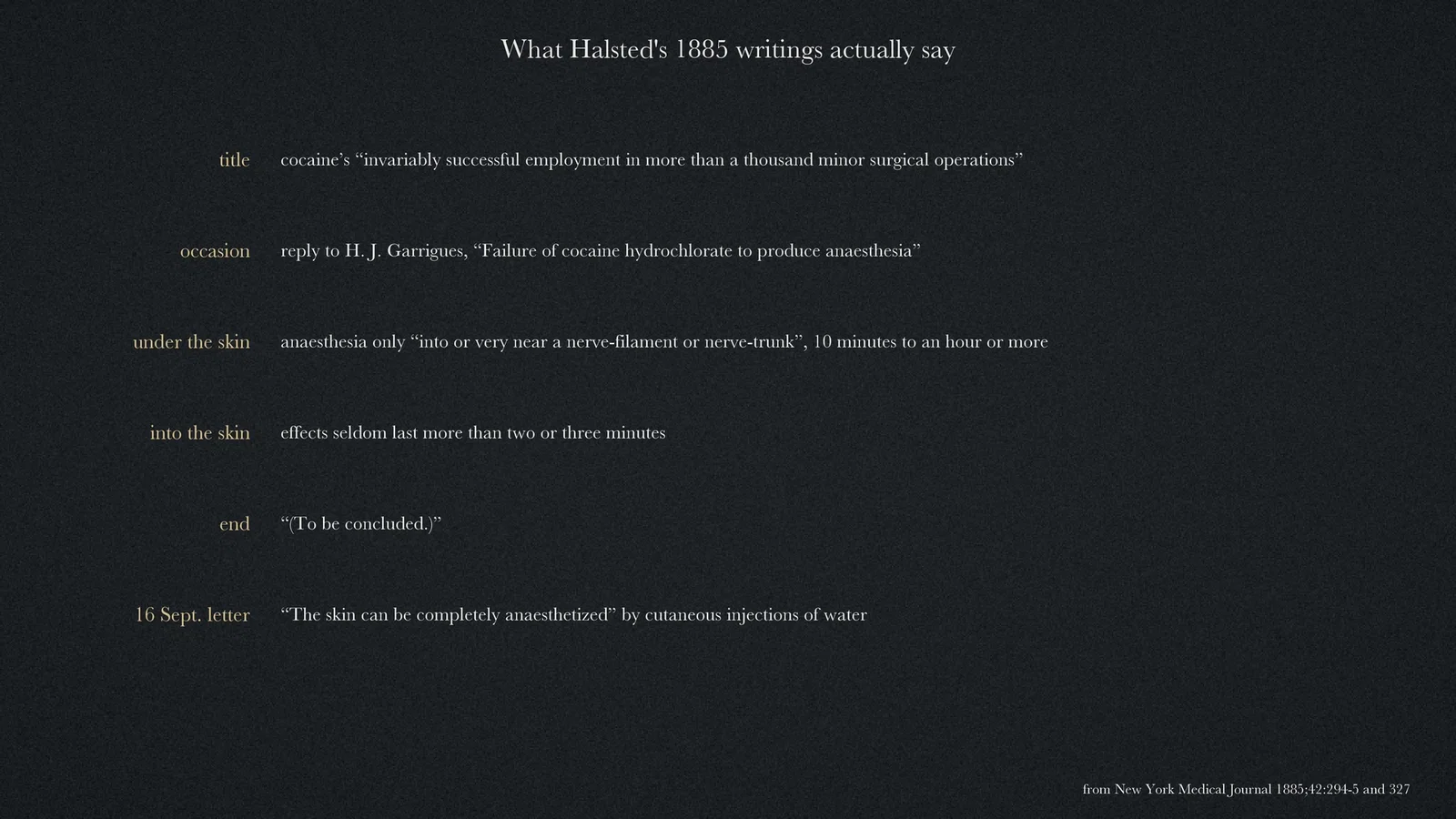
The practical point is clear enough once found. Cocaine "injected under the skin", Halsted wrote, "probably produces anaesthesia of the same only when made into or very near a nerve-filament or nerve-trunk", and the anaesthesia then lasts "from ten minutes to an hour or more"; injected into the skin, its effects "seldom last more than two or three minutes". [1] The paper is about where to put the drug relative to the nerve, which is the principle of nerve blockade, but its example is a minor incision, not a limb. It ends abruptly with "(To be concluded.)". [1]
Four days later, on 16 September, Halsted wrote to the editor that a footnote had been left out. Its substance: "The skin can be completely anaesthetized to any extent by cutaneous injections of water", and Halsted had "at times, of late, used water instead of cocaine in minor operations requiring skin incisions". The editors called it, together with an article by Corning in the same issue, one of the "curiosities of local anaesthesia". [1] Neither the paper nor the letter mentions the brachial plexus.
Where the plexus story comes from
The account appears, in the sources used here, in a 1958 paper on brachial plexus block by F. Paul Ansbro, Albert E. Blundell, Wilbert E. Hernandez and James V. Carter. Its review of the literature begins: "In 1885 Halstead [sic] performed the first regional anesthesia procedure and indeed performed the first operation under brachial block", and it attributes the details to Matas: Halsted "freed the cords and nerves of the brachial plexus after blocking the roots in the neck with cocaine solution." The same paragraph dates Crile's direct injection of each exposed nerve to 1897 and Hirschel's axillary route to 1911. [2]
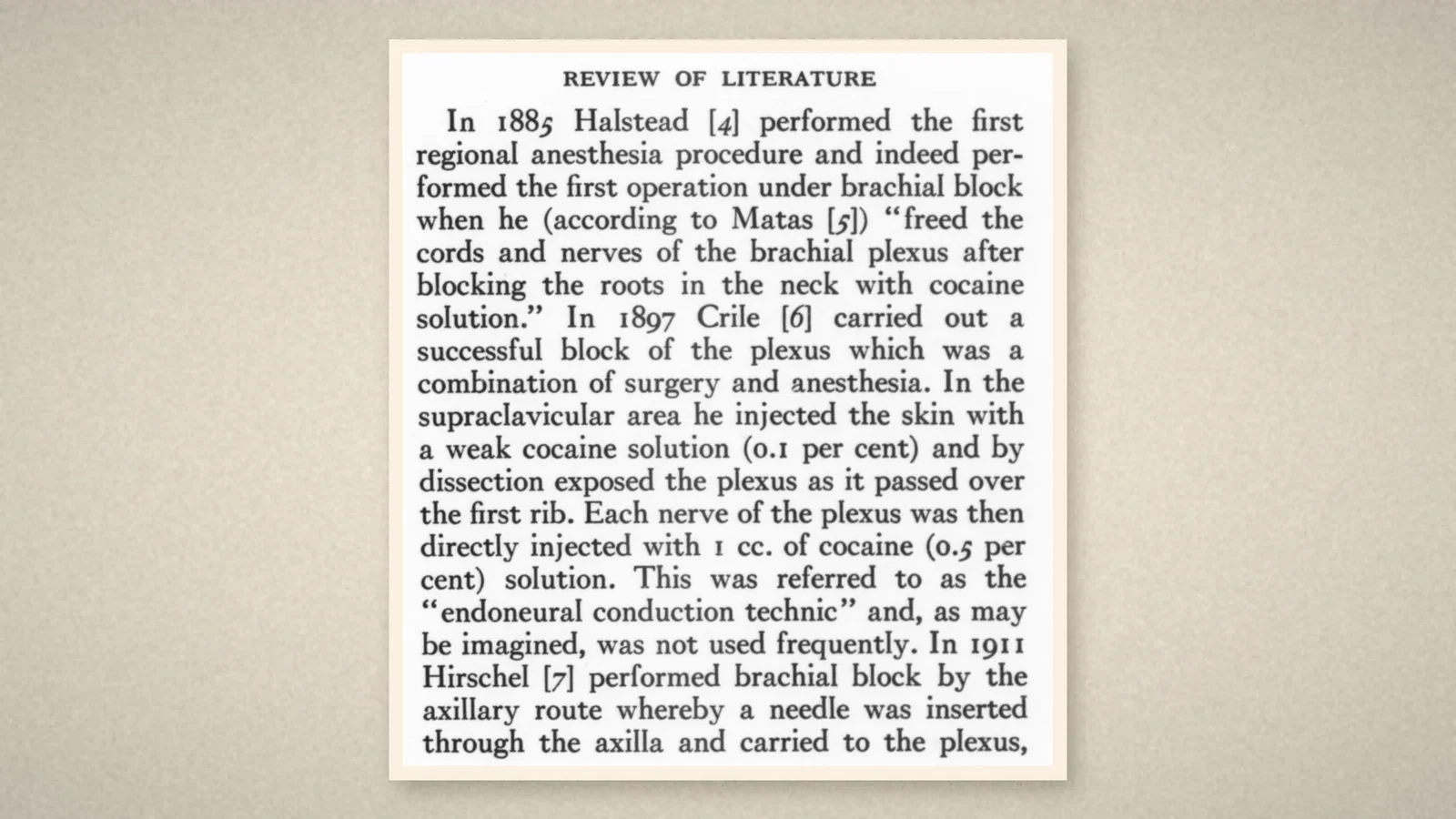
A later Indian MD thesis on brachial plexus block repeats the story with a different date: the block "was first practiced by Prof Halsted (1884) by directly exposing the nerve roots in the neck", and gives Crile's operation as 1887 rather than 1897. [3] The chain therefore runs from an operation for which no record by Halsted was found, through Matas’s 1925 memorial address, which is not covered here, to a 1958 quotation and later retellings whose dates drift.
What the record shows
None of this shows the attribution is wrong. Halsted's 1885 paper does state, plainly, that cocaine works when placed at a nerve trunk, and a surgeon who believed that could well have blocked the roots of the plexus before freeing it. But the operation itself is known here only through later writers, and the date varies between 1884 and 1885 depending on the source. In a history of regional anaesthesia it belongs as a well-repeated attribution with a thin documentary base, alongside the published principle that Halsted did put in print.
Sources and reading limits
Read: Halsted's paper of 12 September 1885 and letter of 16 September 1885 in the New York Medical Journal, vol. 42, pp. 294–295 and 327; the first page and literature review of Ansbro et al. 1958; the historical paragraphs of Mehta's thesis.
Not covered: Matas’s 1925 Halsted memorial address (Bull Johns Hopkins Hosp. 1925;36), which Ansbro et al. cite as the source of the account; Crile’s report; any notebook, letter or hospital record of Halsted’s; histories available only as lending copies; the dental nerve blocks of 1884, covered in a separate article.
Two illustrations are page crops from the 1885 journal and the 1958 article; two are drawn from the sources.
- Halsted WS. Practical comments on the use and abuse of cocaine; suggested by its invariably successful employment in more than a thousand minor surgical operations. N Y Med J. 1885;42:294-5. Halsted WS. Water as a local anaesthetic [letter]. N Y Med J. 1885;42:327. Internet Archive
- Ansbro FP, Blundell AE, Hernandez WE, Carter JV. Brachial plexus block. Am J Surg. 1958;95(6):953-62. PubMed
- Mehta R. Effect of alkalinization of lignocaine hydrochloride on brachial plexus block [MD thesis]. Jhansi: M.L.R. Medical College, Bundelkhand University. Internet Archive
Continue exploring
Related reading connects shared questions and contexts; it does not by itself establish historical influence.
- 1884: Knapp Injects Cocaine Behind the Eye
- 1884: Halsted and Hall Report a Jaw Nerve Block in a Postscript
Anesthesia Epochs · The Source Room · About & Editorial Method
Published November 2, 2026. Sources and reading limits are stated above. Illustrations are labelled as original source images or AI-made. Historical accounts are educational; they are not current treatment instructions.