
On 23 July 1887 George E. Fell kept a morphine-poisoned patient alive through a tracheotomy with a laboratory bellows for two and a half hours, then named the method forced respiration and set out five requirements for the apparatus.
Reading Library · Anesthesia Epochs · 中文版
Watch the education video (for clinicians)
1887: Fell's Bellows — Forced Respiration in Opium Poisoning · Anesthesia Epochs Education Series
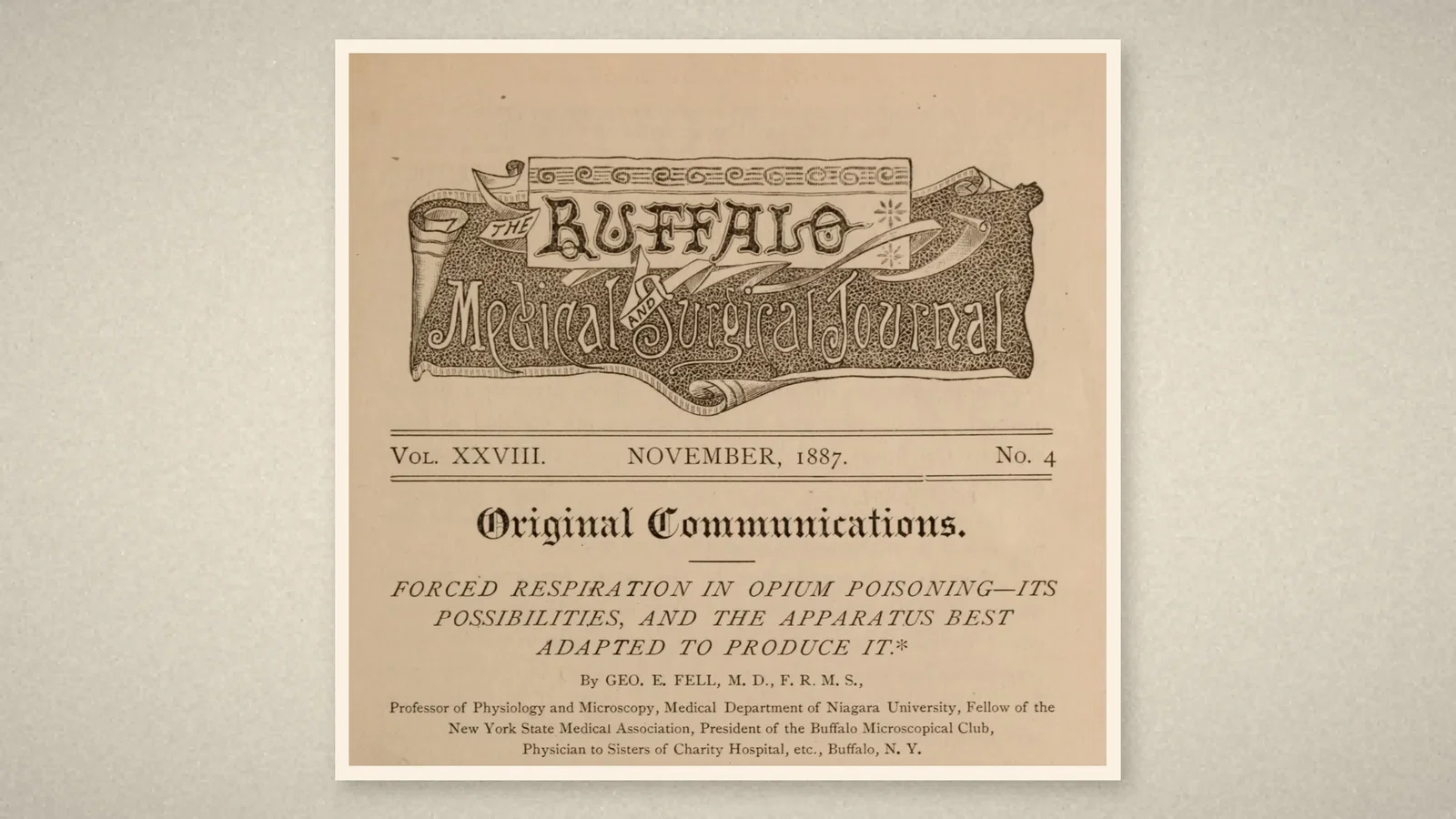
Mechanical ventilation in intensive care has an ancestor in a house on Morgan Street, Buffalo, on a July morning in 1887. The Australian Society of Anaesthetists' timeline records that George Edward Fell, a Buffalo physician, "rediscovered" the use of bellows for intermittent positive pressure ventilation in 1887. This article reads Fell's own report, "Forced respiration in opium poisoning: its possibilities, and the apparatus best adapted to produce it", read at the International Medical Congress in Washington on 9 September 1887 and printed in the Buffalo Medical and Surgical Journal that November. [1][2]
Three kinds of artificial respiration
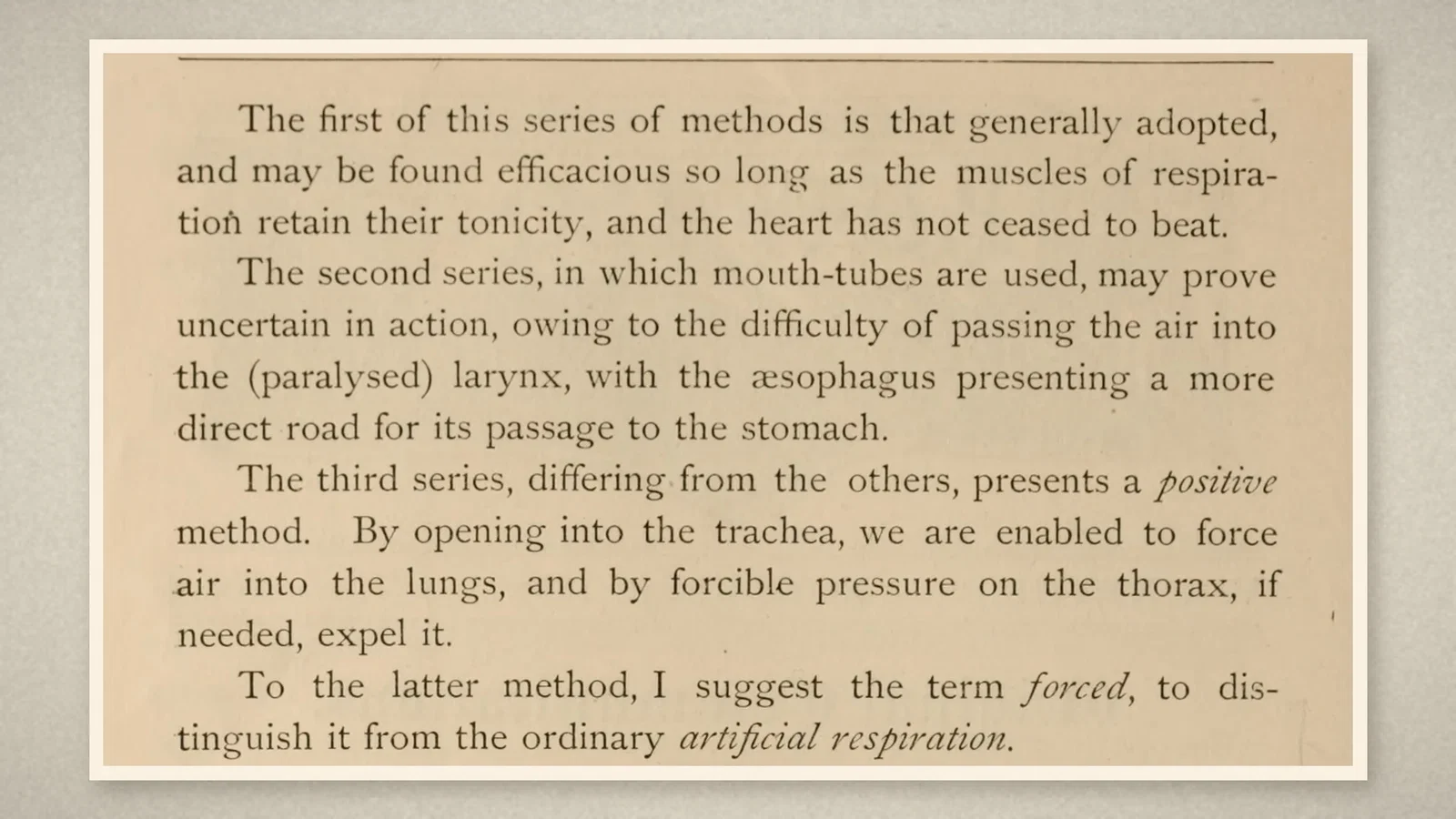
Fell, professor of physiology and microscopy in the medical department of Niagara University, began by sorting the existing methods into three series. The first, the methods of Marshall Hall, Sylvester, Howard and others, moved the patient's limbs or body and pressed on the chest; they worked "so long as the muscles of respiration retain their tonicity, and the heart has not ceased to beat". The second used mouth-tubes and bellows, and was uncertain because of "the difficulty of passing the air into the (paralysed) larynx, with the oesophagus presenting a more direct road for its passage to the stomach". The third was the laboratory method: open the trachea, force air into the lungs and, if needed, press it out again. "To the latter method, I suggest the term forced, to distinguish it from the ordinary artificial respiration." [1]
Fell wrote that, after searching the literature and asking leading Buffalo practitioners, no case could be found in which forced respiration had been used on a human patient in opium poisoning. The paper explains the motive: in June 1886 a night clerk in a Buffalo drug store, Thos. J. Dyke, had died of a morphine overdose despite electricity, atropine, coffee, brandy and Sylvester's method, and Fell had resolved to try the operation if the chance came again. [1]
The case of 23 July 1887
At half past midnight on Saturday 23 July 1887 Fell was called to Patrick Burns, a book-keeper who had taken morphine after drinking heavily. Emetics, atropine and walking the patient round the block failed; by about half past three Sylvester's method was being used, without benefit, and Fell went home a little after five, expecting to sign the death certificate. At about eight Dr F. R. Campbell found the patient still alive and sent for Fell. Respiration was "not more than one per minute", the pulse barely perceptible, the face cyanosed; then the pupils dilated widely, which Fell read as the "dilatation of asphyxia". [1]
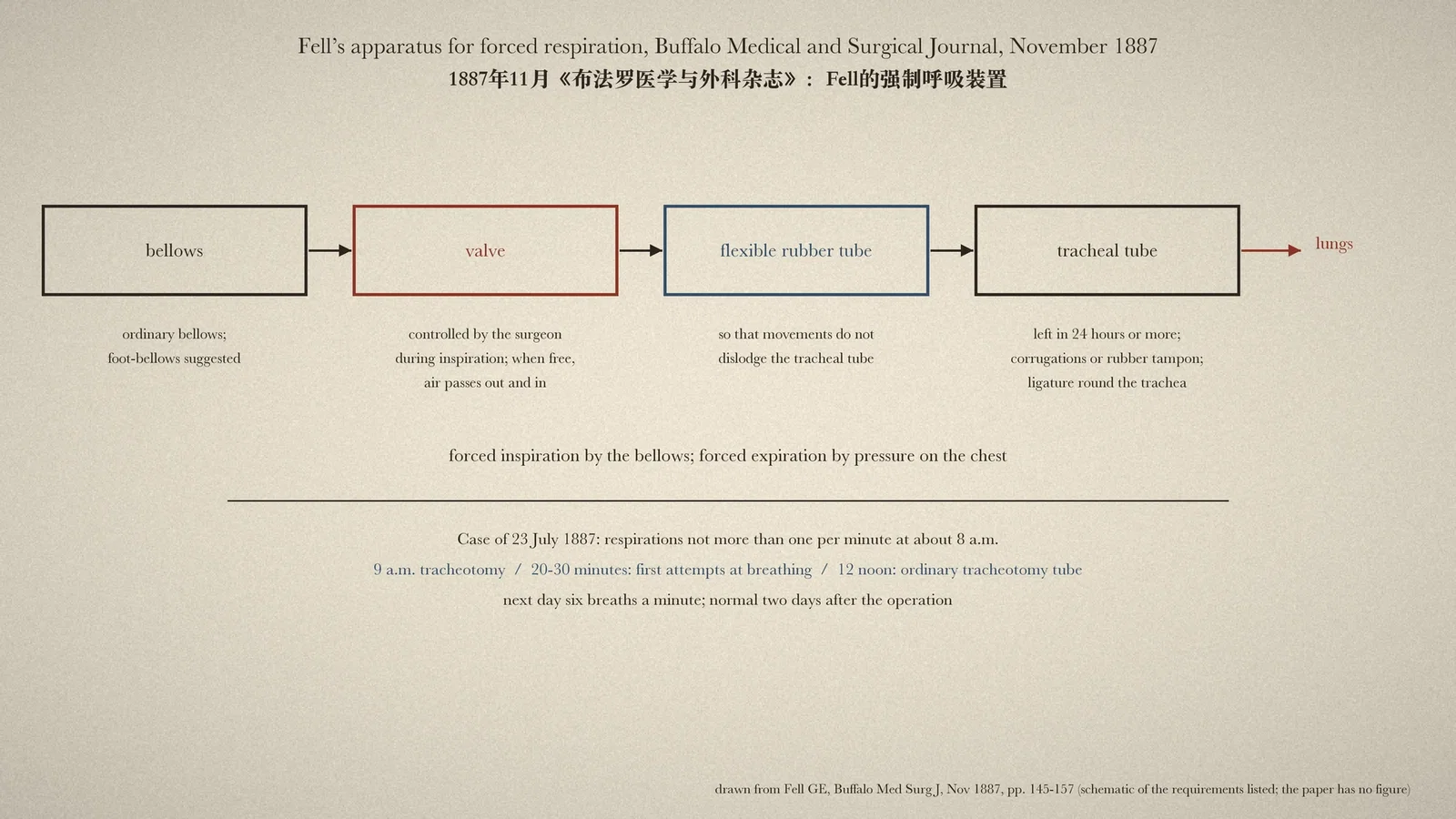
Fell had taught physiology since the department was founded and knew how artificial respiration was done on dogs. The apparatus used for that in the college laboratory was at Fell's house nearby; Campbell agreed to assist, and at nine o'clock, with poorly suited instruments, a low tracheotomy was begun. The bleeding was controlled, and "the greatest difficulty was experienced in passing a ligature about the trachea to prevent the air from passing up the throat". Then the forced respirations began: the bellows inflated the lungs, and since there was no expiratory effort at all, expiration was forced by pressure on the chest. [1]
The heart responded before the lungs. The blood changed from venous to arterial colour and the pulse at the wrist became stronger and regular well before any breathing; the forced respirations ran twenty to thirty minutes before the first attempts at natural breathing. Consciousness returned while the respirations were still being done for the patient, and Fell noted how the effects of withholding or supplying "an excess of air" could be seen. When the patient began to move, the tube loosened and bleeding began again, which Fell called "the most serious time in the operation". At noon, after two and a half hours, an ordinary tracheotomy tube replaced the apparatus. Breathing slowed again to six a minute the next day, and became normal two days after the operation. [1]
What the apparatus needed
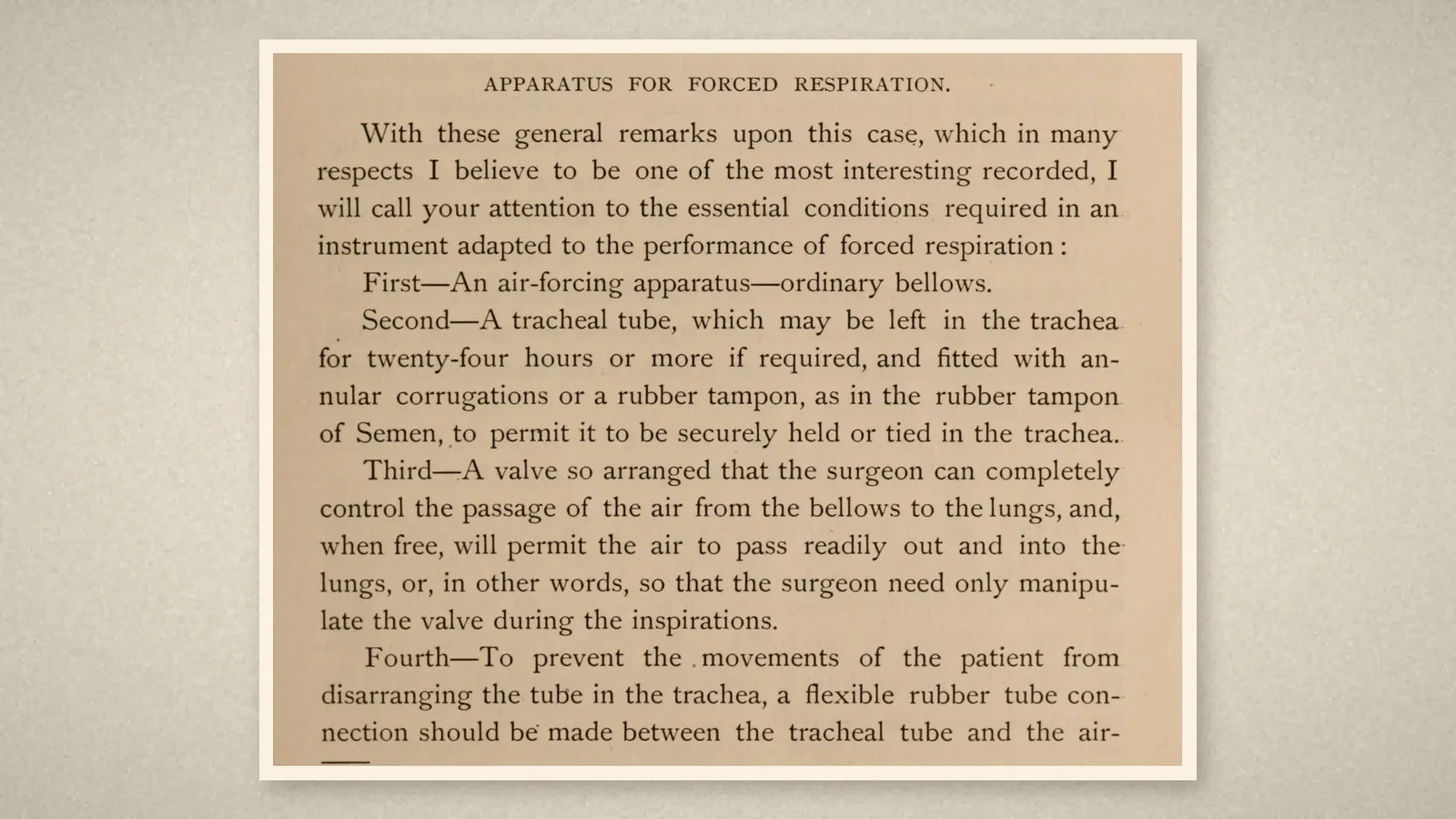
The paper ends with the "essential conditions" for an instrument. First, "an air-forcing apparatus — ordinary bellows". Second, a tracheal tube that could stay in for twenty-four hours or more, with annular corrugations or a rubber tampon so that it could be secured in the trachea. Third, a valve by which the surgeon controlled the air from the bellows, and which, when free, let air pass readily out of and into the lungs. Fourth, flexible rubber connections, so that the patient's movements would not displace the tube. Fifth, a detachable piece on the tracheotomy tube so that respirations could be resumed. Fell added that foot-bellows would let a practitioner work without an assistant, proposed a warmed, humidified air supply through a heated water vessel like a Woolf bottle, and warned that the surgeon must prevent over-inflation. Pure oxygen was thought unnecessary. [1]
What the record shows
Almost every element of an invasive ventilator circuit is named in these pages: a source of positive pressure, a controlled inspiratory valve with free expiration, compliant tubing to protect the airway connection from movement, a tracheal tube that seals and can be left in place, warming and humidification, and the danger of over-inflation. The case also records two observations: the heart recovered before breathing did, and breathing slowed again the next day, which is why Fell concluded that respirations should be "readily renewed within twenty-four hours".
Sources and reading limits
Read: Fell’s paper in the Buffalo Medical and Surgical Journal, November 1887, pp. 145–157, in full; the ASA timeline entry for 1887.
Not covered: Fell’s later papers and the Fell-O’Dwyer apparatus; the case of about 84 hours of ventilation of another doctor described in the ASA timeline, which is not in this paper. The paper has no drawing of the apparatus. The issue’s masthead reads Vol. XXVIII, November 1887, No. 4, while the Internet Archive catalogues the bound volume as 27 (1887–1888); the citation follows the masthead. Fell’s statement that no earlier human case in opium poisoning could be found is Fell’s own, and the treatment is recorded here, not endorsed.
Three illustrations are crops of the 1887 journal; one is drawn from the paper's list of requirements.
- Fell GE. Forced respiration in opium poisoning: its possibilities, and the apparatus best adapted to produce it. Buffalo Med Surg J. 1887 Nov;28(4):145-57. Internet Archive
- Australian Society of Anaesthetists. Anaesthesia history timeline. 2024. ASA
Continue exploring
Related reading connects shared questions and contexts; it does not by itself establish historical influence.
- 1885: O'Dwyer Publishes Intubation of the Larynx
- 1901: Kuhn Passes a Metal Hose Through the Mouth into the Trachea
Anesthesia Epochs · The Source Room · About & Editorial Method
Published November 2, 2026. Sources and reading limits are stated above. Illustrations are labelled as original source images or AI-made. Historical accounts are educational; they are not current treatment instructions.