
On 21 September 1889 Curt Schimmelbusch applied for a British patent on a chloroform mask whose clamp let any air-pervious cloth be fitted fresh for each patient, and in 1892 described a boilable version covered with six to eight layers of new gauze for every anaesthetic.
Reading Library · Anesthesia Epochs · 中文版
Watch the education video (for clinicians)
1889: Schimmelbusch's Mask — A New Cloth Every Time · Anesthesia Epochs Education Series
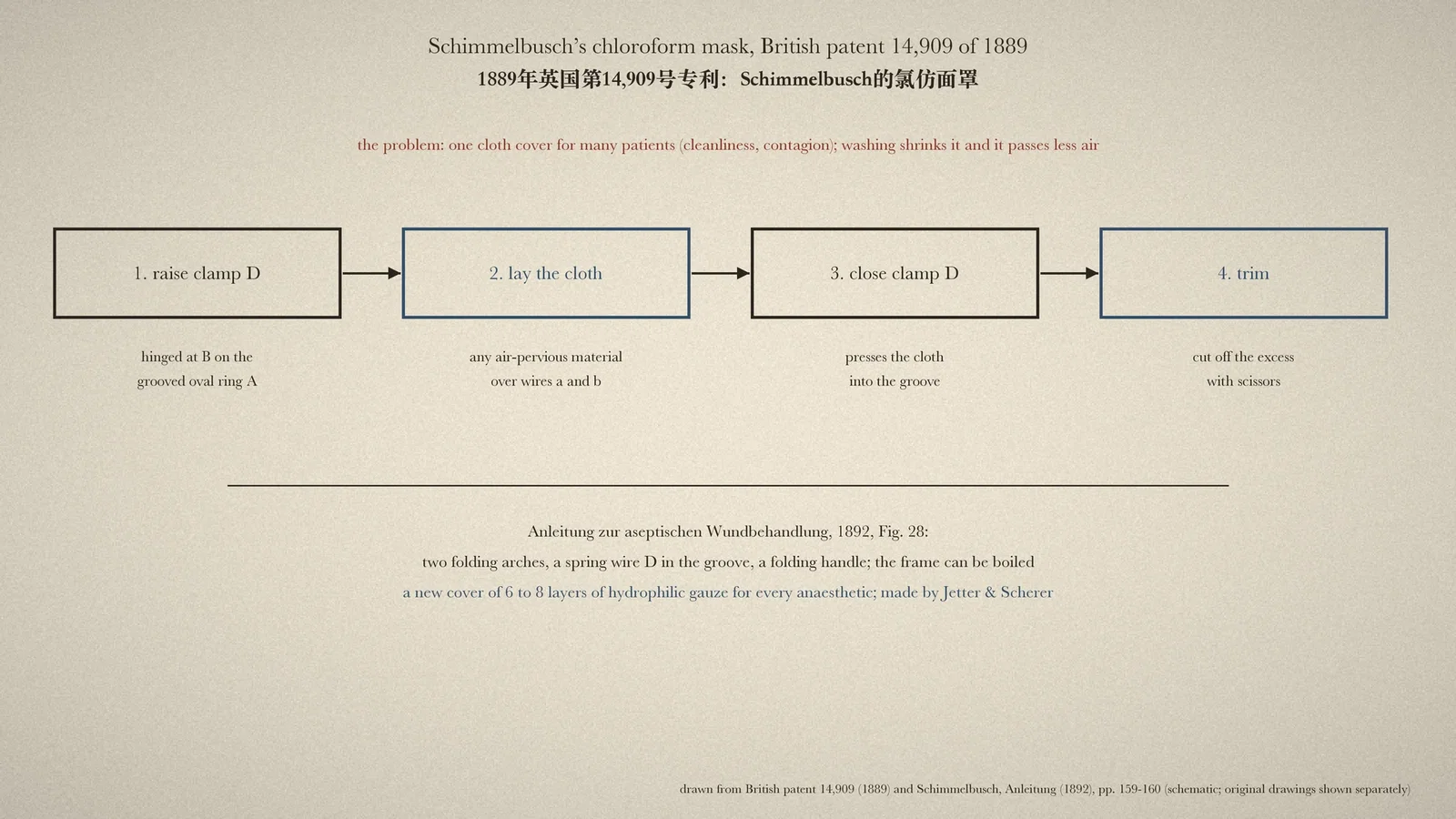
The Schimmelbusch mask, an oval wire frame covered with gauze onto which ether or chloroform is dripped, is the picture most people have of "open drop" anaesthesia. The History of Anaesthesia Society timeline dates it to 1890. This article reads two documents written by Curt Schimmelbusch: a British patent applied for in September 1889, and a guide to aseptic wound treatment published in Berlin in 1892. Both make clear that the frame was not the new idea. The new idea was the cover. [1][2][3]
The patent
British patent no. 14,909 of 1889, "Improvements in Apparatus for Administering Chloroform", was applied for on 21 September 1889 and accepted on 2 November, through agents in Liverpool. The applicant described Schimmelbusch as an assistant medical practitioner "of the Royal Hospital, Ziegelstrasse, Berlin". [1]
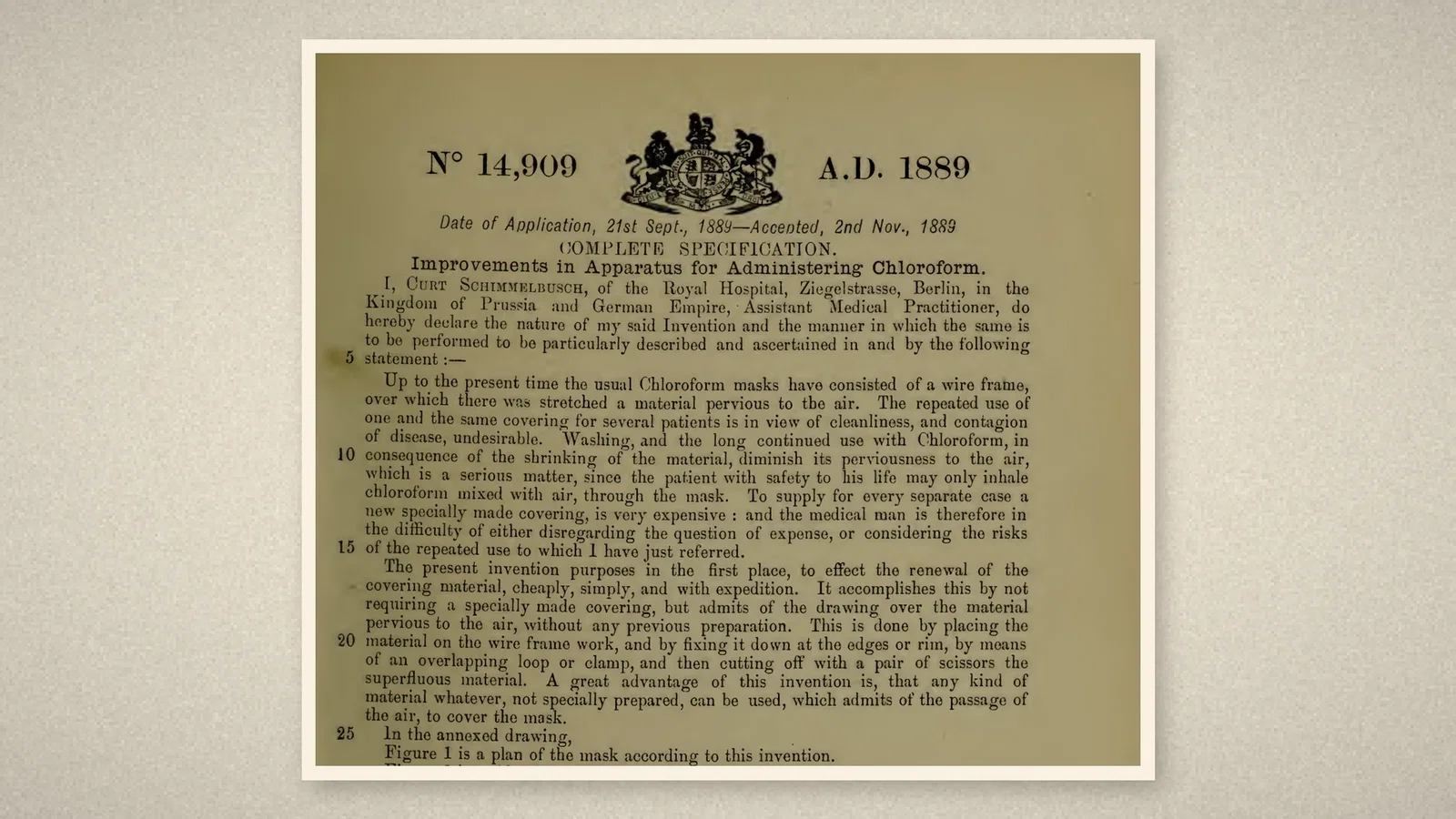
The specification begins with the state of the art: "Up to the present time the usual Chloroform masks have consisted of a wire frame, over which there was stretched a material pervious to the air." It then sets out three problems. Using "one and the same covering for several patients is in view of cleanliness, and contagion of disease, undesirable". Washing, and long use with chloroform, shrank the material and reduced "its perviousness to the air", a serious matter because the patient could safely breathe chloroform only mixed with air through the mask. And a new, specially made cover for every case was "very expensive". [1]
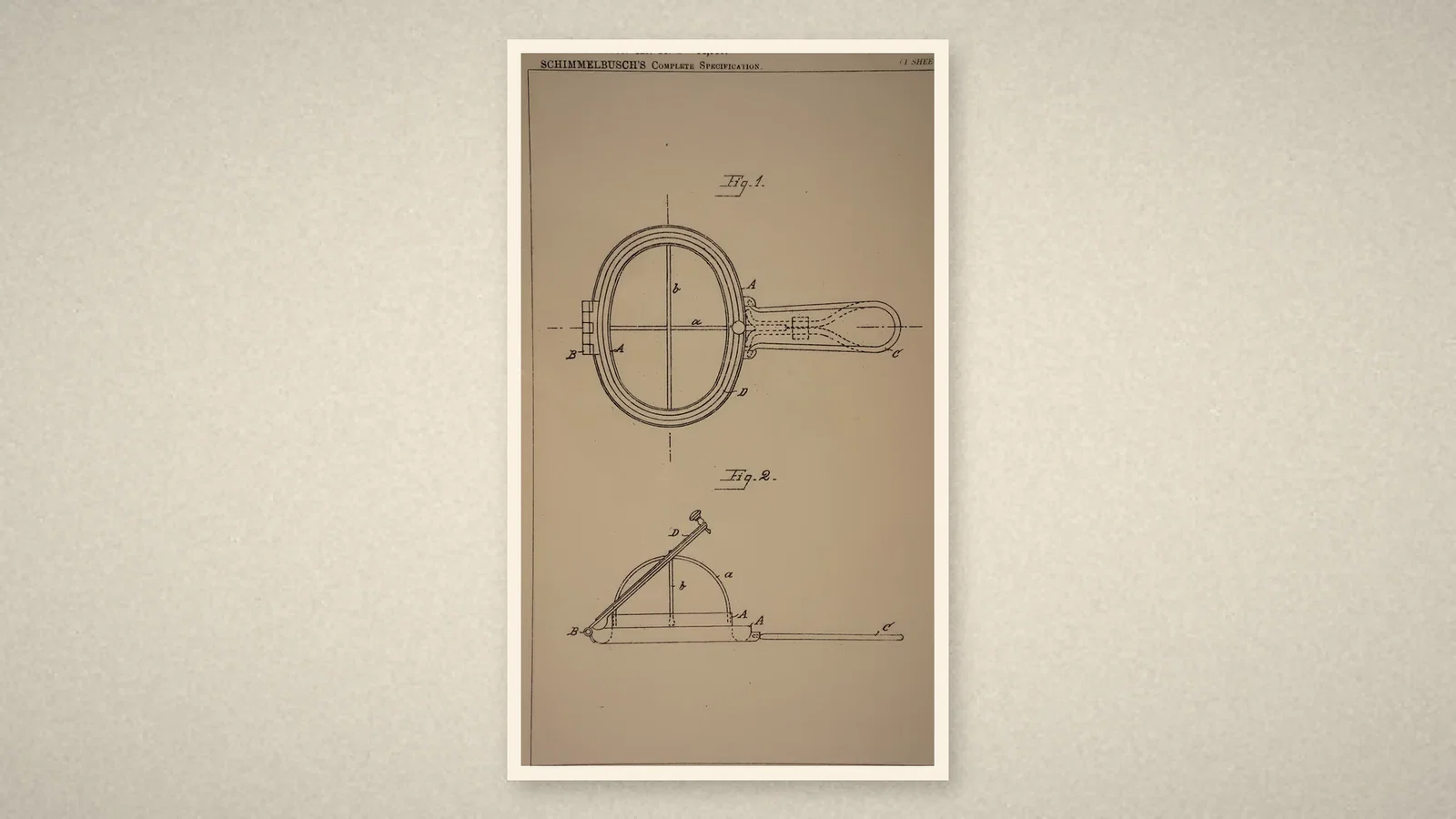
The invention was meant "to effect the renewal of the covering material, cheaply, simply, and with expedition". The mask was an oval grooved metal ring shaped to the face, with a hinge on one side and a handle on the other; inside the ring, two bent wires arched along the axes of the oval. A loop or clamp, hinged at the same point, closed onto the groove. To use it, one raised the clamp, laid the cloth over the wires, shut the clamp down into the groove, and "then cutting off with a pair of scissors the superfluous material". "Any kind of material whatever, not specially prepared," could be used, as long as it let air through. [1]
The 1892 version
Three years later, in the Anleitung zur aseptischen Wundbehandlung, a handbook of aseptic surgery, Schimmelbusch returned to the mask in the chapter on the operation. Instruments used for chloroform, "in particular the mask", deserved attention, the book argued, especially in operations on the face or mouth, since erysipelas, diphtheria and the like could easily be carried by infected chloroform masks and mouth gags. Gags and tongue forceps could be boiled with the other instruments; the author had designed a mask "whose wire frame can likewise be boiled" and which could easily be given a new cover of sterile gauze for every anaesthetic. [2]
The book names the competition. Even the widely used masks of Esmarch and of Skinner, "these simple wire frames with a cloth cover tied over them", were far from easy to keep clean; a fitted cloth cover for every anaesthetic was too costly, and frequent washing or disinfection shrank the cloth, so that it let through less air, the dilution of the chloroform vapour fell and "the danger of asphyxia rises". [2]
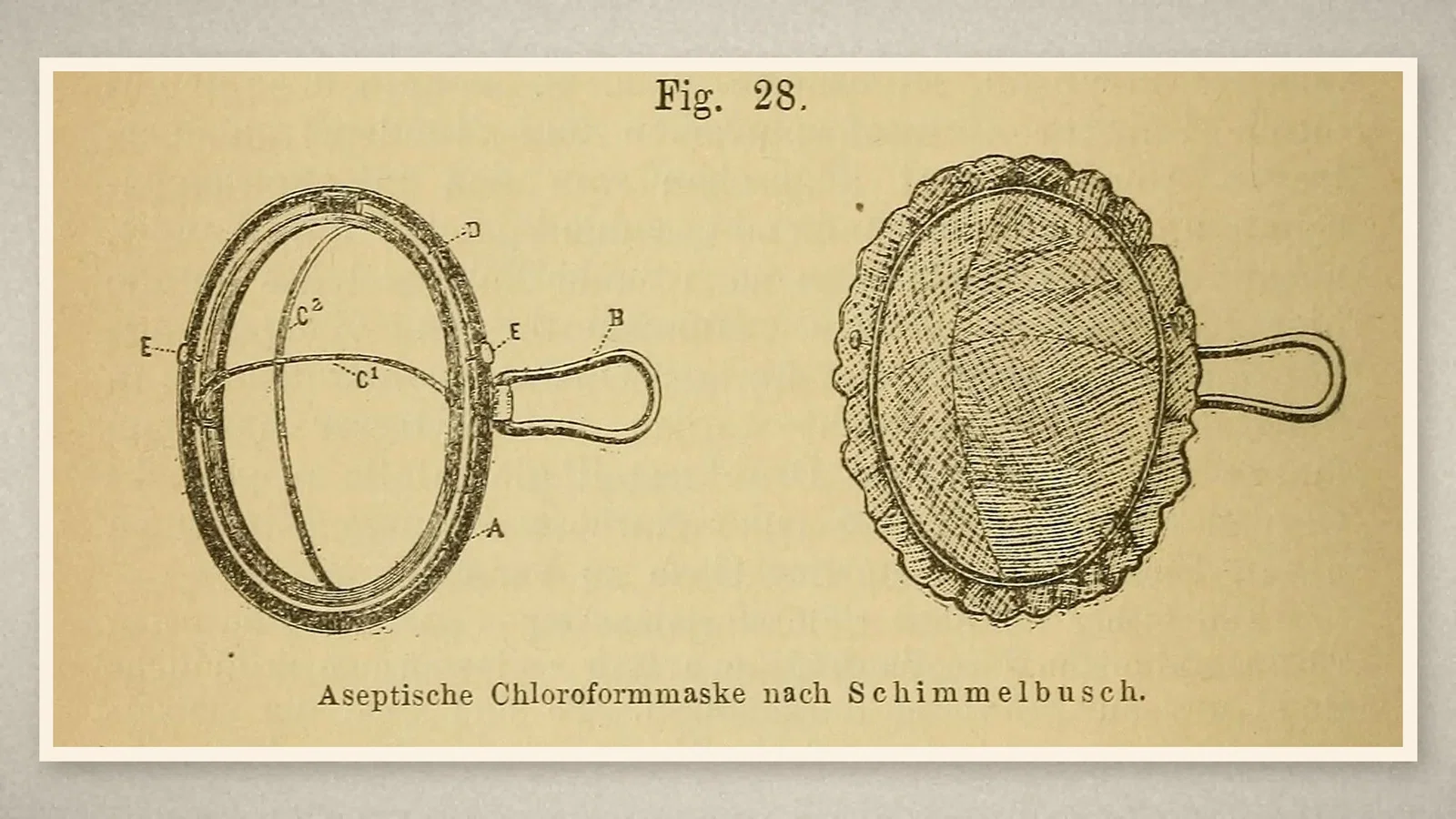
The 1892 mask differs from the patent drawing. Two arches, which fold up and lock where they cross, replace the fixed wires; a springing wire lying in the groove of the ring, removed by two small handles, replaces the hinged clamp; and the handle folds. Six to eight layers of hydrophilic gauze were laid over the frame, the spring wire pressed them into the groove, and the excess was cut off with scissors, "not too close to the ring". A footnote says the mask was made by Jetter & Scherer and could be had from all instrument dealers. [2]
What the record shows
The Schimmelbusch mask is usually remembered as a shape. These documents show that it was designed as an answer to infection control: a cheap frame that could be boiled, and a disposable, standardised cover that kept the same air permeability every time. The reasoning that connects the two problems is worth keeping: a dirty or shrunken cover was not only unhygienic but dangerous, because it reduced the air diluting the vapour. The modern single-use face mask follows the same logic.
Sources and reading limits
Read: British patent 14,909 of 1889, complete specification and drawing; Schimmelbusch’s Anleitung zur aseptischen Wundbehandlung (Berlin 1892), pp. 159–160 with Fig. 28; the History of Anaesthesia Society timeline.
Not covered: any German patent or journal description of 1889 or 1890; a further timeline entry and museum record; the masks of Esmarch and Skinner themselves. The timeline gives 1890; the article uses the date of the patent application, 21 September 1889. The patent and the book describe different versions, and both are given as printed. Both documents say that wire-frame masks covered with cloth were already in use. Quotations from the German are translated for this article.
Three illustrations are crops of the 1889 patent and the 1892 book, including their original drawings; one is drawn from the patent.
- Schimmelbusch C. Improvements in apparatus for administering chloroform. British patent 14,909. London: HMSO; 1889. Internet Archive
- Schimmelbusch C. Anleitung zur aseptischen Wundbehandlung. Berlin: Hirschwald; 1892. pp. 159-60. Internet Archive
- History of Anaesthesia Society. Timeline. HAS
Continue exploring
Related reading connects shared questions and contexts; it does not by itself establish historical influence.
- 1862: Skinner Shows a Chloroform Apparatus to Fit a Hat
- 1908: Ombrédanne's Ether Inhaler with a Confined Atmosphere
Anesthesia Epochs · The Source Room · About & Editorial Method
Published November 2, 2026. Sources and reading limits are stated above. Illustrations are labelled as original source images or AI-made. Historical accounts are educational; they are not current treatment instructions.