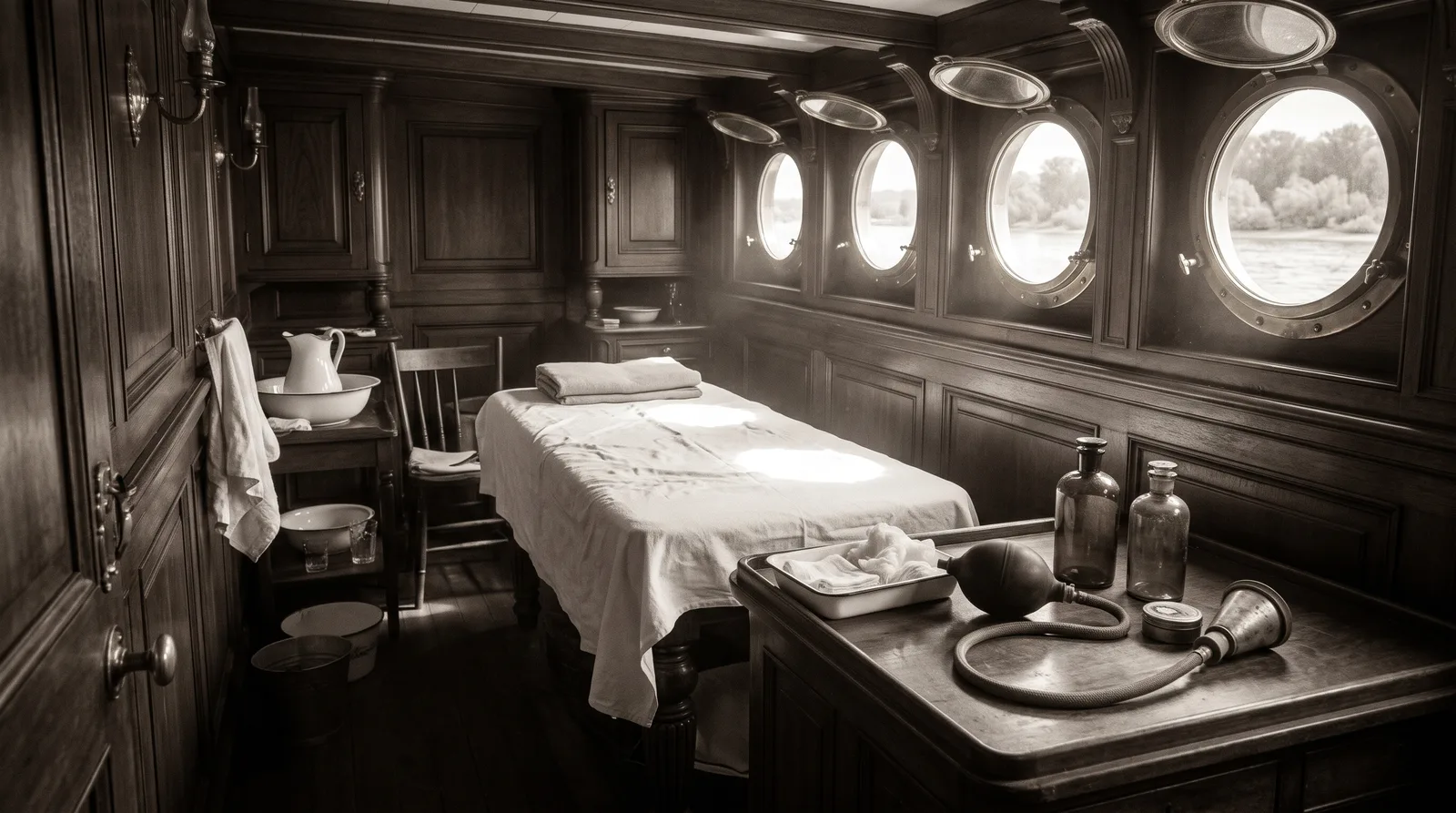
In 1917 the surgeon W. W. Keen revealed that in July 1893 President Grover Cleveland’s jaw tumour had been removed in secret aboard the yacht Oneida, with nitrous oxide from a dentist for the first steps and ether from O’Reilly for the rest, because the doctors feared the anaesthetic more than the operation.
Reading Library · Anesthesia Epochs · 中文版
Watch the education video (for clinicians)
1893: Cleveland's Secret Jaw Surgery — The Anesthetic Troubled Us · Anesthesia Epochs Education Series
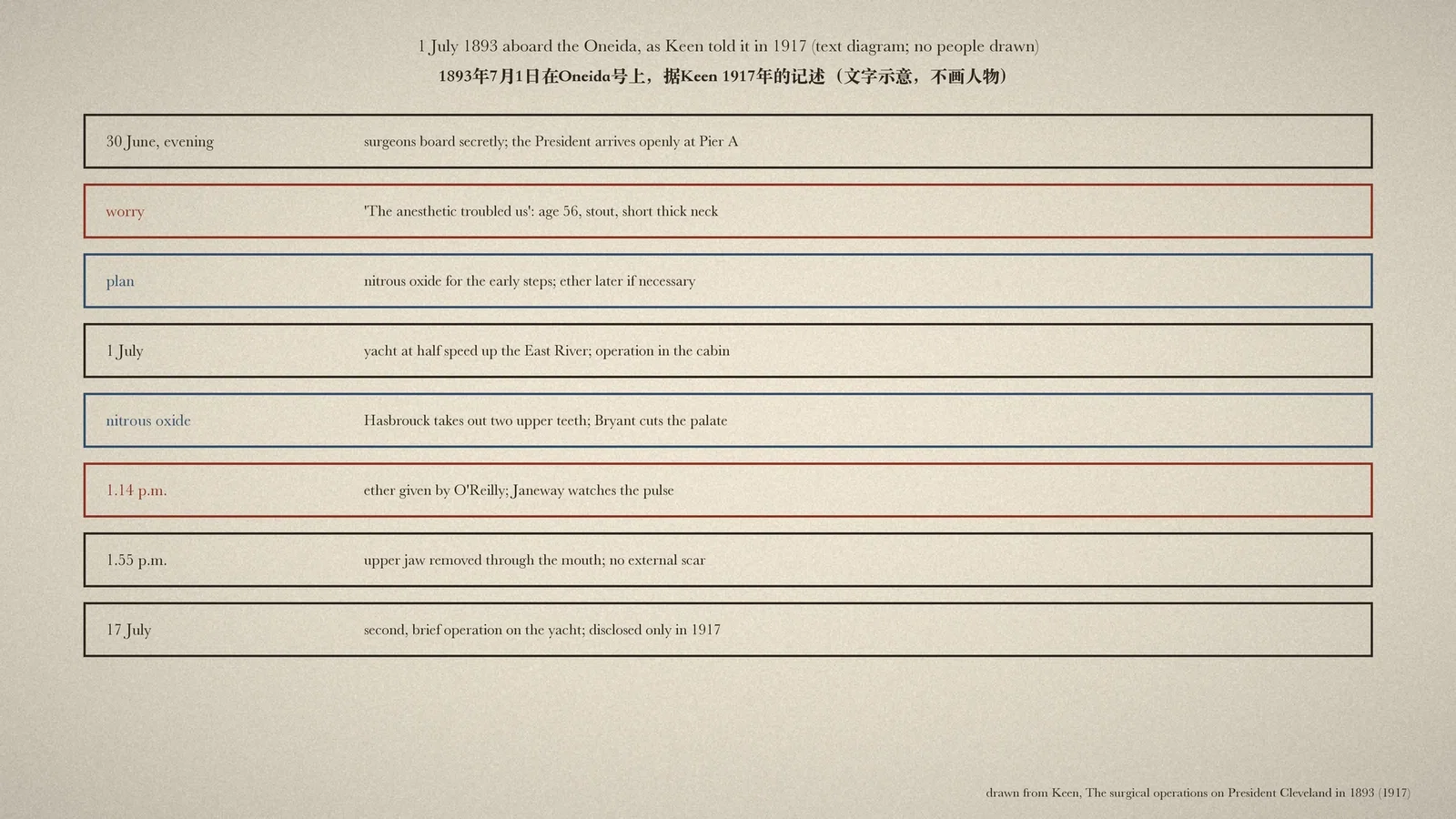
In the summer of 1893 the President of the United States had a growth in the mouth that might be malignant. It was removed in secret in the cabin of a yacht, the crew told only that two bad teeth were coming out. The surgeon W. W. Keen, who took part, later wrote that what worried the doctors most was not the operation but the anaesthetic. Keen made the story public only twenty-four years afterwards. [1, p. 34][1, p. 37]
The book
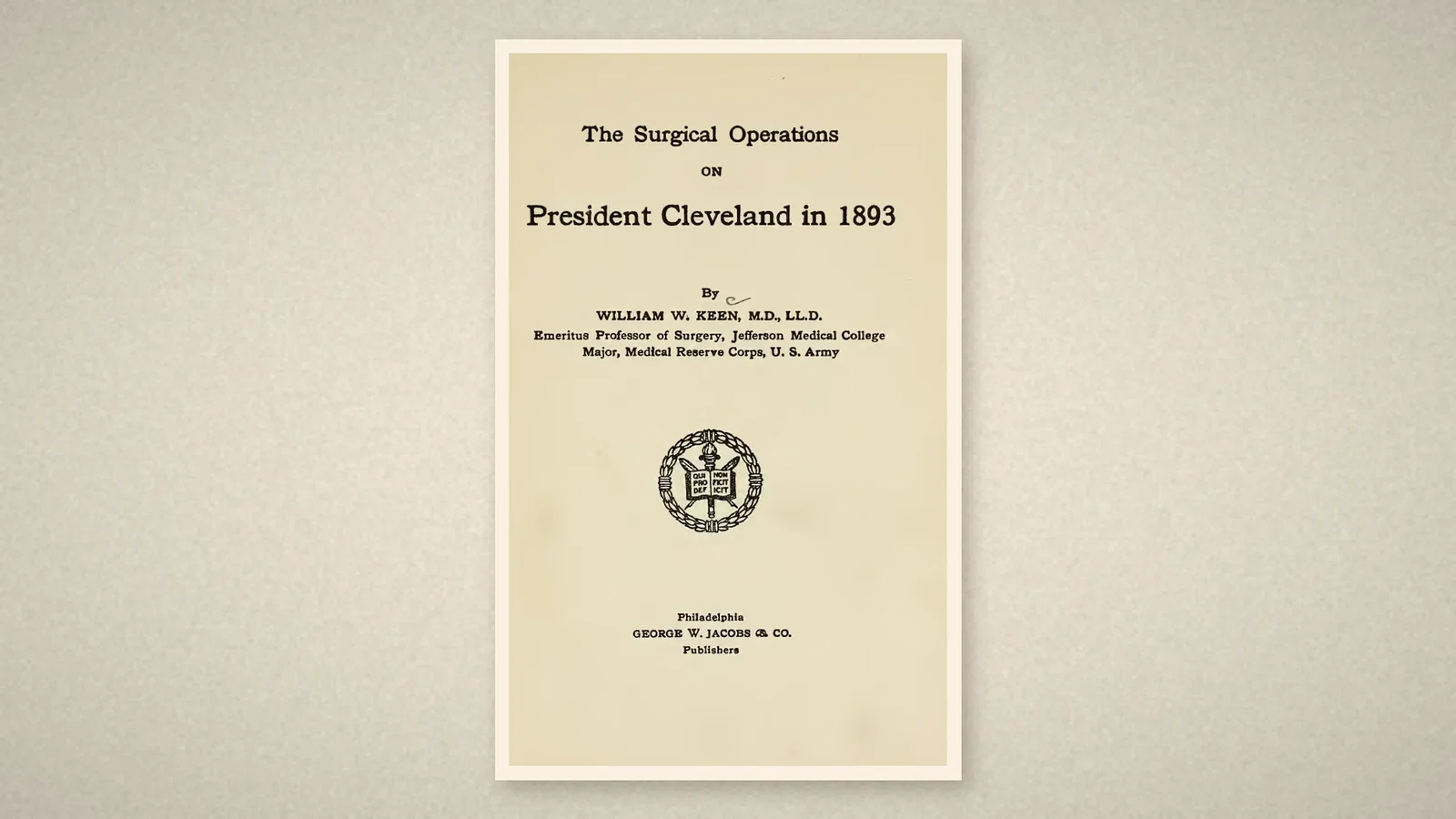
In 1917 George W. Jacobs & Co. of Philadelphia published "The surgical operations on President Cleveland in 1893" by William W. Keen, emeritus professor of surgery at Jefferson Medical College. [1, title page]
In the foreword Keen explains that Joseph D. Bryant, the operating surgeon, had meant to publish a full account but died suddenly in April 1914, and that most of those who took part were dead. With the consent of Cleveland's widow, Keen published the story first in the Saturday Evening Post of 22 September 1917 and then, enlarged, as a book. Keen also wanted to clear the name of a journalist: on 29 August 1893 E. J. Edwards had revealed the operation in the Philadelphia Press and had been called a liar. [1, foreword]
Why the secrecy
A rough ulcer on the President's palate had been sampled, and the fragment was strongly suggestive of malignancy. Once Bryant had confirmed it, the President agreed to an operation but insisted on a time and place that would avoid disclosure, fearing the effect of the news on the financial questions of the day. The date was fixed for 1 July, the place Commodore Benedict's yacht, the Oneida. An operating table, instruments, drugs and dressings were sent aboard, and Dr Ferdinand Hasbrouck, "a dentist accustomed to giving nitrous oxid", was engaged to assist. [1, p. 31][1, p. 32]
"The anesthetic troubled us"
"The anesthetic troubled us," Keen wrote. "Our anxiety related not so much to the operation itself as to the anesthetic and its possible dangers." The dangers might arise in breathing, heart or kidneys; the patient was 56, very stout, with a short thick neck, "just the build and age for a possible apoplexy", and worn out by four months of exacting work and office-seekers; and the improved methods of later years were not yet to hand. [1, p. 34][1, p. 35]
After canvassing the matter, the doctors decided to do at least the earlier steps under nitrous oxide and the later ones, if necessary, under ether. Hasbrouck doubted that nitrous oxide alone could keep the patient well anaesthetized long enough to finish. [1, p. 35]
In the cabin
On 1 July the yacht went up New York's East River at half speed while the operation was performed. As they passed in sight of Bellevue Hospital the doctors left the deck for the cabin, in case anyone from the hospital recognised them. Benedict and the Secretary of War, Lamont, stayed on deck; in the cabin, besides the doctors, there was only the steward to fetch and carry. The crew were told that two badly ulcerated teeth had to be removed, hence the fresh air, disinfected quarters and skilled doctors. [1, p. 36][1, p. 37]
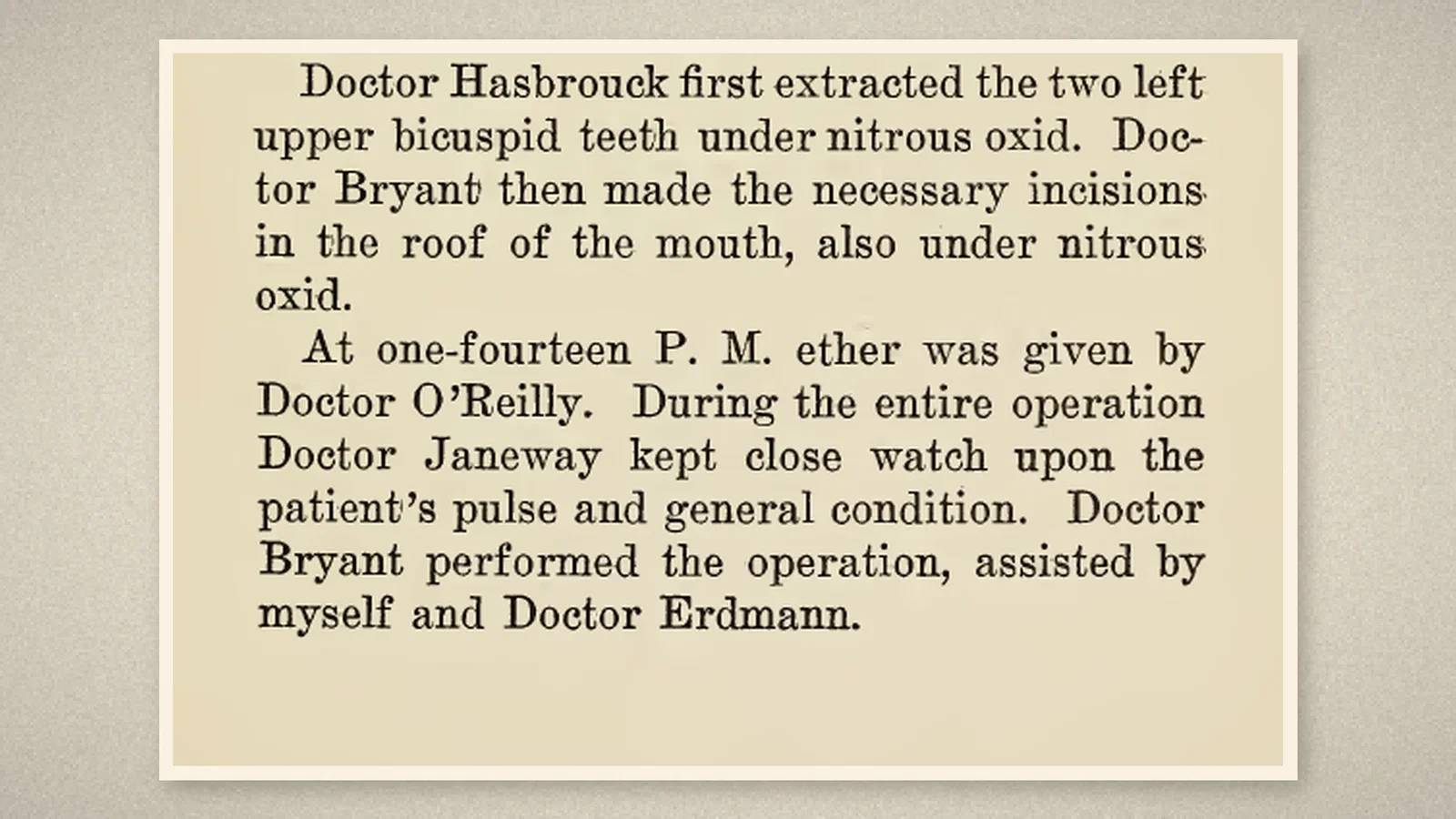
Hasbrouck first extracted the two left upper bicuspid teeth under nitrous oxide, and Bryant made the incisions in the roof of the mouth, also under nitrous oxide. "At one-fourteen P. M. ether was given by Doctor O'Reilly." Throughout the operation Janeway kept close watch on the patient's pulse and general condition, and Bryant operated with Keen and Erdmann assisting. [1, p. 37]
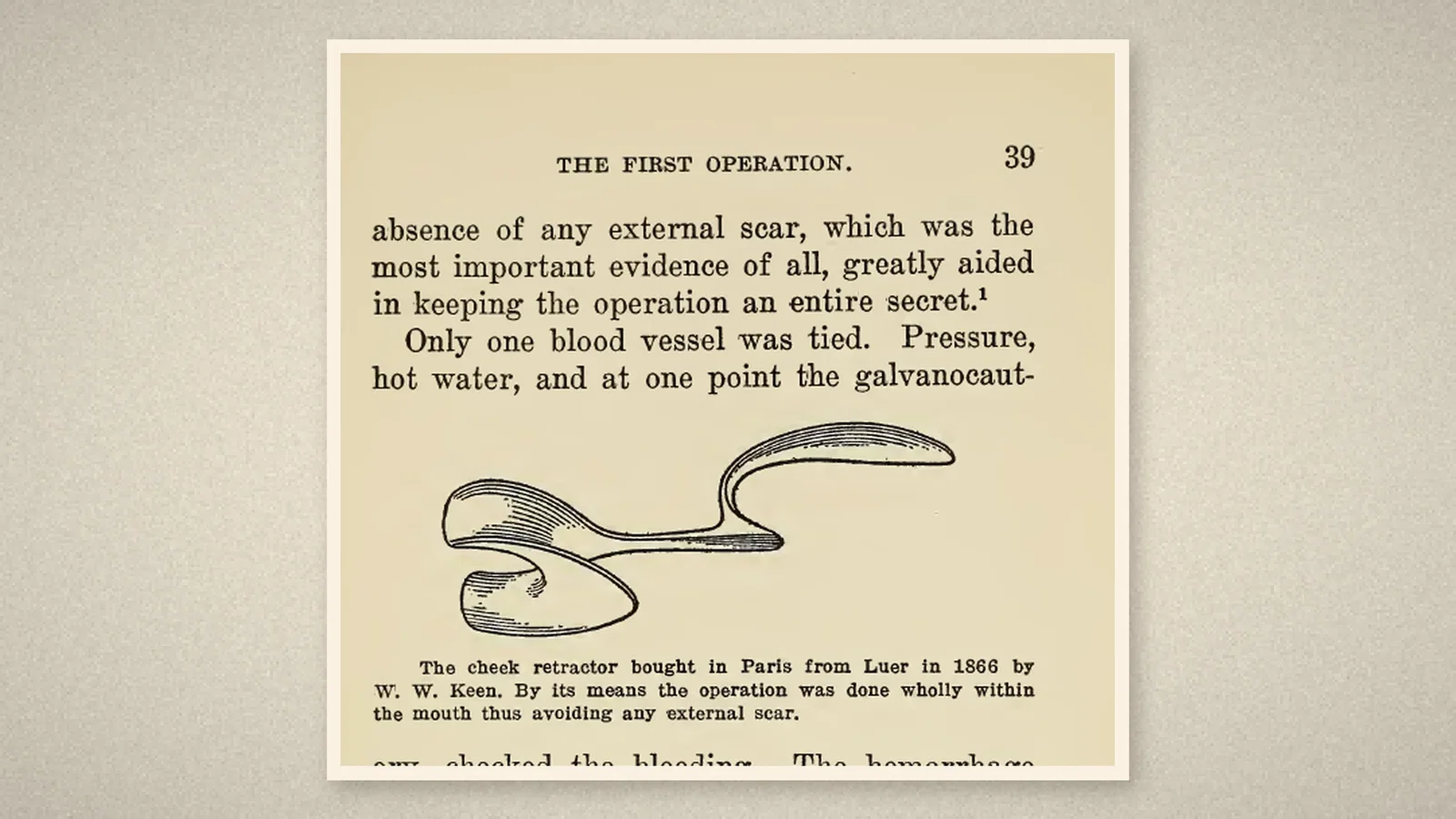
The left upper jaw was removed from the first bicuspid to just beyond the last molar, with a small piece of the soft palate; the antrum held a gelatinous mass, later confirmed as a sarcoma. The whole operation was done inside the mouth, with a cheek retractor Keen had brought from Paris in 1866, and left no external scar, which in Keen's view did most to keep the secret. The operation ended at 1.55 p.m. [1, p. 38][1, p. 39]
A second operation
Bryant was not quite satisfied with the look of one point, Keen writes, and on 17 July the doctors boarded the yacht again, removed the remaining suspicious tissue and cauterized the whole surface; this operation was brief. "This second operation has never been disclosed before." [1, p. 42][1, p. 43]
What the record shows
An operation whose greatest worry was the anaesthetic. For a stout, exhausted, short-necked patient in middle age, the doctors chose nitrous oxide, the dentist's familiar agent, first and ether after, and set a physician to do nothing but watch the pulse. It is also a story of secrecy, in which the place, the time and the cover story were all chosen so that no one would know.
Sources and reading limits
Read: W. W. Keen, The surgical operations on President Cleveland in 1893 (Philadelphia: George W. Jacobs, 1917): the foreword and the account of the preparations and both operations (pp. 31–44) closely, the rest for context, with the page images of the title page and pp. 34–39.
Not covered: the Saturday Evening Post article of 22 September 1917 in its original form; E. J. Edwards’s report in the Philadelphia Press of 29 August 1893; Bryant’s own notes; R. L. O’Brien’s article used by Keen; any anaesthetic record by O’Reilly or Hasbrouck; a Canadian Anesthesiologists’ Society article. Keen wrote twenty-four years later, as a participant working from memory and notes, partly to vindicate a journalist; the book gives no amounts of nitrous oxide or ether.
- Keen WW. The surgical operations on President Cleveland in 1893. Philadelphia: George W. Jacobs; 1917. Internet Archive
Continue exploring
Related reading connects shared questions and contexts; it does not by itself establish historical influence.
Anesthesia Epochs · The Source Room · About & Editorial Method
Published November 3, 2026. Sources and reading limits are stated above. Illustrations are labelled as original source images or AI-made. Historical accounts are educational; they are not current treatment instructions.