In 1899 two papers from the Marburg pharmacological institute proposed that anaesthetic potency depends on solubility in fat-like substances: Hans Meyer set out three theses, and Fritz Baum found that the order of partition coefficients between olive oil and water matched the order of potency almost completely.
Reading Library · Anesthesia Epochs · 中文版
Watch the education video (for clinicians)
1899: Meyer and Baum — Fat, Water and Anaesthetic Potency · Anesthesia Epochs Education Series

Ether, chloroform and nitrous oxide have nothing in common chemically, so why do they all abolish consciousness? Toward the end of the nineteenth century anaesthetics had been in use for half a century and the question was still open. In 1899 two papers from the Pharmacological Institute of the University of Marburg offered a simple and testable answer: look at whether the substance dissolves in fat. [1, p. 109][1, p. 119]
A question
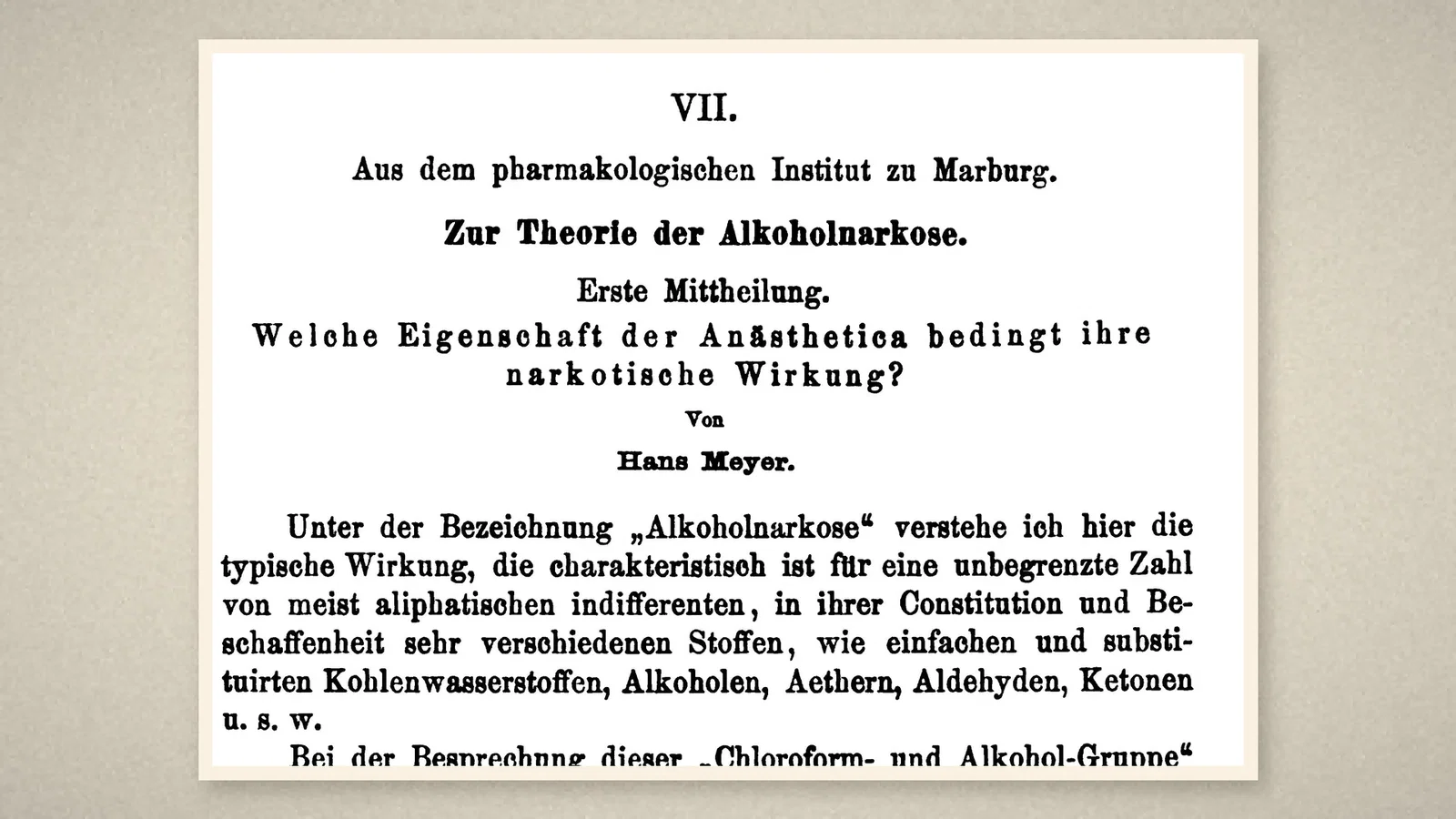
The first paper, by Hans Meyer, carried the question as its subtitle: which property of anaesthetics causes their narcotic action? By "alcohol narcosis" Meyer meant the typical action shared by an unlimited number of mostly aliphatic, indifferent substances of very different constitution: hydrocarbons, alcohols, ethers, aldehydes, ketones and so on. Some had ascribed the action to hydrocarbon groups, others to the ethyl group or to chlorine, bromine and iodine; since nitrous oxide and carbon dioxide also produce it, Meyer argued, none of these could serve as a general theory. [1, pp. 109-110]
Earlier clues
Meyer gathered clues that had been neglected. In 1847 v. Bibra and Harless compared animals repeatedly etherised with controls and found less ether-extractable fat in the brains of the etherised, concluding that ether in the blood removed fat from the brain. In 1866 L. Hermann found that all aliphatic narcotics dissolve red blood cells and suggested that lecithin, cholesterol and fats, shared by nervous tissue and red-cell stroma, might be the common point of attack of these fat-dissolving agents. Later Raphaël Dubois saw plants exude fine droplets of water in chloroform and ether vapour. [1, pp. 110-111]
This relatively simple view, Meyer wrote, had received hardly any consideration, let alone acceptance, from modern pharmacology, although no one had raised a sound objection to it. [1, p. 112]
Three theses
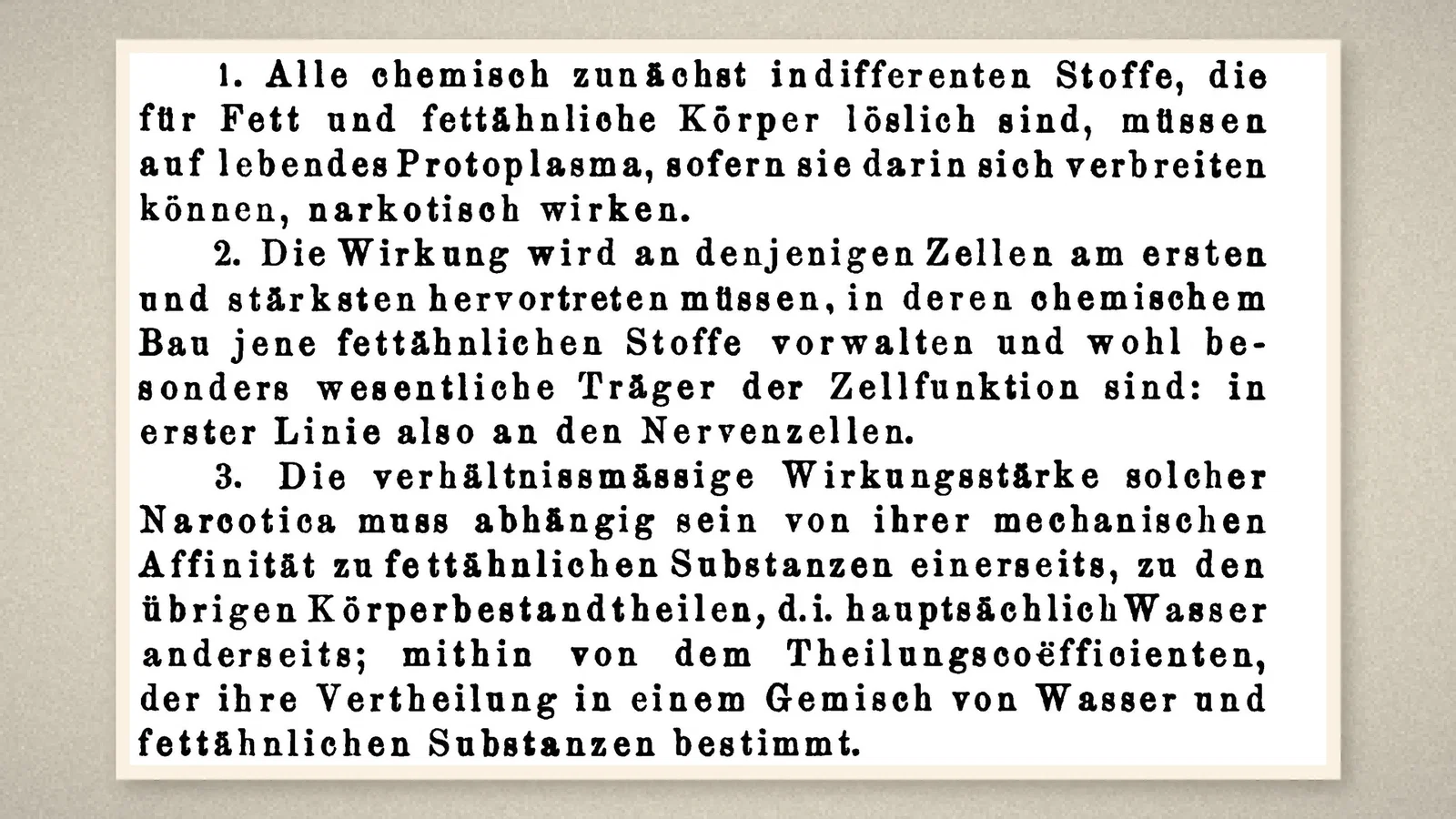
Meyer set the idea down as three theses. First, all chemically indifferent substances that are soluble in fat and fat-like bodies must act narcotically on living protoplasm, provided they can spread in it. Second, the action must appear first and most strongly in cells whose chemical structure is dominated by these fat-like substances and in which they carry function, that is, above all in nerve cells. Third, the relative potency of such narcotics must depend on their affinity for fat-like substances on the one hand and for the other body constituents, chiefly water, on the other: in other words, on the partition coefficient that governs their distribution in a mixture of water and fat-like substances. [1, p. 112]
Meyer added that only a parallel rise and fall was meant, not proportionality, since drug action does not grow in proportion to the amount given and the "fat" of protoplasm is not a single substance. The second thesis, Meyer said, matched known facts; the first and third could be tested by experiment. Meyer's own paper reported tests in frogs, pigeons, rabbits and dogs, and the third thesis was left to Dr Baum in the next paper. [1, pp. 113-114]
Olive oil and water
The second paper, by Fritz Baum, was subtitled "a physico-chemical contribution to the theory of narcotics". Lethal dose was a poor measure of potency, Baum argued, because death often follows secondary effects; narcosis itself should be the index, so Baum took as each drug's threshold the lowest concentration just able to produce a given degree of narcosis, as determined by earlier workers mainly in tadpoles. Using olive oil to stand for the fat-like substances of the body, Baum measured each drug's partition coefficient between olive oil and water at a room temperature of 18 °C. [1, pp. 119-121]
The agreement in the order of the two series, Baum reported, was almost complete, and hardly better could be expected given the unavoidable inaccuracy of measuring potency and, at times, partition coefficients. [1, p. 122]
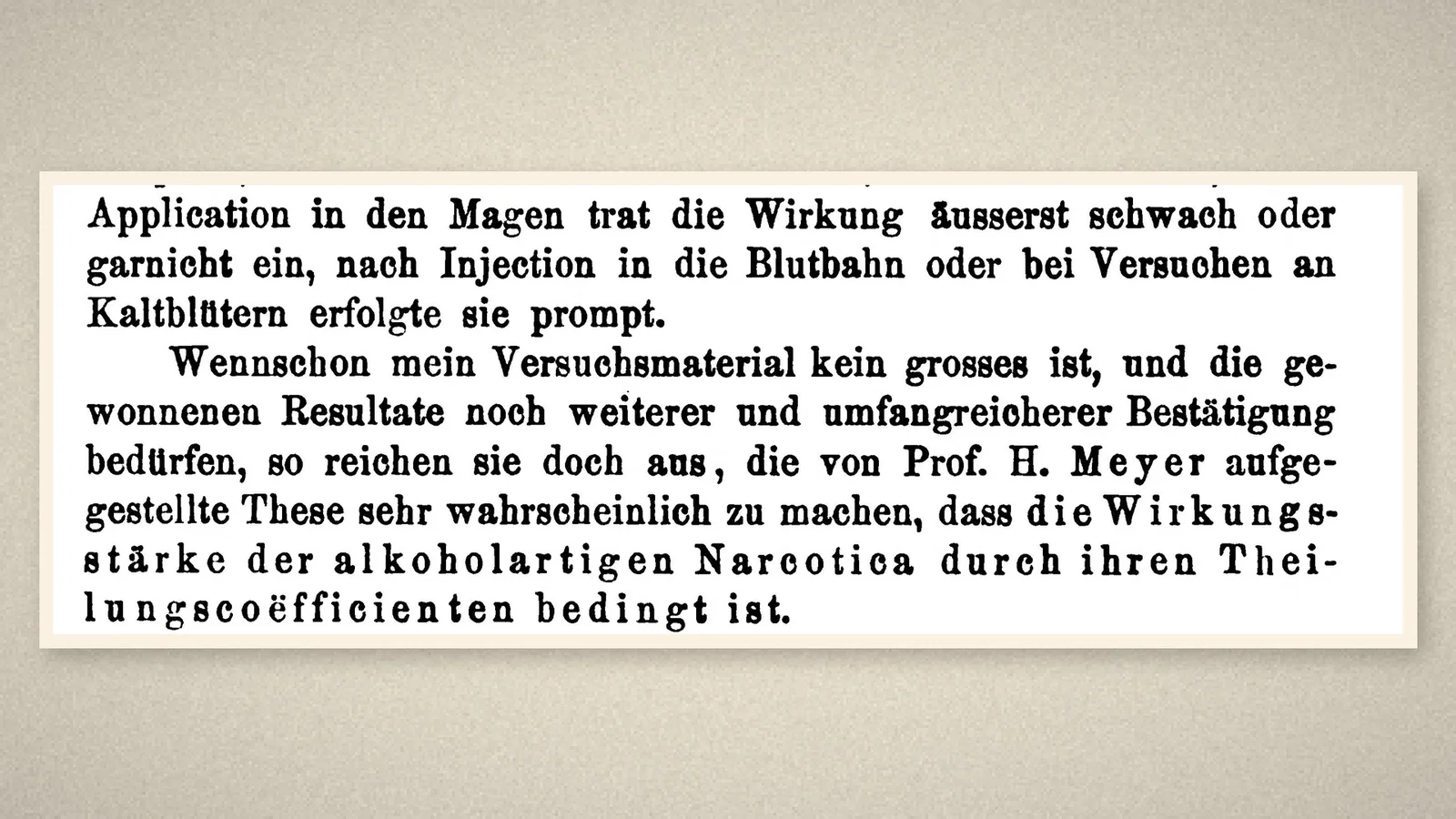
Baum's conclusion was restrained: the material was not large and the results needed wider confirmation, but they were enough to make Professor Meyer's thesis very probable, that the potency of alcohol-like narcotics is determined by their partition coefficient. [1, p. 124]
Afterwards
The Australian Society of Anaesthetists' history timeline lists 1899 as one of many hypothesised mechanisms of general anaesthesia: Meyer related the potency of general anaesthetics to their lipid solubility, and the British biologist Overton supported the theory in 1901, the two together giving the Meyer-Overton hypothesis. [2, p. 30]
What the record shows
Meyer and Baum did not say what an anaesthetic actually does inside a nerve cell. They offered a measurable regularity: the more soluble in fat, the stronger the action. Because it could be measured, later workers could test it, refine it and find its exceptions.
Sources and reading limits
Read: Hans Meyer’s paper in volume 42 (1899) of the Archiv für experimentelle Pathologie und Pharmakologie, pp. 109–118, and Fritz Baum’s paper, pp. 119–125, with page images of pp. 109, 112, 119 and 124; the 1899 entry of the Australian Society of Anaesthetists’ 2024 history timeline, p. 30.
Not covered: the details of the animal protocols; Overton’s Studien über die Narkose (1901) and its English translation; Meyer’s later papers of 1901. Threshold concentrations and doses are not given here, and ‘alcohol narcosis’ is the authors’ term for a whole class of indifferent anaesthetics, not alcohol alone.
- Meyer H. Zur Theorie der Alkoholnarkose. Erste Mittheilung. Welche Eigenschaft der Anästhetica bedingt ihre narkotische Wirkung? Arch Exp Pathol Pharmakol. 1899;42:109-18. Baum F. Zur Theorie der Alkoholnarkose. Zweite Mittheilung. Ein physikalisch-chemischer Beitrag zur Theorie der Narcotica. Arch Exp Pathol Pharmakol. 1899;42:119 ff. Internet Archive
- Australian Society of Anaesthetists. Anaesthesia History Timeline. 2024. PDF
Continue exploring
Related reading connects shared questions and contexts; it does not by itself establish historical influence.
- 1847: Flourens Tracks Ether's Action Through the Nervous System
- 1847: Snow Makes Ether a Question of Observation and Control
Anesthesia Epochs · The Source Room · About & Editorial Method
Published November 4, 2026. Sources and reading limits are stated above. Illustrations are labelled as original source images or AI-made. Historical accounts are educational; they are not current treatment instructions.