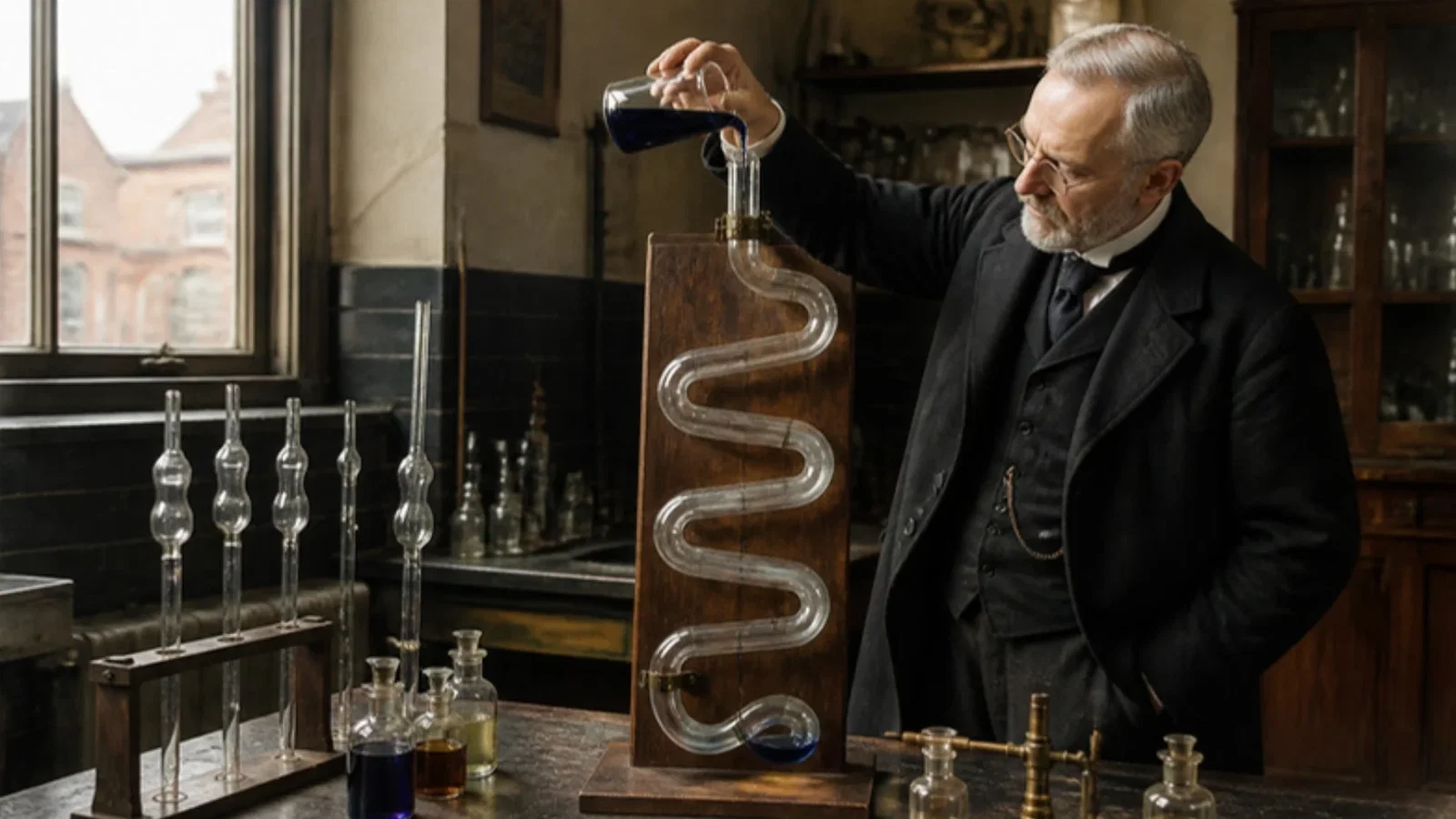
A London surgeon reported 100 spinal anaesthetics with stovaine, measured the specific gravity of each solution against cerebrospinal fluid, and used glass tubes bent to the curves of the spine to show that a heavy solution sinks to the lowest point it can reach.
Reading Library · Anesthesia Epochs · 中文版
Watch the education video (for clinicians)
1907: Barker's Heavy Spinal Solution — Density and Spread · Anesthesia Epochs Education Series
An anaesthetist giving a spinal today often chooses a "heavy" or a "plain" solution and then uses the patient's position to steer it. The reasoning behind that choice was set out at length in the British Medical Journal of 23 March 1907 by Arthur E. Barker, Professor of Surgery at University College Hospital, London. The report covers 100 spinal anaesthetics with stovaine, and then turns from the operating table to glass tubes, a balance and a coloured dye. This article reads it in the original. [1]
A cautious report
Barker opened by disclaiming "all intention of advocating the immediate or general introduction of spinal analgesia". The method, as Barker dated it, went back to Bier on 16 August 1898, but had come into wide use only with stovaine; Barker cited 2,000 cases by Tuffier and 1,000 in Bier's clinic. The 100 London patients, aged 15 to 71, were chosen partly because a general anaesthetic seemed especially undesirable; those who wished to sleep, nervous patients and children were given one. [1]
All 100 received stovaine, supplied by M. Billon in Paris. Most of the first 50 had Chaput's solution; all but one of the second 50 had a new glucose-stovaine solution made for Barker. The first dose was 3 to 6 cg, usually about 5, and only three patients needed a supplementary 2 cg. Analgesia was inadequate in 11 of the first 50 cases and in none of the second, but Barker warned against crediting the solution: the first series had been done with less experience. There were three deaths, which Barker judged wholly unconnected with the anaesthetic. [1]
Why the results were "wayward"
The second part of the paper, headed "Physical", starts from a problem every user knew. Results were "wayward", as Bier had put it: sometimes no effect, sometimes the wrong side or the wrong level, and no drug had yet given uniform results "as to the height and the side affected". Barker saw only three ways a drug injected at the second lumbar interspace could reach the mid-dorsal cord: slow diffusion, shifting of the whole column of spinal fluid, or gravitation "if the injected compound be distinctly heavier than the liquor spinalis". [1]
Bier's school raised the pelvis to push the fluid column toward the head. Barker doubted that this could carry a fluid lighter than the spinal fluid some eight or ten inches up the canal. Bier's solution had a specific gravity of 1.0058 against 1.0070 for spinal fluid, and Barker thought pelvic elevation merely sped up its diffusion. A simple experiment showed the alternative: a dyed fluid of the same density formed a cloud and slowly spread, while a much heavier one sank "in a definite stream" and lay at the bottom as a separate layer. If spinal analgesia was to be localized, Barker concluded, "we ought to employ the force of gravity" on a compound denser than the spinal fluid, which would sink to the most dependent part of the canal and stay there almost undiluted. [1]
Weighing the solutions
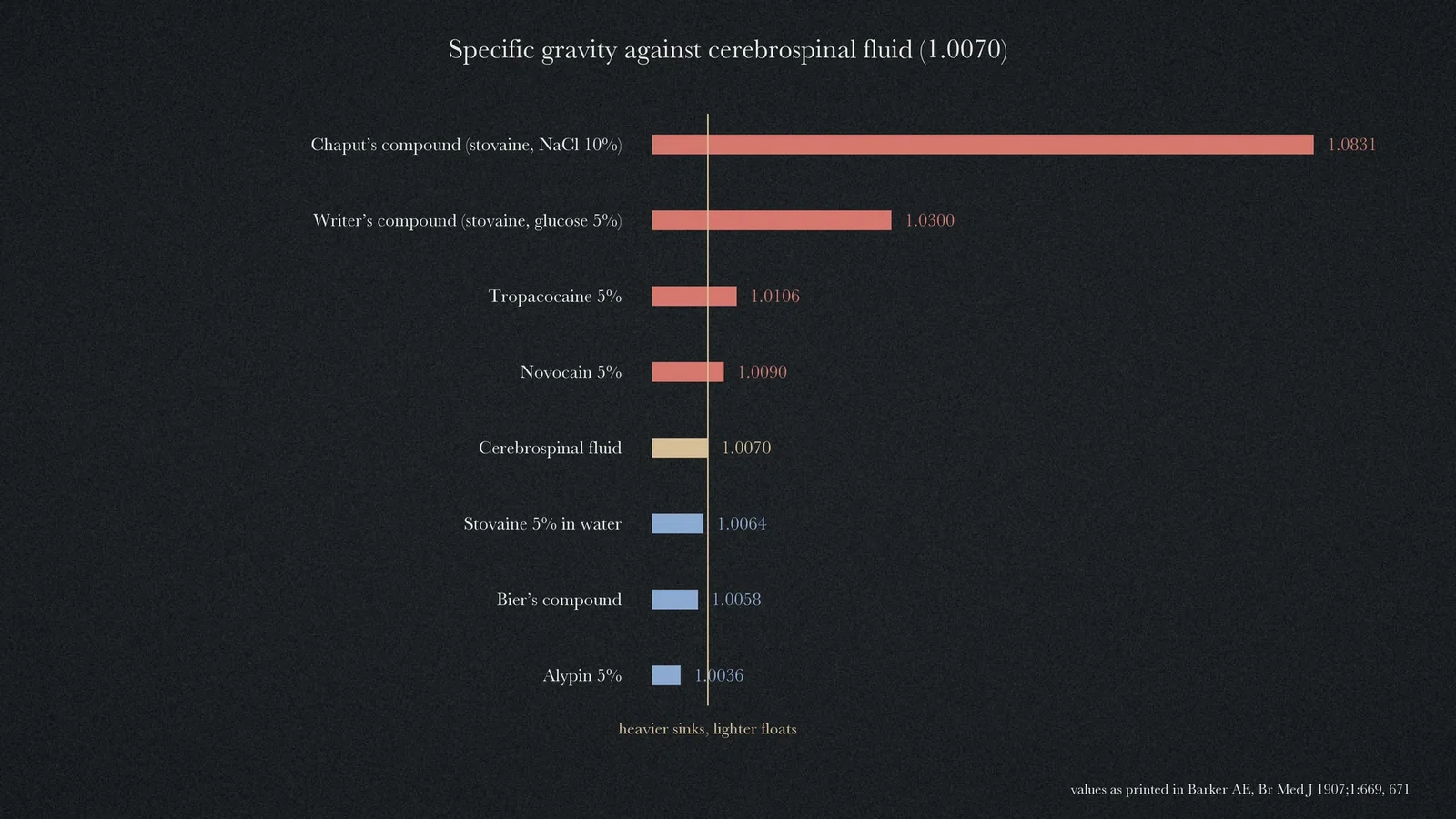
With help from the hospital's pharmacologist, Mr R. Bennett, who made the measurements on a Westphal balance, Barker tabulated the densities: spinal fluid 1.0070; Chaput's compound, stovaine with 10 per cent salt, 1.0831; Bier's compound 1.0058. Chaput and Tuffier had long used their very heavy solution with good results, but, Barker argued, its success "probably lies in its high specific gravity" rather than in the reasons given for it. Its salt content made it strongly hypertonic, however, so Barker asked Billon to replace the 10 per cent salt with 5 per cent glucose. The new solution had a specific gravity of 1.0300. Along the way Barker found that stovaine itself destroyed red blood cells in every solution tried, including Bier's, which had been thought isotonic. [1]
Glass tubes and Braune's section
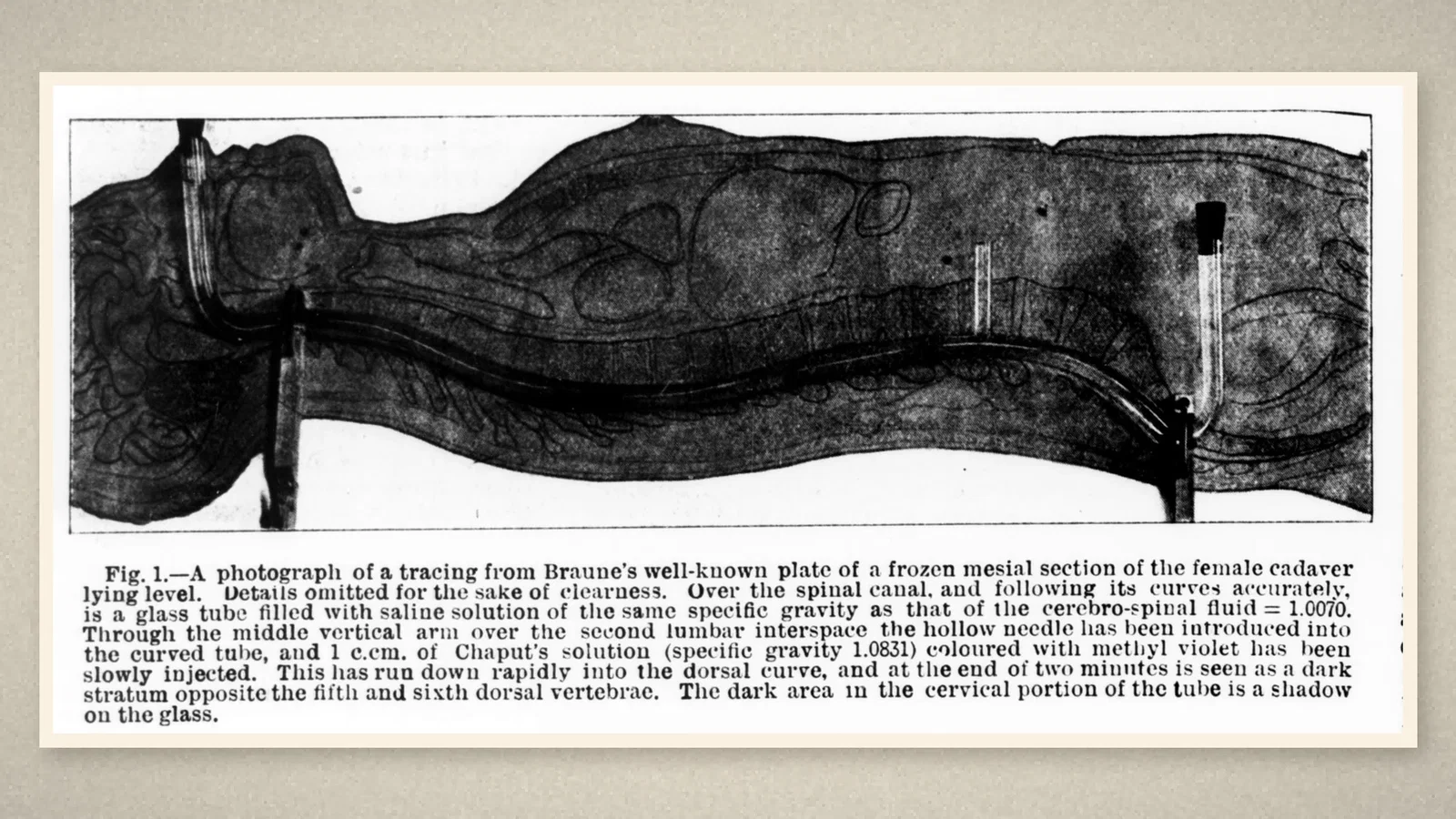
To see what happened inside the canal, Barker had glass tubes bent to the curves of the spine as shown in Braune's frozen section of a body lying on its back, with a side arm at the second lumbar interspace, and filled them with salt solution of specific gravity 1.0070. Coloured Chaput's solution injected through the side arm ran down into the dorsal curve and, after two minutes, lay as a dark layer opposite the fifth and sixth dorsal vertebrae. Bier's lighter compound, injected the same way with the pelvis raised, rose in the vertical arm instead. [1]
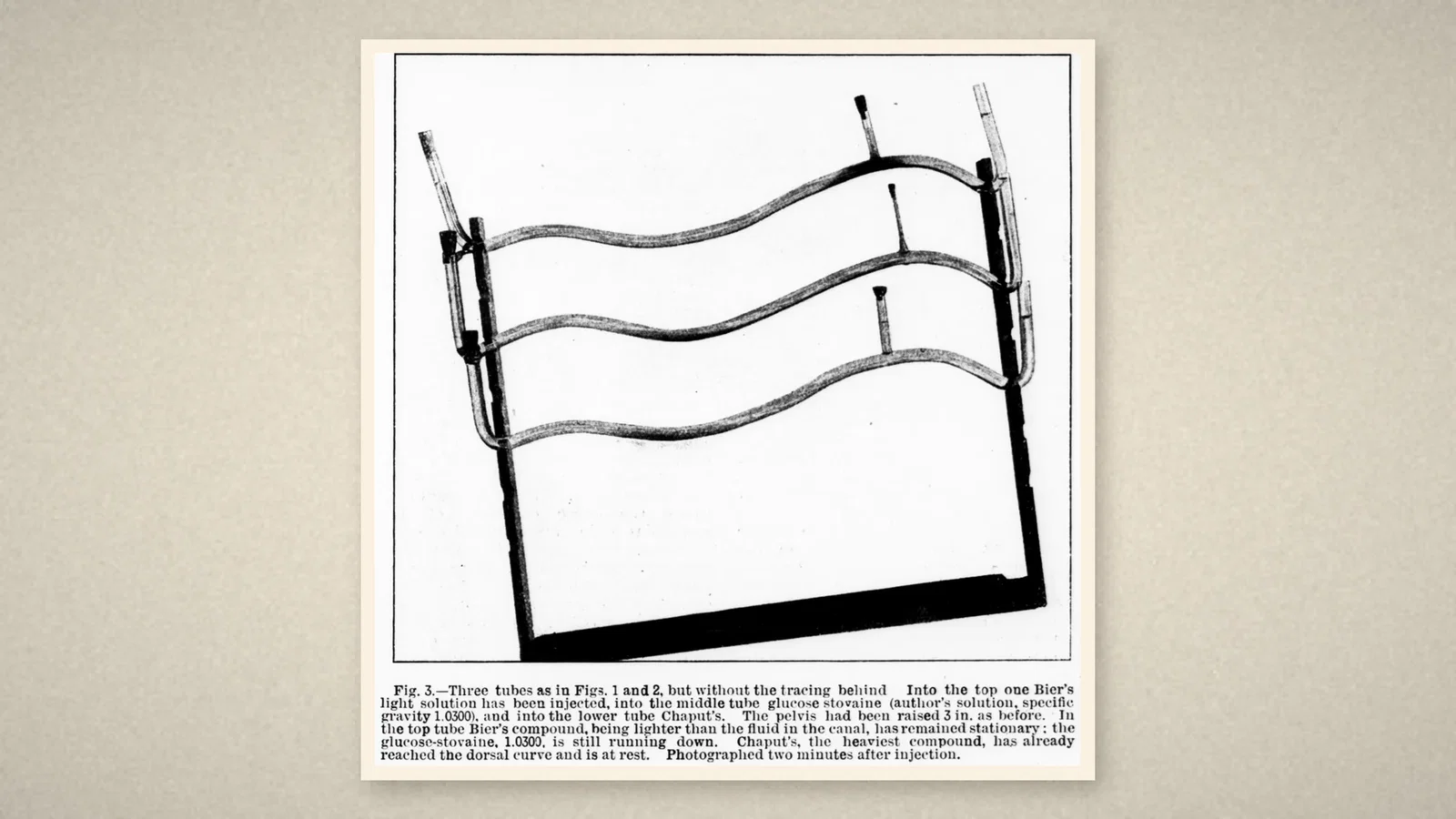
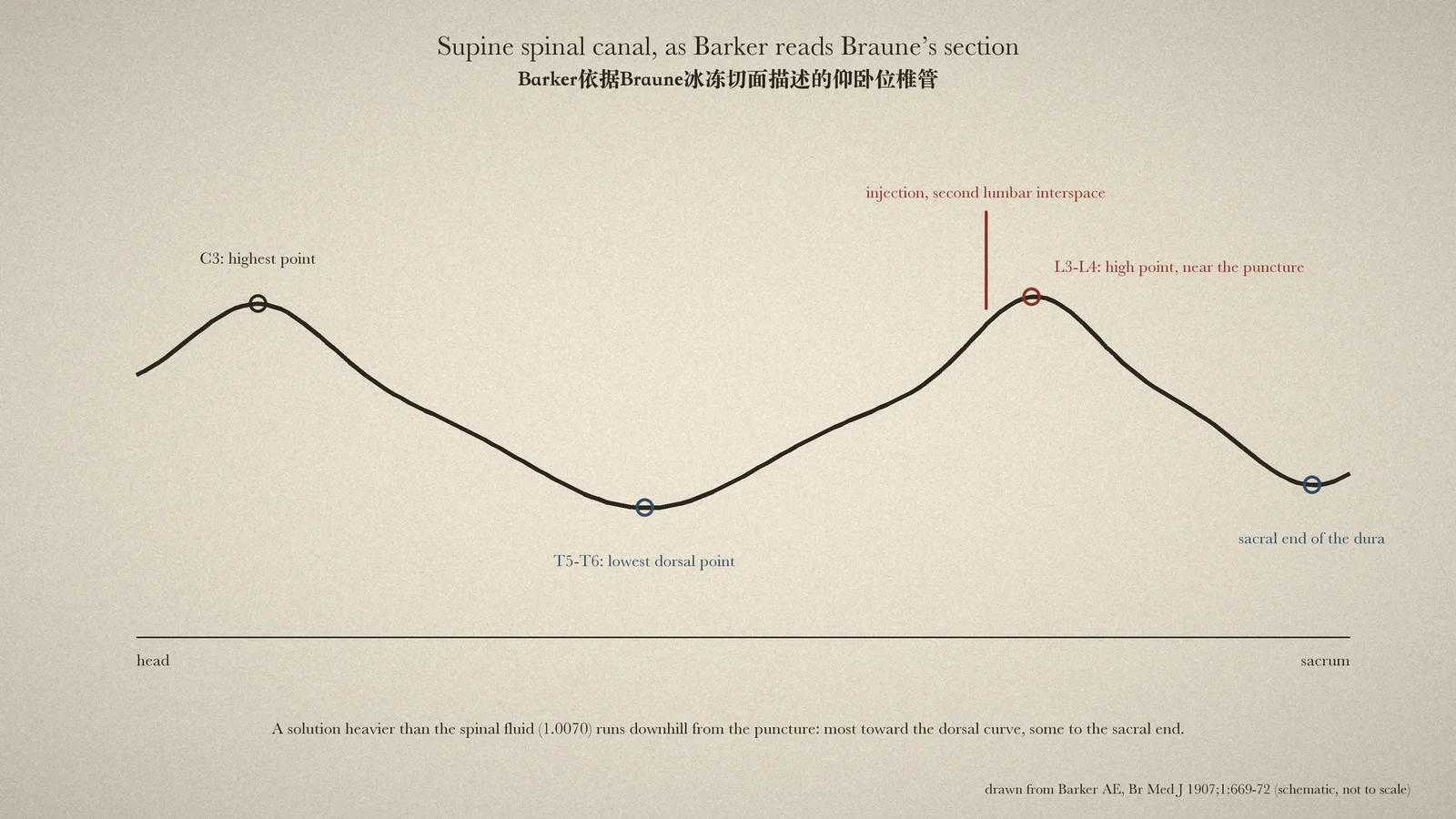
The anatomy explained why. Lying flat, the canal is highest in the neck and next highest between the third and fourth lumbar vertebrae, close to where the needle goes in; from there it slopes down to the fifth or sixth dorsal vertebra in one direction and to the sacral end in the other. A heavy solution would therefore run mostly to the dorsal curve, with some to the sacrum. Barker drew practical rules from this: inject sitting up and the solution collects in the sacral sac, numbing the perineum; inject with the patient on one side, knees drawn up, and it flows upward and gathers in the dorsal curve when the patient rolls onto the back; keep the head forward on a pillow so that it cannot reach the neck. Barker never aimed for analgesia above the nipple line. In the second 50 cases, the height and side of the analgesia were, in Barker's words, "remarkably uniform". [1]
What the record shows
Barker did not invent the heavy solution, and said so; Chaput and Tuffier were already using one. What the 1907 paper added was the explanation: measure the solution against the spinal fluid, know the curves of the spine, and use position deliberately. The tubes were an experiment in vitro, which Barker admitted living patients would modify. The closing warning still stands: there is a place for spinal analgesia, "but only when those who would employ it have studied its theory and practice fully", and it is "not for casual use by the inexperienced". J. A. Lee's 1979 biographical article calls Arthur Edward James Barker (1850-1916) a "British pioneer of regional analgesia". [1] [2]
Sources and reading limits
Read: Barker's 1907 report, Parts I and II in full and the start of Part III; the PubMed record of Lee's 1979 article (title only).
Not covered: the rest of Part III and most of the appended case notes; Lee's article itself; the papers of Chaput, Tuffier and Bier that Barker cites; later work on spinal solutions. Where this subject is now described as "baricity and position", Barker's own words are specific gravity, density and weight. Doses and gravities are as printed.
Two illustrations are page crops from the 1907 article; two are drawn from it.
- Barker AE. A report on clinical experiences with spinal analgesia in 100 cases, and some reflections on the procedure. Br Med J. 1907;1(2412):665-74. Internet Archive
- Lee JA. Arthur Edward James Barker 1850-1916. British pioneer of regional analgesia. Anaesthesia. 1979;34(9):885-91. PubMed
Continue exploring
Related reading connects shared questions and contexts; it does not by itself establish historical influence.
- 1906: Dean Leaves the Spinal Cannula In
- 1899: Tuffier Brings Spinal Cocaine to the Société de Chirurgie
- 1898: Bier's Spinal Analgesia and Its Aftermath
Anesthesia Epochs · The Source Room · About & Editorial Method
Published November 2, 2026. Sources and reading limits are stated above. Illustrations are labelled as original source images or AI-made. Historical accounts are educational; they are not current treatment instructions.