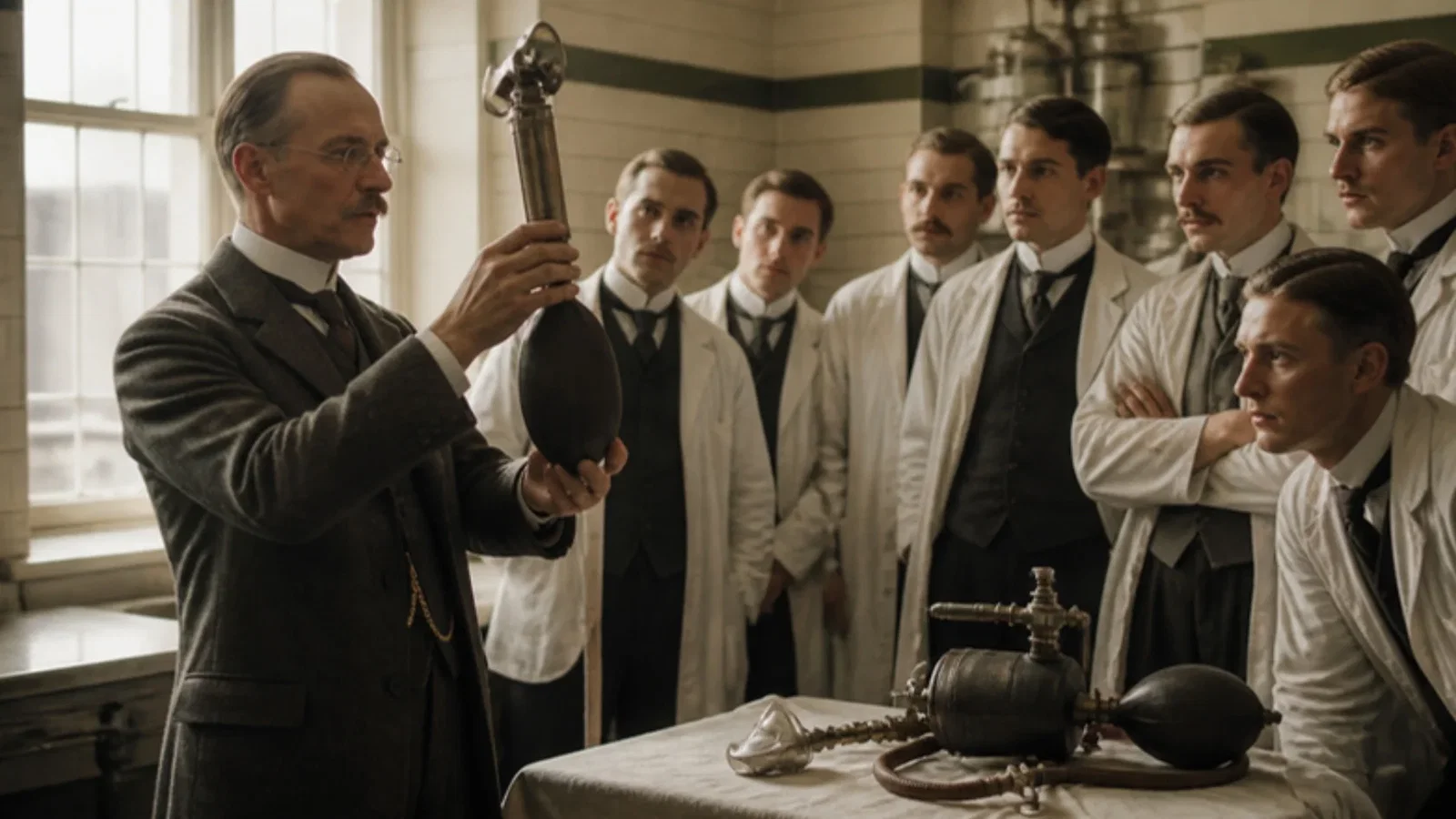
R. J. Probyn-Williams, senior anaesthetist and instructor at the London Hospital, described in the second edition of 'A Practical Guide to the Administration of Anaesthetics' (1909), after Clover's portable regulating ether inhaler, 'the simpler form of inhaler shown in Fig. 22', the Probyn-Williams ether inhaler: a vertical tube through which the patient breathed, with face-piece and bag at either end, and a horizontal rotating tube that turned more or less of the stream into the ether chamber; the vertical tube had the lumen of an average adult trachea and no narrowing anywhere, so there was 'no obstruction to free respiration, as there is in all forms of Clover's inhaler'; with no water-jacket it could be boiled, and it was 'the lightest form of all regulating ether inhalers'. Buxton's textbook of 1920 called the form 'probably one of the best'.
Reading Library · Anesthesia Epochs · 中文版
Watch the education video (for clinicians)
1909: The Probyn-Williams Ether Inhaler — The London Hospital · Anesthesia Epochs Education Series
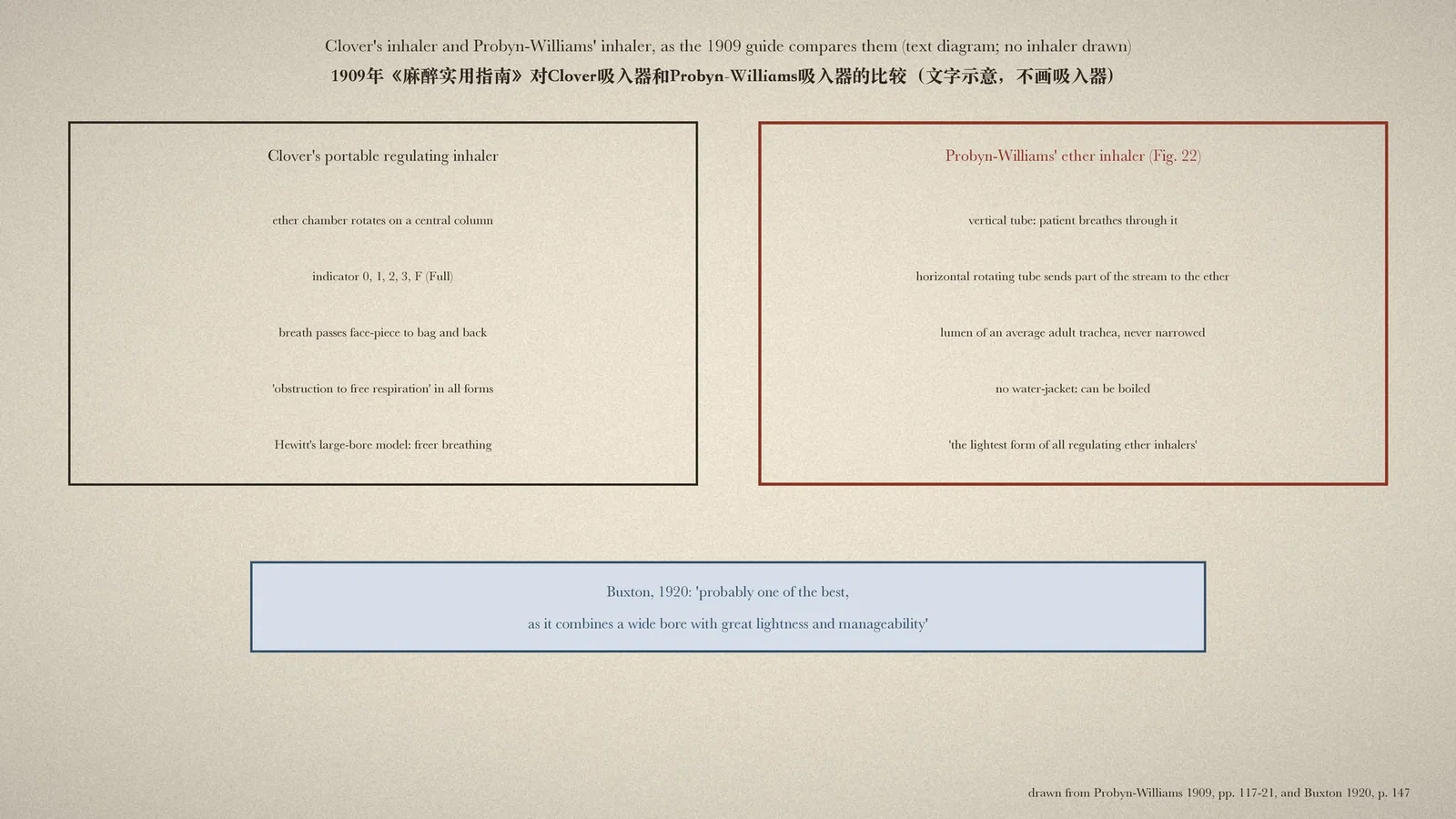
By the early twentieth century, the standard closed ether inhaler in Britain was Clover's portable regulating inhaler. It worked, but breathing through it was not easy. An anaesthetist at the London Hospital designed a simpler version around one idea: the patient should breathe through a tube as wide as the trachea. [1, pp. 117-20]
The author
R. J. Probyn-Williams was senior anaesthetist and instructor in anaesthetics at the London Hospital, lecturer on anaesthetics at its medical college, anaesthetist to the Royal Dental Hospital of London, and lately president of the Society of Anaesthetists. The second edition of "A Practical Guide to the Administration of Anaesthetics" was published by Longmans, Green in 1909. [1, title page]
Starting from Clover
The ether chapter first explains Clover's inhaler. The ether chamber rotates on a central column, and more or less of the breath passes through it on the way from face-piece to bag and back, as shown by an indicator marked from 0 to F, "Full". Among the many modifications of Clover's inhaler, Probyn-Williams singles out Hewitt's large-bore model, which has a great advantage "in the freedom with which the patient can respire through it", something anyone can feel by breathing through the two forms in turn. [1, pp. 117-19]
The simpler form
"A free air-way is also provided in the simpler form of inhaler shown in Fig. 22. This differs somewhat from the Clover model." [1, p. 119]
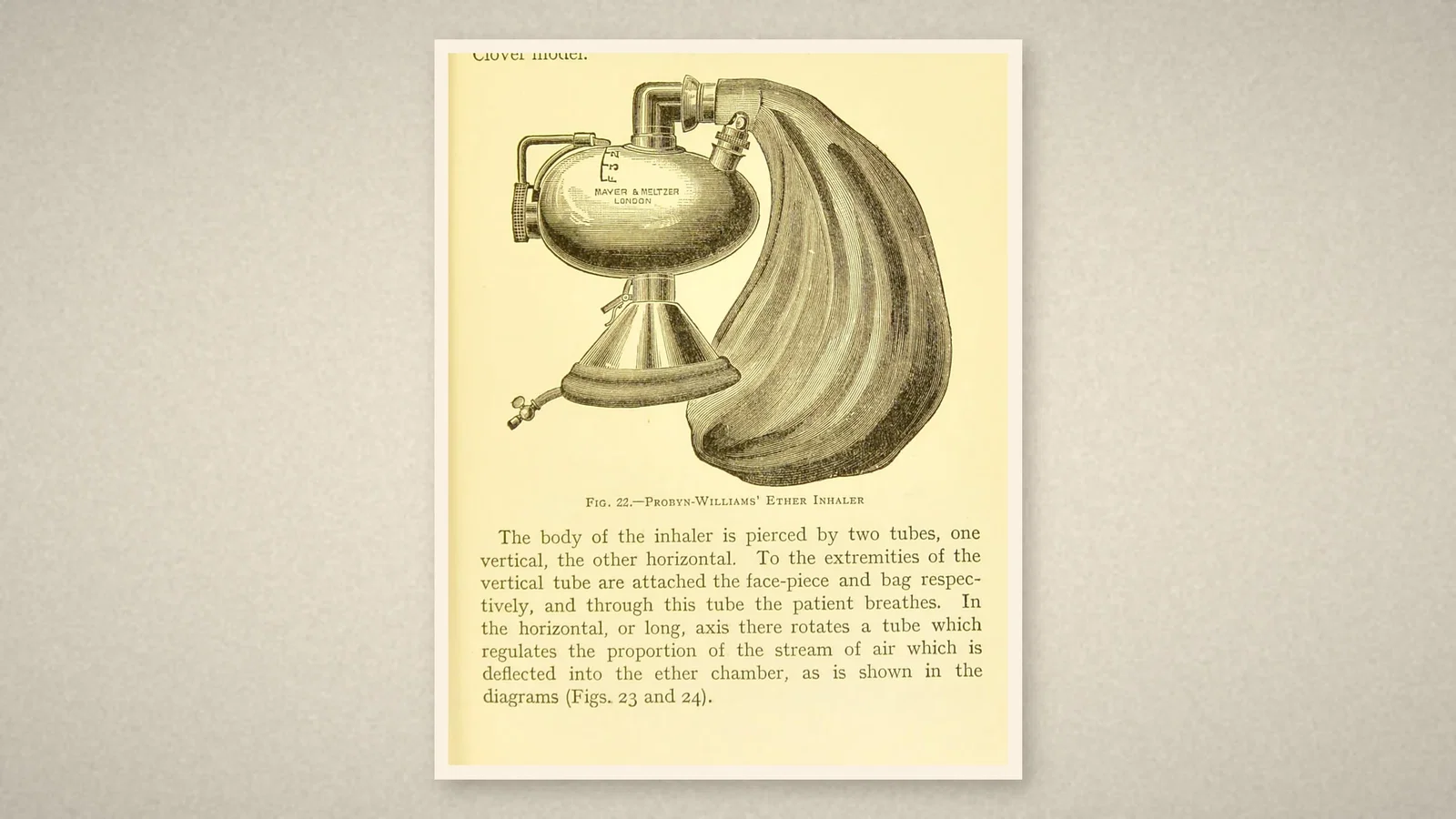
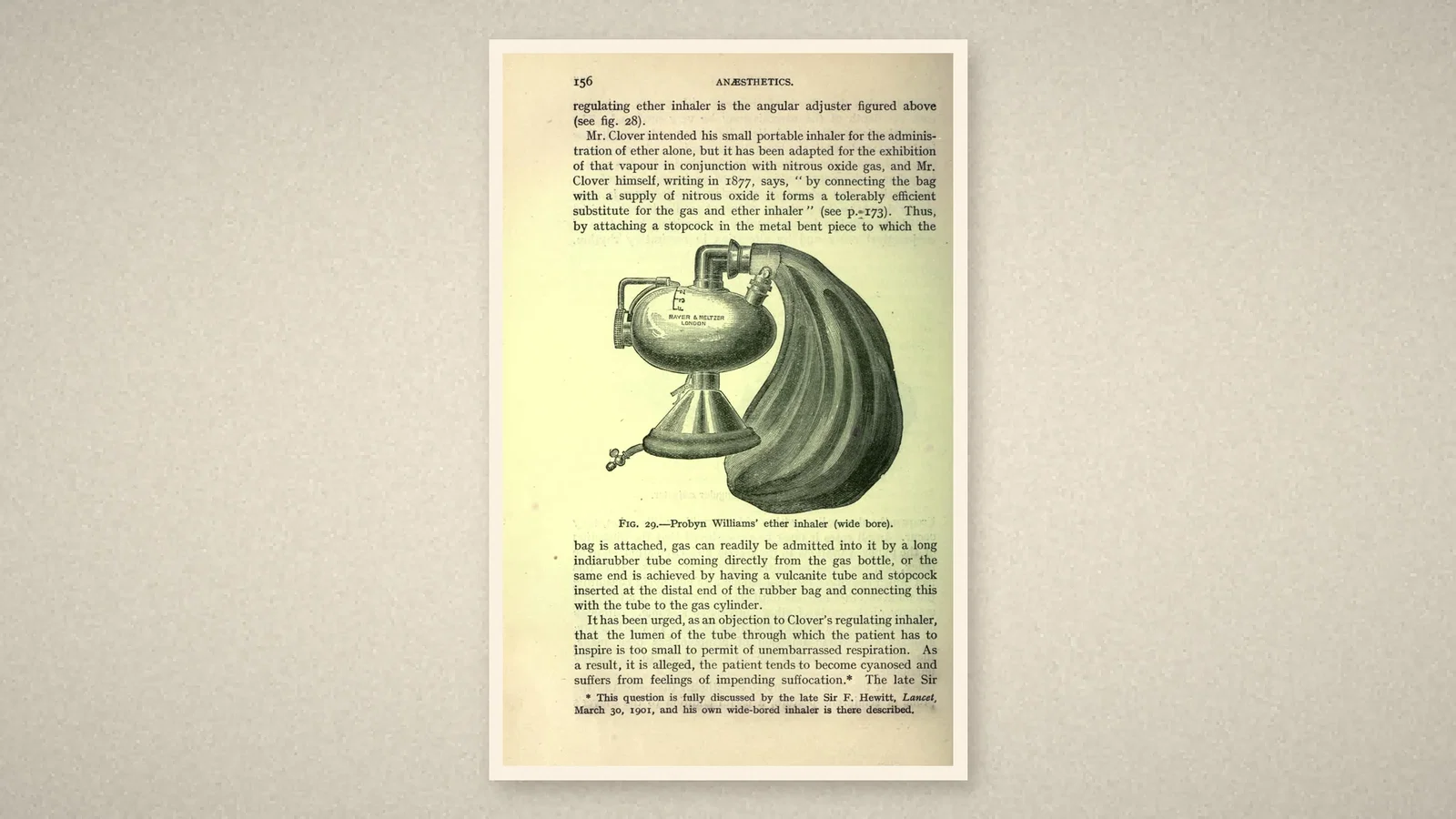
The body of the inhaler is pierced by two tubes. The face-piece and the bag fit on the ends of the vertical tube, and the patient breathes straight through it. Along the horizontal axis a second tube rotates and decides what share of the air stream is turned aside into the ether chamber. Figures 23 and 24 show the inside with the indicator at 0 and at F. The engraving of the instrument carries the makers' name, Mayer & Meltzer, London. [1, pp. 119-21]
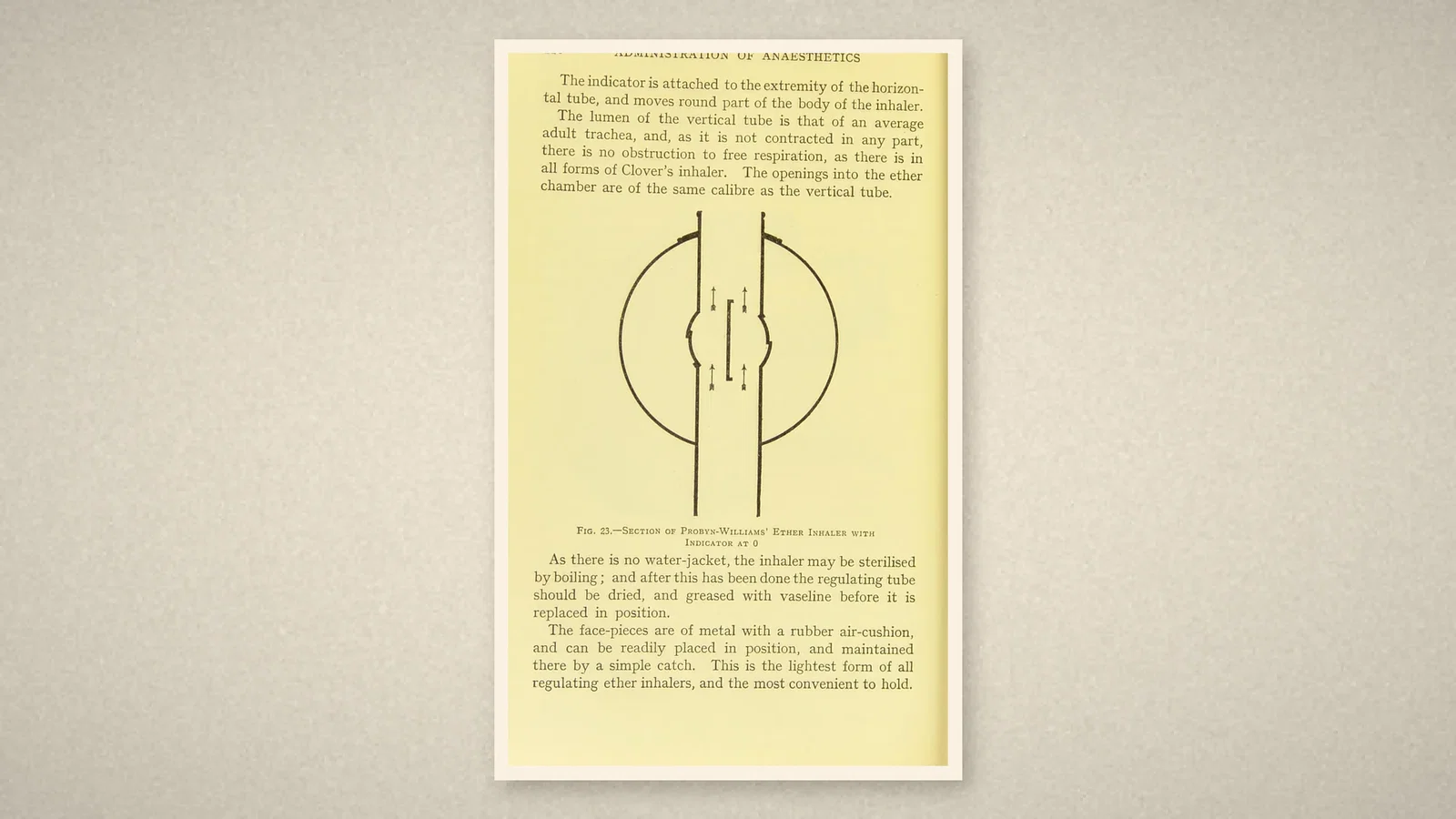
The key sentence is about the bore. "The lumen of the vertical tube is that of an average adult trachea, and, as it is not contracted in any part, there is no obstruction to free respiration, as there is in all forms of Clover's inhaler." The openings into the ether chamber are the same size. There is no water-jacket, so the whole inhaler can be boiled; afterwards the regulating tube is dried and greased with vaseline. The face-pieces are metal with a rubber air-cushion and attach with a simple catch. The author's verdict: "This is the lightest form of all regulating ether inhalers, and the most convenient to hold." [1, p. 120]
A second opinion
Eleven years later, the sixth edition of Dudley Wilmot Buxton's "Anaesthetics, their uses and administration" took up the same comparison. Buxton called Clover's portable regulating inhaler the best of the closed type, and of its modifications wrote: "The form suggested by Dr. Probyn Williams is probably one of the best, as it combines a wide bore with great lightness and manageability." The book reproduces the instrument as fig. 29, "Probyn Williams' ether inhaler (wide bore)", in the section on the complaint that Clover's narrow tube made patients cyanosed and short of breath. [2, pp. 147, 156]
What the record shows
A refinement made by measuring an airway rather than by adding parts. Clover's inhaler controlled the ether well; the problem was the passage the patient had to breathe through. Probyn-Williams kept the regulating idea, made the breathing channel straight and as wide as a trachea, removed the water-jacket so the device could be boiled, and ended up with what the designer considered the lightest regulating inhaler available.
Sources and reading limits
Read: Probyn-Williams, "A practical guide to the administration of anaesthetics", 2nd ed. (London, 1909), the ether chapter pp. 116-23 with the title page; Buxton, "Anaesthetics, their uses and administration", 6th ed. (Philadelphia, 1920), pp. 147-57 on ether inhalers.
Not covered: the first edition of the guide; any journal note in which the inhaler was first announced; the makers' catalogue; Hewitt's paper on wide-bore inhalers, which Buxton cites; the Wood Library-Museum video.
Limits: the year the inhaler was introduced is not stated in what was read, so the article is dated by the 1909 description. The comparison with Clover's inhaler is the designer's judgement, and Buxton's is a later textbook opinion. The makers' name is read from the engraving. Ether quantities are not repeated.
Three illustrations are crops of the 1909 guide (pp. 119-20) and of Buxton's 1920 textbook (p. 156); one is a text diagram drawn from them, with no inhaler drawn.
- Probyn-Williams RJ. A practical guide to the administration of anaesthetics. 2nd ed. London: Longmans, Green; 1909. p. 117-22. Internet Archive
- Buxton DW. Anaesthetics, their uses and administration. 6th ed. Philadelphia: P. Blakiston's Son; 1920. p. 147-57. Internet Archive
Continue exploring
Related reading connects shared questions and contexts; it does not by itself establish historical influence.
- 1847: Hedley's Wooden Ether Inhaler in the Pharmaceutical Journal
- 1847: Charrière Prints an Illustrated Leaflet on Ether Inhalers
Anesthesia Epochs · The Source Room · About & Editorial Method
Published November 3, 2026. Sources and reading limits are stated above. Illustrations are labelled as original source images or AI-made. Historical accounts are educational; they are not current treatment instructions.