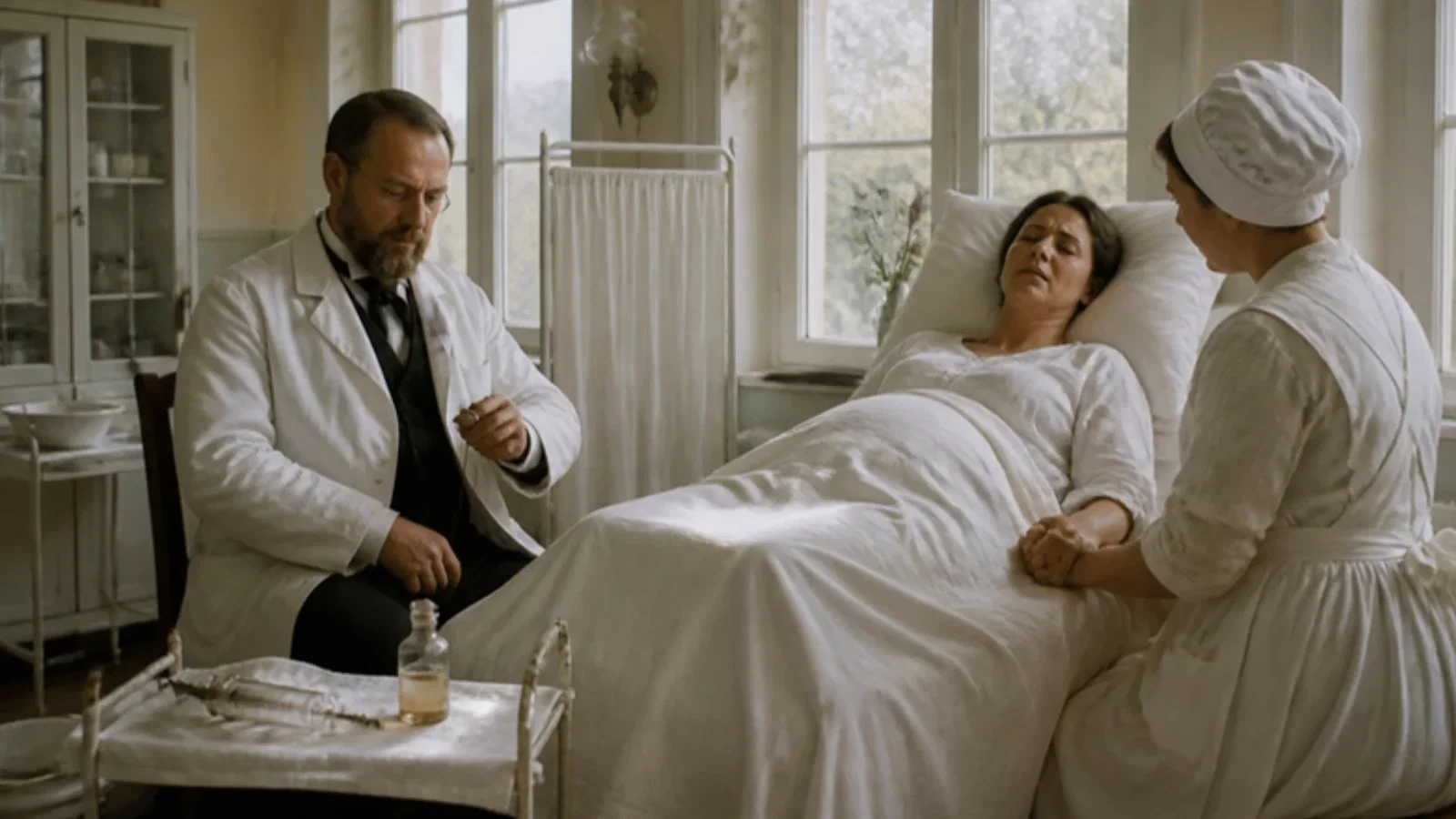
Walter Stoeckel injected novocaine through the sacral hiatus to ease labour pain, reporting 141 cases; colleagues in Heidelberg and elsewhere found the relief modest and the effect on contractions worrying.
Reading Library · Anesthesia Epochs · 中文版
Watch the education video (for clinicians)
1909: Stoeckel's Sacral Anaesthesia — Into the Labour Room · Anesthesia Epochs Education Series
Epidural analgesia for labour has a long prehistory, and one of its early chapters was written in Germany in 1909. Walter Stoeckel opened the year's first issue of the Zentralblatt für Gynäkologie with "Über sakrale Anästhesie" (On sacral anaesthesia), after presenting the method to the Middle Rhine Society for Obstetrics and Gynaecology on 7 November 1908. Stoeckel's own paper could not be obtained for this article. What survives in an open copy is the account in the German annual review of obstetrics and gynaecology for 1909, which abstracts the paper, the discussion of the talk and the first attempts to repeat it. This article is built on that review and its successor for 1910. [1] [2]
The setting
The same section of the 1909 review shows why labour pain was an open problem. Krönig, reporting to the international congress in Budapest, held that lumbar spinal anaesthesia had no place in ordinary obstetrics, because it abolished the mother's bearing-down effort; it belonged only to larger operations such as caesarean section. Much of the rest of the section dealt with scopolamine-morphine "twilight sleep" and its risks for mother and child. [1]
The method, as abstracted
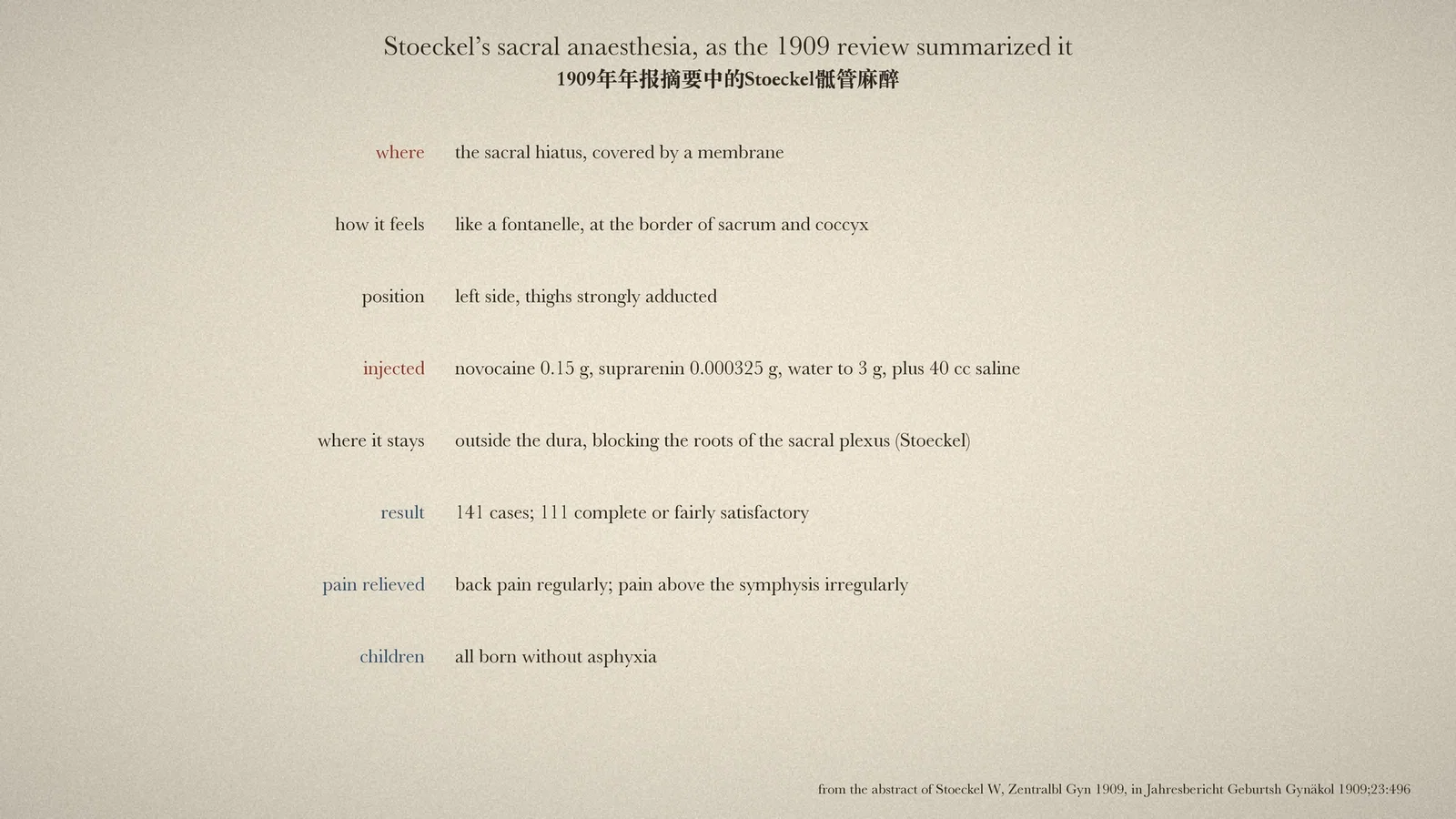
According to the review, Stoeckel injected 0.15 g of novocaine with 0.000325 g of suprarenin, made up to 3 g with distilled water, followed by 40 cc of physiological saline. The needle went in at the sacral hiatus, "covered by a membrane", which "gives the feel of a fontanelle" and is easy to find at the border between sacrum and coccyx. The injection was given with the woman lying on the left side, thighs strongly adducted. [1]
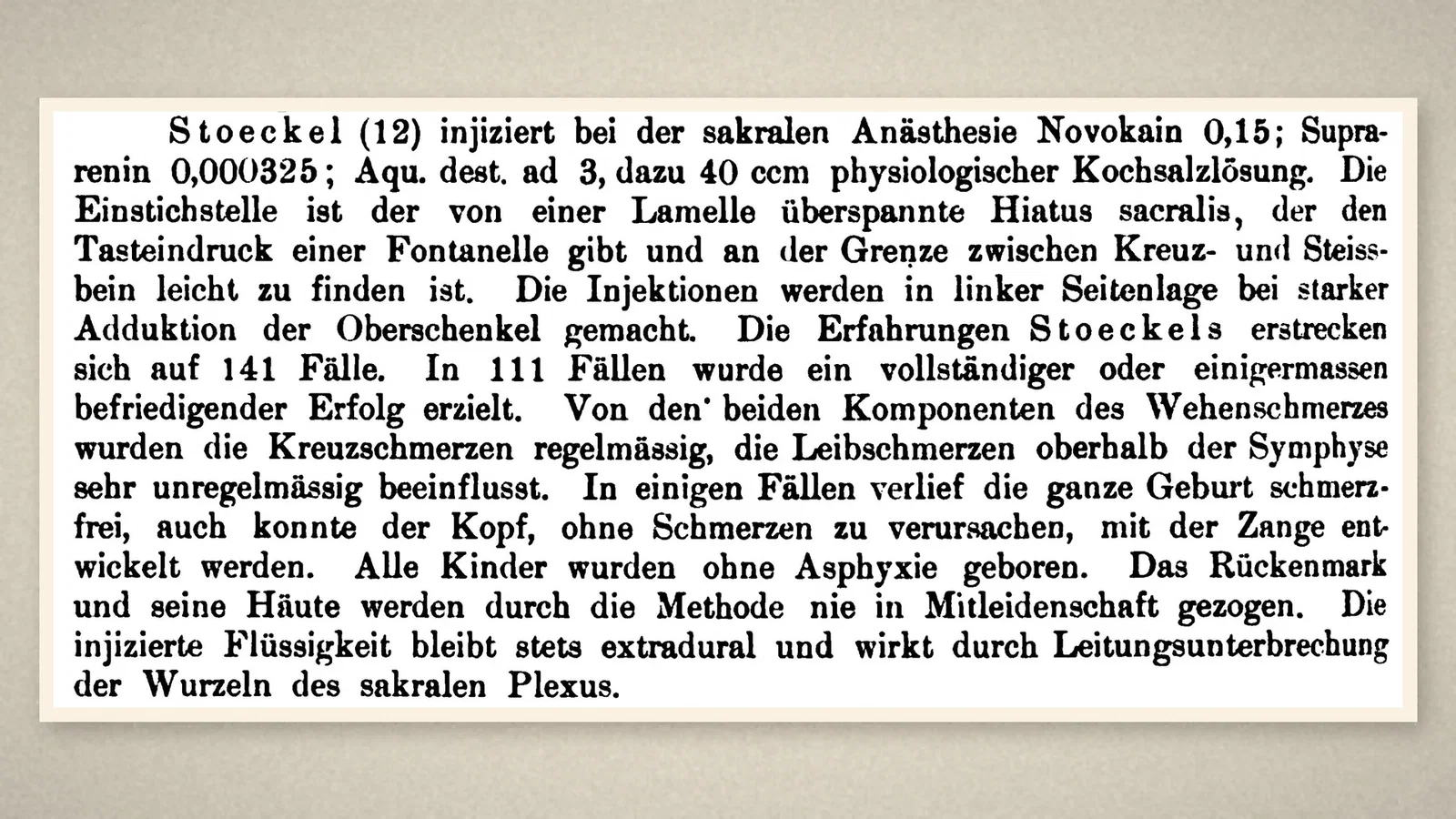
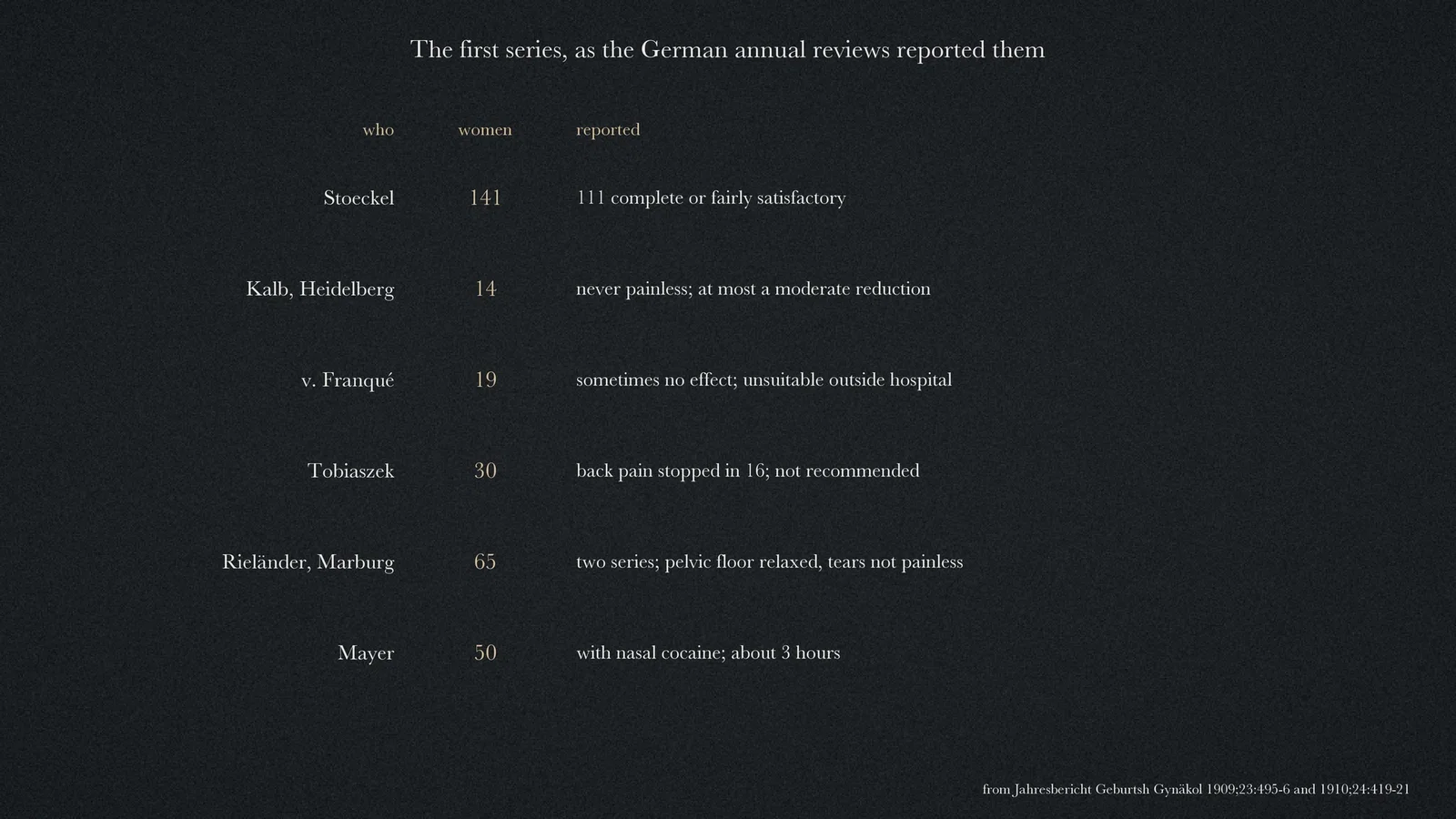
Stoeckel's experience covered 141 cases, with complete or fairly satisfactory relief in 111. Of the two parts of labour pain, the pain in the small of the back was regularly relieved, while the pain in the abdomen above the symphysis was affected very irregularly. In some cases the whole labour was painless, and the head could even be delivered with forceps without pain. "All children were born without asphyxia." The spinal cord and its membranes, Stoeckel held, were never involved: the fluid stayed extradural and worked by blocking the roots of the sacral plexus. The 1909 review also records that Stoeckel had used sacral anaesthesia with good results for essential dysmenorrhoea. [1]
Doubts from the first users
The discussion of Stoeckel's talk was mixed. Kalb reported 14 obstetric cases from the Heidelberg women's clinic: relief was absent in three, and in eight other cases there were five successes and three failures; contractions were weakened in four. Subjectively, the abstract says, it was never a matter of painlessness, at most a moderate reduction of pain. v. Franqué reported 19 cases with some complete failures and thought the method unsuitable outside hospital. In closing, Stoeckel replied that complete painlessness was not even desirable, since abolishing pain entirely made disturbances or delays of labour more likely, and ruled out infection at the puncture site. [1]
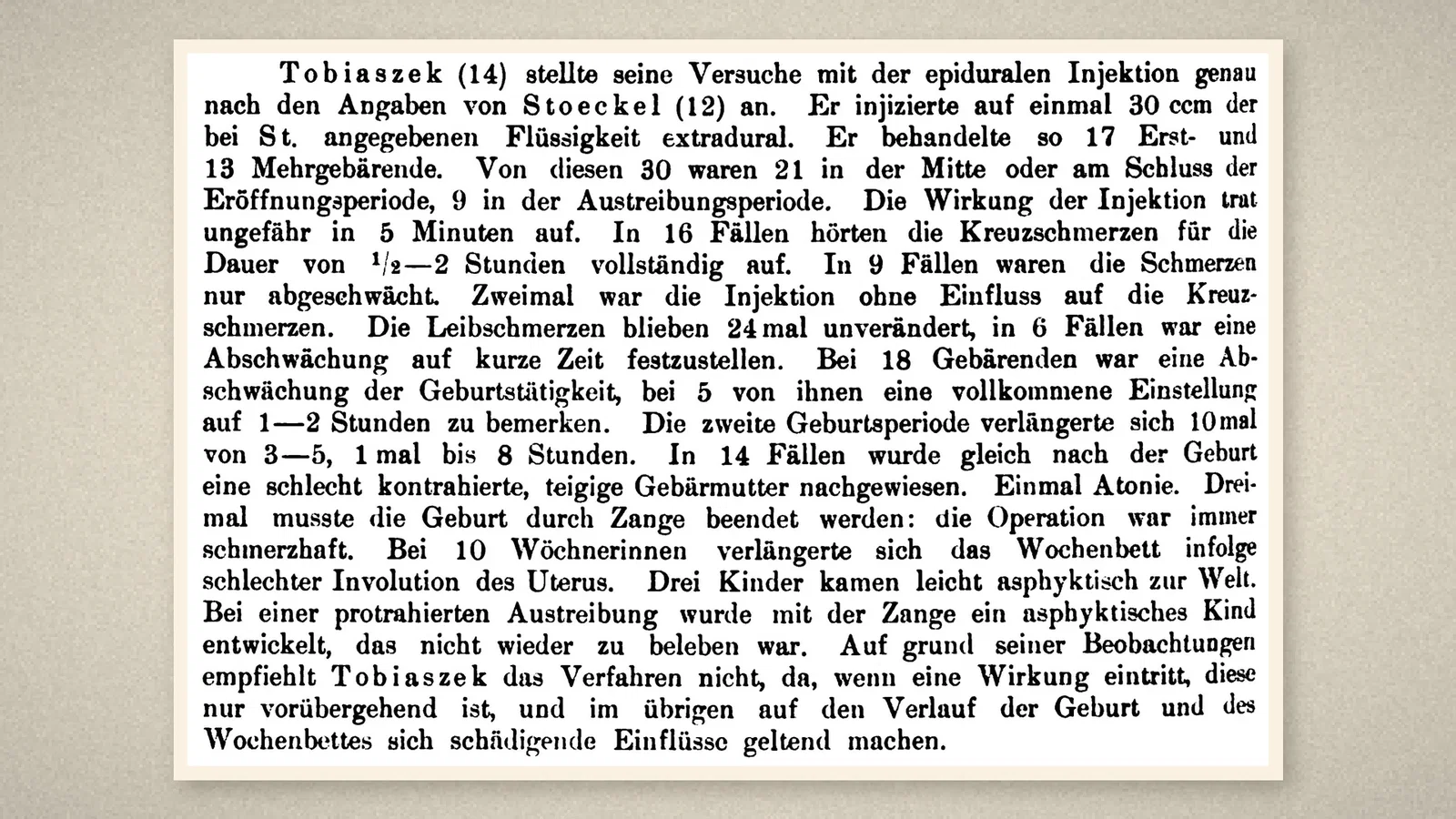
Maryan Tobiaszek then followed Stoeckel's directions exactly in 30 women, injecting 30 cc at once. In 16 the back pain stopped completely for half an hour to two hours; the abdominal pain was unchanged in 24. Labour weakened in 18 women and stopped for one to two hours in five; three forceps deliveries were painful; one asphyxiated child delivered by forceps after a protracted second stage could not be revived. Tobiaszek did not recommend the method. [1]
Marburg keeps trying
The 1910 review notes that "despite the hardly encouraging reports from other clinics", the trials continued at Marburg with modifications. A. Rieländer reported 65 cases in two series. With a novocaine-suprarenin injection after nasal cocaine painting, results were disappointing; with an alypin-suprarenin solution, contractions and bearing down were hardly affected, the pelvic floor often relaxed, but tears still could not be sutured painlessly. K. Mayer reported 50 women given Stoeckel's sacral injection after nasal cocaine, with relief starting in five to ten minutes and lasting about three hours on average. [2]
What the record shows
The 1909 record shows a method that worked best on exactly the pain it was aimed at, low back pain carried by the sacral roots, and much less on the rest, together with an early and frank argument about whether labour should be made fully painless at all. A. Doughty's 1990 article later called Walter Stoeckel (1871-1961) "a pioneer of regional analgesia in obstetrics". [3] Whether Stoeckel was the first to use the caudal route in labour is not settled by these sources, and this article does not claim it.
Sources and reading limits
Read: the section on anaesthesia in labour in the German annual review for 1909 (vol. 23, pp. 493-6) and for 1910 (vol. 24, pp. 419-21); the PubMed record of Doughty's 1990 article (title only).
Not covered: Stoeckel's paper in Zentralblatt für Gynäkologie 1909, No. 1, and the published report of the 1908 talk, neither found in an open copy; Doughty's article itself; the original papers of Kalb, v. Franqué, Tobiaszek, Rieländer and Mayer. Every statement about Stoeckel's method and results here is a reviewer's summary, not Stoeckel's own words. Doses are as printed; German quotations are translated for this article.
Two illustrations are page crops from the 1909 review; two are drawn from the reviews.
- [Narkose der Kreissenden]. Jahresbericht über die Fortschritte auf dem Gebiete der Geburtshilfe und Gynäkologie. 1909;23:493-6. Including abstracts of Stoeckel W. Über sakrale Anästhesie. Zentralbl Gyn. 1909;(1):1. Internet Archive
- [Narkose der Kreissenden]. Jahresbericht über die Fortschritte auf dem Gebiete der Geburtshilfe und Gynäkologie. 1910;24:419-21. Internet Archive
- Doughty A. Walter Stoeckel (1871-1961). A pioneer of regional analgesia in obstetrics. Anaesthesia. 1990;45(6):468-71. PubMed
Continue exploring
Related reading connects shared questions and contexts; it does not by itself establish historical influence.
- 1908: Bier Injects Novocaine into a Vein Between Two Bandages
- 1907: Barker Makes the Spinal Solution Heavier Than Spinal Fluid
Anesthesia Epochs · The Source Room · About & Editorial Method
Published November 2, 2026. Sources and reading limits are stated above. Illustrations are labelled as original source images or AI-made. Historical accounts are educational; they are not current treatment instructions.