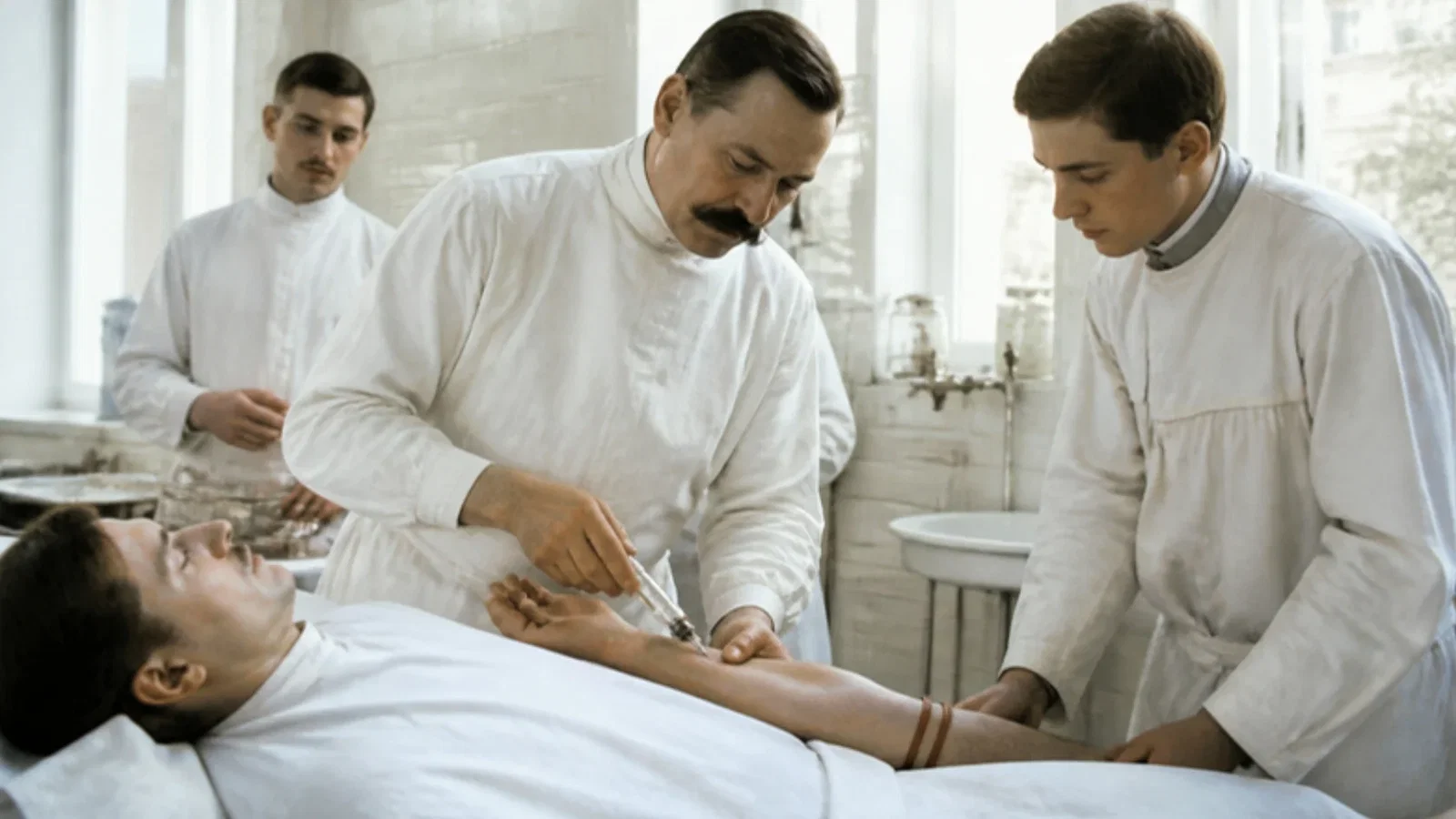
At the 1908 German surgical congress August Bier described closing off a segment of a bloodless limb with two soft rubber bandages and injecting dilute novocaine into an opened vein, so that resections and amputations could be done under local anaesthesia.
Reading Library · Anesthesia Epochs · 中文版
Watch the education video (for clinicians)
1908: Bier's Block — Novocaine Between Two Bandages · Anesthesia Epochs Education Series
The "Bier block", a dose of local anaesthetic run into the veins of an arm held bloodless by a tourniquet, is still in wide use. It began in Berlin in April 1908, at the 37th Congress of the German Surgical Society, held from 21 to 24 April in the Langenbeck-Haus. The congress report, printed as a supplement to the Zentralblatt für Chirurgie, includes as item 9 August Bier's own summary of a talk titled "On a new way to produce local anaesthesia in the limbs". This article reads that summary, and a 2008 centenary review by Almiro dos Reis Jr for what came after. [1] [2]
The problem
Bier began with the operations that local anaesthesia could not yet make painless: on the limbs, "resections, amputations, exarticulations, necrotomies and so on". [1] Infiltration and nerve blocks could numb skin and small areas; a joint resection or an amputation was another matter.
The method
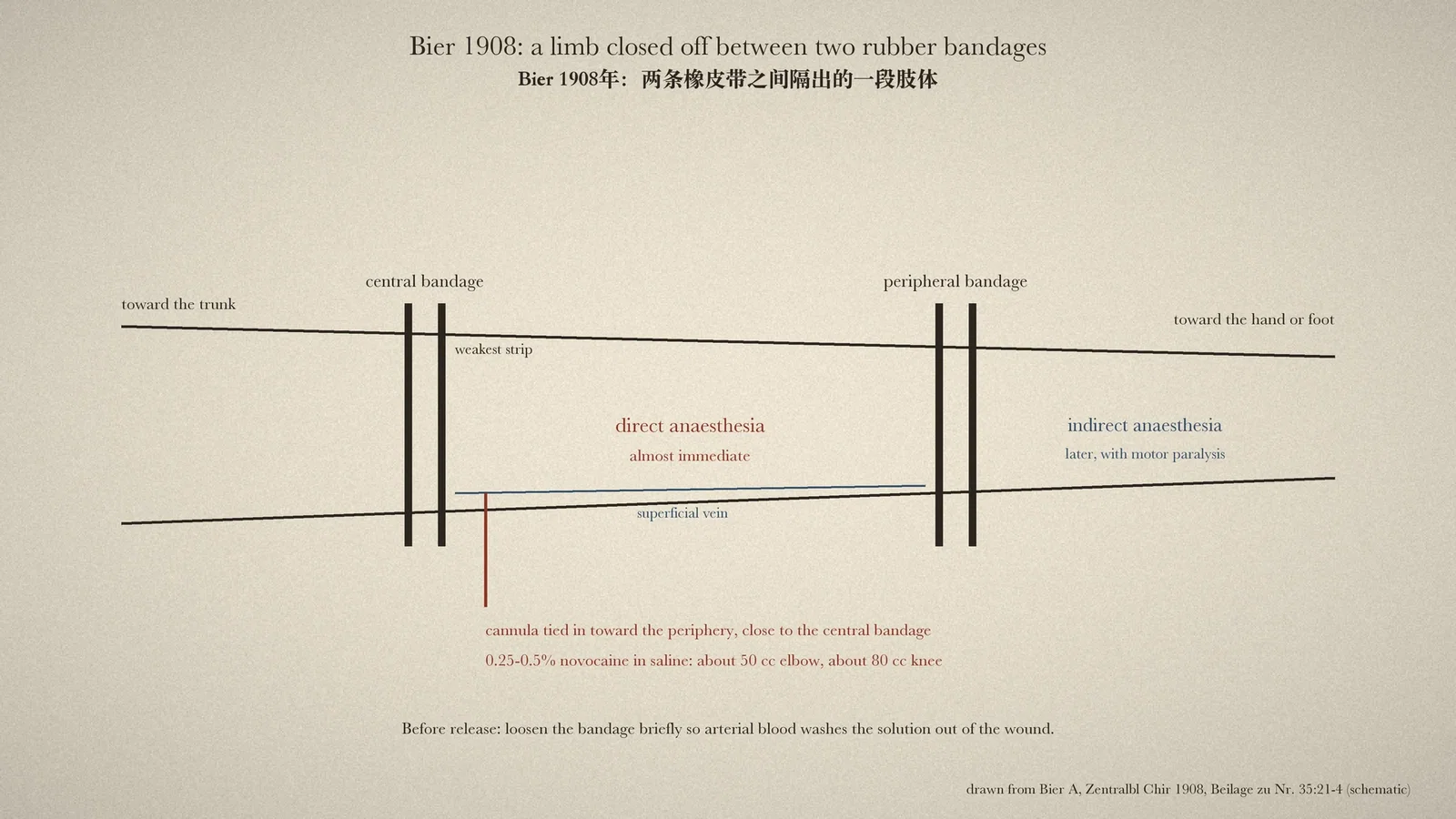
Bier closed off the area to be anaesthetized between two rubber bandages, one above and one below the operating field. They had to be soft and thin, and wound over a broad area, because the usual form of Esmarch's tourniquet was itself very painful; applied this way it was barely uncomfortable. Usually the blood was first driven out of the whole limb with Esmarch's expulsion bandage, which Bier called almost forgotten. [1]
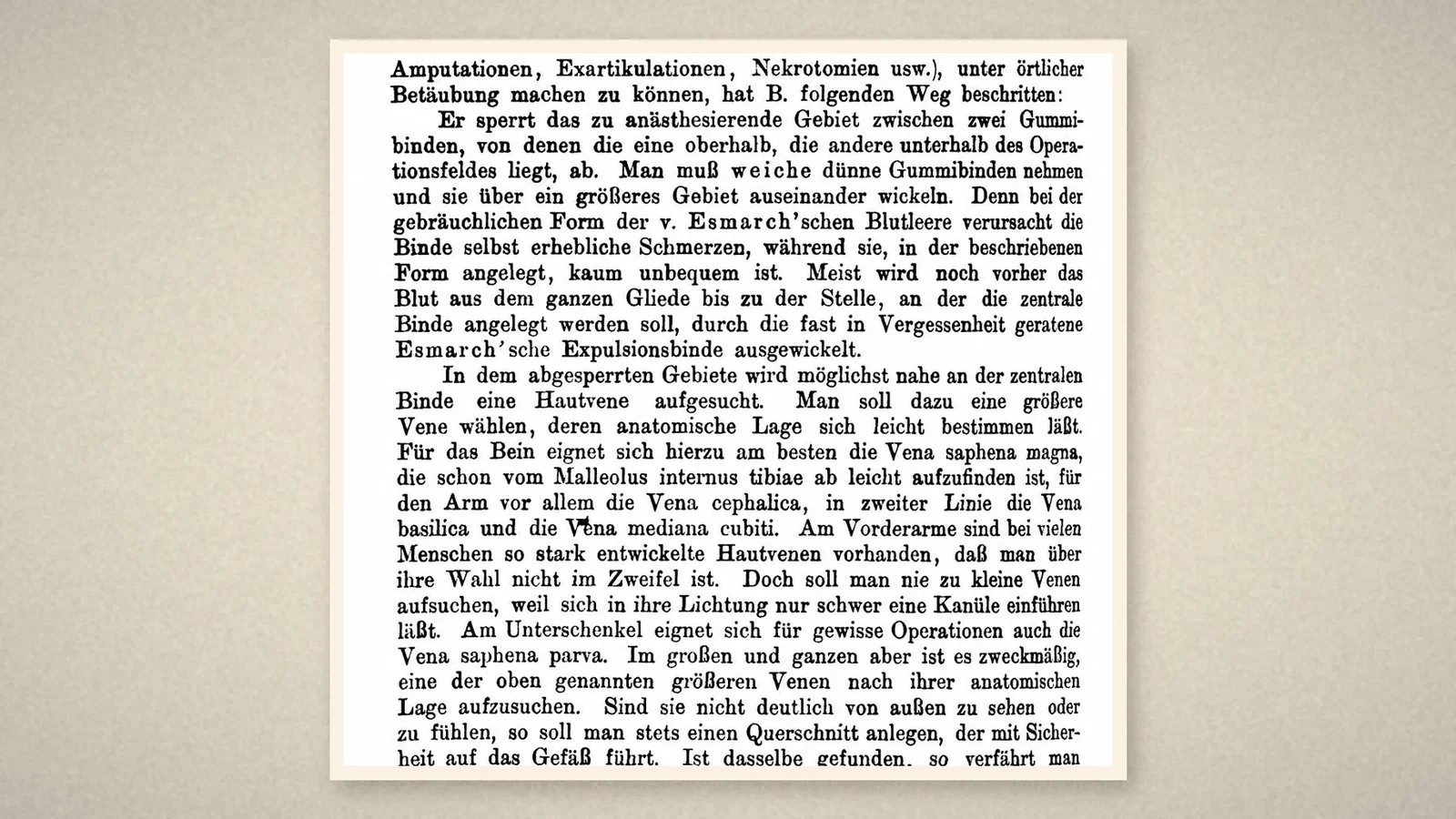
Inside the closed-off segment, as close as possible to the upper, central bandage, Bier exposed a large superficial vein: the great saphenous for the leg, the cephalic for the arm, or the basilic or median cubital; if no vein could be seen or felt, a transverse incision was made over its known position. The vein was handled as for a saline infusion. Two loops of thread went around it, it was slit, a fine metal cannula was tied in pointing toward the periphery, "toward the valves", and the vein was tied off toward the centre. Then 0.25 to 0.5 per cent novocaine, dissolved in physiological saline to avoid irritating the tissues, was injected. Lately Bier had used only the 0.5 per cent solution, which anaesthetized more reliably: about 50 cc for an adult's elbow resection, about 80 cc for a knee. [1]
Direct and indirect anaesthesia
If the injection went well, the whole operating area became anaesthetic almost at once. The weakest spot was always a strip just below the central bandage, so that bandage was not to be placed too close to the operation. In most cases, given enough of the 0.5 per cent solution and a longer wait, the whole limb below the lower bandage became numb as well. Bier called the first "direct" and the second "indirect" anaesthesia and operated mostly under the direct kind; soon after the indirect anaesthesia appeared, the limb was also paralysed. The cannula and syringe were the familiar instruments of saline infusion. Under this anaesthesia Bier had done knee and elbow resections, amputations, necrotomies and tendon transfers painlessly, and claimed to be near the ideal of doing every operation that could be done in an artificially bloodless field under local anaesthesia. [1]
The danger in the vein
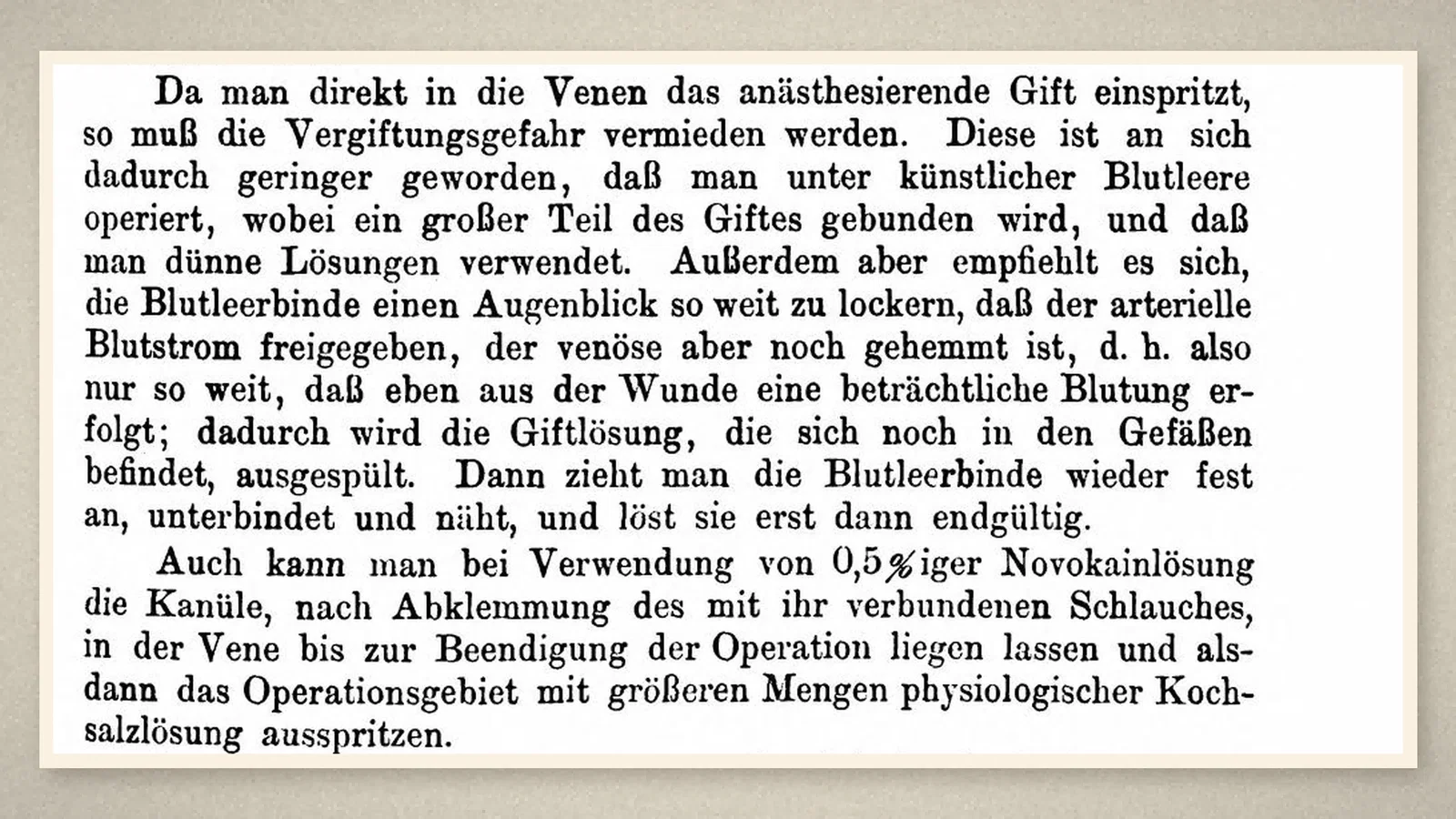
Because the anaesthetic went straight into the veins, Bier wrote, the risk of poisoning had to be avoided. The bloodless field and the dilute solution already reduced it. Before the end, the tourniquet was loosened for a moment, just enough to let arterial blood in while the veins stayed blocked, so that the solution still in the vessels bled out through the wound; then it was tightened again, the vessels tied and the wound sutured before final release. Alternatively the cannula could be left in the vein, clamped, and the area flushed with saline at the end. Both kinds of anaesthesia vanished almost immediately once the tourniquet came off, and the paralysis even sooner, so release had to wait until the operation was almost finished. Adding adrenaline to prolong the effect seemed to Bier not without danger when the drug went directly into the vessels. The prerequisite for success was "an absolutely reliable bloodlessness". [1]
What came after
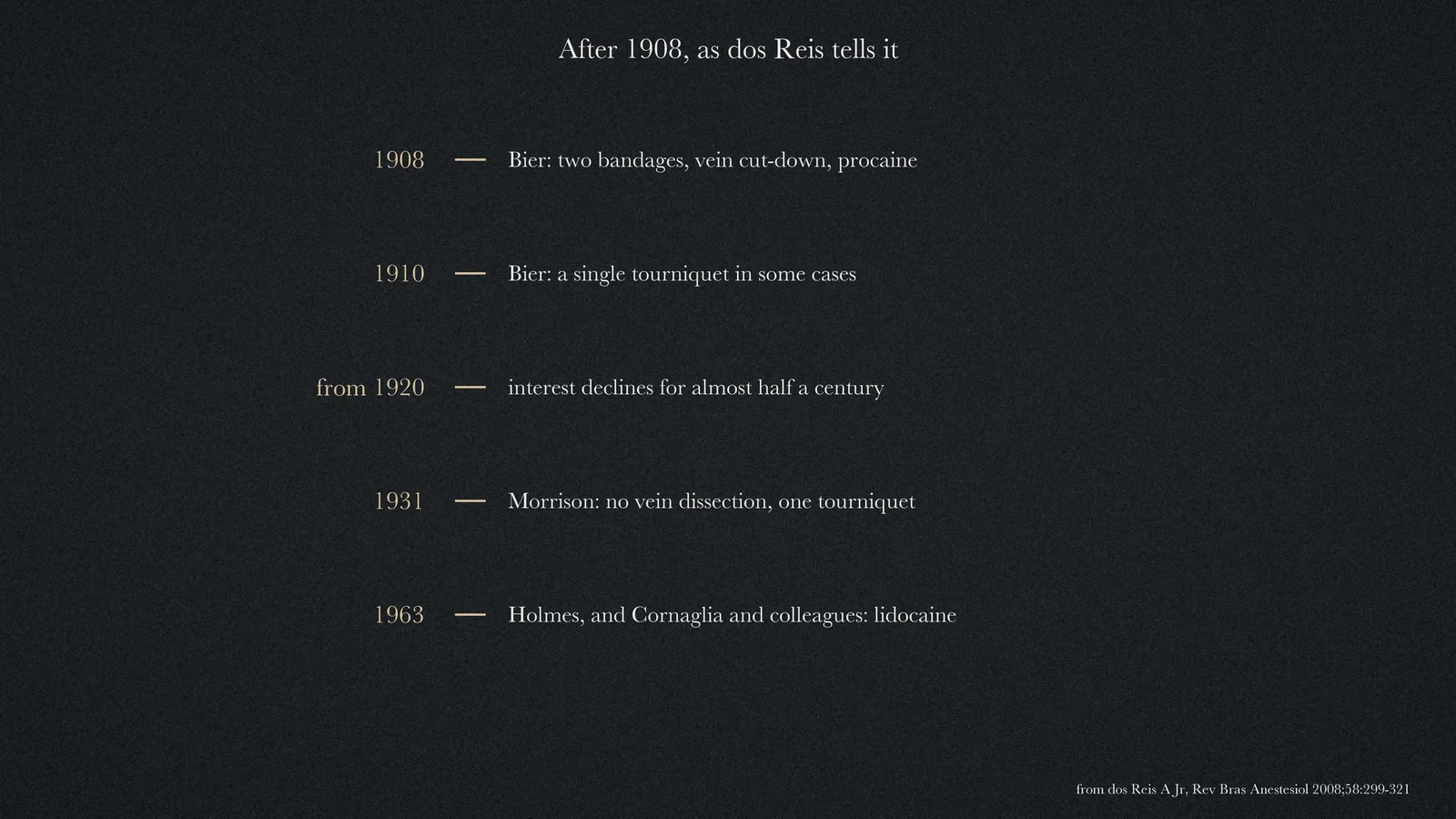
According to dos Reis, Bier's full paper appeared in Archiv für klinische Chirurgie the same year, and a report of 1910 already described using a single tourniquet in some cases. From 1920, interest in the method declined for almost half a century, for reasons that included the rise of brachial plexus and spinal blocks, the inconvenience of cutting down on a vein and isolating a segment of the limb, and fear of toxic reactions. In 1931 Morrison recommended giving up the vein dissection and the second tourniquet; in 1963 reports by Holmes, and by Cornaglia and colleagues, used lidocaine, and interest in the technique rose again. [2]
What the record shows
Bier's 1908 summary already holds the method's essentials and its central hazard: a bloodless limb, a dilute local anaesthetic filling its veins, and a tourniquet that must not be released too early. The way the drug was given, by surgical cut-down between two bandages, was later simplified away.
Sources and reading limits
Read: Bier's own summary in the report of the 1908 congress, supplement to Zentralblatt für Chirurgie No. 35, pp. 21-24; the English full text of dos Reis's 2008 review.
Not covered: Bier's full paper in Archiv für klinische Chirurgie (vol. 86), which was not found online; Bier's later papers; the papers of Morrison, Holmes and others, known here only through dos Reis. The report does not give the day of Bier's talk within the congress. dos Reis's summary of the original method, drawn from three of Bier's papers, gives 50 or 100 mL; the 1908 summary gives about 50 cc for an elbow and about 80 cc for a knee. Doses are as printed; German quotations are translated for this article.
Two illustrations are page crops from the 1908 report; two are drawn from the sources.
- Bier A. Über einen neuen Weg Lokalanästhesie an den Gliedmaßen hervorzurufen [Selbstbericht]. Zentralbl Chir. 1908;35(Beilage zu Nr. 35):21-4. Internet Archive
- dos Reis A Jr. Intravenous regional anesthesia--first century (1908-2008). Beggining, development, and current status. Rev Bras Anestesiol. 2008;58(3):299-321. DOI
Continue exploring
Related reading connects shared questions and contexts; it does not by itself establish historical influence.
- 1894: Schleich's Infiltration Anaesthesia with Very Dilute Solutions
- 1907: Barker Makes the Spinal Solution Heavier Than Spinal Fluid
- 1898: Bier's Spinal Analgesia and Its Aftermath
Anesthesia Epochs · The Source Room · About & Editorial Method
Published November 2, 2026. Sources and reading limits are stated above. Illustrations are labelled as original source images or AI-made. Historical accounts are educational; they are not current treatment instructions.