In 1894 the Berlin surgeon Carl Ludwig Schleich, first rebuffed by colleagues, showed that tissue swollen with very weak cocaine solution could be cut without pain, and argued that most operations then done under chloroform did not need it.
Reading Library · Anesthesia Epochs · 中文版
Watch the education video (for clinicians)
1894: Schleich's Infiltration Anaesthesia — Very Dilute Solutions · Anesthesia Epochs Education Series
Cocaine made local anaesthesia possible, and also dangerous. The strong solutions then in use could reach a toxic dose within a few syringes, so only small operations could be done with them. In 1894 a Berlin surgeon, Carl Ludwig Schleich, published a book arguing that the answer was not stronger drugs but far weaker ones, pushed into the tissue in volume. Its title was Schmerzlose Operationen, "painless operations", and its subtitle promised local anaesthesia "with indifferent fluids". [1]
A method first rejected
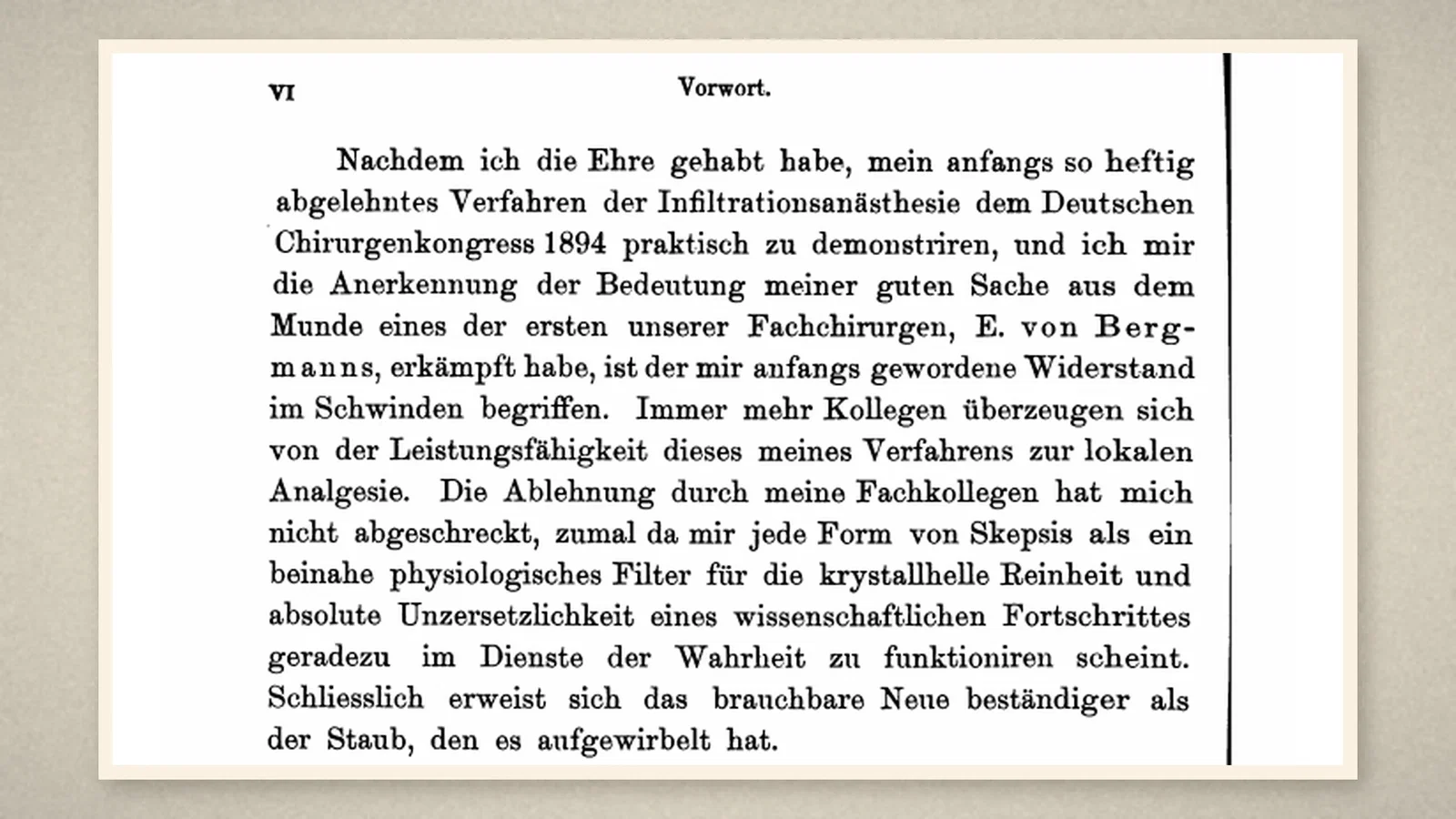
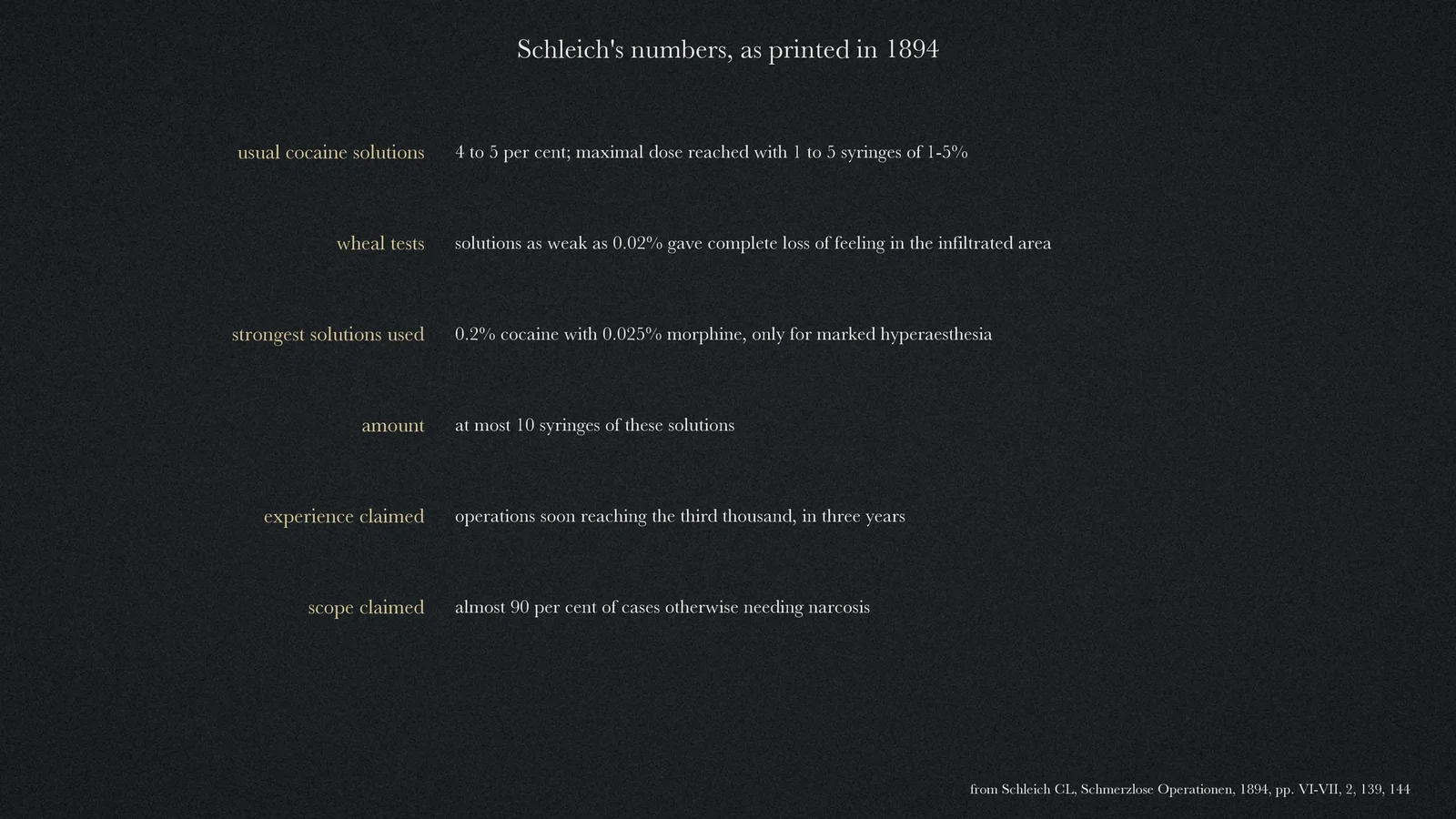
The preface opens with a reflection on how "tradition becomes law" in medicine, and then turns personal. The method of infiltration anaesthesia had at first been "so vehemently rejected", Schleich wrote, but it had now been demonstrated in practice to the German Surgical Congress of 1894, and Schleich had "won" recognition from E. von Bergmann, one of the leading surgeons of the day; resistance was fading. The book, the preface adds, describes the technique of all the operations done with the method in the previous three years, whose number "will soon reach the third thousand". [1]
A 1993 history by M. Goerig and J. Schulte am Esch confirms that the method "did not receive due attention" from surgeons at first, adds that Schleich was partly to blame, and notes that within a few years it was hailed as the "first great medical feat in the discipline of German surgery". [2]
Weaker, not stronger
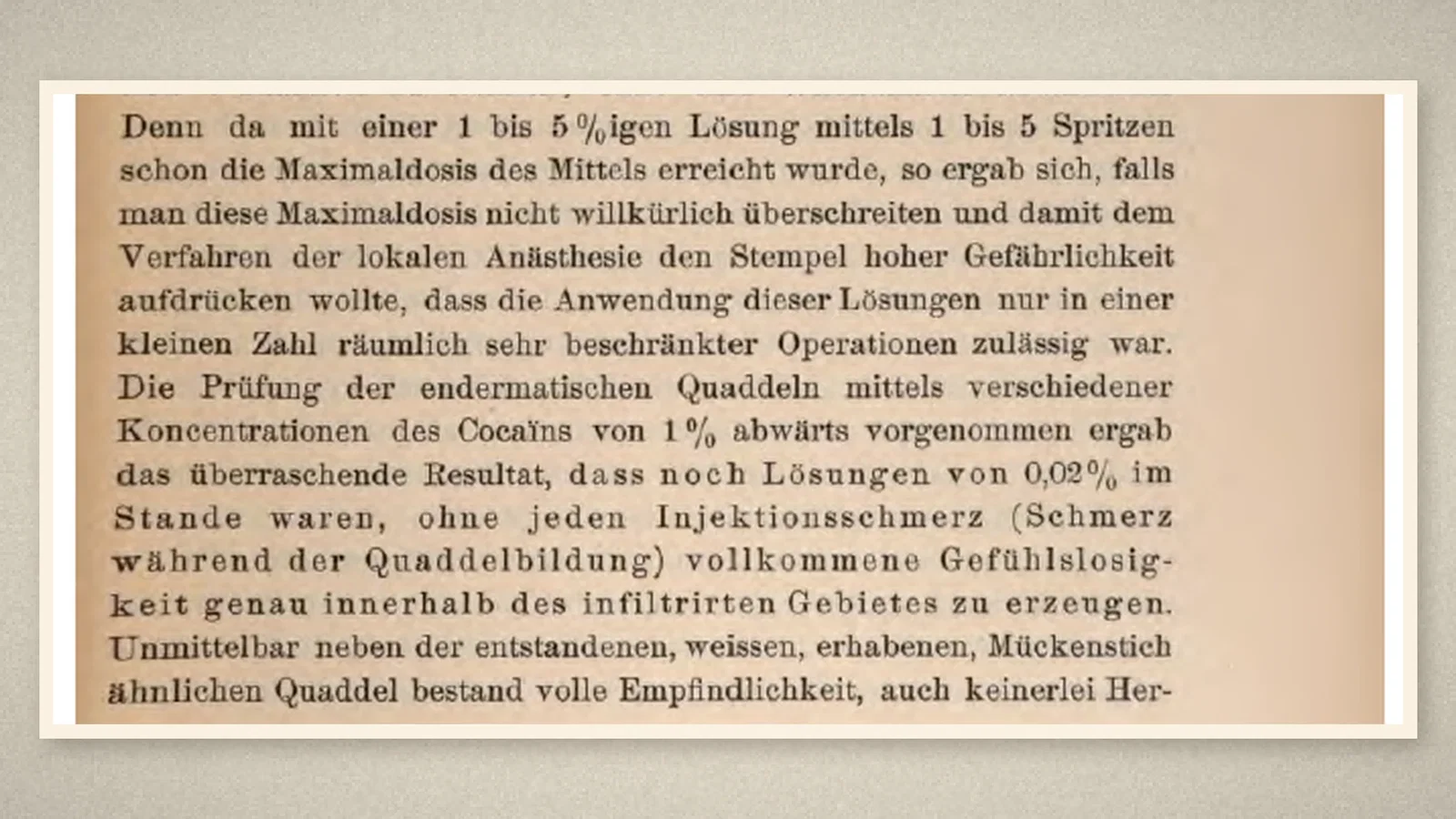
The core of the argument is in the chapter on the theory of local anaesthesia. Schleich pointed out that with the usual four to five per cent cocaine solutions the maximal dose was reached with one to five syringes of a one to five per cent solution, which confined local anaesthesia to "a small number of spatially very limited operations". [1] To find the lower limit, Schleich raised wheals in the skin with a fine needle almost flat under the epidermis and tested them with ever weaker solutions. The "surprising result" was that solutions of 0.02 per cent still produced, without pain on injection, "complete loss of feeling exactly within the infiltrated area", while sensation remained normal right next to the wheal. [1]
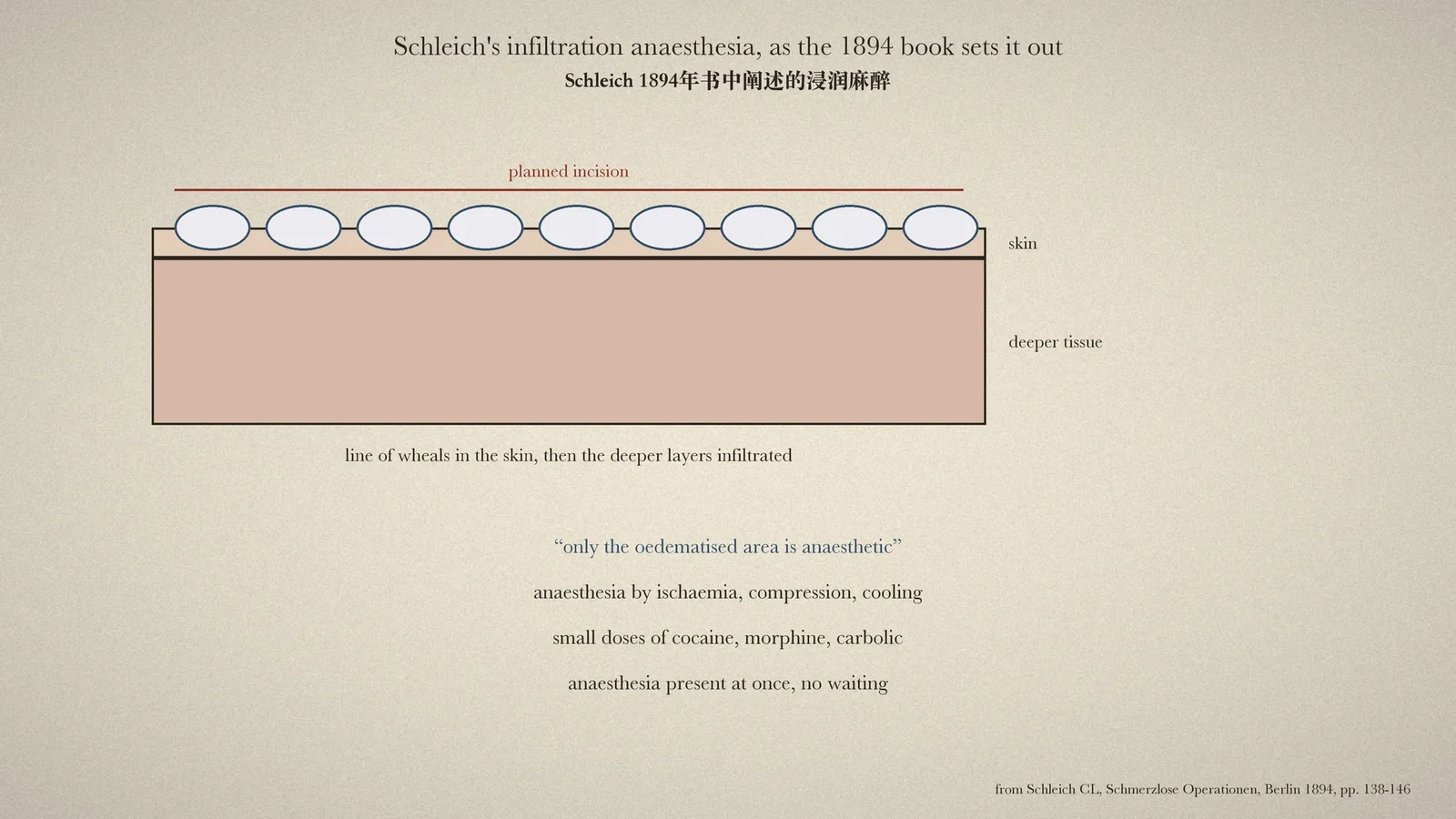
The practical method followed. The first prick was made painless with an ether spray or a drop of strong cocaine or carbolic acid. Then a line of wheals was raised in the skin exactly along the planned incision, and the deeper tissue was infiltrated as far as the operation would reach. Nothing was cut until the artificial oedema was complete, because "only the oedematised area is anaesthetic". The anaesthesia, Schleich wrote, came mainly from ischaemia, compression and cooling, with the small doses of narcotics (morphine, cocaine, carbolic acid) overcoming the pain of infiltrating plain fluid, and it was present at once: "the effect need not be waited for". [1] The strongest solutions, used only for very sensitive inflamed tissue, contained 0.2 per cent cocaine and 0.025 per cent morphine, and at most ten syringes were needed. [1]
An argument against narcosis
Schleich did not present infiltration as a mere convenience. The introduction argues that general narcosis, "especially the most widespread form, chloroform narcosis, but also ether narcosis", was more dangerous than most surgeons would admit, and that there was already a painless method that could exclude that danger "in almost 90 per cent of all cases which could otherwise only have been operated on under narcosis". [1] Goerig and Schulte am Esch add that Schleich also demanded, against resistance, that only specially trained physicians should give anaesthetics. [2]
What the record shows
Schleich's book shifted the question of local anaesthesia from how strong the drug must be to how it is placed: dilute solution, enough volume, the whole field of the incision infiltrated before the knife. The numbers that made the case, nearly three thousand operations and nine cases in ten, are the author's own, and the book is also a polemic against chloroform. Both should be kept in view.
Sources and reading limits
Read: Schleich’s Schmerzlose Operationen (1894): title, dedication, preface, the opening of the introduction and the chapter on the theory of infiltration anaesthesia (pp. 138–146), with their page images; the PubMed abstract of Goerig and Schulte am Esch 1993.
Not covered: the operative chapters and the sections on general narcosis in Schleich’s book; Schleich’s earlier congress presentation; later editions; the full texts of the two Goerig articles; the later naming of “regional anaesthesia” and the use of adrenaline as an adjuvant. Quotations from the German are translated here; doses are given as printed.
- Schleich CL. Schmerzlose Operationen: oertliche Betäubung mit indifferenten Flüssigkeiten; Psychophysik des natürlichen und künstlichen Schlafes. Berlin: Julius Springer; 1894. Internet Archive
- Goerig M, Schulte am Esch J. [Carl Ludwig Schleich--pioneer exclusively in infiltration anesthesia?]. Anasthesiol Intensivmed Notfallmed Schmerzther. 1993;28(2):113-24. PubMed
Continue exploring
Related reading connects shared questions and contexts; it does not by itself establish historical influence.
- 1885: Halsted and the Brachial Plexus Block, an Attribution Without a Paper
- 1884: Halsted and Hall Report a Jaw Nerve Block in a Postscript
Anesthesia Epochs · The Source Room · About & Editorial Method
Published November 2, 2026. Sources and reading limits are stated above. Illustrations are labelled as original source images or AI-made. Historical accounts are educational; they are not current treatment instructions.