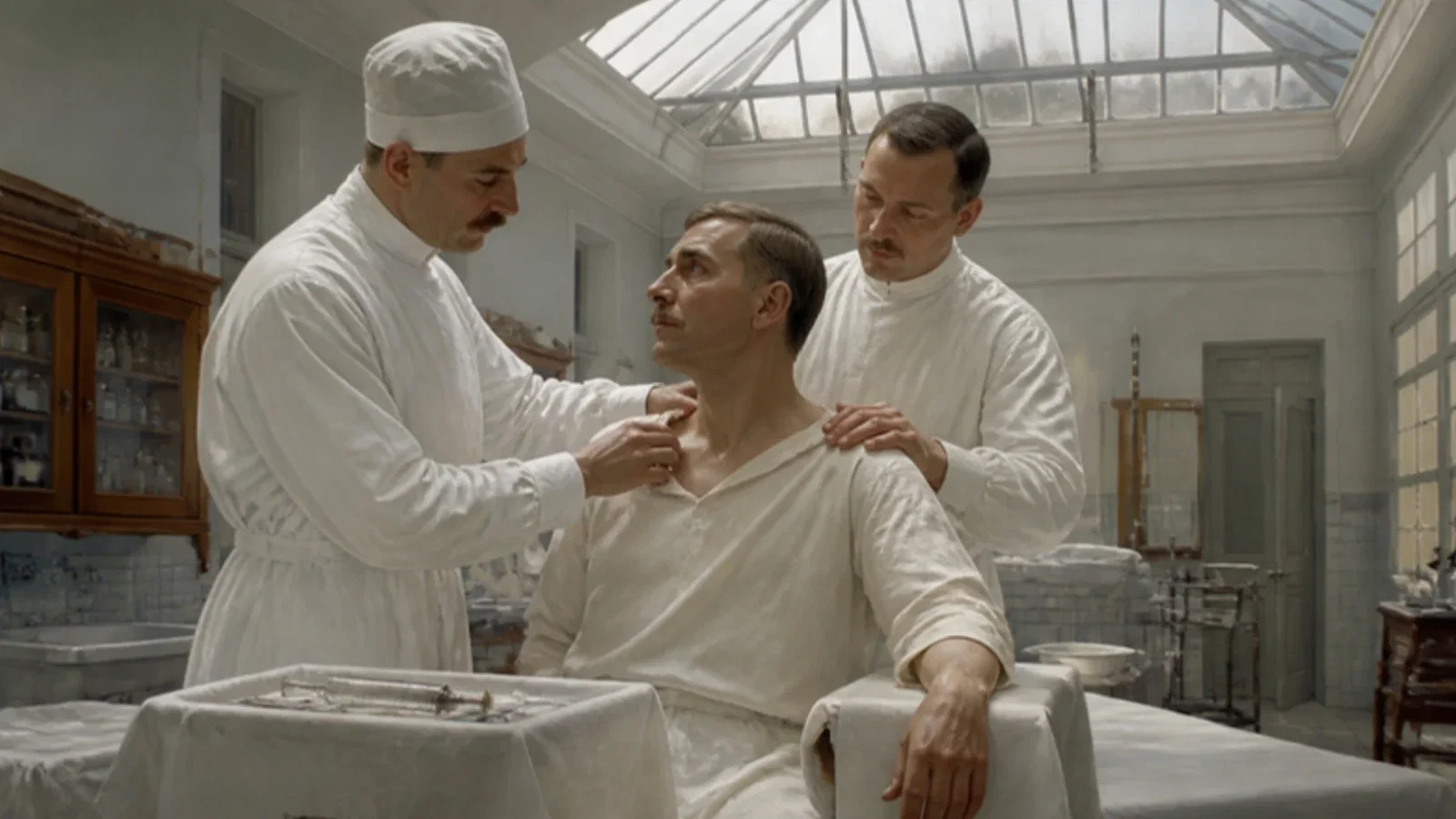
Georg Hirschel in Heidelberg reached the brachial plexus through the axilla; shortly afterwards D. Kulenkampff in Zwickau went above the clavicle, using the subclavian artery and first rib as guides and waiting for paraesthesiae.
Reading Library · Anesthesia Epochs · 中文版
Watch the education video (for clinicians)
1911: Two Routes to the Brachial Plexus — Hirschel and Kulenkampff · Anesthesia Epochs Education Series
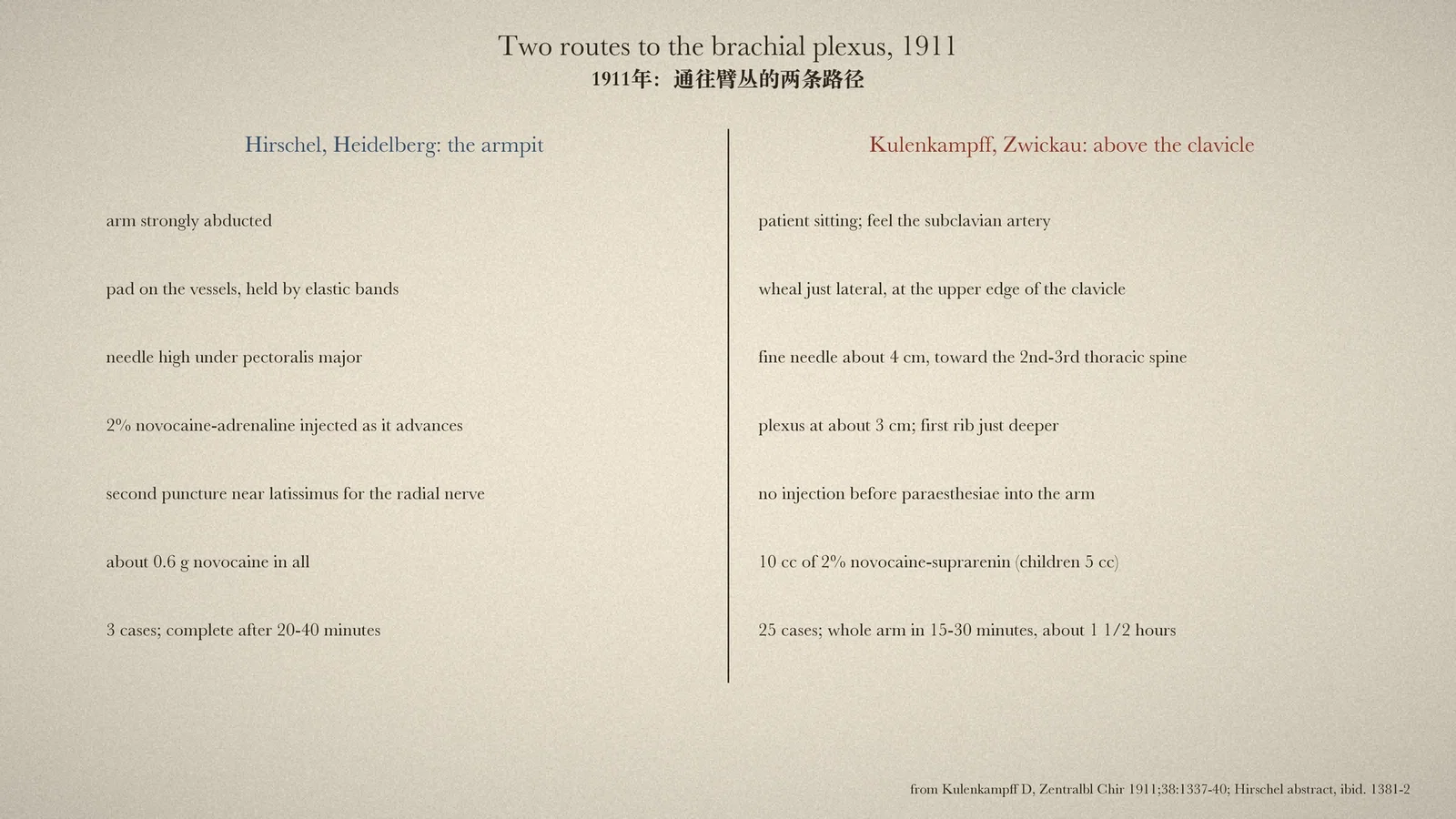
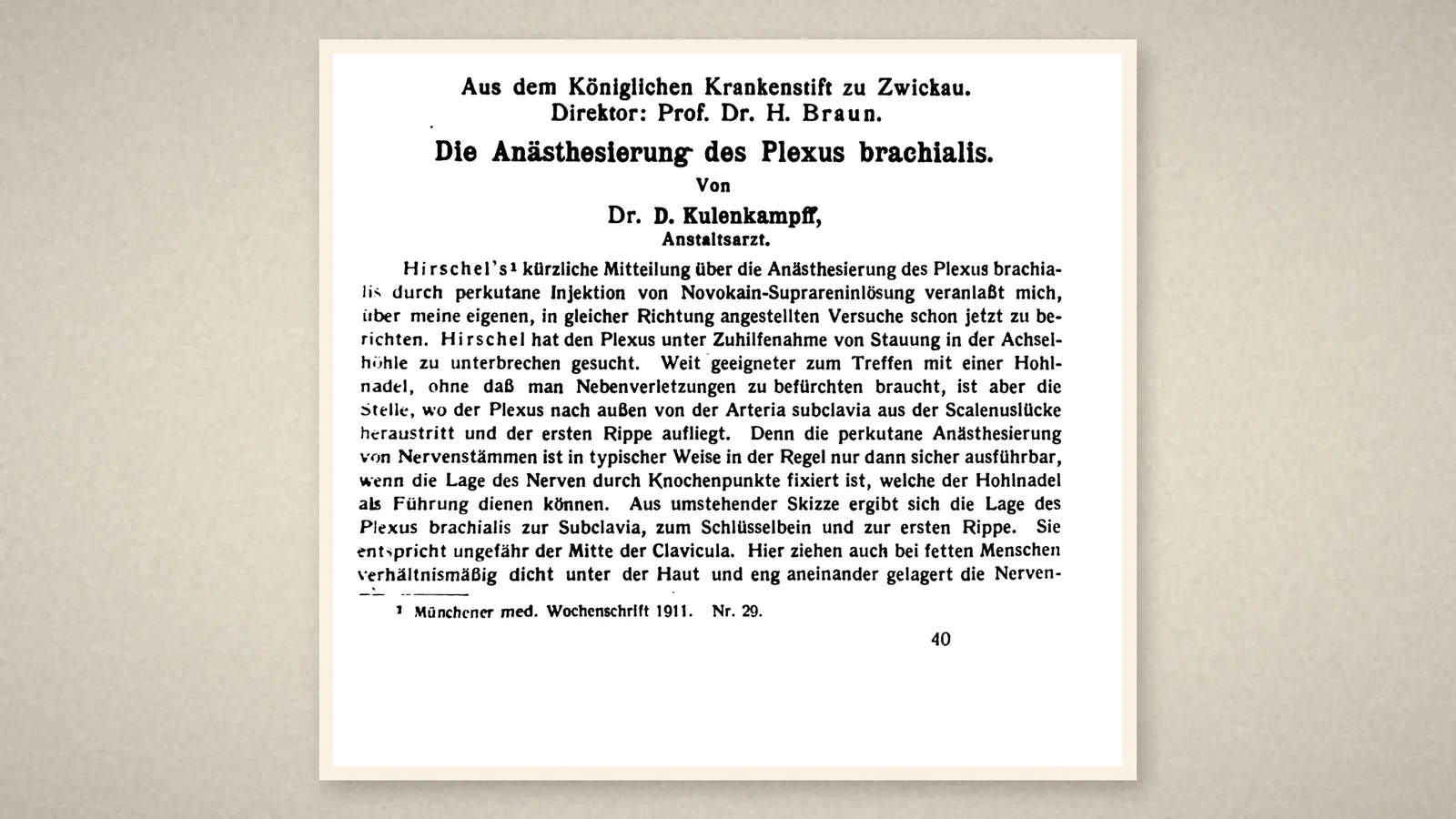
Blocking the nerves of the whole arm with one injection through the skin, without cutting down on them, is everyday regional anaesthesia now. In 1911 two German surgeons published two ways of doing it, the second prompted by the first. Georg Hirschel of the Heidelberg surgical clinic went in through the armpit; D. Kulenkampff of the royal hospital in Zwickau went in above the collarbone. Both reports can be read in the Zentralblatt für Chirurgie of that autumn: Kulenkampff's as an original communication in No. 40, dated Saturday 7 October 1911, and Hirschel's as an abstract in No. 41 of a paper in the Münchener medizinische Wochenschrift. [1] [2]
Hirschel: the armpit
According to the abstract, Hirschel abducted the arm strongly and, to slow the absorption of the anaesthetic, made a light congestion with a pad pressed on the vessels and held by two elastic bands around shoulder and chest. The artery was fixed with the fingers and the needle introduced as high as possible under the pectoralis major, in the line of the arm. As the needle advanced, 2 per cent novocaine with adrenaline had to be injected at once, so that the vessels would move aside and not be injured. The median and ulnar nerves were bathed with a few syringefuls; a further puncture below the artery, near the insertion of latissimus dorsi, was needed for the radial nerve. In three operations (removal of a bullet above the elbow, an amputation of the upper arm, an operation for tuberculosis of the ulna) anaesthesia was complete after 20 to 40 minutes, though the patients had also had morphine or pantopon. The large dose of about 0.6 g of novocaine was tolerated without trouble. [2]
Kulenkampff: above the clavicle
Kulenkampff, writing from Zwickau, where H. Braun was director, said that Hirschel's recent report had prompted publication of experiments made "in the same direction". A far better target than the armpit, Kulenkampff argued, was the place where the plexus leaves the gap between the scalene muscles, lateral to the subclavian artery, and lies on the first rib. Percutaneous blocks of nerve trunks were, as a rule, reliable only where bony landmarks could guide the needle. Here the subclavian artery, palpable in every patient, marked the medial side, and the clavicle and first rib the limits below. [1]
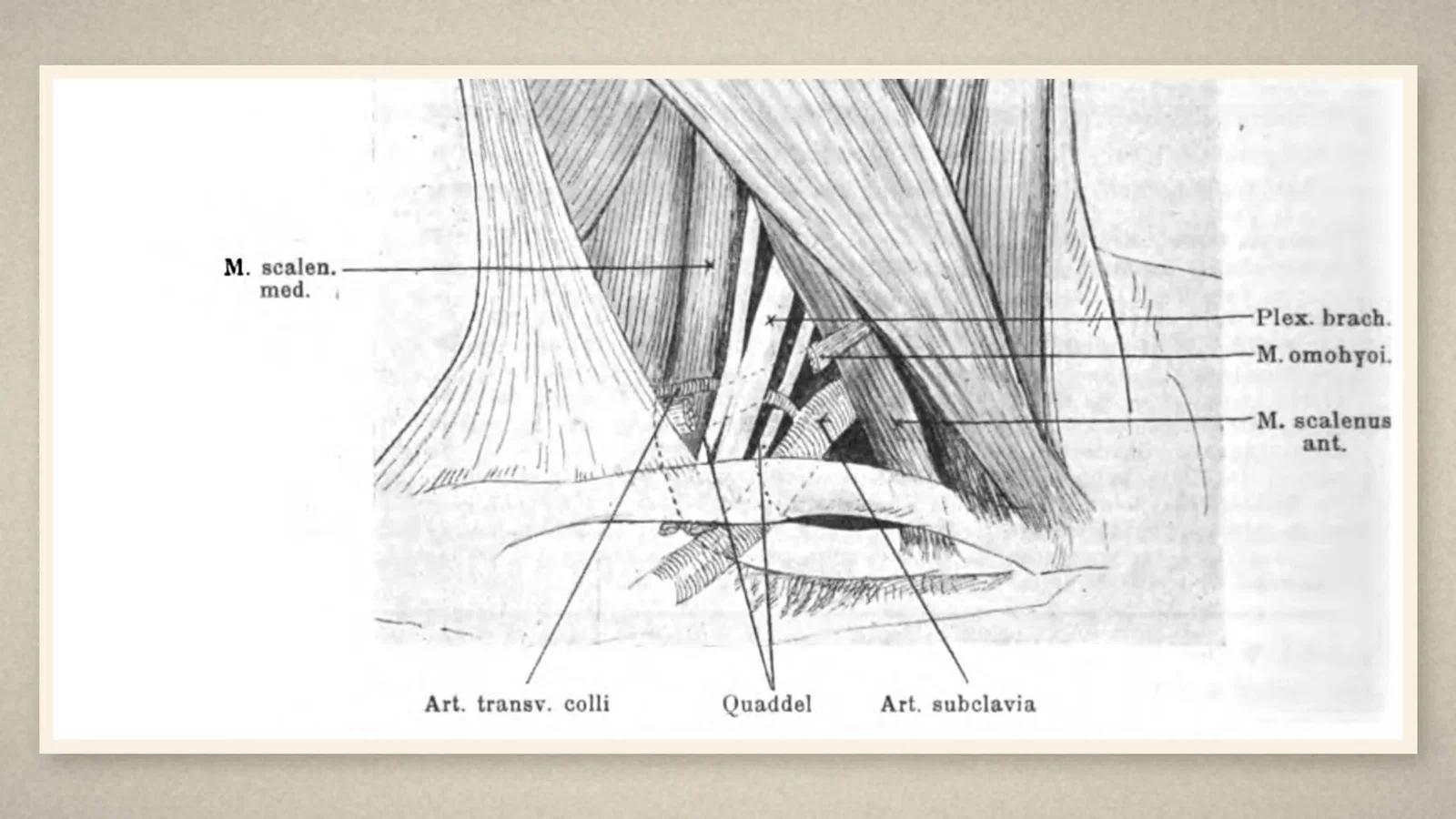
The technique was set out step by step. With the patient best seated, the subclavian artery is felt; a skin wheal is raised just lateral to it, close to the upper edge of the clavicle, and a fine needle about 4 cm long is introduced, aimed slightly medially and backwards and downwards, as if toward the spine of the second or third thoracic vertebra. The plexus lies about 3 cm deep, the first rib a little deeper. Touching the nerve trunks produces paraesthesiae and twitching in the arm, "no pain, as I know from my own experience", and nothing is to be injected until those paraesthesiae appear. If the needle meets the rib without them, it is too far lateral. Then 10 cc of 2 per cent novocaine-suprarenin is injected in an adult, 5 cc in a child. [1]
What the patients felt
A strong feeling of warmth spread through the arm first; within minutes the territory of the nerve touched by the needle was numb, and on average after 15 to 30 minutes the whole arm was anaesthetic apart from a triangle over the deltoid, with heavy weakness. In the self-experiment Kulenkampff could no longer open a door. Anaesthesia usually lasted one and a half hours, in some cases two to three. There were never complaints at the injection site; the only discomfort was the wheal. [1]
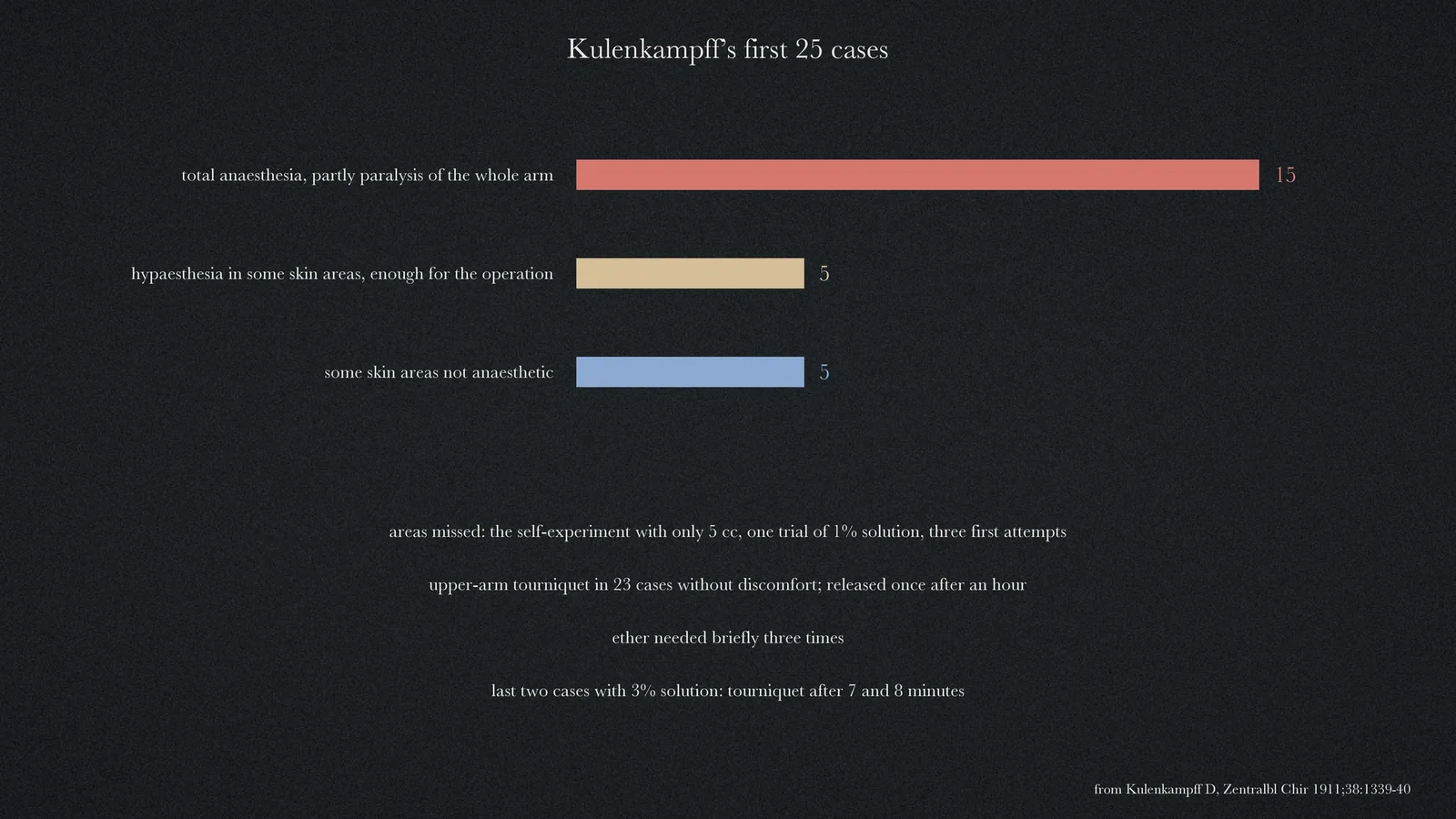
The method had been tried in 25 cases. In 23 the upper arm was then tied off without the least discomfort, once released after an hour because of pressure pain. Three elbow exarticulations were done painlessly, the nerve trunks drawn out and cut without pain. Total anaesthesia, partly with paralysis of the whole arm, was achieved 15 times; a hypaesthesia sufficient for the operation 5 times; and in 5 cases some skin areas were missed: the self-experiment with only 5 cc, one trial of 1 per cent solution and three first attempts. Ether had to be given briefly three times. Kulenkampff linked the painless tourniquet to Bier's observation in vein anaesthesia that the large nerve trunks become insensitive before the skin. [1]
Kulenkampff's verdict was confident: a typical, harmless procedure, easy after a few attempts, for which the self-experiment could serve as proof. For operations on the arm, general anaesthesia had become "almost", and the much more cumbersome vein anaesthesia "entirely", superfluous. [1]
What the record shows
The two 1911 reports set the terms for brachial plexus block: Hirschel chose the axilla and relied on injecting as the needle advanced; Kulenkampff chose the clavicle, relied on bony and arterial landmarks and made paraesthesia the sign of the right depth. Kulenkampff's claim of harmlessness rested on 25 cases. Neither report claims to be the first plexus block, and this article does not make that claim for them.
Sources and reading limits
Read: Kulenkampff's communication in Zentralblatt für Chirurgie 1911, No. 40, pp. 1337-40, in full; the abstract of Hirschel's paper in the same journal, No. 41, pp. 1381-2.
Not covered: Hirschel's own paper in the Münchener medizinische Wochenschrift; later reports on the two routes and their complications; the 1964, 1973 and 1974 developments, which belong to later chapters. Kulenkampff's first name is printed only as an initial and is kept that way. Doses are as printed; German quotations are translated for this article.
Two illustrations are page crops from the 1911 journal; two are drawn from it.
- Kulenkampff D. Die Anästhesierung des Plexus brachialis. Zentralbl Chir. 1911;38(40):1337-40. Internet Archive
- Hirschel G. Die Anästhesierung des Plexus brachialis bei Operationen an der oberen Extremität. Münch Med Wochenschr. 1911;(29). Abstract by Kramer in Zentralbl Chir. 1911;38(41):1381-2. Internet Archive
Continue exploring
Related reading connects shared questions and contexts; it does not by itself establish historical influence.
- 1908: Bier Injects Novocaine into a Vein Between Two Bandages
- 1885: Halsted and the Brachial Plexus Block, an Attribution Without a Paper
Anesthesia Epochs · The Source Room · About & Editorial Method
Published November 2, 2026. Sources and reading limits are stated above. Illustrations are labelled as original source images or AI-made. Historical accounts are educational; they are not current treatment instructions.