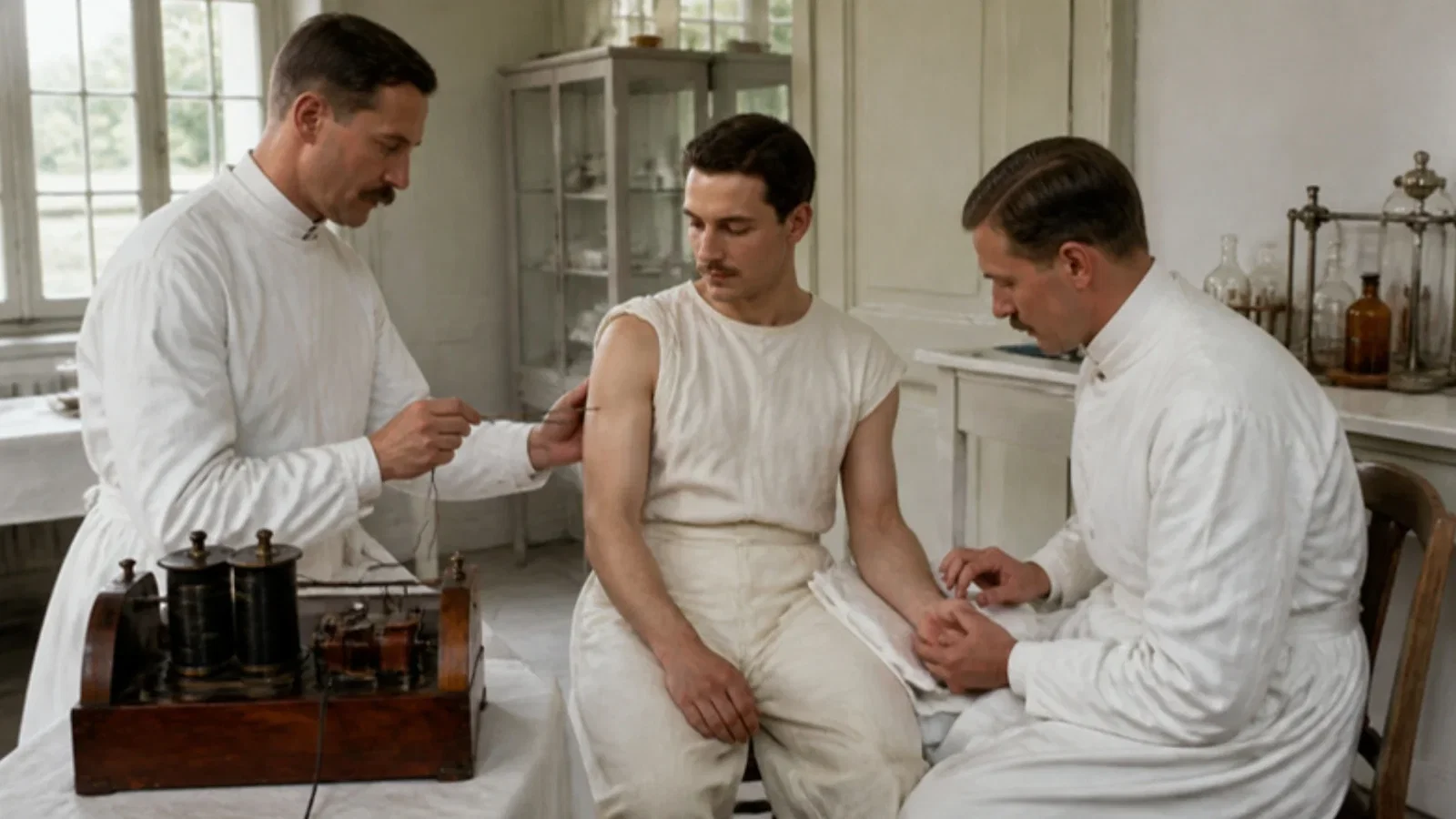
A Tübingen surgeon lacquered an injection needle to its tip and used it as the electrode of a weak faradic current: when the tip touched a mixed nerve, the muscles it supplied twitched, and the anaesthetic went in at that moment.
Reading Library · Anesthesia Epochs · 中文版
Watch the education video (for clinicians)
1912: Perthes — Let an Electric Current Find the Nerve · Anesthesia Epochs Education Series
A nerve stimulator, a small box that sends a weak current down an insulated needle and makes a muscle twitch when the tip is close to a nerve, has long been used as an aid to nerve blocks. The idea is set out, in its essentials, in two short papers that G. Perthes of the surgical clinic in Tübingen published in the Münchener medizinische Wochenschrift in 1912. The papers themselves are not covered here. What can be read in open copies is an abstract of the second paper, printed in the Zentralblatt für Chirurgie in 1913, and the account in the third edition of H. Braun's textbook of local anaesthesia, published the same year. This article is built on those two. [1] [2]
The problem: finding a nerve you cannot see
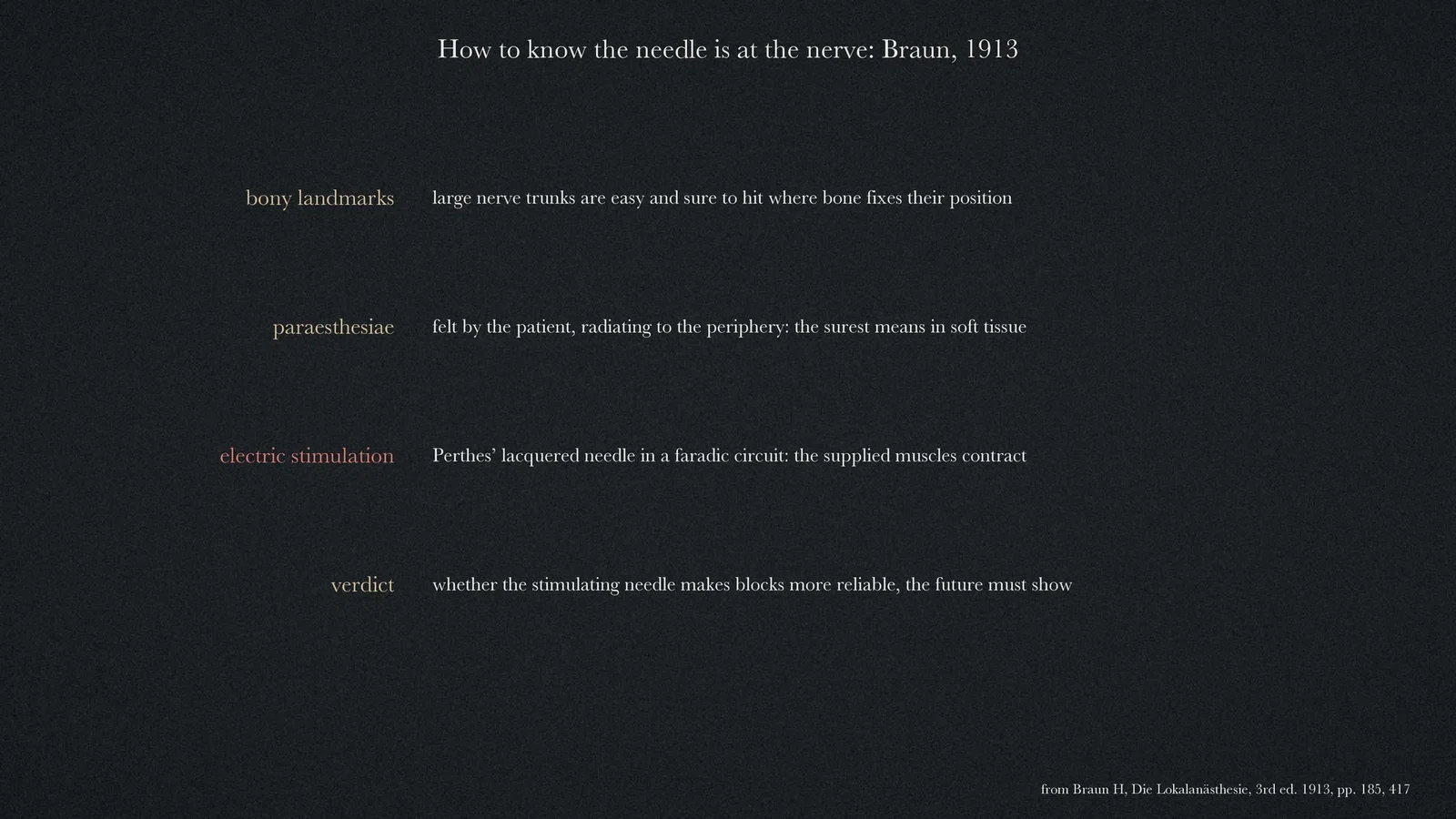
By 1913 Braun could list a run of new percutaneous blocks: Läwen's of the sciatic and femoral nerves, and Hirschel's and Kulenkampff's of the brachial plexus. Large nerve trunks, Braun wrote, were easy and sure to hit with a hollow needle where bony landmarks fixed their position; in the middle of soft tissue it took much more practice. There, the surest means of bringing the needle tip to the right place were the paraesthesiae that radiate to the periphery when the needle touches the nerve, felt and reported by the patient. [2]
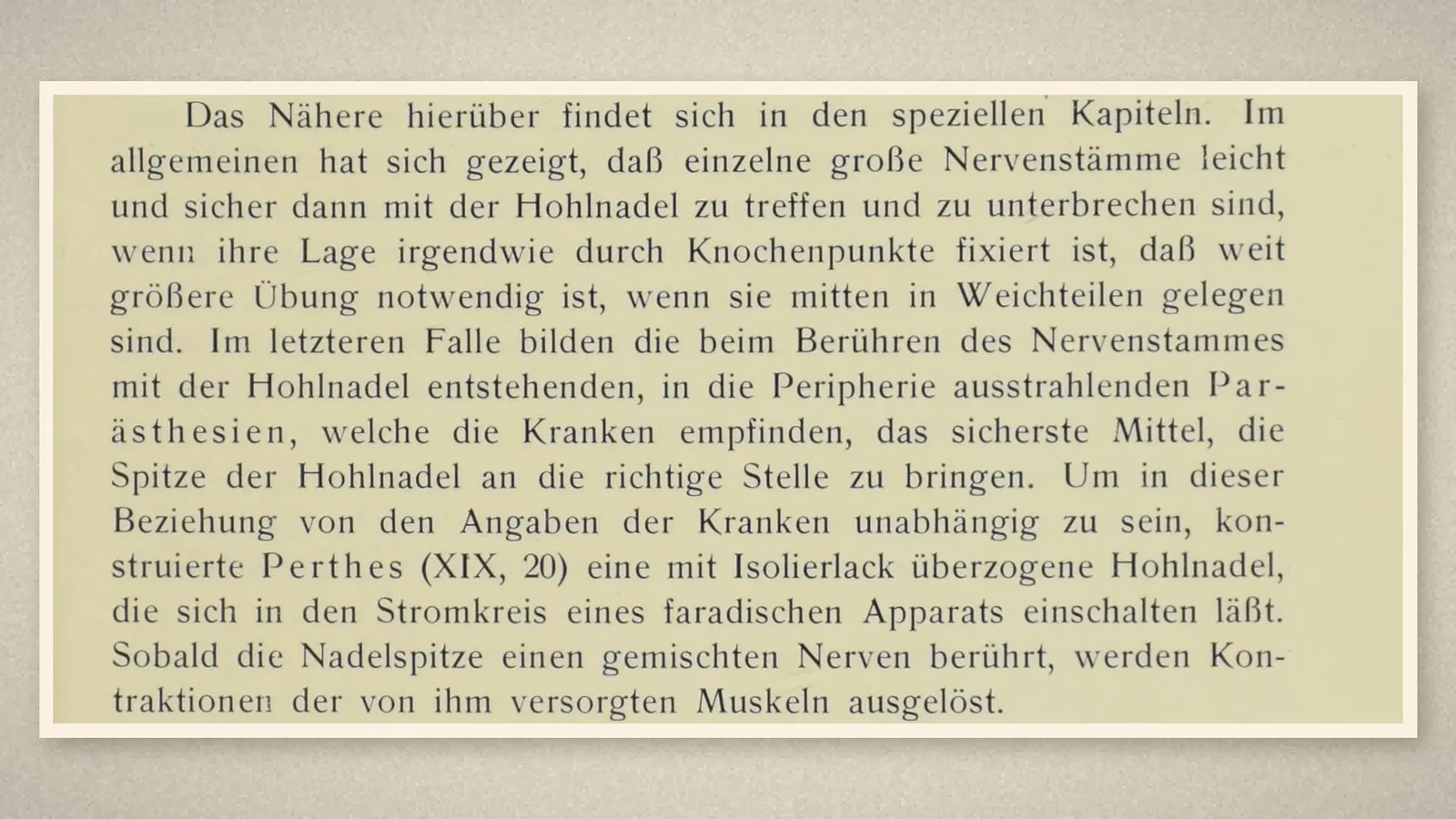
"To be independent of the patients' statements in this respect", Braun continued, Perthes constructed a hollow needle coated with insulating lacquer that could be connected into the circuit of a faradic apparatus. As soon as the tip touched a mixed nerve, the muscles it supplied contracted. [2]
The method, as the abstract gives it
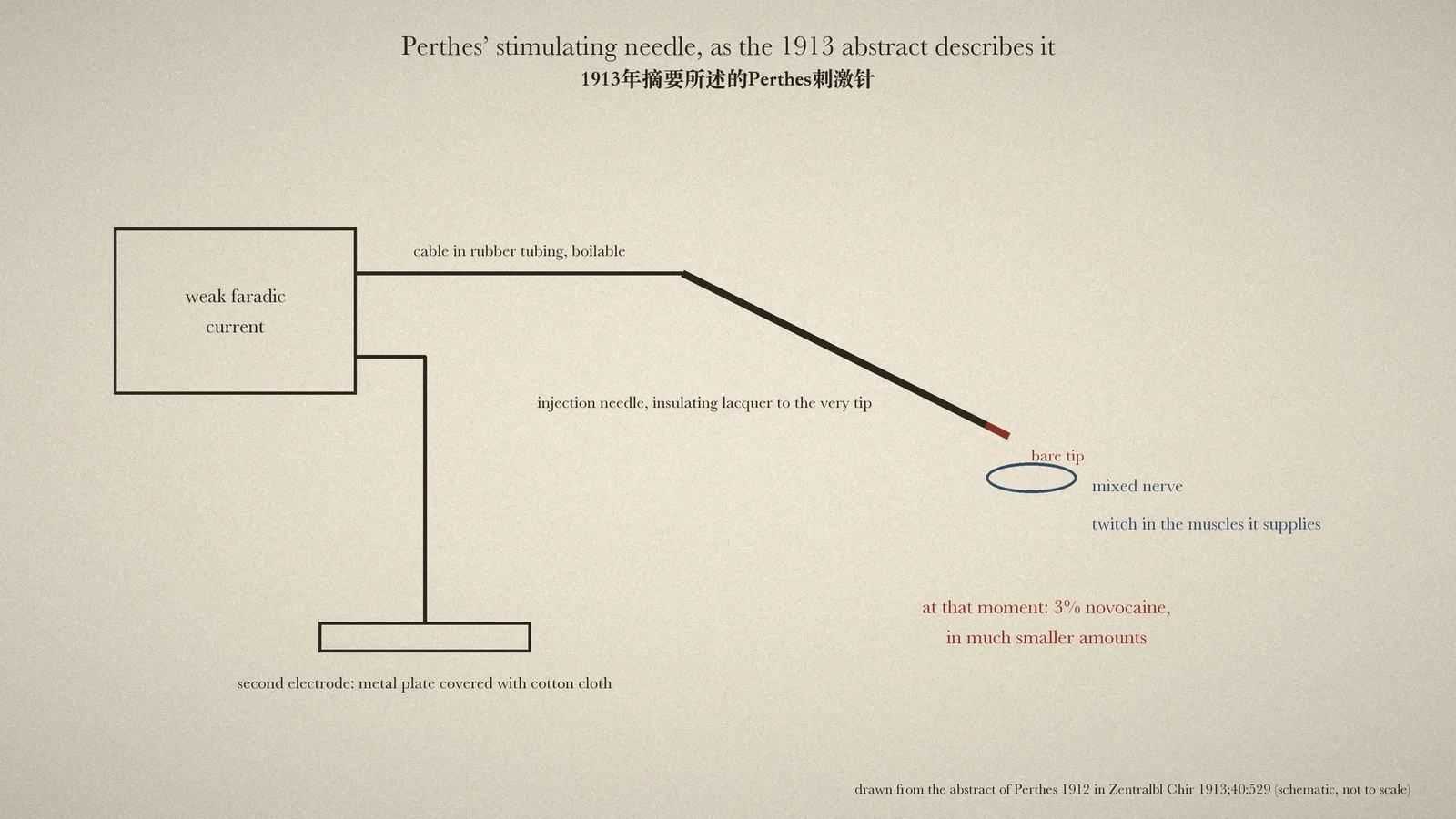
The 1913 abstract adds the details. The injection needle was coated with insulating lacquer up to the very tip and served as one electrode of a weak faradic current; the other electrode was a metal plate covered with cotton cloth. The cable to the needle was sheathed in rubber tubing and could be boiled. Electrical stimulation that produced a muscle twitch in the territory of the nerve showed whether the needle tip had reached the nerve to be blocked. If it had, 3 per cent novocaine was injected "at that same moment", and much smaller amounts were needed. [1]
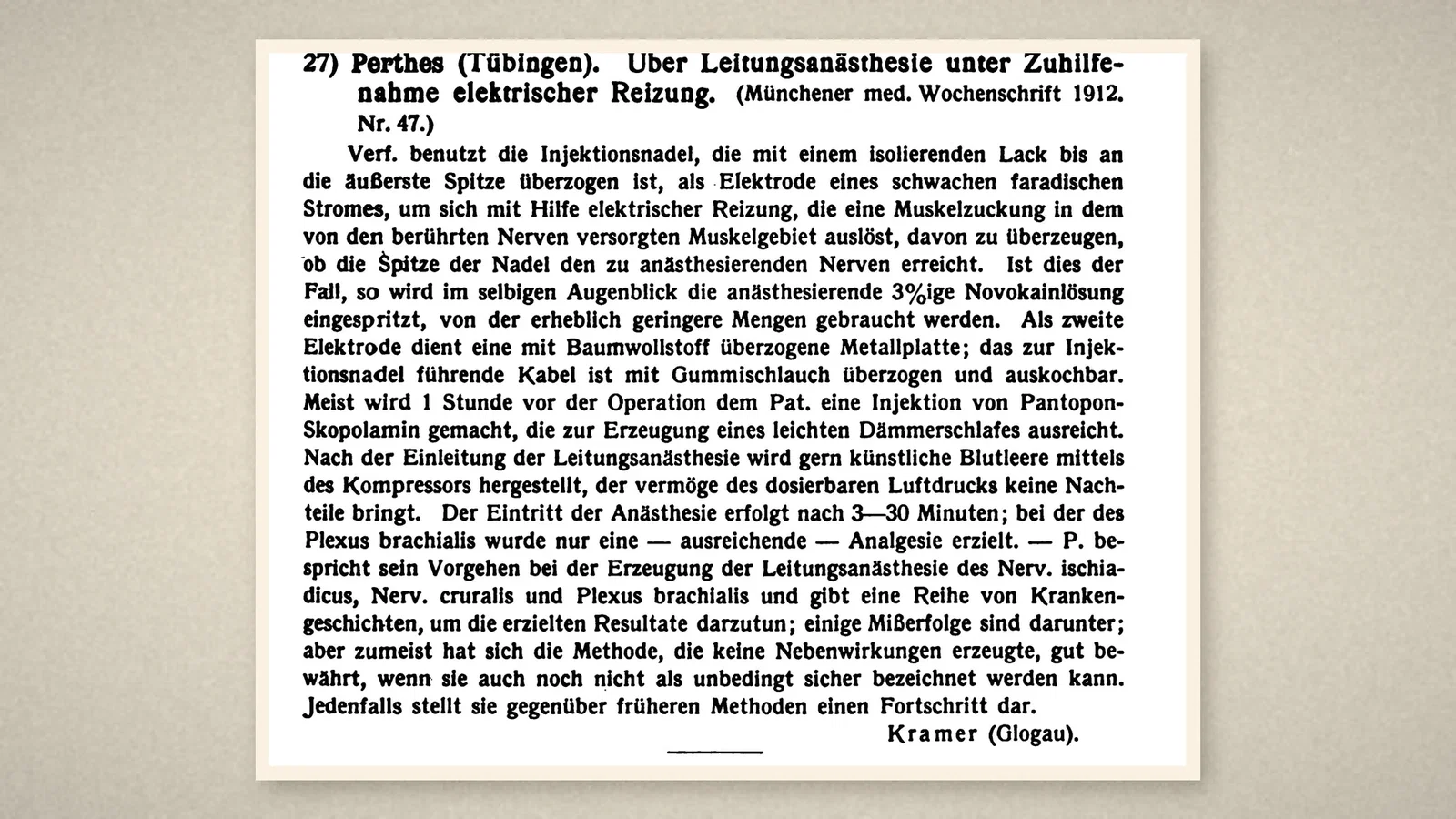
Patients usually received an injection of pantopon and scopolamine an hour before operation, enough for light twilight sleep, and after the block a bloodless field was often made with a compressor. Anaesthesia came on after 3 to 30 minutes; at the brachial plexus only an analgesia, though an adequate one, was obtained. Perthes described blocks of the sciatic nerve, the femoral nerve and the brachial plexus and gave a series of case histories, including some failures. The reviewer's conclusion was measured: the method, which produced no side effects, had mostly proved itself, "even if it cannot yet be called absolutely certain", and was in any case an advance on earlier methods. [1]
Braun's textbook adds two applications. Perthes sought the sciatic nerve in the gluteal fold, and, in a footnote, had managed to reach the obturator nerve at the obturator foramen with the "stimulating cannula" from the region of the pubic tubercle. [2]
A careful welcome
Braun did not oversell it. For the sciatic nerve, Braun's own advice was that the puncture site mattered little; the essential step was to search with the needle until paraesthesiae radiated into the toes, and then to inject. "Whether it becomes more reliable with the help of Perthes' stimulating needle, the future must show." [2]
What the record shows
In 1912 the question of how to know the needle is at the nerve had three answers side by side: bone, the patient's paraesthesiae, and Perthes' current. The insulated needle with a bare tip, the twitch as the signal and the injection at that instant are recognizably the method later stimulators automated. This article does not claim Perthes was the first to stimulate a nerve electrically for this purpose; the sources read here do not say.
Sources and reading limits
Read: the abstract of Perthes' paper in Zentralblatt für Chirurgie 1913, No. 14, p. 529; Braun's Die Lokalanästhesie, 3rd edition, 1913, pp. 185 and 417-8 and the bibliography.
Not covered: Perthes' two papers in the Münchener medizinische Wochenschrift 1912 (No. 40, p. 2205, and No. 47, p. 2545); the 1955 development, which belongs to a later chapter; the later literature on nerve stimulators. Perthes' first name appears only as an initial in these sources. Doses are as printed; German quotations are translated for this article.
Two illustrations are page crops from the 1913 sources; two are drawn from them.
- Perthes G. Über Leitungsanästhesie unter Zuhilfenahme elektrischer Reizung. Münch Med Wochenschr. 1912;(47):2545. Abstract by Kramer in Zentralbl Chir. 1913;40(14):529. Internet Archive
- Braun H. Die Lokalanästhesie, ihre wissenschaftlichen Grundlagen und praktische Anwendung. 3rd ed. Leipzig: J. A. Barth; 1913. Internet Archive
Continue exploring
Related reading connects shared questions and contexts; it does not by itself establish historical influence.
- 1911: Two Needles for the Brachial Plexus
- 1908: Bier Injects Novocaine into a Vein Between Two Bandages
Anesthesia Epochs · The Source Room · About & Editorial Method
Published November 2, 2026. Sources and reading limits are stated above. Illustrations are labelled as original source images or AI-made. Historical accounts are educational; they are not current treatment instructions.