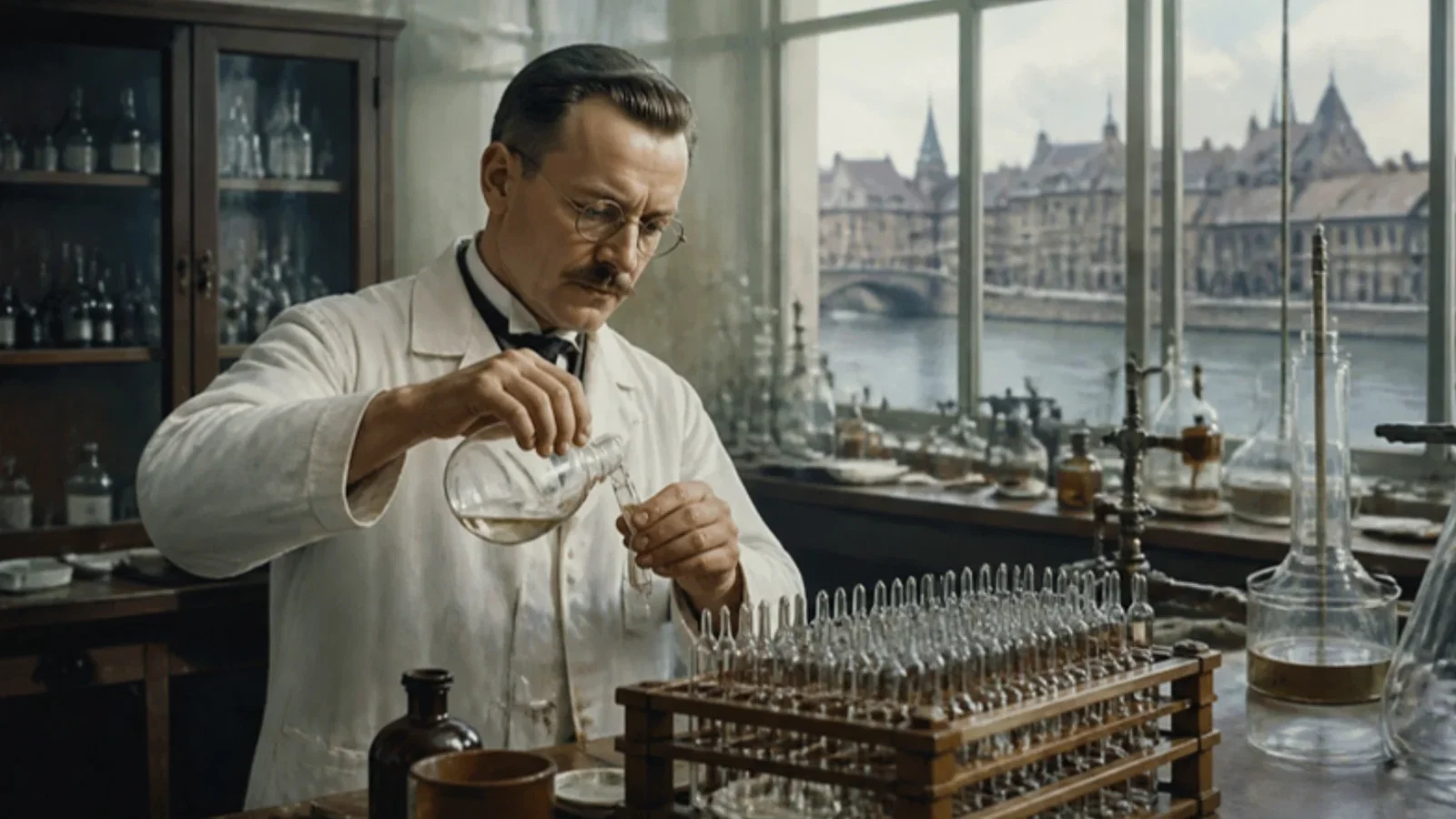
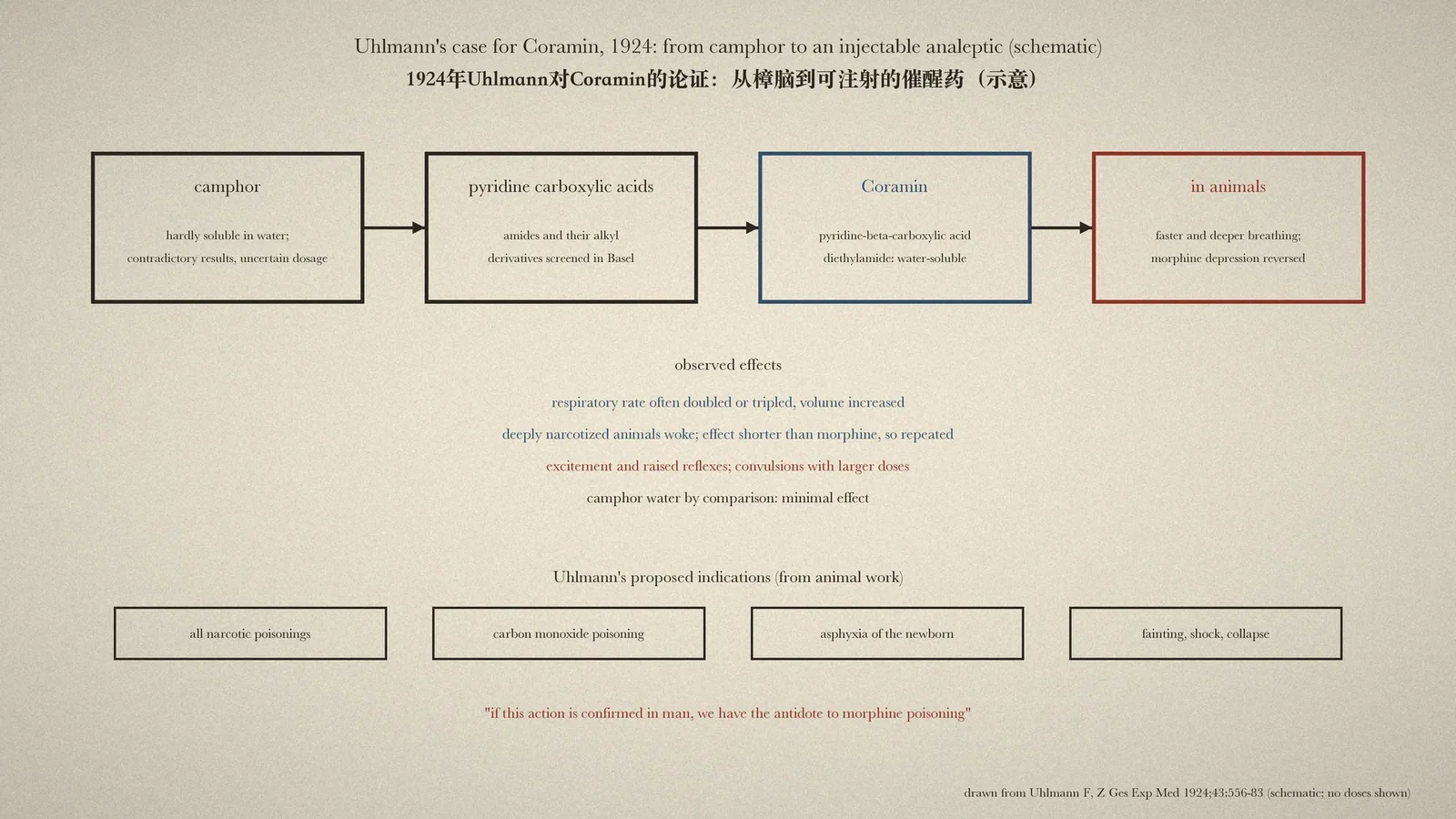
Fr. Uhlmann of the biological institute of the Gesellschaft für Chemische Industrie in Basel described pyridine-beta-carboxylic acid diethylamide, Coramin: injected into rabbits it made breathing at once faster and deeper, readily restored breathing depressed by morphine and woke deeply narcotized animals, far outdoing camphor water; larger doses caused convulsions; from these animal results Uhlmann proposed it for all narcotic poisonings, asphyxia of the newborn, shock and collapse, and called it a likely antidote to morphine poisoning if confirmed in man.
Reading Library · Anesthesia Epochs · 中文版
Watch the education video (for clinicians)
1924: Coramin (Nikethamide) — The Antidote That Was Never Confirmed · Anesthesia Epochs Education Series
A patient who would not breathe after an anaesthetic or an overdose was once given a "respiratory stimulant". The Australian Society of Anaesthetists (ASA) timeline places in 1924 the development of nikethamide (Coramine), "first marketed by Gesellschaft für Chemische Industrie in Basel", and says it was introduced "mainly as an analeptic in cases of overdose of hypnotics, narcotics and/or anaesthetics". This article reads the laboratory paper that set out the drug's pharmacology: Fr. Uhlmann, "Über Coramin", from the biological institute of the same Basel company, received by the Zeitschrift für die gesamte experimentelle Medizin on 15 July 1924. [1][2]
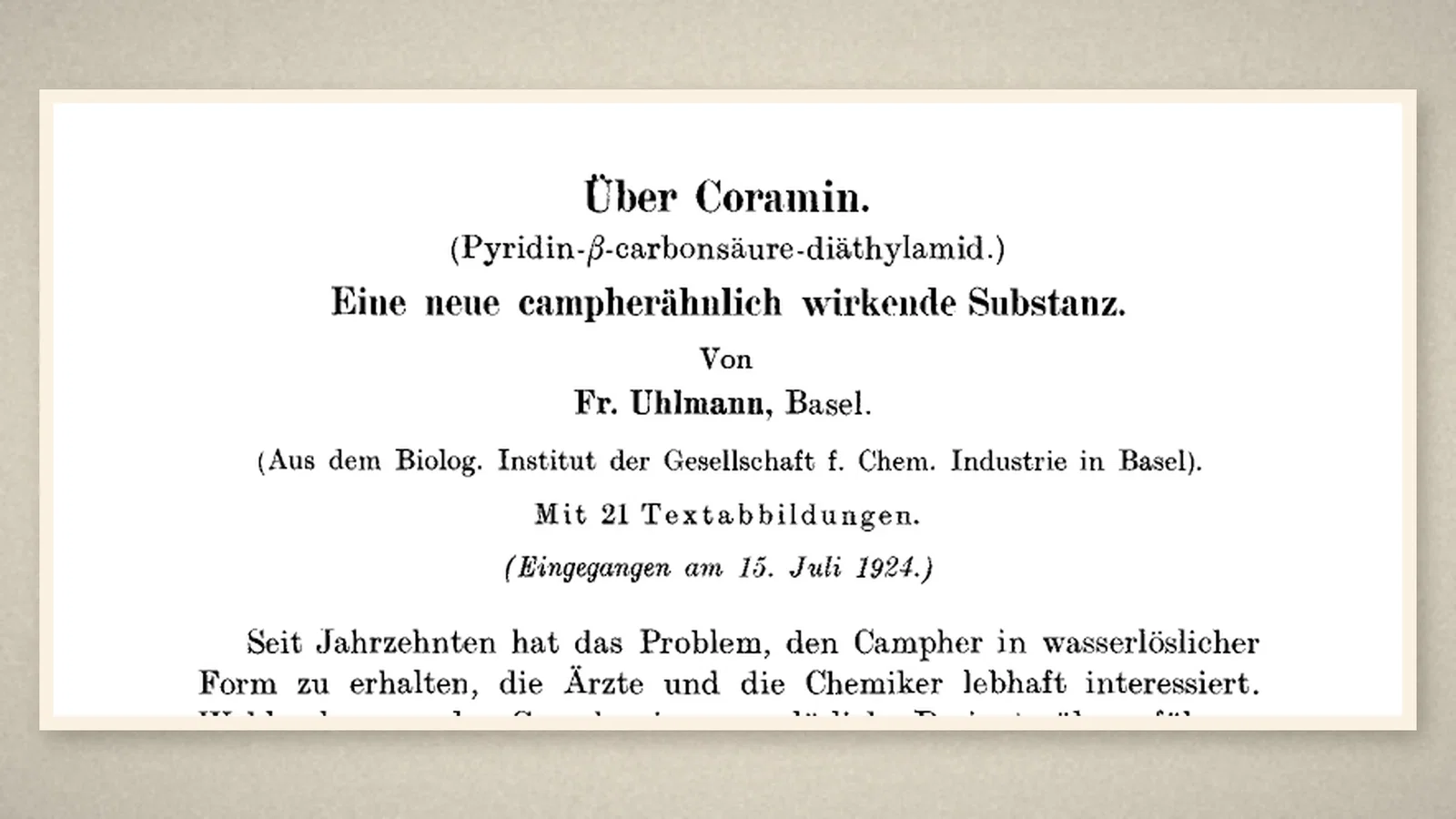
A soluble camphor
The paper's subtitle is "a new substance with camphor-like action". For decades, Uhlmann wrote, physicians and chemists had wanted camphor in water-soluble form, but it dissolves poorly in water. Uhlmann blamed that insolubility for a pharmacological literature of "contradictory results" unlike that of almost any other pure substance: with camphor water, camphor oil or solid camphor and variable absorption, there could be no talk of secure dosage. Earlier chemists had tried to make soluble camphor derivatives and lost the typical effects. The Basel laboratories had instead looked, "regardless of chemical class", for a water-soluble substance with camphor's action that could be injected. [1]
They found it among the pyridine carboxylic acids and their amides. The simple acids and amides were weakly narcotic and of low toxicity; adding alkyl groups to the amide changed the picture to excitation, faster breathing and, at high doses, strychnine-like convulsions. Of the dialkylamides, one stood out "in the desired sense": pyridine-beta-carboxylic acid diethylamide, a water-soluble liquid, named Coramin. Uhlmann noted that E. St. Faust had already published a short account of it. [1]
What it did in animals
Injected into a rabbit's ear vein, Coramin produced "almost at once" a markedly quickened, "flying" respiration, "not only faster but also deeper". The animal became excited, alert and aggressive, with heightened reflexes and trembling; the effect peaked at 15 to 20 minutes and faded over one to two hours. Higher doses brought convulsions, beginning in the jaw muscles, that could be fatal. [1]
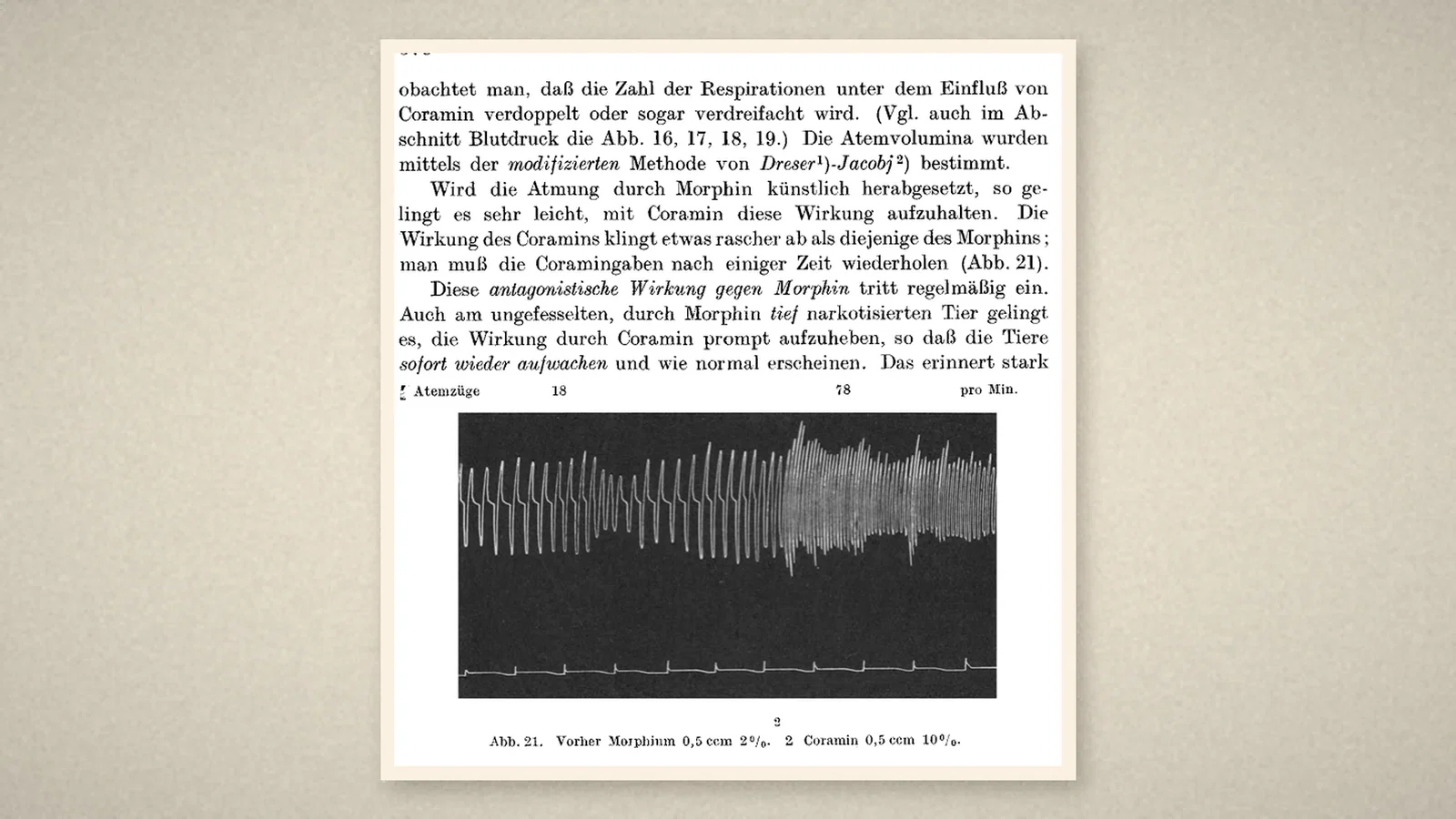
The section on respiration explains the claim. Many drugs raise the breathing rate, but few raise both rate and volume. With Coramin the number of breaths was "not seldom doubled or even tripled", and the volume rose too. "If breathing is artificially depressed by morphine, Coramin very easily reverses this effect." The effect wore off somewhat sooner than morphine's, so doses had to be repeated. In unrestrained animals deeply narcotized with morphine, Coramin made them "wake again at once and appear normal". Camphor water, tested for comparison, had "a minimal" effect on rate and volume. [1]
Uhlmann's conclusions
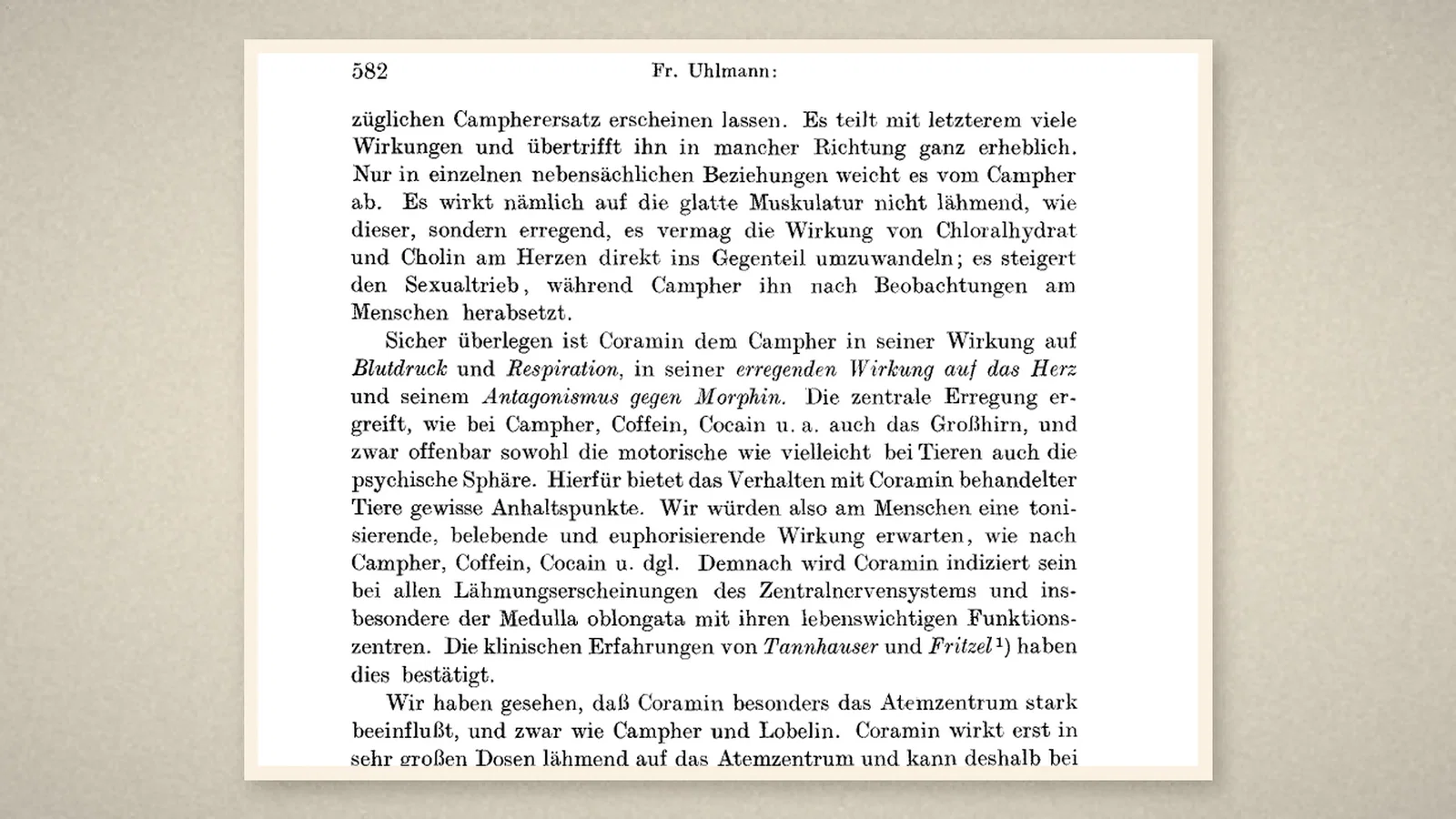
In the summary Uhlmann judged Coramin "certainly superior to camphor" in its action on blood pressure and respiration, on the heart, and "in its antagonism to morphine". The stimulation of the respiratory centre was typical; only "very large doses" paralysed it. The antagonism to morphine was, in Uhlmann's view, "more pronounced than with any known drug except atropine", without atropine's effects on glands and accommodation. "If this action is confirmed in man, we have the antidote to morphine poisoning." Uhlmann expected a broad therapeutic range and proposed, among other indications, "all narcotic poisonings", carbon monoxide poisoning, "asphyxia of the newborn", and "fainting, shock, collapse", citing early clinical experience by Tannhauser and Fritzel. [1]
What the record shows
The paper shows why analeptics entered anaesthesia: a drug that made animals breathe faster and deeper, and woke them from morphine narcosis, looked like a remedy for the depressed patient. It also shows the limits written into that promise. The effect was shorter than the depressant's, larger doses caused convulsions, and every human indication rested on animal work. How analeptics later fared in practice lies outside the sources read here.
Sources and reading limits
Read: Uhlmann F, Z Ges Exp Med 1924;43:556-83, in full, from the Springer PDF (German; the text layer has character errors, so key passages were checked against page images of pp. 556, 578 and 582); the ASA timeline entry for 1924.
Not covered: E. St. Faust's short report and Tannhauser and Fritzel's clinical report (both Schweizerische medizinische Wochenschrift 1924, no. 10); Guth's paper; any source on nikethamide's later clinical use and abandonment. The fuller story is the rise and fall of respiratory stimulants; this article documents only the rise, from animal pharmacology, and states the fall only as context without a source. The ASA credits the development to "E Faust"; the paper read here is Uhlmann's, which cites Faust. The ASA's "first marketed" is quoted as its own. All results are from animal experiments; Uhlmann's human indications are proposals. Doses and concentrations are not repeated. German quotations are translated for this article.
Three illustrations are crops of pp. 556, 578 and 582, including Abb. 21; one is drawn from the text.
- Uhlmann F. Über Coramin (Pyridin-β-carbonsäure-diäthylamid): eine neue campherähnlich wirkende Substanz. Z Ges Exp Med. 1924;43:556-83. Springer
- Australian Society of Anaesthetists. Anaesthesia history timeline. 2024. ASA
Continue exploring
Related reading connects shared questions and contexts; it does not by itself establish historical influence.
- 1924: Berger Records the Human Brain's Electrical Rhythm
- 1915: Pohl's N-Allylnorcodeine Pushes Morphine Back
Anesthesia Epochs · The Source Room · About & Editorial Method
Published November 2, 2026. Sources and reading limits are stated above. Illustrations are labelled as original source images or AI-made. Historical accounts are educational; they are not current treatment instructions.