
Swap the methyl on codeine's nitrogen for an allyl group, and a dog with morphine-depressed breathing wakes at once.
Reading Library · Anesthesia Epochs · 中文版
Watch the education video (for clinicians)
1915: Pohl's N-Allylnorcodeine — Pushing Morphine Back · Anesthesia Epochs Education Series
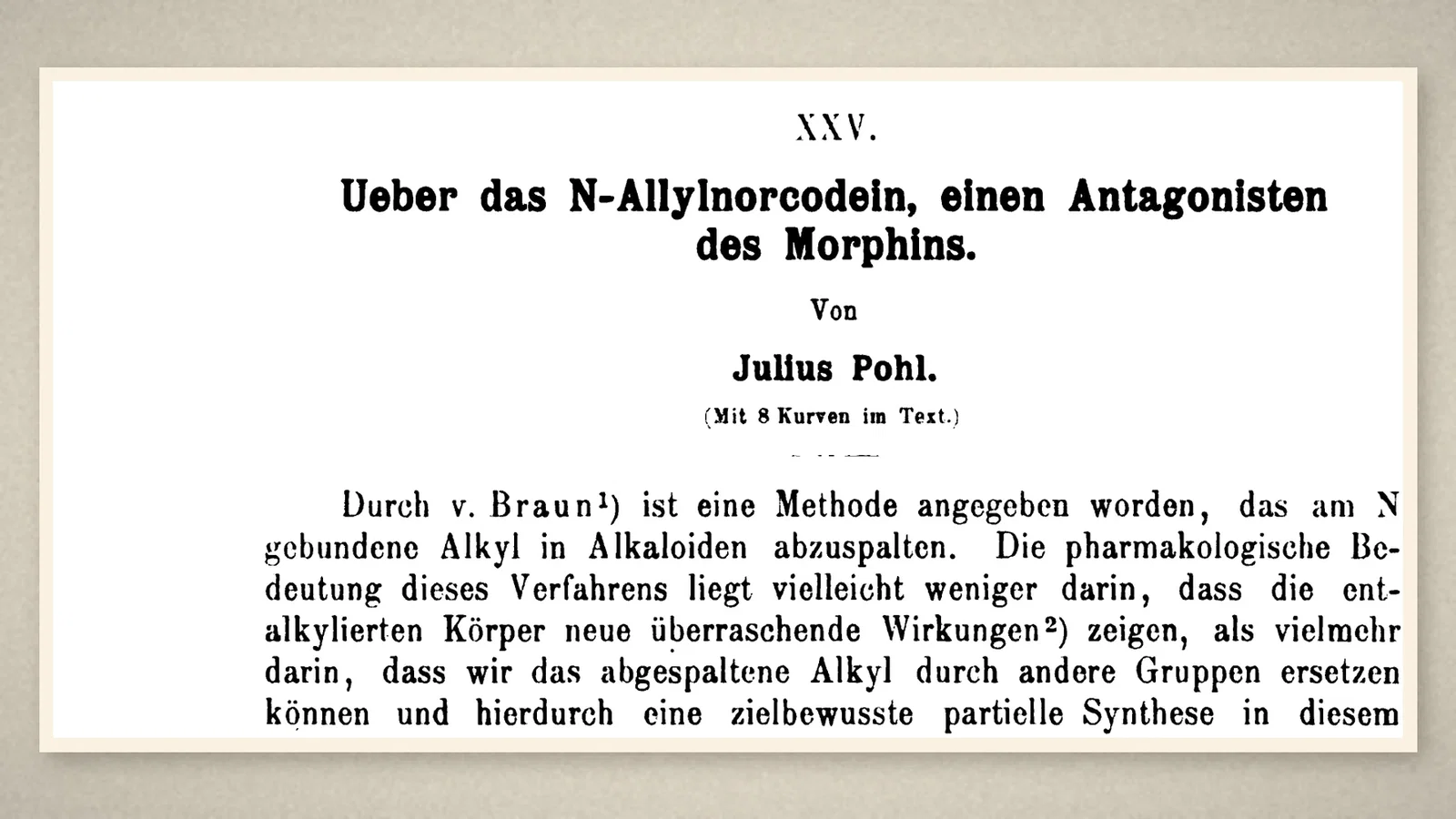
Every anaesthetist knows that morphine's respiratory depression can be reversed with an antagonist. One starting point for such drugs is a paper by Julius Pohl, director of the pharmacological institute of the University of Breslau: "Ueber das N-Allylnorcodein, einen Antagonisten des Morphins" ("On N-allylnorcodeine, an antagonist of morphine"). [1, p. 370] It appeared in the Zeitschrift für experimentelle Pathologie und Therapie, vol. 17, no. 3, issued on 24 November 1915. [1]
One small chemical change
Pohl begins with method. The chemist von Braun had found a way to remove the alkyl group bound to the nitrogen of alkaloids; its pharmacological importance, Pohl suggested, lay less in any new action of the dealkylated bases than in the fact "that we can replace the removed alkyl with other groups", making targeted partial synthesis possible across this large field. [1, p. 370]
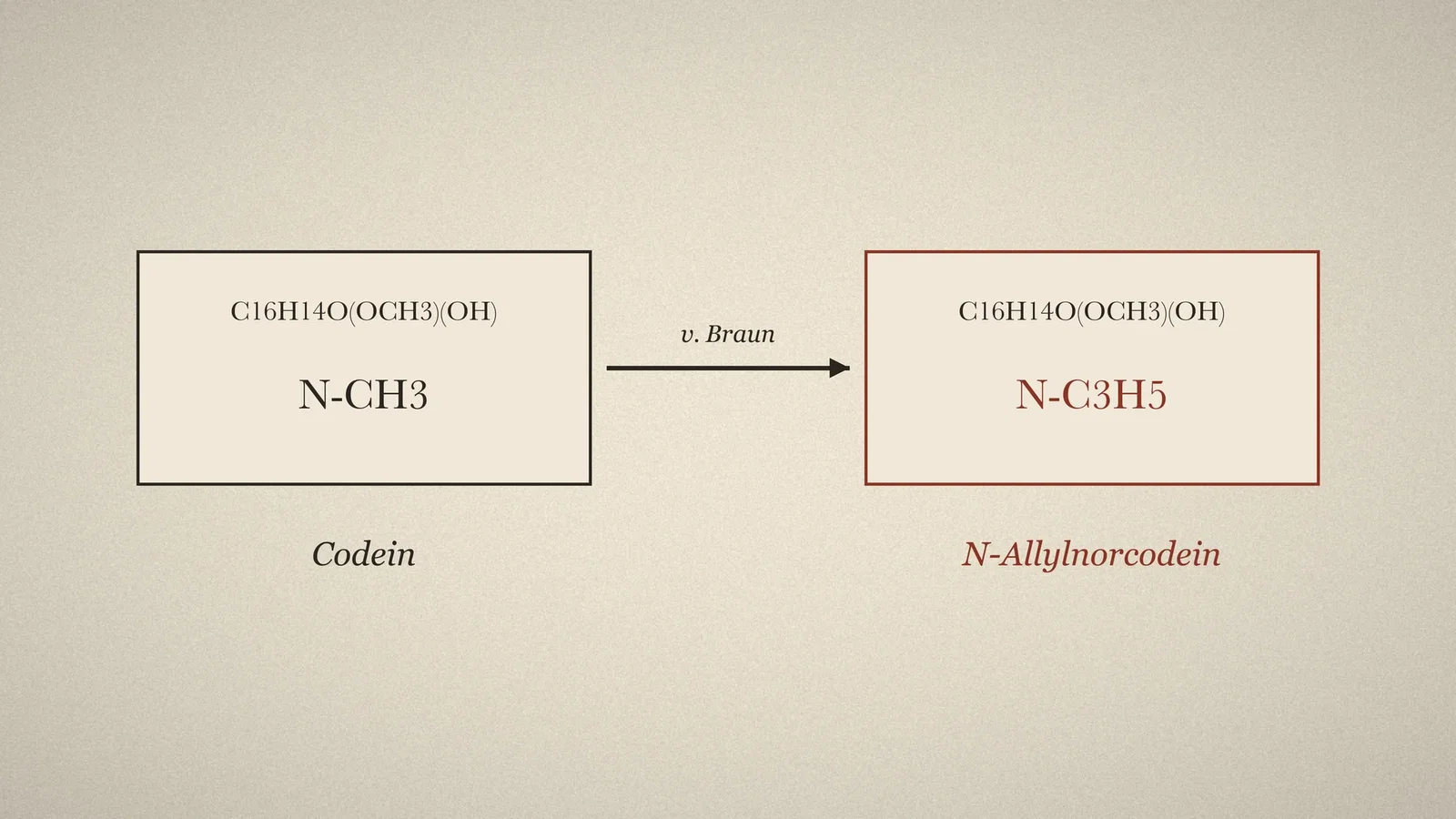
The N-allylnorcodeine, Pohl wrote, had been synthesized at Pohl's request, first by Professor von Braun and then by the firm of Hoffmann-La Roche. [1, p. 370] The formulae printed in the paper show a single change: the methyl on codeine's nitrogen (N-CH₃) replaced by an allyl group (N-C₃H₅). [1, p. 371]
Why this change? For years, Pohl wrote, the aim had been to replace the empirically found respiratory stimulants with better synthetic ones; work in Pohl's laboratory had shown that the allyl group could, under certain conditions, increase "respiratory energy", and the idea was to direct that stimulant effect, within alkaloid-like substances, to the central nervous system. [1, p. 370]
Almost no narcosis of its own
On its own the substance was mild. Given intravenously at 0.02 g it produced at first no central disturbance at all, "in particular there is no trace of narcosis", while the same dose of morphine clearly slowed breathing and made the animal drowsy. [1, p. 371]
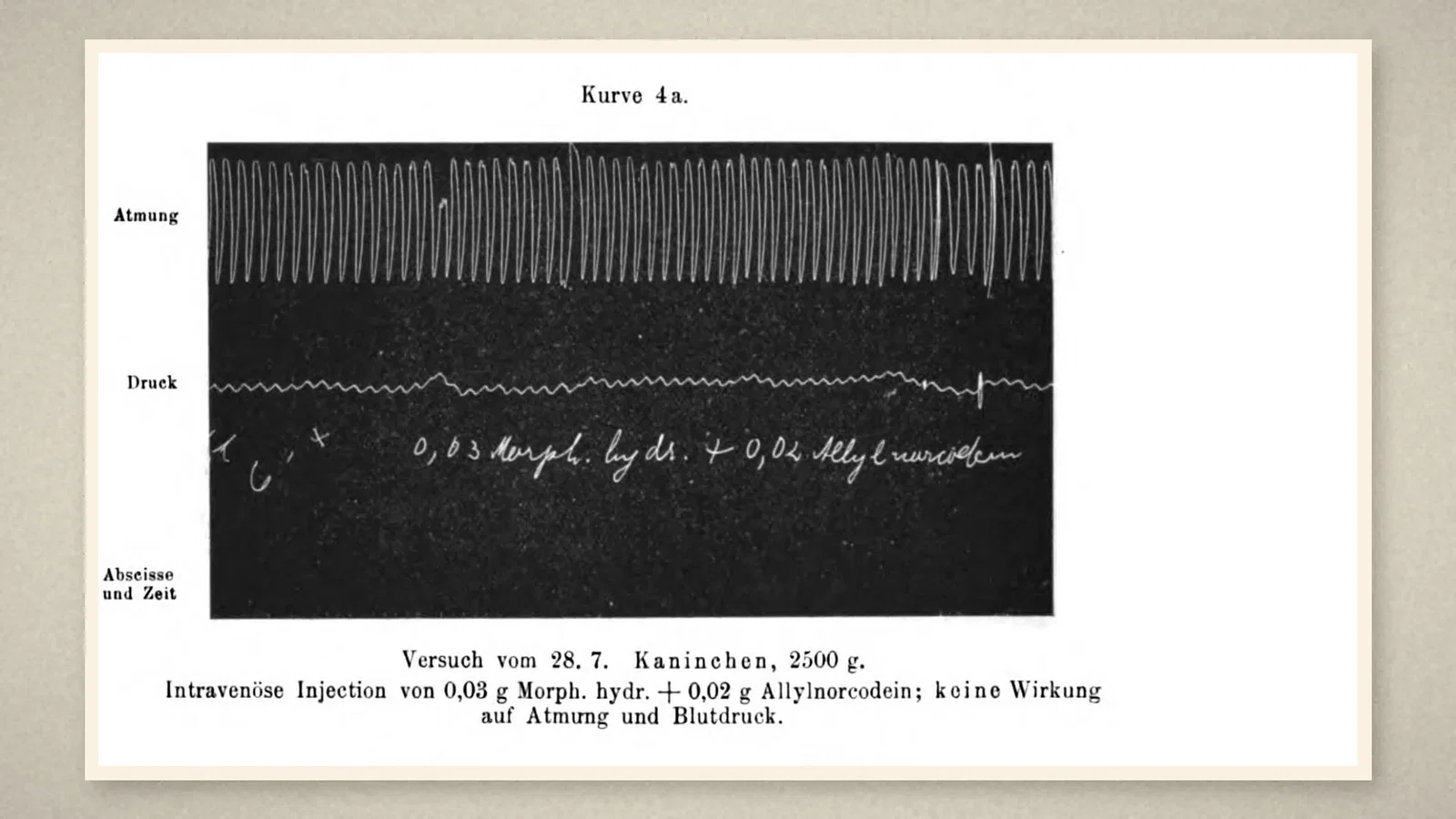
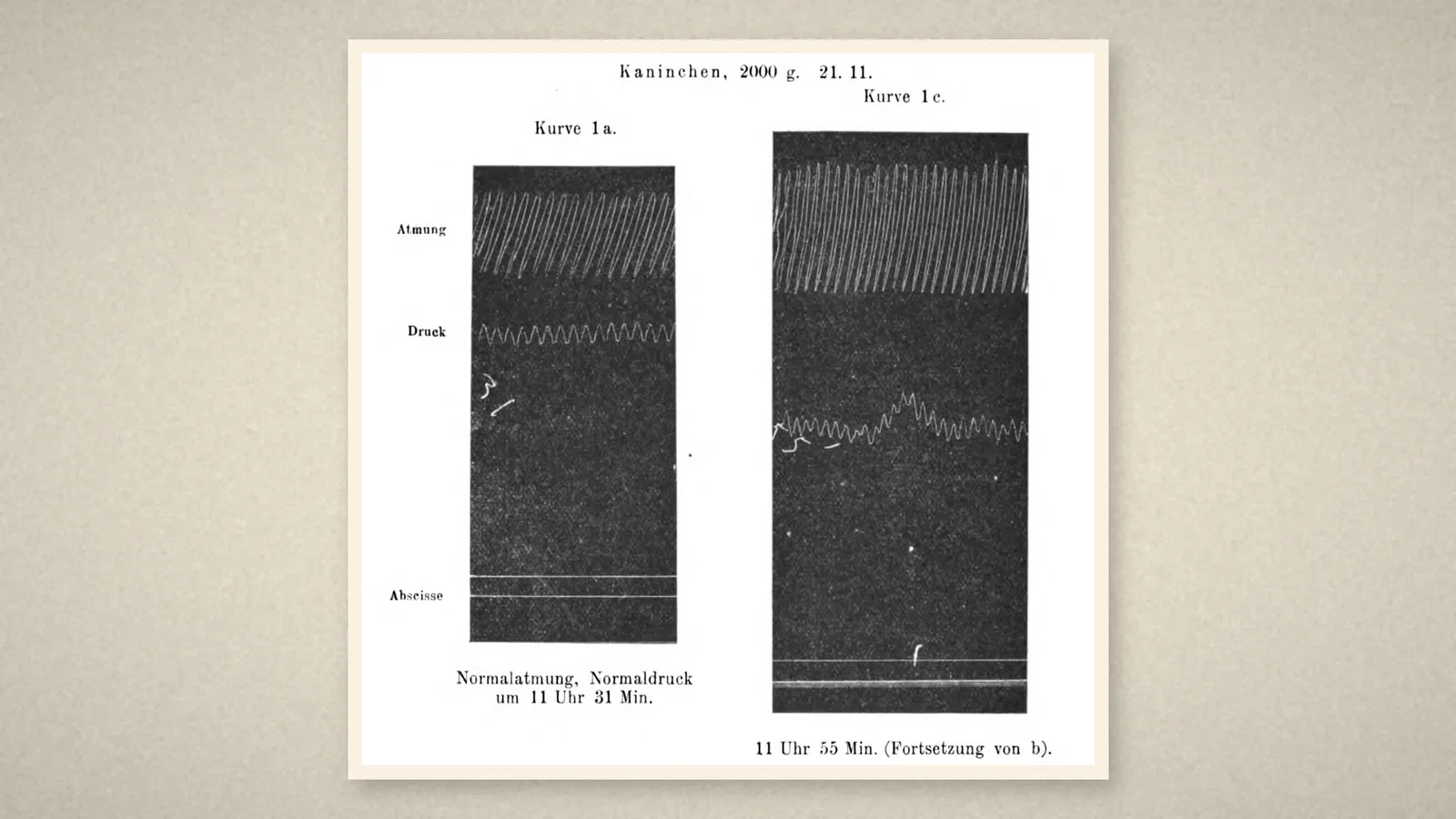
The finding lay in what happened with morphine. Curve 1 shows a rabbit's breathing slowed by morphine and quickening at once after N-allylnorcodeine. [1, p. 372] Against the still more depressant heroin it was "of prompt effect" too. [1, p. 372] Given together with morphine, "the morphine effect does not develop": Curve 4a records a rabbit given 0.03 g morphine and 0.02 g allylnorcodeine intravenously, with no effect on breathing or blood pressure. [1, p. 375–376]
Surer than atropine
Atropine, Pohl noted, was the traditional recommended antagonist of morphine, and gave figures to show how little it achieved. Compared with Trendelenburg's atropine ester, N-allylnorcodeine was "probably the surer antagonist": Pohl had never had a failure with it, while the atropine ester worked only with very small doses of morphine or repeated small doses. [1, p. 376–377]
A dog wakes up
The most vivid experiment in the paper is a 9-kg dog. After 0.08 g morphine subcutaneously it showed the full central morphine effect: lying quiet, breathing slowed and shallow to half its normal depth, eyes almost closed, head sunk. Then 0.04 g N-allylnorcodeine intravenously: "the animal at once becomes lively", eyes wide open, looking about, breathing back to normal strength. A few minutes later its head sank and it slept again; another 0.04 g, and it woke again at once. [1, p. 378]
Pohl concluded that the effect, though transient, was a definite and striking lessening of the dog's cerebral symptoms, so that "homologous clinical antagonistic effects are to be expected". [1, p. 378] Pohl judged the site of action to be central. [1, p. 378] At the end Pohl tested it against respiratory depression from chloral, with a positive result, and urged that it be tried clinically "in any case" in the common states of asphyxia. [1, p. 380–381]
What the record shows
In 1915 a pharmacologist replaced one methyl on codeine's nitrogen with an allyl group, obtained a substance that hardly narcotized at all yet prevented and reversed the respiratory depression of morphine and heroin, and saw a dog "at once" wake up. The opioid antagonists later used in anaesthesia followed the same path of altering the nitrogen; that came decades later, and this paper showed only the first step.
Sources and reading limits
Read: Julius Pohl, "Ueber das N-Allylnorcodein, einen Antagonisten des Morphins", Zeitschrift für experimentelle Pathologie und Therapie vol. 17, pp. 370–382 (full text), in no. 3 of the volume, issued 24 November 1915; the volume's contents and the opening of Hertha Heimann's companion paper on nor-morphine derivatives from the same institute.
Not covered: volume 17 began in 1914, but Pohl's paper is in no. 3, issued on 24 November 1915, and itself cites a source of April 1915, so the article is dated 1915. The later chain of dates from nalorphine and naloxone to naltrexone and opioid receptors is not documented in what was read, and no dates are given for those later steps here. Pohl called the substance a centrally acting respiratory stimulant and antagonist; this article does not discuss receptor mechanisms, and "the first specific opioid antagonist" is not Pohl's wording and is not used.
Of the four illustrations, three are crops of pages and curves from the 1915 paper and one is a diagram drawn for this article from its formulae.
- Pohl J. Ueber das N-Allylnorcodein, einen Antagonisten des Morphins. Z Exp Pathol Ther. 1915;17(3):370-82. Internet Archive
Continue exploring
Related reading connects shared questions and contexts; it does not by itself establish historical influence.
- 1914: The Scottish Society of Anaesthetists Is Founded After a Dinner
- 1914: Dale Divides Acetylcholine's Actions into Muscarine and Nicotine
Anesthesia Epochs · The Source Room · About & Editorial Method
Published November 2, 2026. Sources and reading limits are stated above. Illustrations are labelled as original source images or AI-made. Historical accounts are educational; they are not current treatment instructions.