
In the CSA Bulletin of 2002 Merlin Larson, writing for the Arthur E. Guedel Memorial Anesthesia Center, re-read the correspondence of Ralph Waters and Arthur Guedel from 1926 to 1928: Waters thought a casual preoperative assessment of metabolic rate might help, Guedel was unenthusiastic and focused almost entirely on intraoperative management, and in reporting a death during tonsillectomy Guedel blamed the surgeon's ignorance of a heart condition without asking the anaesthetist to find out; Larson read this as the role of the anaesthetist of that time, which Waters later helped to change, and which took decades to establish.
Reading Library · Anesthesia Epochs · 中文版
Watch the education video (for clinicians)
1926–1928: Waters and Guedel — The Missing Preanaesthetic Evaluation · Anesthesia Epochs Education Series
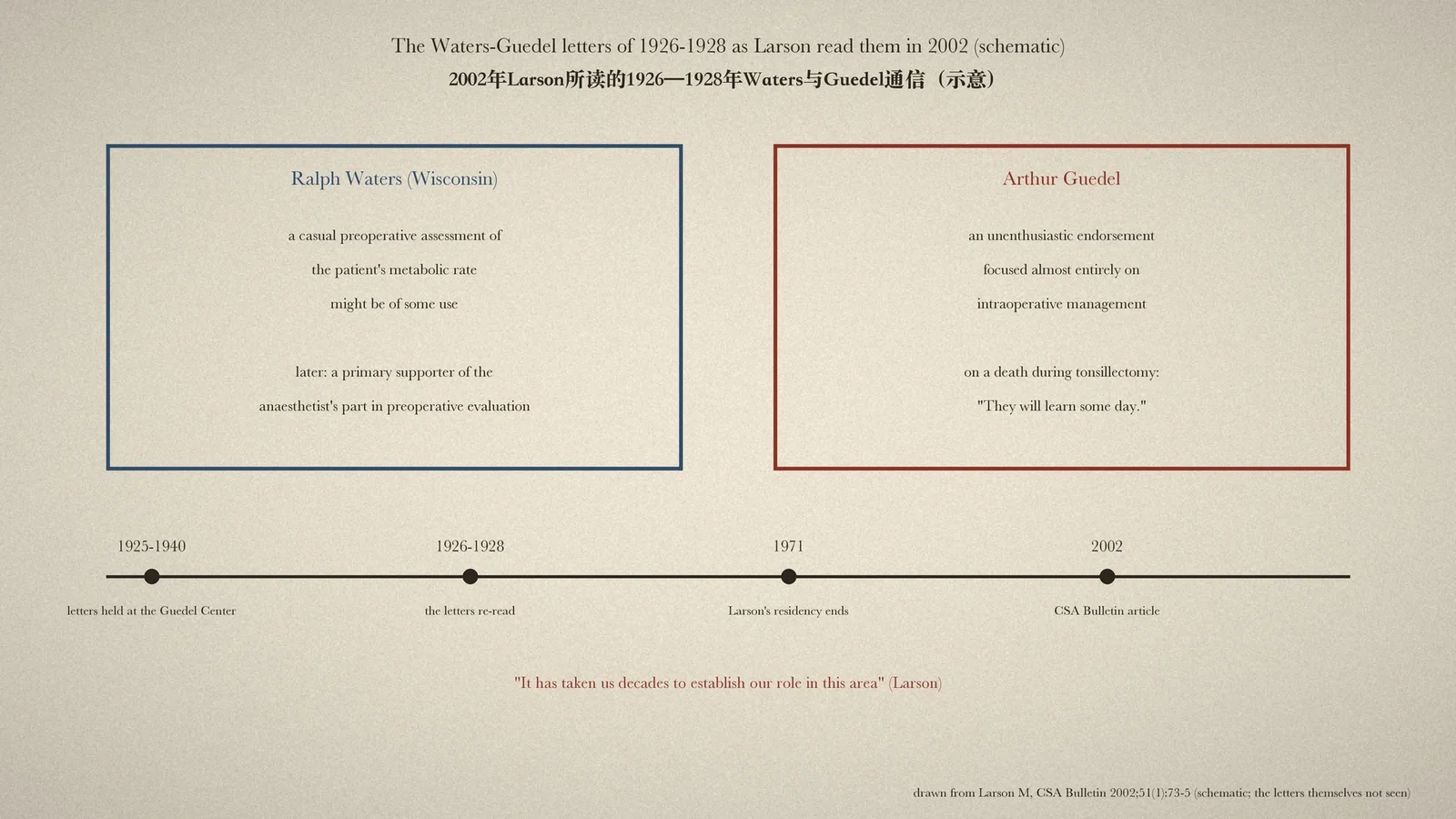
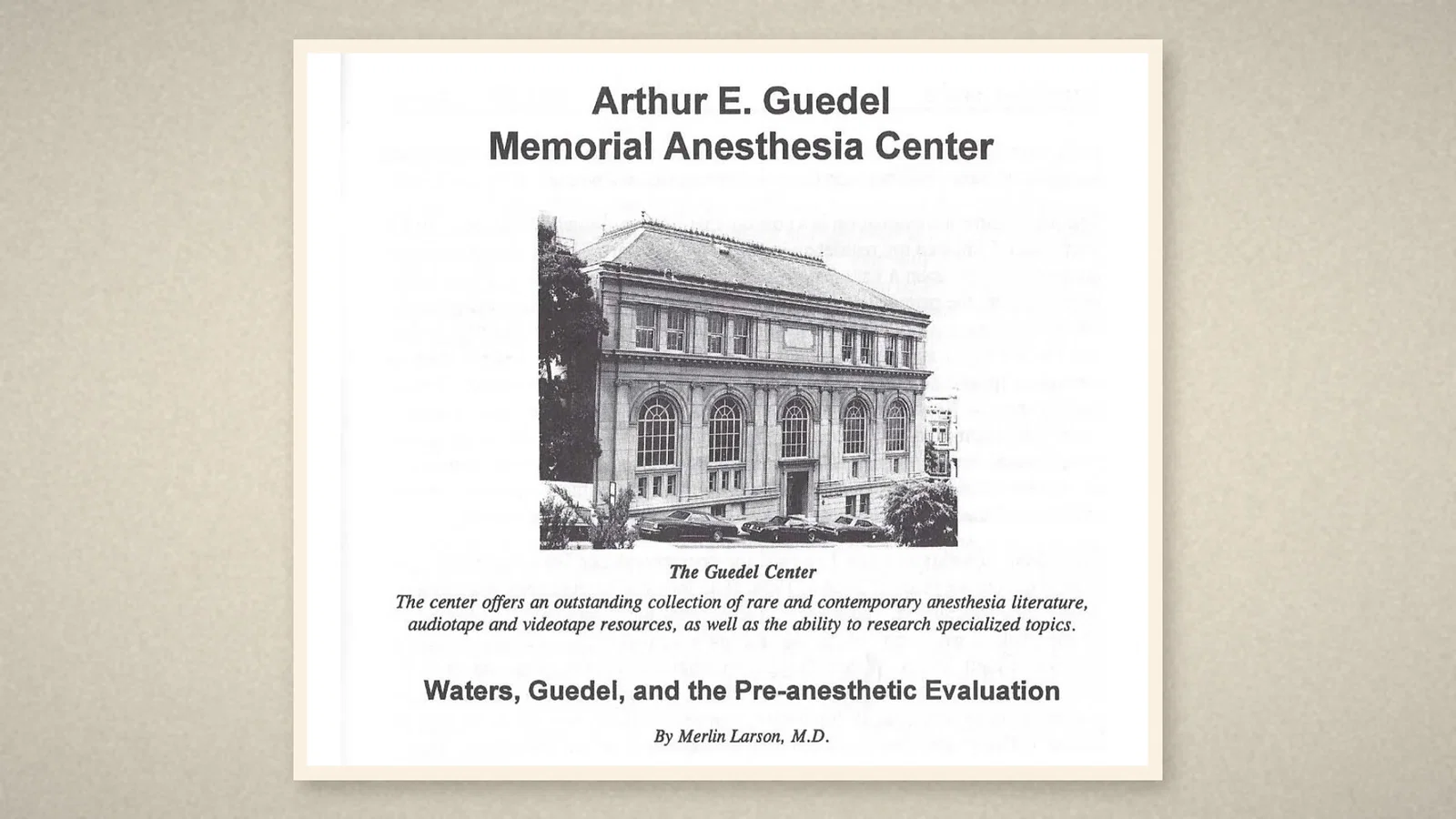
Who should know the patient before the anaesthetic begins? Today the answer seems obvious. In the January-March 2002 issue of the CSA Bulletin, the journal of the California Society of Anesthesiologists, Merlin Larson asked how two founders of the specialty had answered it. The article, "Waters, Guedel, and the Pre-anesthetic Evaluation", appeared in the column of the Arthur E. Guedel Memorial Anesthesia Center, which holds "several files containing correspondence between Ralph Waters and Arthur Guedel", covering the years 1925 to 1940. [1, p. 73]
An anniversary
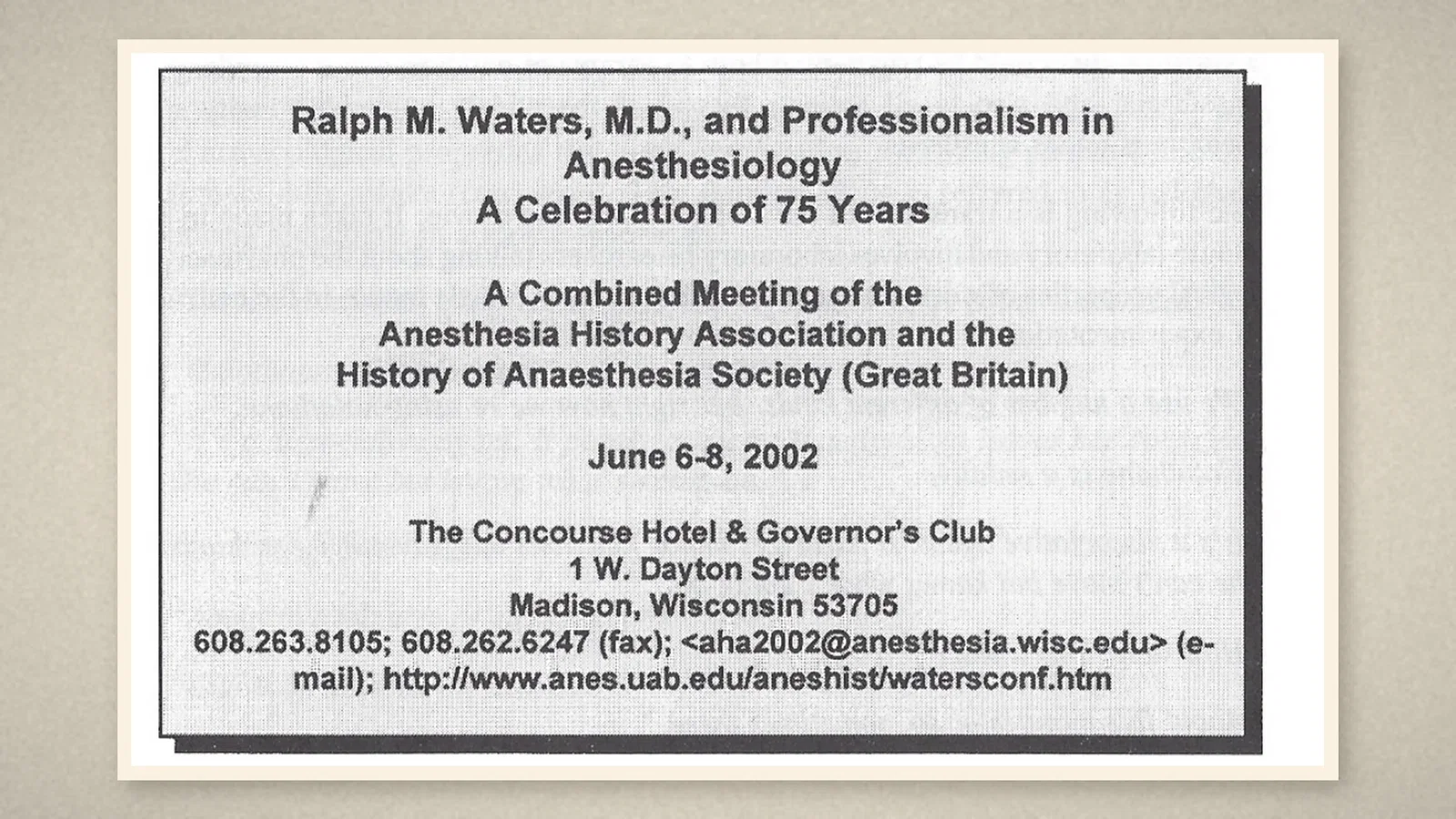
Larson wrote in an anniversary year. 2002 marked 75 years since Waters' appointment as Assistant Professor of Surgery in charge of Anesthesia at the University of Wisconsin Medical School, where, in Larson's words, Waters "eventually developed the first academic Department of Anesthesiology". The ASA timeline records the department under 1927, as "World's first academic department of anesthesiology founded", in Madison, Wisconsin. The American Society of Anesthesiologists gave its September Newsletter to Waters, and three history societies organised a meeting in Madison in June 2002. [1, pp. 73, 75][2, p. 43]
The question Larson brought
Larson's interest came from practice. After residency, which Larson finished in 1971, "it was very common to wait upon a valuable document entitled the 'History & Physical'" from the surgeon or an internist, which often described "the contemplated surgical anatomy (eye or knee) and everything else 'WNL'". Such a document, Larson judged, was "often little more than a superficial attempt to fulfill necessary hospital requirements", and in response several departments of anaesthesia had set up their own pre-anesthetic evaluation clinics. [1, p. 74]
What the letters say
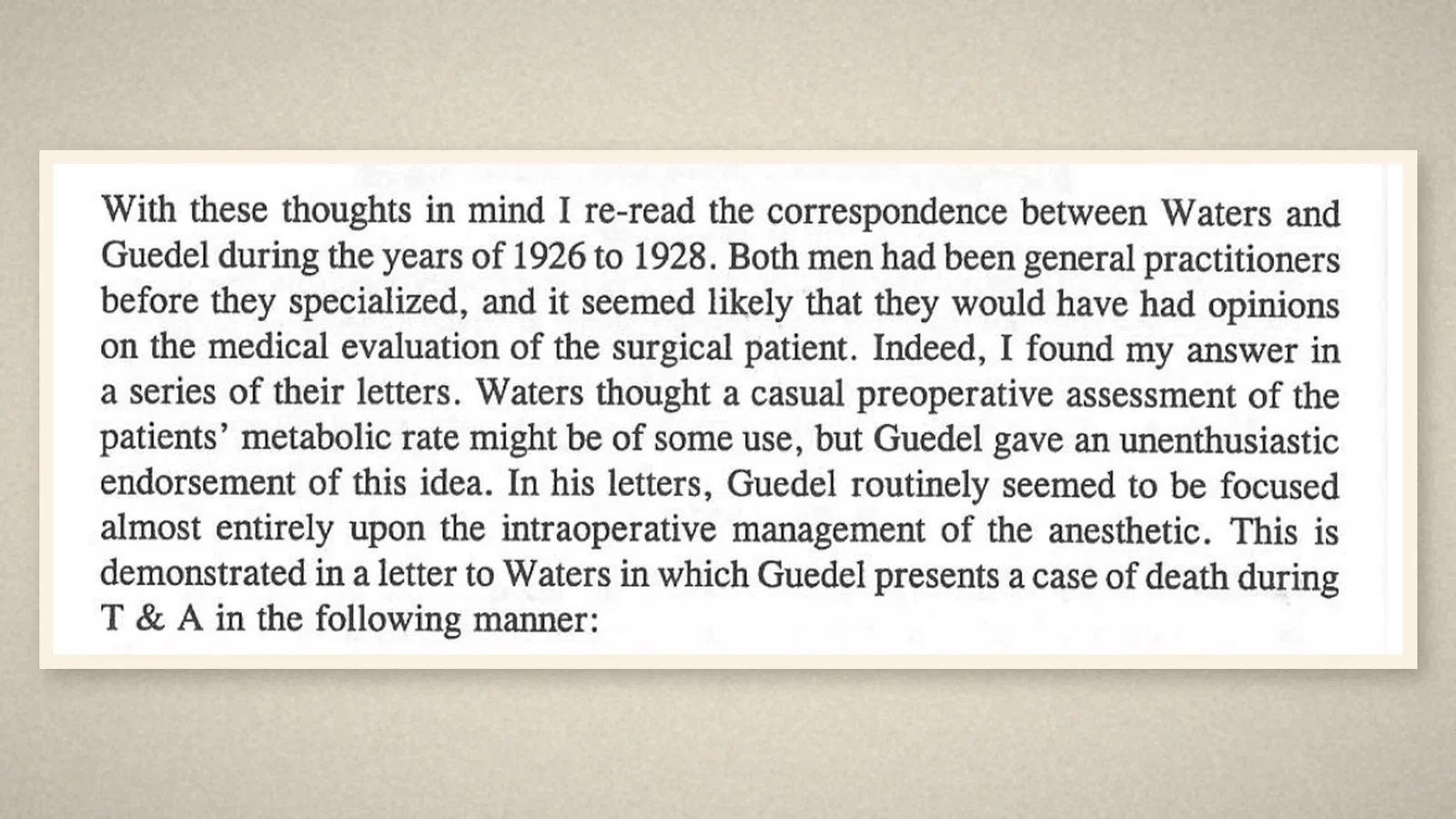
With this in mind, Larson "re-read the correspondence between Waters and Guedel during the years of 1926 to 1928". Both men had been general practitioners before they specialised, so they might be expected to have views on the medical evaluation of the surgical patient. They did, but not the same views. "Waters thought a casual preoperative assessment of the patients' metabolic rate might be of some use, but Guedel gave an unenthusiastic endorsement of this idea." In the letters, Guedel "routinely seemed to be focused almost entirely upon the intraoperative management of the anesthetic". [1, p. 74]
Larson's example is a letter in which Guedel reported a death during tonsillectomy and adenoidectomy. A young child had died under ether given by an intern; only afterwards did it emerge that the child had been under a physician's care for heart disease. Guedel thought the surgeon had known nothing of this, recorded the surgeon's view that anybody could give the anaesthetic for "just a tonsil", and ended: "They will learn some day." Larson noted that the intern worked "without an endotracheal tube, no intravenous access, and no monitors". [1, pp. 74-5]
Larson's reading
What struck Larson was where Guedel placed the fault. Guedel's "underlying thought" was that the surgeon had not known of the heart disease, and Guedel "apparently had little interest in having" the intern "obtain the information about cardiac disease before the anesthetic was administered". Larson was careful about the judgement: "This observation is not meant to diminish the stature of Guedel", who "was simply acting out the role of the anesthesiologist of that time". Popular textbooks of the early twentieth century, such as Gwathmey's, had no discussion of the pre-anaesthetic evaluation, only brief notes on premedication. Waters later became "one of the primary supporters for the anesthesiologists' involvement in the pre-operative evaluation". [1, p. 75]
What the record shows
The letters, as Larson reads them, show a specialty that measured itself by what happened during the anaesthetic. The patient's history belonged to the surgeon. The case in the letter shows the cost of that division, and Larson's last sentence states the lesson without blame: "It has taken us decades to establish our role in this area when it would have been best to have had it from the beginning."
Sources and reading limits
Read: Larson's three-page article in the CSA Bulletin, January-March 2002, in full; the ASA timeline entry for 1927.
Not covered: the Waters-Guedel letters themselves, which are held at the Guedel Center and are not digitised; Waters' own later writings on preoperative evaluation; Gwathmey's textbook; the ASA Newsletter issue on Waters. The letters could not be obtained, so everything said here about them is Larson's reading and Larson's quotation. Larson's "first academic Department" and the ASA's "World's first academic department" are quoted as theirs. Larson gives no source for Waters' later support of preoperative evaluation; this article says only "later". The child in the letter is not identified, and the account of the death is Guedel's, as Larson quotes it. Quotations are from the English original.
Three illustrations are crops of the article (pp. 73, 74 and 75); one is drawn from its text.
- Larson M. Waters, Guedel, and the pre-anesthetic evaluation. CSA Bulletin. 2002 Jan-Mar;51(1):73-5. Internet Archive
- Australian Society of Anaesthetists. Anaesthesia history timeline. 2024. ASA
Continue exploring
Related reading connects shared questions and contexts; it does not by itself establish historical influence.
- 1931: Guedel and Waters' Cuffed Endotracheal Tube
- 1927: Ralph Waters Joins Wisconsin with a Three-Year Residency
Anesthesia Epochs · The Source Room · About & Editorial Method
Published November 2, 2026. Sources and reading limits are stated above. Illustrations are labelled as original source images or AI-made. Historical accounts are educational; they are not current treatment instructions.