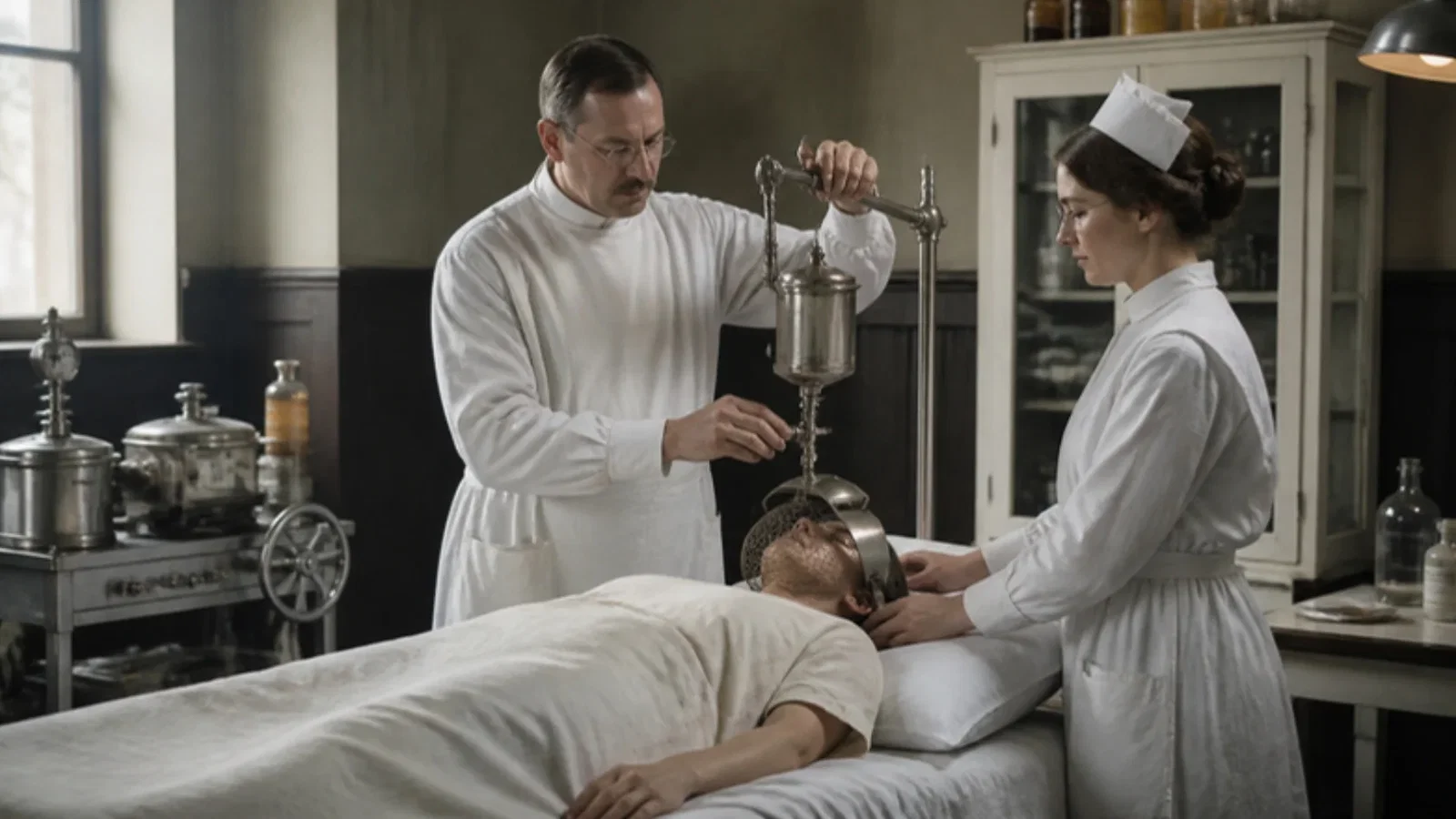
In August 1928 J. B. H. Waring of Blanchester, Ohio, published 'Safe, efficient ether anesthesia' in the Virginia Medical Monthly: ether accidents were mostly the fault of the 'unsafe' anaesthetist; to smooth drop ether, Waring built an 'anesthesia arm' holding the ether can with an adjustable dropper, then compared masks. The Yankauer chloroform mask fitted almost any face and was compact, reliable and cheap, but under gauze it let in so much air that ether was wasted, and the usual remedies, a wet towel or an old rubber glove, were untidy and hid the patient's colour. Waring added first a metal cuff with a rubber top and then an all-metal hood, giving the Yankauer the two-chambered vaporisation of the Ferguson inhaler and leaving eyes and face in view.
Reading Library · Anesthesia Epochs · 中文版
Watch the education video (for clinicians)
1928: Waring's Hooded Yankauer Mask — Open-Drop Ether · Anesthesia Epochs Education Series

The Yankauer mask was a small wire frame covered with gauze, used to drip chloroform or ether onto a patient's face. Most of what is known about it comes from people who used it. One of them, a physician from a small Ohio town, wrote in 1928 about what it did well, where it failed with ether, and how it could be fixed with a piece of metal. [1, pp. 342-3]
The article
"Safe, efficient ether anesthesia", by J. B. H. Waring of Blanchester, Ohio, appeared in the Virginia Medical Monthly in August 1928. Waring started from a questionnaire by Edwin MacD. Stanton of Fellows of the American College of Surgeons, which showed that ether was the standard anaesthetic of most American surgeons. Ether could fairly be called "safe", Waring argued; when things went wrong, "the anesthetist was the 'unsafe' factor". In small communities the family physician usually gave the anaesthetic, and the law treated almost any licensed physician as competent. Waring had received ether twice, once from a cone of newspaper and towel, and remembered both. [1, pp. 340-1]
The arm
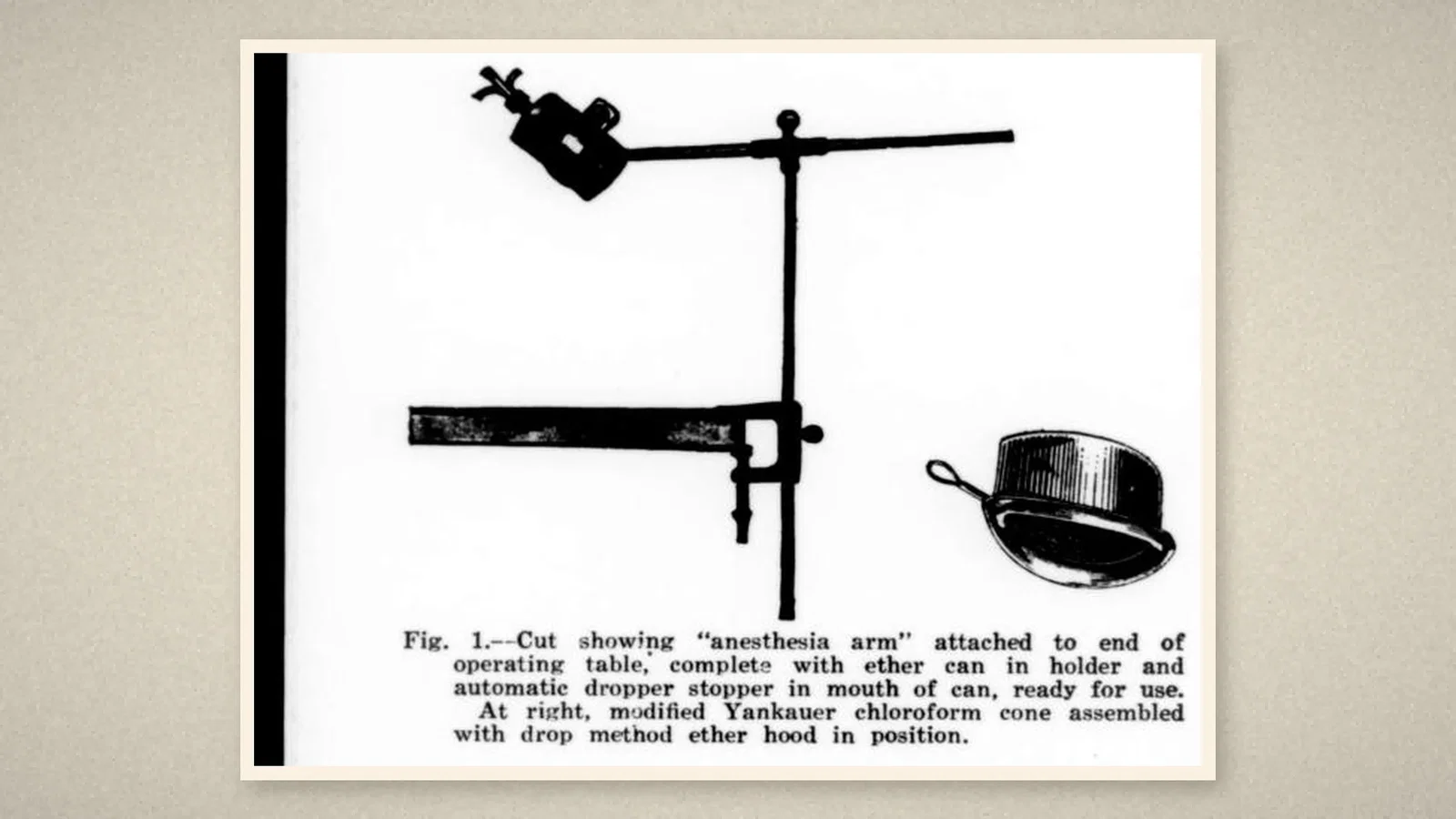
The first improvement was not a mask. Waring built what was called, "for want of a better name", an "anesthesia arm": a bracket that clamped to the operating table, a bedside table, a chair or a bed, or stood on a weighted base, and held the ordinary ether can upside down over the patient's face. A cork with a needle valve meant the drip "could be dropped at any desired rate", increased, reduced or stopped at will, and the anaesthetist no longer had to hold the can for an hour or two. [1, p. 342]
The mask
Then Waring compared masks. The Ferguson inhaler, a wire frame with a drawn cloth hood, vaporised ether very well, but it had to be reassembled for every case, pressed on the face and was awkward to hold. The Yankauer chloroform mask, by contrast, impressed Waring with its "almost invariably easy application to the features of various patients", its compactness and its reliability, and it was cheap and in wide use. [1, pp. 342-3]
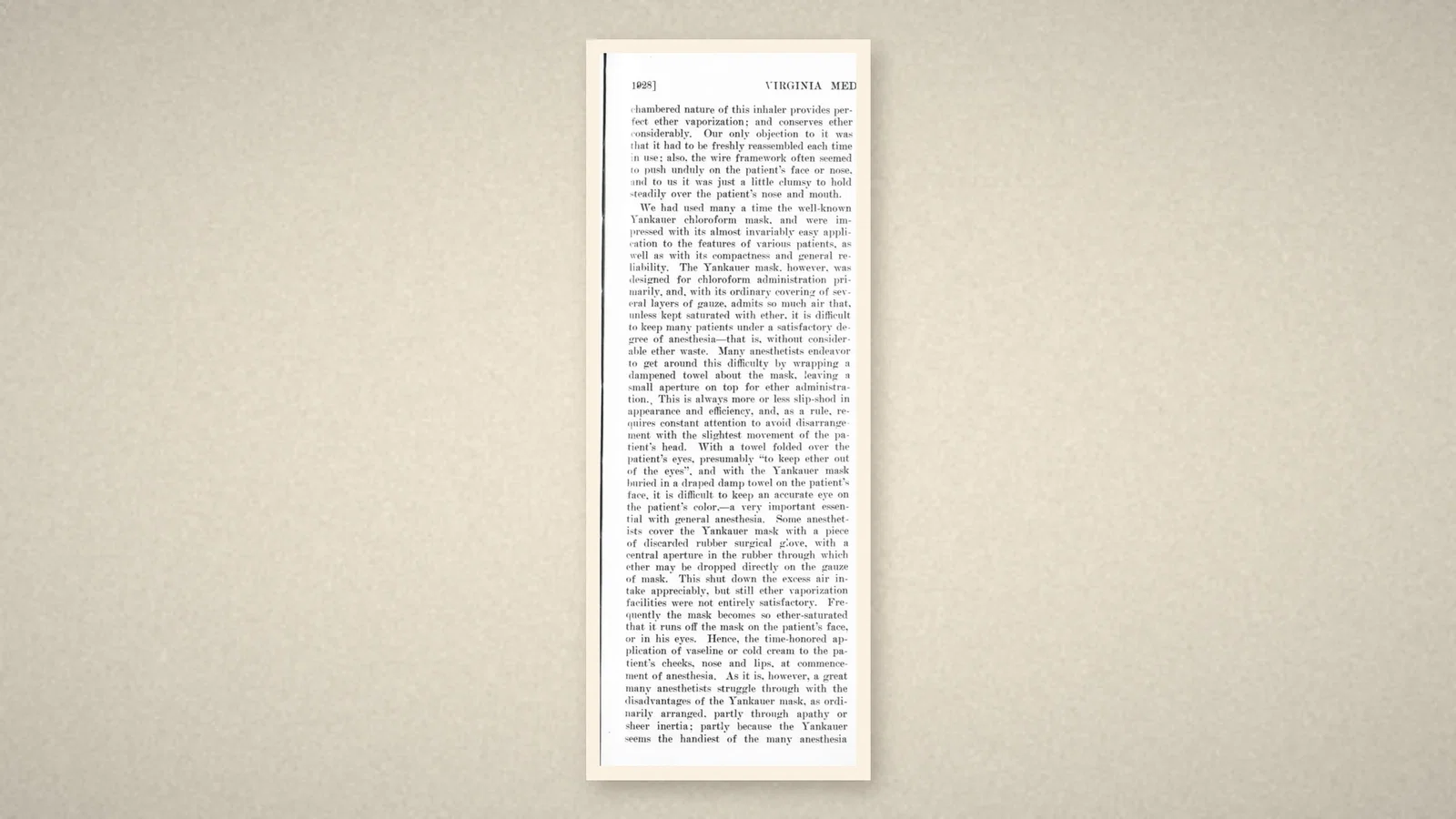
Its weakness was ether. The Yankauer had been "designed for chloroform administration primarily", and under several layers of gauze it let in so much air that patients were either too light or ether was wasted. Anaesthetists improvised. Some wrapped the mask in a damp towel, leaving a small hole for the drip; others covered it with a piece "of discarded rubber surgical glove". Both looked untidy and shifted when the head moved, and with a towel also folded over the eyes it was hard to keep watching the patient's colour, "a very important essential" in general anaesthesia. [1, p. 343]
The hood
Waring tried to "combine the advantages of the Yankauer and the Ferguson masks". The first version was a metal cuff fitted snugly over the gauze-covered mask, with a sheet of rubber tissue stretched across it and a small hole in the centre, which made "a rubber-covered two-chambered inhaler". The next step was "an all-metal-covering hood", which slipped over the Yankauer and gave it the Ferguson's vaporising efficiency while keeping the Yankauer's easy handling. [1, p. 343]
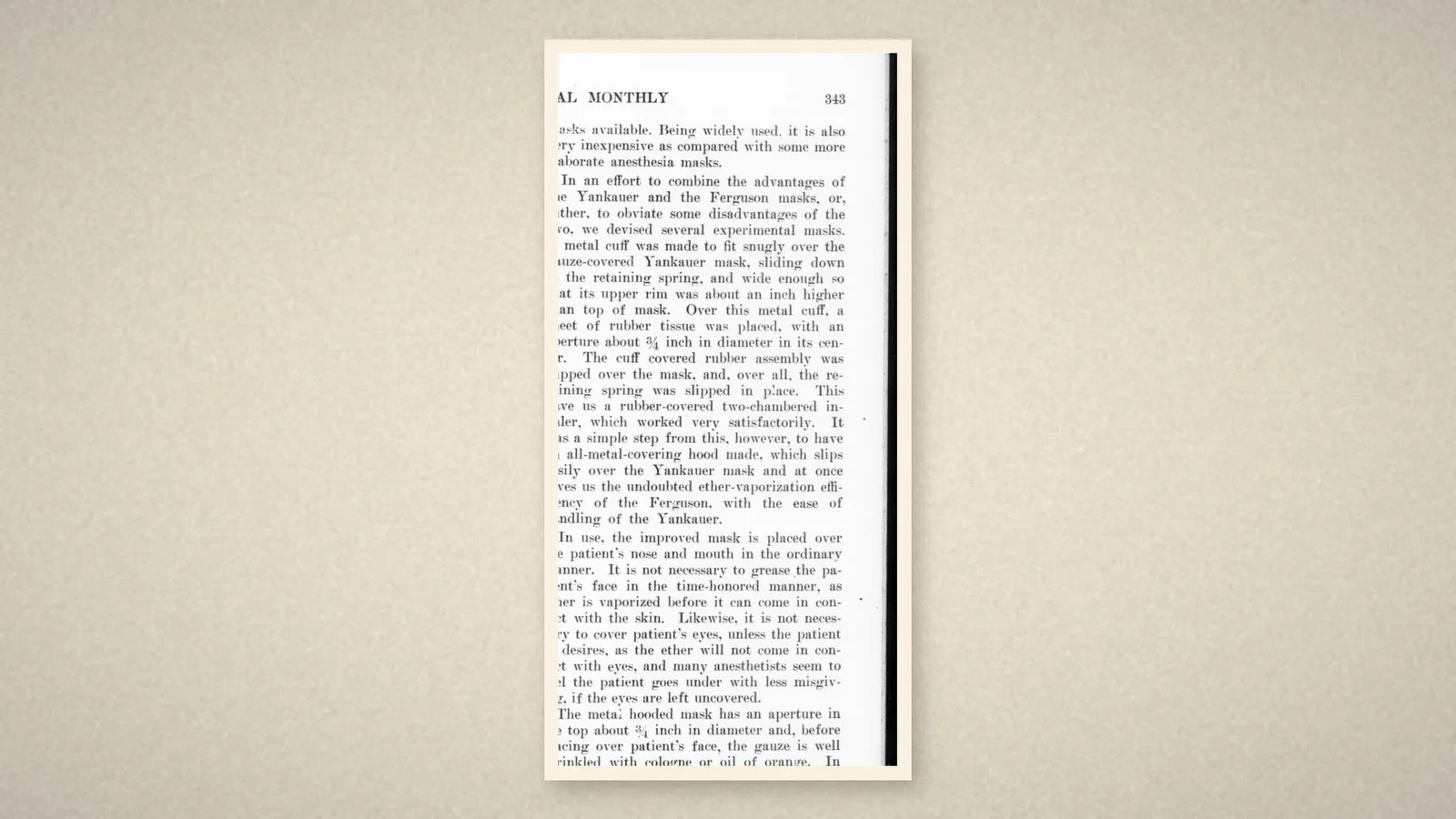
In use, ether dripped through the hole onto the gauze, vaporised at once, and the heavier vapour sank into the air space beneath, where the patient breathed it mixed with air. No grease on the face was needed and the eyes did not have to be covered, so the face stayed in view throughout. Waring claimed that the average major operation now needed less than half the usual ether. [1, pp. 343-4]
What the record shows
A widely used mask seen through one user's complaints. The Yankauer fitted almost anyone and cost little; the problem was air. Towels and old gloves were the common fix. Waring's metal hood was a tidier version of the same idea, and it left the patient's face visible, which mattered as much to Waring as the ether it saved.
Sources and reading limits
Read: Waring, "Safe, efficient ether anesthesia", Virginia Medical Monthly August 1928;55(5):340-5, in full.
Not covered: Yankauer's own description of the mask; the description of the Ferguson inhaler; Stanton's questionnaire report; any later report of Waring's hood or arm.
Limits: the claims of smoother induction, less ether and no post-operative pneumonia are Waring's impressions, without figures. The Yankauer mask is seen here only as Waring used it; its design and date are not established by this source. Ether quantities and timings are not repeated.
Three illustrations are crops of the Virginia Medical Monthly (pp. 342-3); one is a text diagram drawn from the article, with no mask drawn.
- Waring JBH. Safe, efficient ether anesthesia. Va Med Mon. 1928;55(5):340-5. Internet Archive
Continue exploring
Related reading connects shared questions and contexts; it does not by itself establish historical influence.
- 1909: Probyn-Williams Describes a Wide-Tube Ether Inhaler
- 1847: Hedley's Wooden Ether Inhaler in the Pharmaceutical Journal
Anesthesia Epochs · The Source Room · About & Editorial Method
Published November 3, 2026. Sources and reading limits are stated above. Illustrations are labelled as original source images or AI-made. Historical accounts are educational; they are not current treatment instructions.