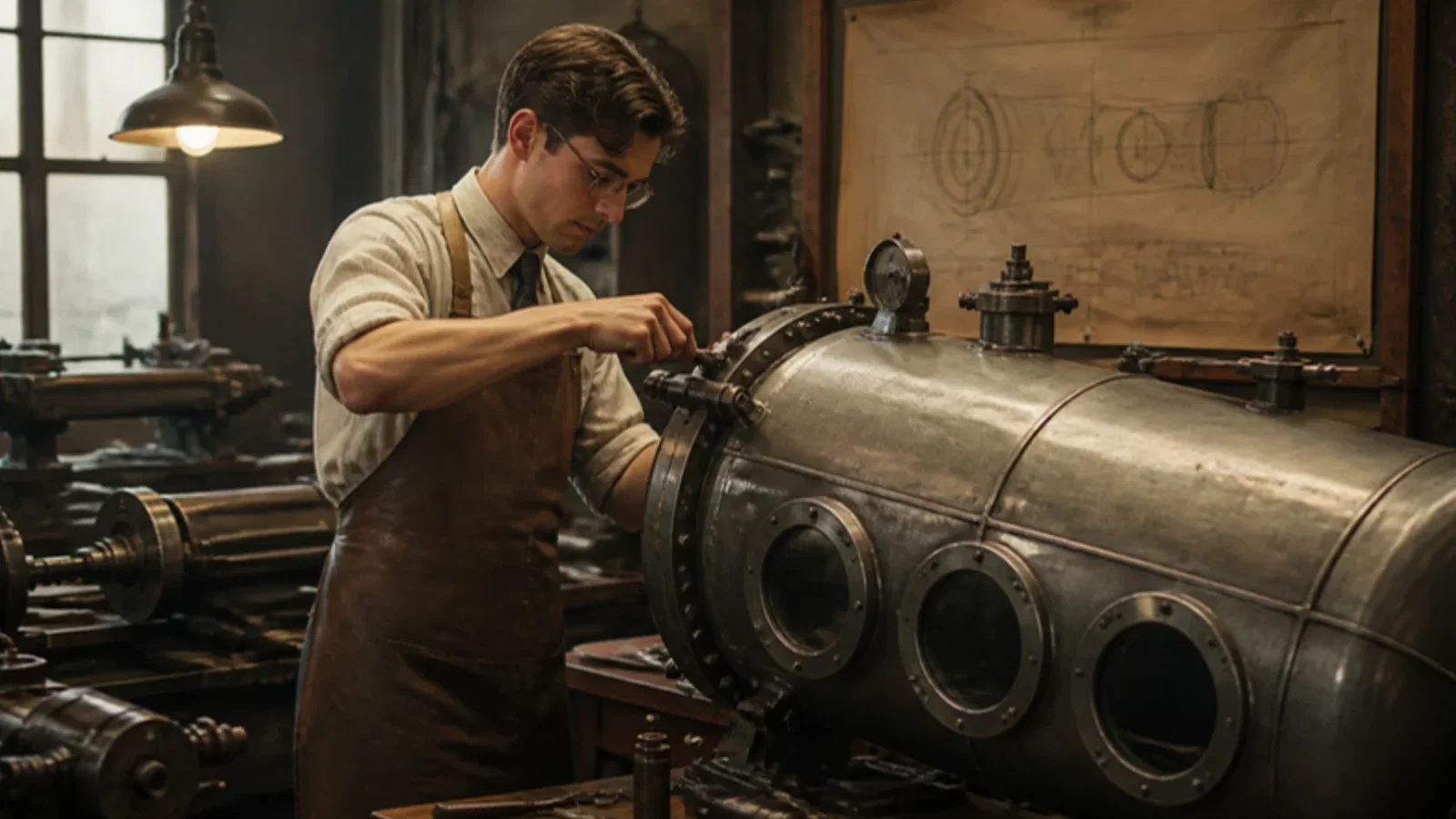
On 1 March 1933 The Nation printed Stewart Griscom's 'Paralysis and Profits': Philip Drinker of Harvard had announced a tank respirator for paralysed poliomyelitis patients in May 1929, but it used noisy vacuum-cleaner blowers, had no hand pump for power failures and few rates; in spring 1931 John Haven Emerson, who ran a machine shop in Harvard Square, saw it at the Children's Hospital in Boston, and by July 1931 had built a machine with a silent leather diaphragm, adjustable to any rate and far cheaper. It was first used in Providence; Warren E. Collins, Inc., maker of the Drinker machine, then sued for infringement. The article takes Emerson's side. In 1957 Herbert Kent still used the Emerson respirator to teach the features of tank respirators.
Reading Library · Anesthesia Epochs · 中文版
Watch the education video (for clinicians)
1931: Emerson's Tank Respirator — Cambridge, Massachusetts · Anesthesia Epochs Education Series
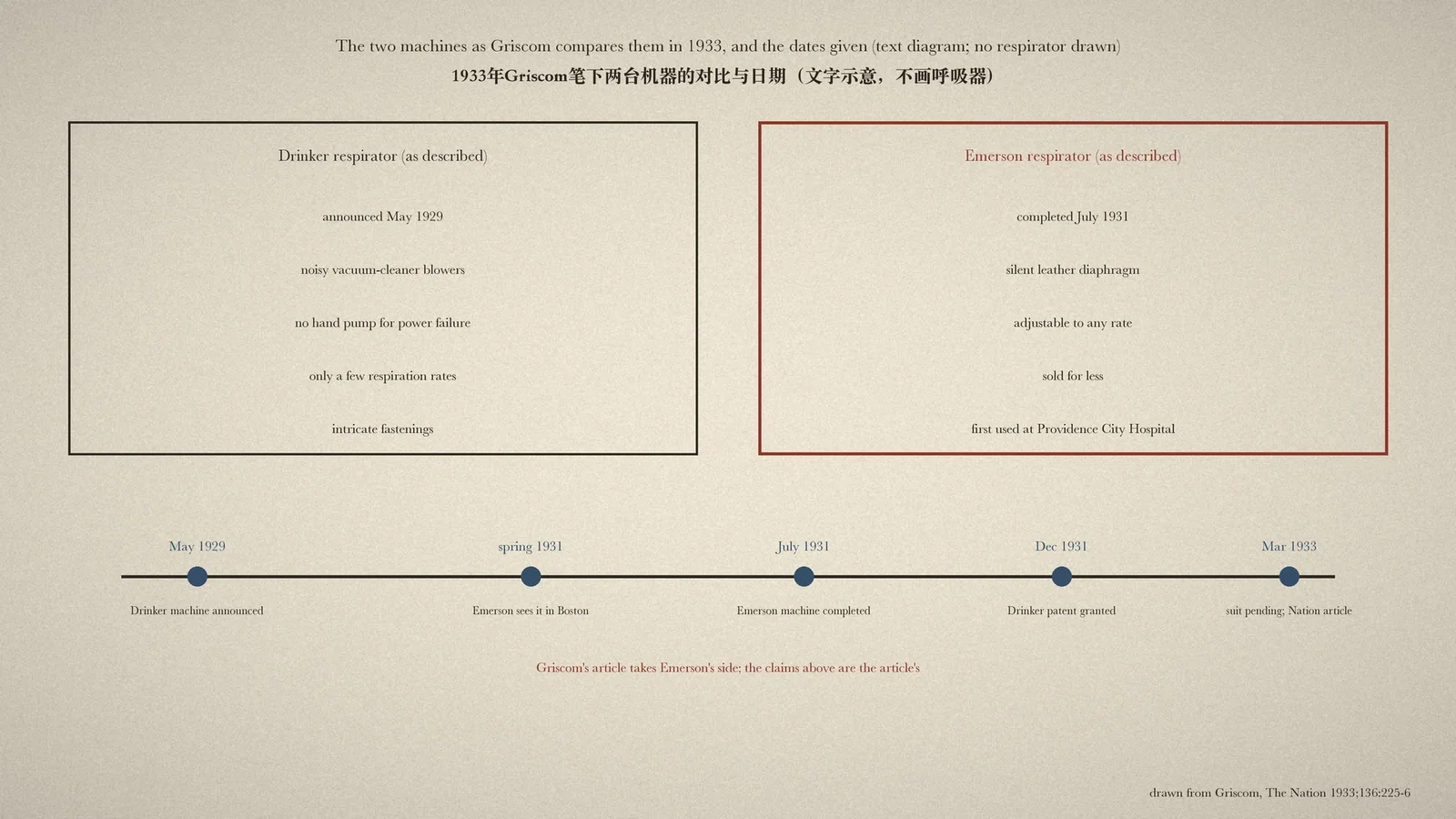
The tank respirator, or "iron lung", kept poliomyelitis patients alive when the muscles of breathing failed. The best-known version came from Harvard. A second one came from a small machine shop in Harvard Square, and within two years the two were in court. The fullest contemporary account is a magazine article written to take sides. [1, pp. 225-6]
The article
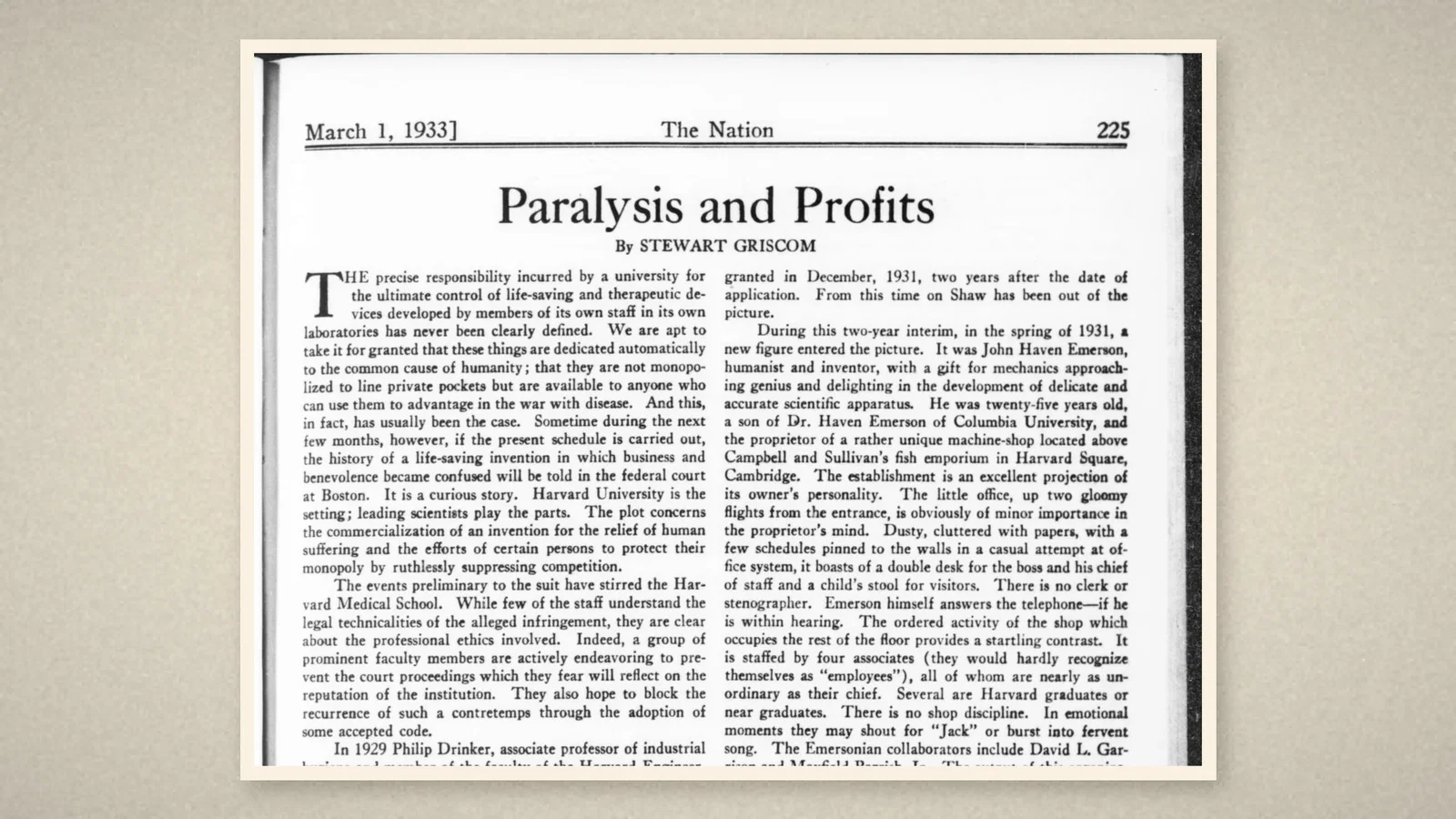
On 1 March 1933 The Nation published "Paralysis and Profits" by Stewart Griscom, about a patent suit expected to be heard in the federal court at Boston. Its subject was the commercial control of a life-saving device developed in a university, and Harvard was the setting. [1, p. 225]
The first machine
According to Griscom, Philip Drinker, associate professor of industrial hygiene, was working on pneumatic life-saving equipment in 1929 when the idea came of a box in which changes of air pressure would help the breathing of poliomyelitis patients whose respiratory muscles were paralysed. Drinker "announced the fact in May, 1929". Griscom called the result "a real asset to life-saving technique", and also "a crude device": noisy vacuum-cleaner blowers pumped the air, there was no hand pump for use if the electricity failed, only a few breathing rates were possible, and complicated fastenings slowed the loading of patients in an emergency. Drinker and Louis Agassiz Shaw applied for a patent, which was granted in December 1931. [1, p. 225]
The second machine
John Haven Emerson, twenty-five years old, ran a machine shop above a fish shop in Harvard Square that made scientific apparatus. In the spring of 1931 Emerson saw the Drinker respirator working at the Children's Hospital in Boston, where staff pointed out its weaknesses. [1, p. 225]
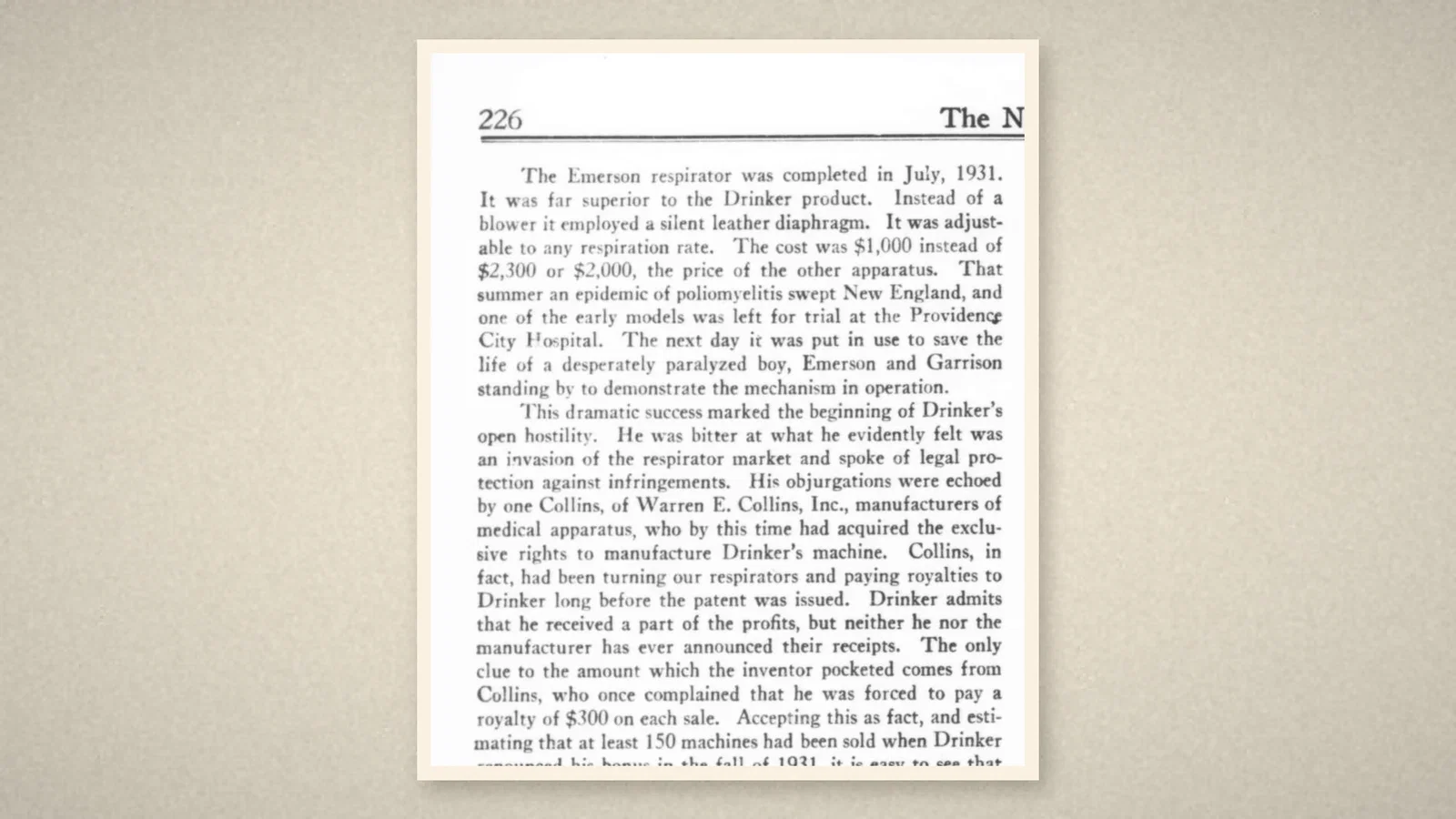
"The Emerson respirator was completed in July, 1931." In place of a blower "it employed a silent leather diaphragm"; it could be set to any respiration rate; and it sold for much less. That summer poliomyelitis swept New England, and an early model left for trial at the Providence City Hospital was used the next day for a badly paralysed boy. [1, p. 226]
The dispute
Griscom's account of what followed is one-sided and should be read that way. Warren E. Collins, Inc., which held the exclusive right to make the Drinker machine, objected to the competition. At the request of the dean of the Harvard Medical School, Emerson held back advertising while the university considered the patent. Shortly afterwards Collins announced a new model, and Griscom claims that every improvement it advertised had first appeared in Emerson's machine. Four months later "the Collins corporation entered suit" for infringement. The article adds that the Emerson respirator had been "officially accepted" by the American Medical Association's Council on Physical Therapy. It ends with a proposal: life-saving devices developed in universities should be licensed to any maker who could guarantee reliability and a reasonable price. [1, p. 226]
A quarter of a century later
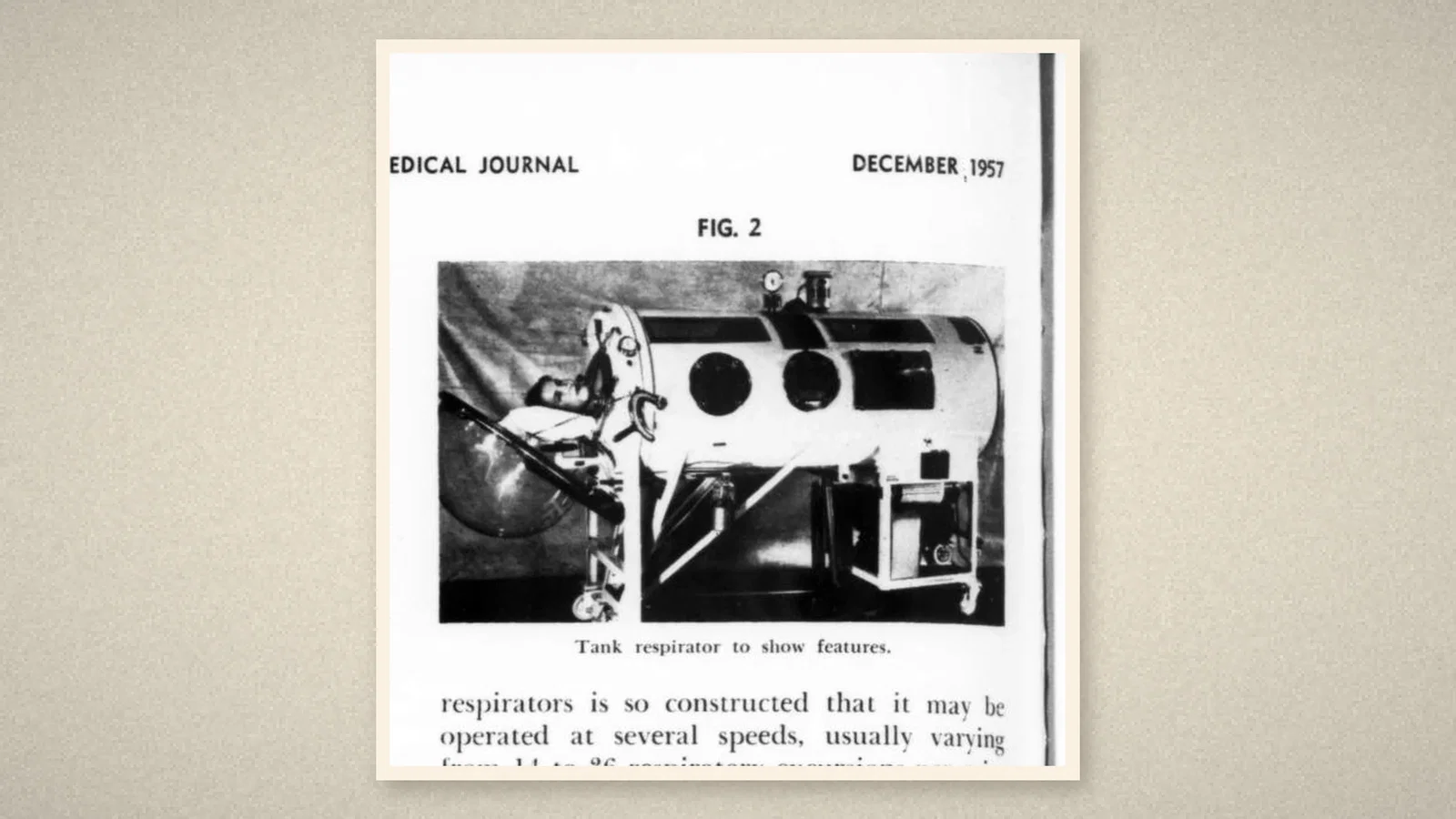
By 1957 the dispute had faded and the machine had become a teaching example. In the Southern Medical Journal, Herbert Kent of Oklahoma City wrote "What physicians should know about respirators", and used the Emerson to explain the tank respirator: understand its design, Kent wrote, and you will know where the essential features of all of them are. Kent described a leather diaphragm at the end of the tank, a concave head plate that left room around the head and throat, an easily reached hand lever, a rotating pressure gauge, larger arm ports and a larger bedpan port. Kent's list of disadvantages was short: the machine was larger and heavier, and harder to move. [2, pp. 1497-9]
What the record shows
A machine improved by someone who had watched the original in use: quieter, adjustable, workable by hand, and cheaper. It also records an early argument over who should control a life-saving device developed in a university, made in a magazine that took one side. By 1957 the same machine was the standard example for teaching doctors how a tank respirator works.
Sources and reading limits
Read: Griscom, "Paralysis and Profits", The Nation 1 March 1933;136:225-6, in full; Kent, "What physicians should know about respirators", Southern Medical Journal December 1957;50:1497-1503, the general section and the descriptions of the Emerson and Drinker-Collins respirators.
Not covered: Drinker and Shaw's 1929 paper and their patent; any Emerson patent; the court record and outcome of the suit; the Council on Physical Therapy's report on the Emerson respirator, which Griscom mentions but which was not found.
Limits: Griscom's article is advocacy journalism written before the case was heard. Its account of people's motives, private conversations and the Collins company's receipts is not repeated here as fact. The rescue at Providence has no independent record in what was read. Kent describes the Emerson respirator of 1957, which may differ from the 1931 model. Prices, pressures and rates are not repeated.
Three illustrations are crops of The Nation (1933, pp. 225-6) and the Southern Medical Journal (1957, p. 1498); one is a text diagram drawn from the 1933 article, with no respirator drawn.
- Griscom S. Paralysis and profits. Nation. 1933;136(3530):225-6. Internet Archive
- Kent H. What physicians should know about respirators. South Med J. 1957;50(12):1497-1503. Internet Archive
Continue exploring
Related reading connects shared questions and contexts; it does not by itself establish historical influence.
- 1944: The AMA Accepts the Kreiselman Bellows Resuscitator, for Physicians Only
- 1962: The European Congress of Anaesthesiology Meets in Vienna
Anesthesia Epochs · The Source Room · About & Editorial Method
Published November 3, 2026. Sources and reading limits are stated above. Illustrations are labelled as original source images or AI-made. Historical accounts are educational; they are not current treatment instructions.