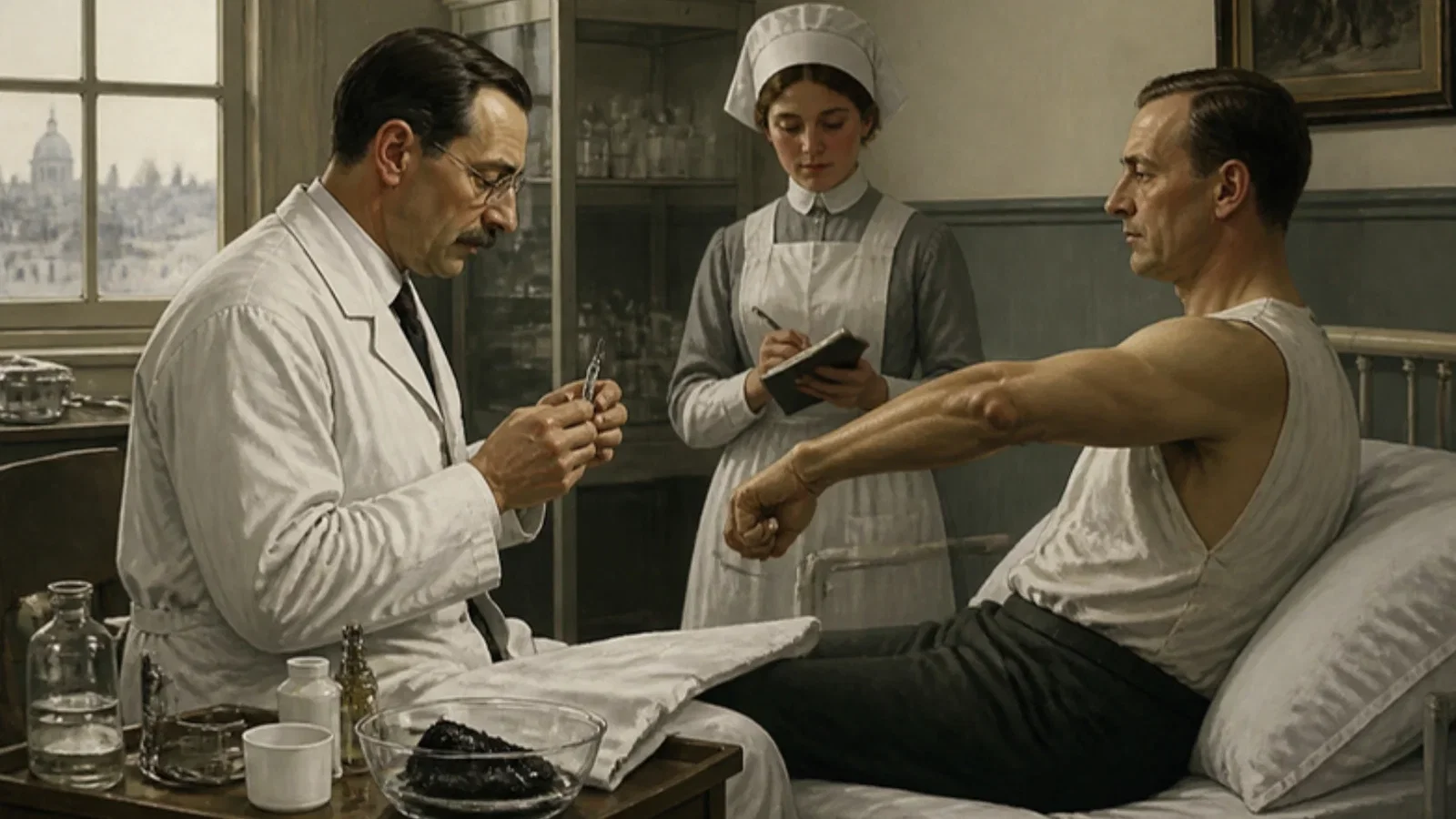
In May 1932 the Section of Neurology of the Proceedings of the Royal Society of Medicine printed Ranyard West's 'Curare in man'. With Hartridge, West had found that curare abolished parathyroid tetany in dogs at half the dose needed to cause weakness, which seemed to justify a cautious trial in man. The curare, a resinous mass 'of the consistency of hard toffee' given by Sir Charles Sherrington and sterilised by Burroughs Wellcome, was injected under the skin in thirty patients, seventeen reported. Epilepsy did not improve, but pyramidal and extrapyramidal rigidity was measurably reduced without detectable weakness, with falls in blood pressure and pulse, headache and giddiness. West called the effect 'lissive', stressed that the work was preliminary and tentative, and warned that curare was neither a unity nor constant. On 8 January 1935 West told the Section of Therapeutics and Pharmacology that one should speak of 'the curares'; in Sir Henry Dale's laboratory Harold King had isolated pure crystalline tubocurarine from a tube curare, which West understood to be the first time. Neither tubocurarine nor curarine was lissive; West now looked to controlled paralysis with artificial respiration for severe tetanus.
Reading Library · Anesthesia Epochs · 中文版
Watch the education video (for clinicians)
1932: Ranyard West's Curare in Man — Rigidity Without Weakness · Anesthesia Epochs Education Series
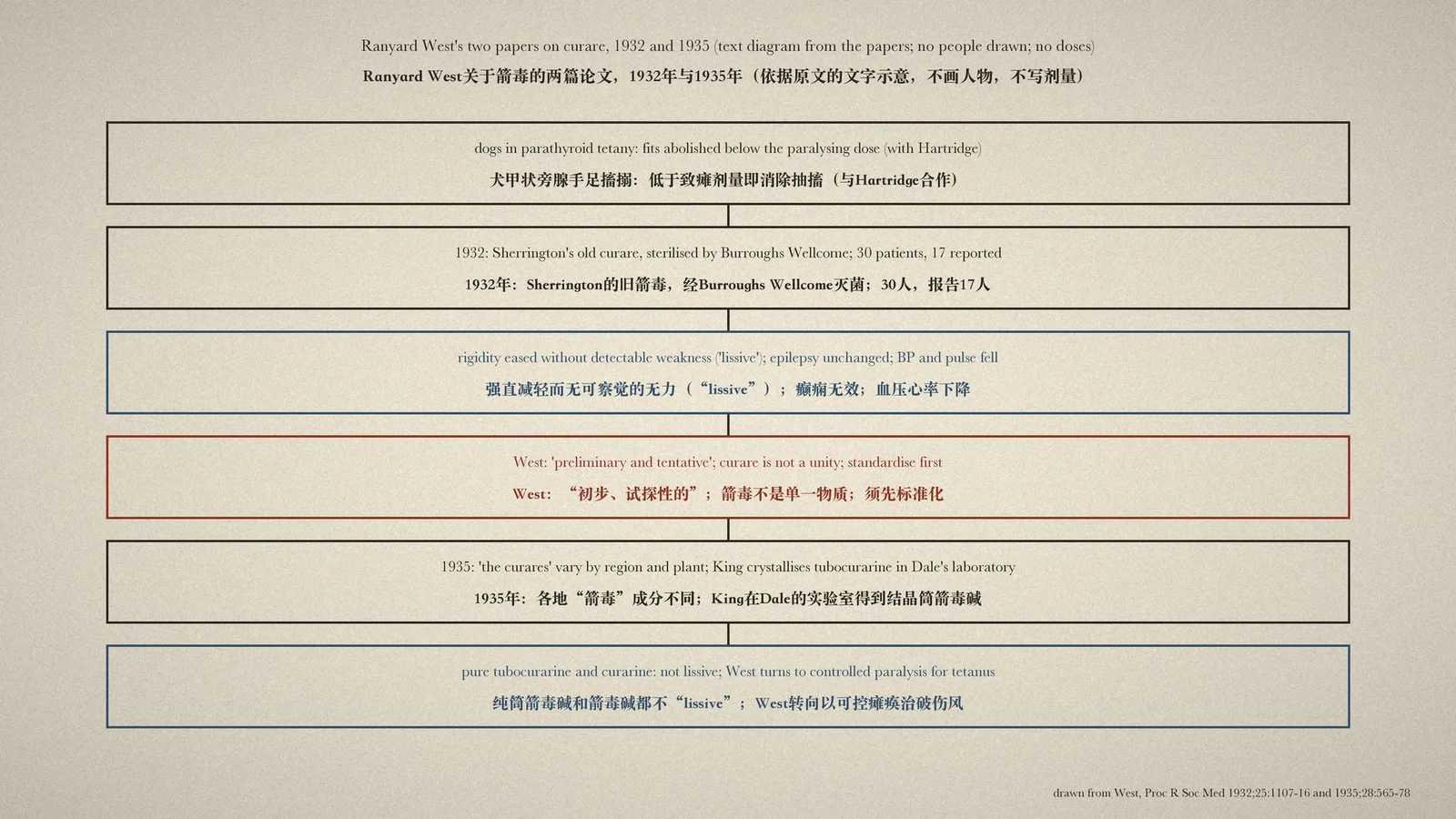
Curare would later become the source of anaesthesia's muscle relaxants, but in 1932, in the hands of a London neurologist, it held a different hope: could it remove the rigidity caused by disease of the brain and spinal cord without leaving the patient weak? Ranyard West's two papers in the Proceedings of the Royal Society of Medicine record the start of that attempt, its difficulties, and something it brought into view almost by the way: crystalline tubocurarine. [1, p. 1107][2, p. 570]
From dogs to people
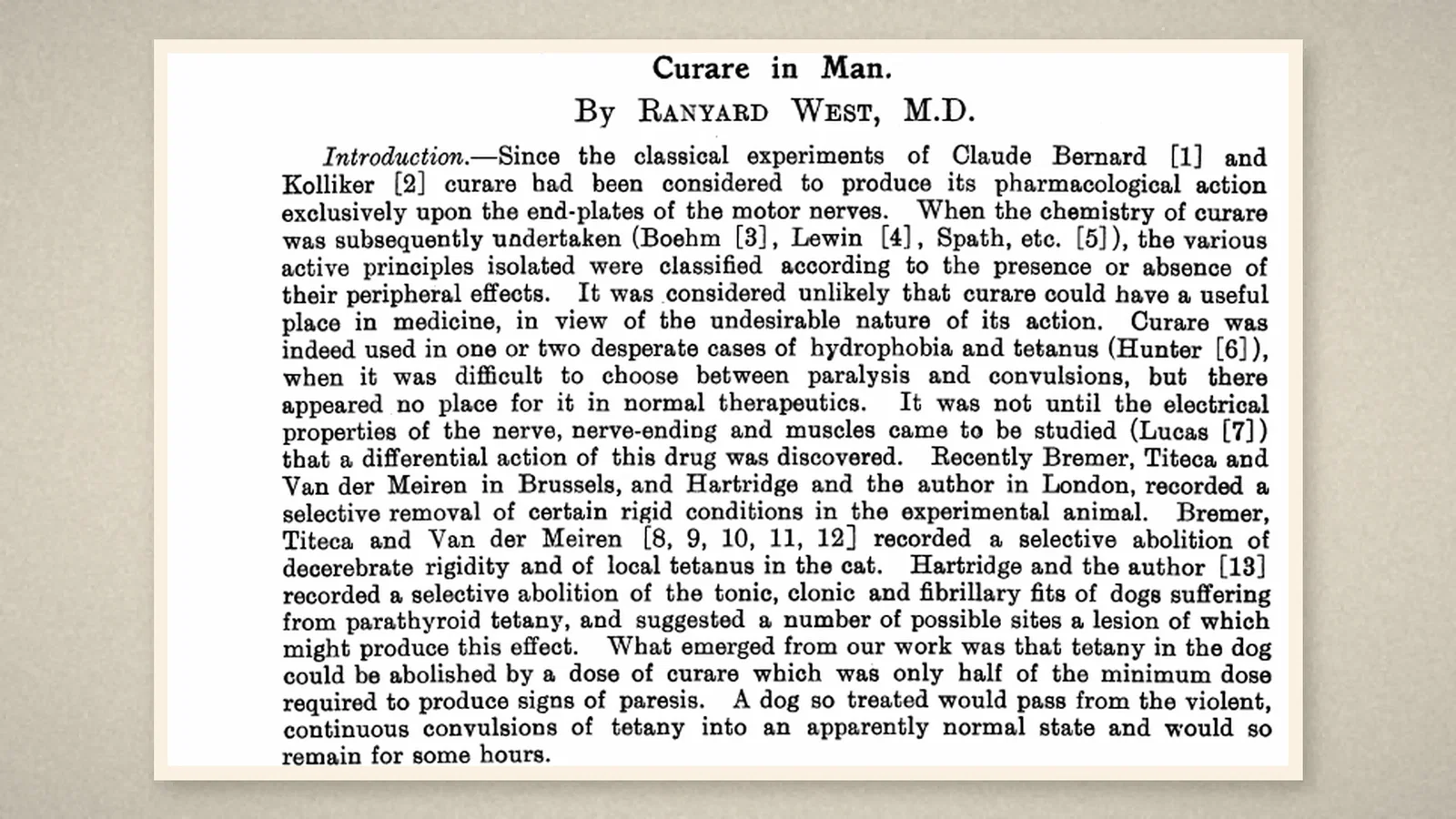
In May 1932 the Section of Neurology of the Proceedings (vol. 25) printed West's "Curare in man". Since the classical experiments of Claude Bernard and Kölliker, the introduction said, curare had been thought to act only on the motor end-plates and to have no useful place in medicine, apart from one or two desperate cases of hydrophobia and tetanus. Recently, though, Bremer and colleagues in Brussels and Hartridge and West in London had seen certain rigid states abolished selectively in animals. Hartridge and West found that the tetany of dogs after parathyroid removal could be abolished "by a dose of curare which was only half of the minimum dose required to produce signs of paresis"; the dog passed from violent convulsions to an apparently normal state for some hours. [1, p. 1107]
West was then studying the nervous mechanism of tetany and its possible links with other diseases of the central nervous system, and the margin seen in dogs seemed to "justify the cautious trial of the drug in man". The curare came from Sir Charles Sherrington, who had obtained it from South America some thirty years before: a resinous mass "of the consistency of hard toffee", only partly soluble in water, which Burroughs Wellcome filtered, sterilised and put into ampoules for injection under the skin. Thirty patients were treated. [1, p. 1108]
Thirty treated, seventeen reported
Ten to thirty minutes after injection most patients had headache and slight giddiness, worse on standing and always with a fall in systolic pressure and a slower pulse; adrenaline given with the curare prevented it. Rigidity was measured with a board and spring balance designed by Professor Hartridge. Calling curare in safe and controlled dosage "a new drug in medicine", West reported a preliminary series of seventeen, some from the Hospital for Epilepsy and Paralysis, Maida Vale. [1, p. 1108][1, p. 1109]
In epilepsy the results were entirely negative. In one patient with frequent night attacks, the dose was raised until the neck flexors were clearly weak, yet a Jacksonian fit began and spread while West was examining the patient; breathing, though, was untroubled, as in the dogs. West set curare aside in epilepsy for the time being. [1, p. 1109]
Patients with paraplegia, hemiplegia and parkinsonian rigidity did better. Some felt their legs were "looser", one could walk with a stick, and the force needed to bend or straighten a limb fell for a day or two. A youth with post-encephalitic parkinsonism rose after an injection and walked across the room swinging both arms, and over the next week, a parent reported, dressed and washed up the tea-things, which had not been possible for months; yet after admission for daily injections "the first excellent results were not maintained". [1, p. 1110][1, p. 1112]
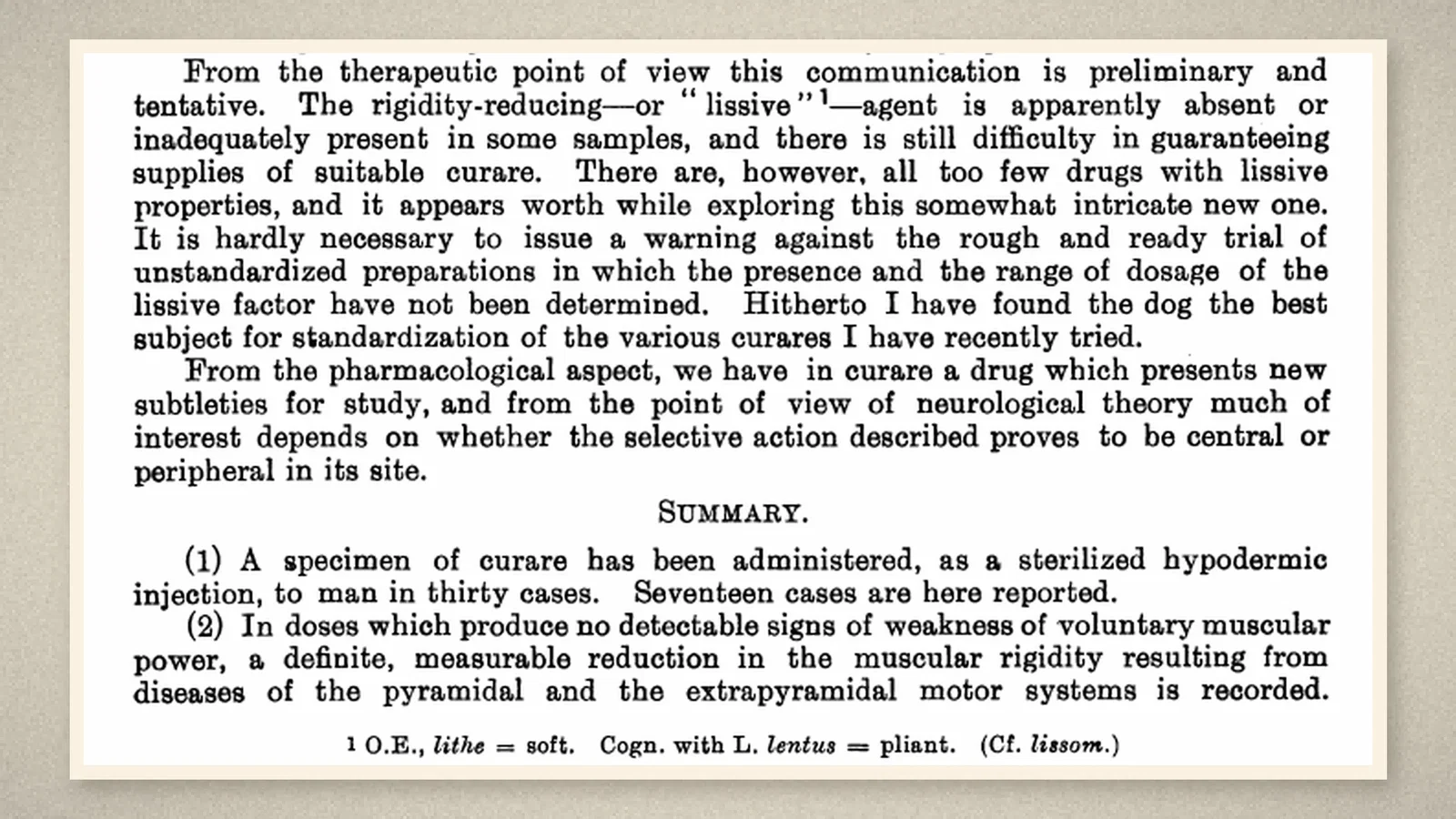
West called the communication "preliminary and tentative". The rigidity-reducing agent was absent or inadequate in some samples, and suitable curare was hard to obtain. West coined the word "lissive" for the effect, from an Old English word for soft, and warned against "the rough and ready trial of unstandardized preparations" whose active factor and dose range were unknown. The summary ended by stressing that curare was "not a unity, or even of constant composition", and needed further chemical and physiological assay. [1, p. 1115][1, p. 1116]
1935: "the curares"
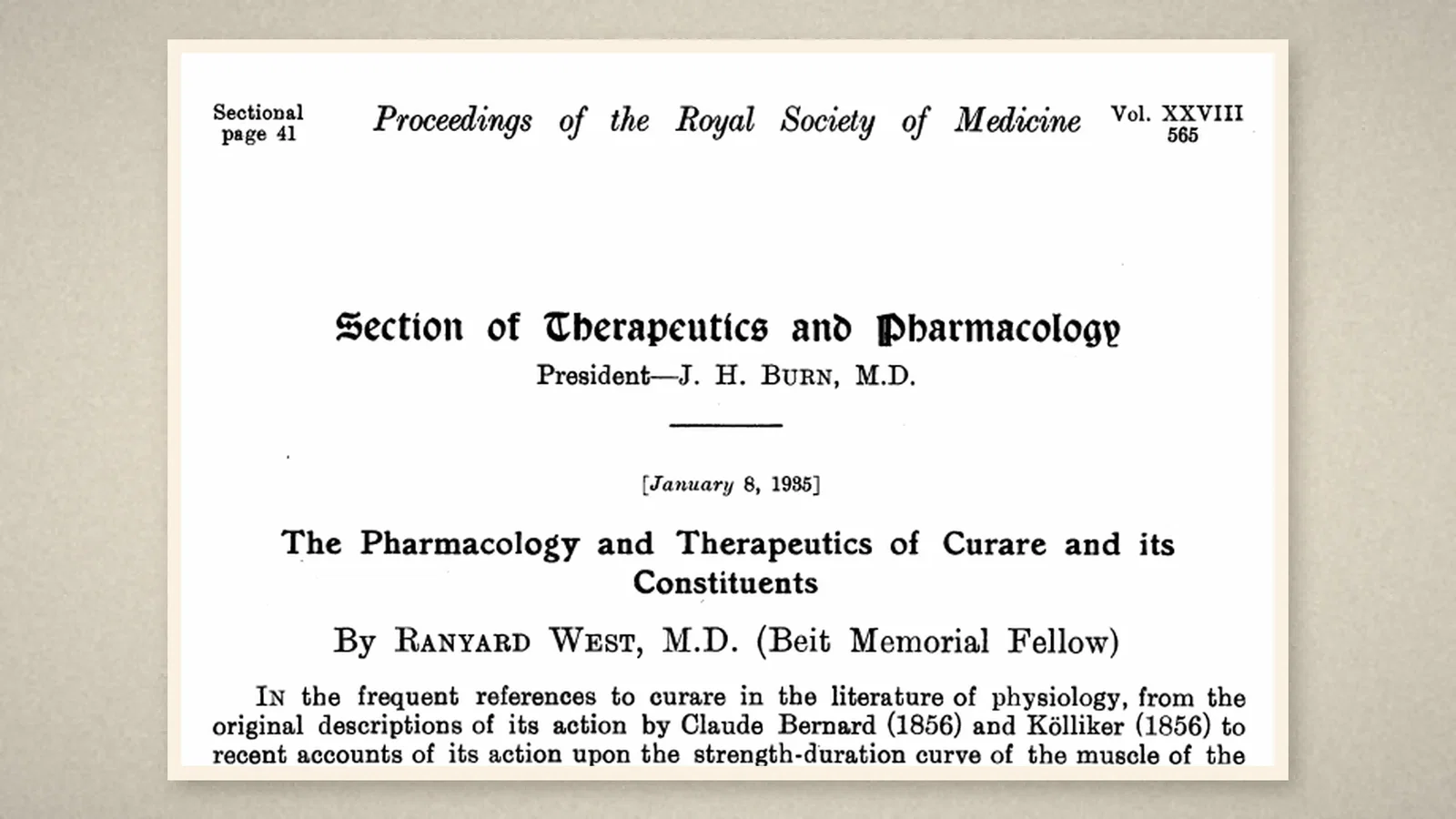
On 8 January 1935 West, now a Beit Memorial Fellow, read "The pharmacology and therapeutics of curare and its constituents" to the Section of Therapeutics and Pharmacology. Curare, the paper began, is a mixture of watery extracts of several poisonous plants that differ from region to region. It traced the drug from Raleigh to Humboldt and the Schomburgk brothers, and recalled its trials in France in hydrophobia, tetanus and epilepsy in the late nineteenth century, after which it all but vanished from British medical writing. [2, p. 565][2, p. 567]
West recounted the work with Hartridge in 1930 and the thirty human cases, whose results had been "irregular and, as such, unsatisfactory" but enough to justify more study. The lissive property did not follow the old classification of curares by their containers, and most curare in Britain existed as small samples kept as travel souvenirs or in museums. [2, p. 567][2, p. 569]
In Sir Henry Dale's chemical research department, Harold King isolated pure crystalline tubocurarine from a tube curare supplied by the British Museum; West wrote, "I understand this is the first occasion on which this substance has been obtained in crystalline form". Pure tubocurarine, however, acted only peripherally in dogs, with no lissive power, and in a patient with spastic paraplegia small doses eased the spasm only slightly while larger ones brought ptosis and difficulty speaking and swallowing. [2, p. 570][2, p. 571]
West expected the therapeutic uses of curarine to remain very limited. Having seen a severe tetanus case die despite crude curare and a Drinker respirator, West judged that "controlled paralysis with artificial respiration" offered a more hopeful standard treatment for severe tetanus than curares of variable strength. "We should, perhaps, speak of the curares, rather than curare," the summary said, and it would be a disappointment if curarine for desperate tetanus were the only outcome. [2, p. 575][2, p. 576][2, p. 577]
What the record shows
West was looking for a drug that removed rigidity alone, and did not find it. But these two papers moved curare from the hunter's poison and the physiology laboratory into clinical injection, standardisation and the chemistry of pure constituents, and they put crystalline tubocurarine on record in the medical literature.
Sources and reading limits
Read: West, "Curare in man", Proc R Soc Med 1932;25:1107-16 (the whole paper with tables, apparatus figure and summary; page images of pp. 1107-1109, 1115 and 1116 checked); West, "The pharmacology and therapeutics of curare and its constituents", Proc R Soc Med 1935;28:565-78 (the whole paper: history, properties of various curares, the lissive action, derivatives, tubocurarine and curarine in man, tetanus and summary; page images of pp. 565 and 566 checked). Both scans were obtained from PubMed Central.
Not covered: Hartridge and West's 1931 papers; the papers of Bremer and colleagues; the earlier French and German clinical literature, known here only through West's review; King's chemical paper on tubocurarine; Florey's and Cole's tetanus work. Some timelines date this topic to 1912 under the heading of curare before 1942; earlier uses are known here only from West's account.
Limits: West called the 1932 results preliminary and tentative and, in 1935, irregular and unsatisfactory; the cases were selected and uncontrolled, and rigidity was measured with a simple spring balance. That King's tubocurarine was crystallised for the first time is West's understanding and is reported as such. All doses, blood pressures, pulse rates and measured forces are omitted, and page crops stop before them; the apparatus drawing is not used because it is labelled with board lengths. Patients are not identified.
Three illustrations are crops of Proc R Soc Med 1932 pp. 1107 and 1115 and 1935 p. 565. One is a text diagram drawn from both papers, with no people and no doses.
- West R. Curare in man. Proc R Soc Med. 1932;25:1107-16. DOI
- West R. The pharmacology and therapeutics of curare and its constituents. Proc R Soc Med. 1935;28:565-78. DOI
Continue exploring
Related reading connects shared questions and contexts; it does not by itself establish historical influence.
- 1940: Bennett Uses Curare to Prevent Fractures in Shock Therapy
- 1946: Prescott, Organe and Rowbotham Report Pure Tubocurarine in 180 Cases
Anesthesia Epochs · The Source Room · About & Editorial Method
Published November 3, 2026. Sources and reading limits are stated above. Illustrations are labelled as original source images or AI-made. Historical accounts are educational; they are not current treatment instructions.