In May 1943 the Squibb chemists Wintersteiner and Dutcher reported in Science that they had isolated crystalline d-tubocurarine, identical with the substance King had found in 1935, from an upper-Amazon curare made from a single, botanically identified species, Chondodendron tomentosum; the chief obstacle to using curare, they wrote, had been the widely varying potency and uncertain composition of the preparations. On 20 July 1946 Frederick Prescott of the Wellcome Research Institution and the anaesthetists Geoffrey Organe and Stanley Rowbotham reported in the Lancet on 180 operations using pure d-tubocurarine chloride, dosed by weight, as an adjunct to anaesthesia. Beforehand, Prescott had taken the drug while awake: ptosis and double vision, then paralysis of face, neck, larynx, limbs, abdomen and intercostals; with a larger dose, breathing failed and 'to be conscious yet paralysed and unable to breathe is a very unpleasant experience', ended by artificial respiration. The drug gave no relief of pain. All patients were intubated; the main complication was respiratory depression, which the authors judged peripheral and temporary.
Reading Library · Anesthesia Epochs · 中文版
Watch the education video (for clinicians)
1943 and 1946: Tubocurarine — From Science to The Lancet · Anesthesia Epochs Education Series
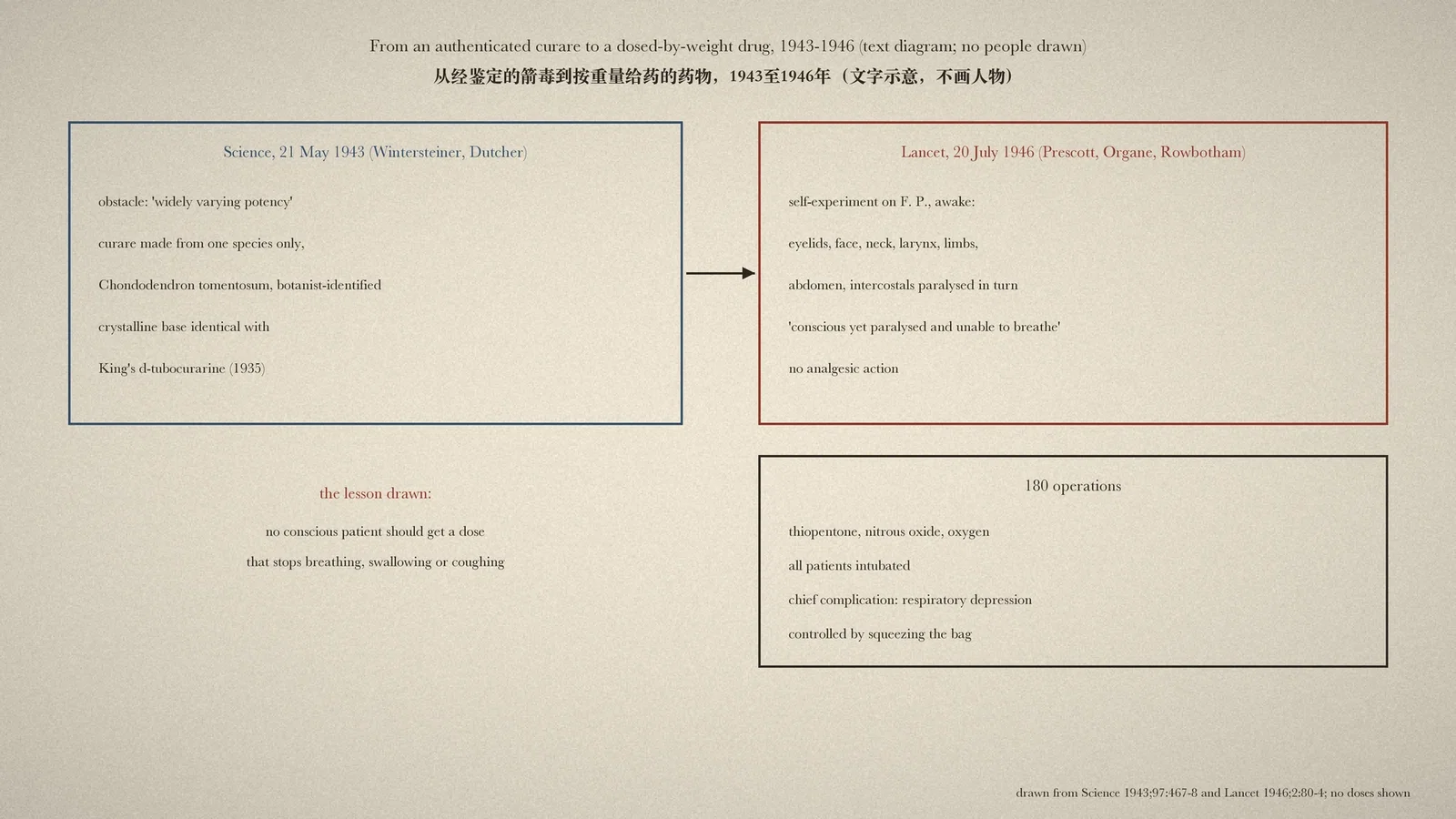
Before curare could become an operating-room drug, one problem had to be solved: every batch was different. Once a pure substance existed, a second problem appeared: it could leave a person completely unable to move, yet neither asleep nor free of pain. This article puts two papers side by side: a chemical note of 1943 and a clinical report of 1946 whose authors included one who had first tried the drug on that author's own body. [1, p. 467][2, p. 80]
1943: the problem of potency
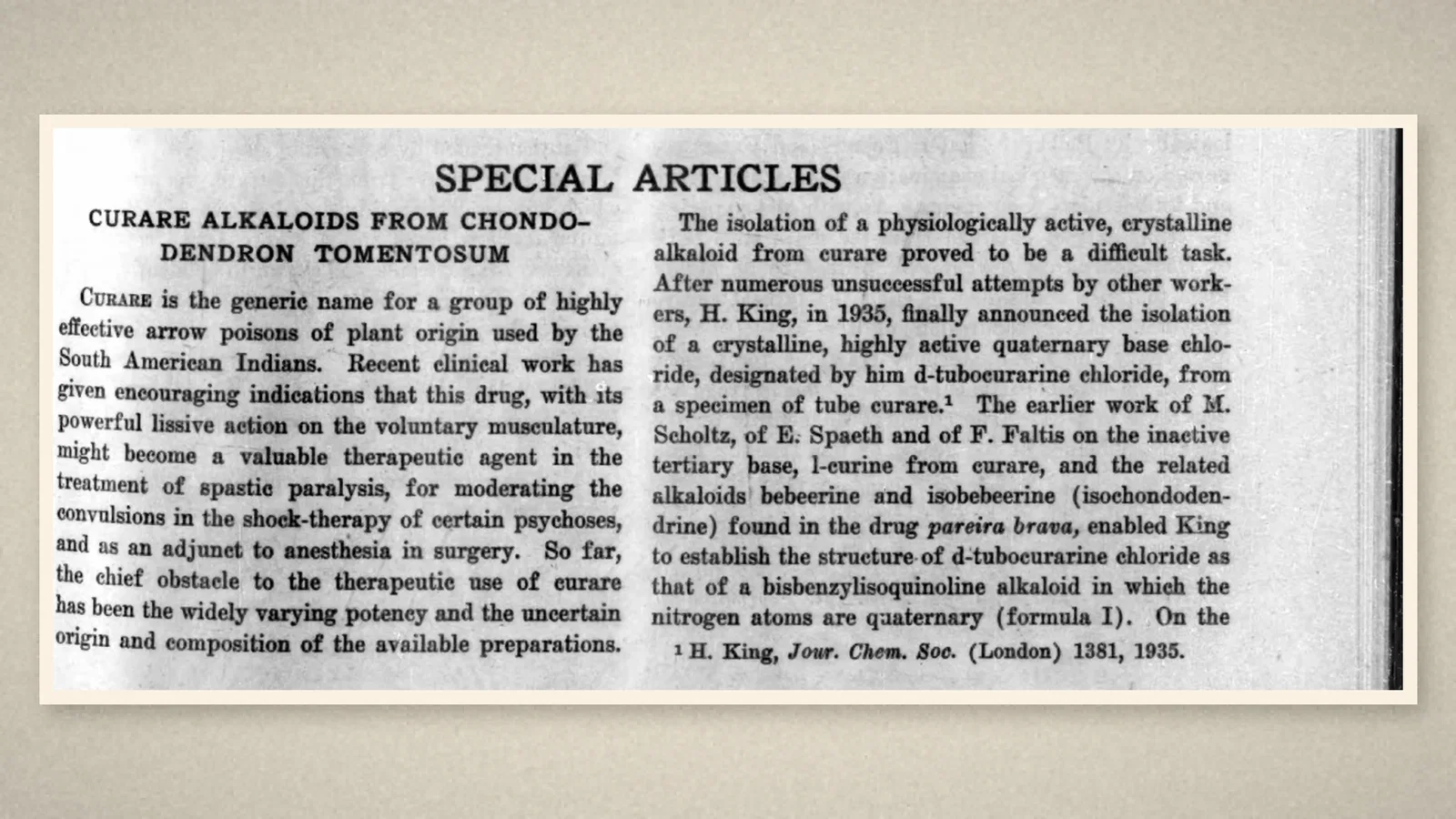
On 21 May 1943 Science printed "Curare alkaloids from Chondodendron tomentosum" by O. Wintersteiner and J. D. Dutcher, chemists at the Squibb Institute for Medical Research. Recent clinical work, they wrote, suggested that curare might be valuable in spastic paralysis, in moderating the convulsions of shock therapy and as an adjunct to surgical anaesthesia; but "the chief obstacle to the therapeutic use of curare has been the widely varying potency and the uncertain origin and composition of the available preparations". [1, p. 467]
H. King, they noted, had in 1935 isolated from a tube curare a crystalline quaternary base named d-tubocurarine chloride. The two chemists had a curare made by Indians of the upper Amazon from a single plant species, Chondodendron tomentosum, identified by a botanist at the time of preparation and backed by herbarium specimens; from it they isolated several crystalline bases, the most active of which proved identical with King's d-tubocurarine. [1, p. 467][1, p. 468]
1946: two preparations to tell apart
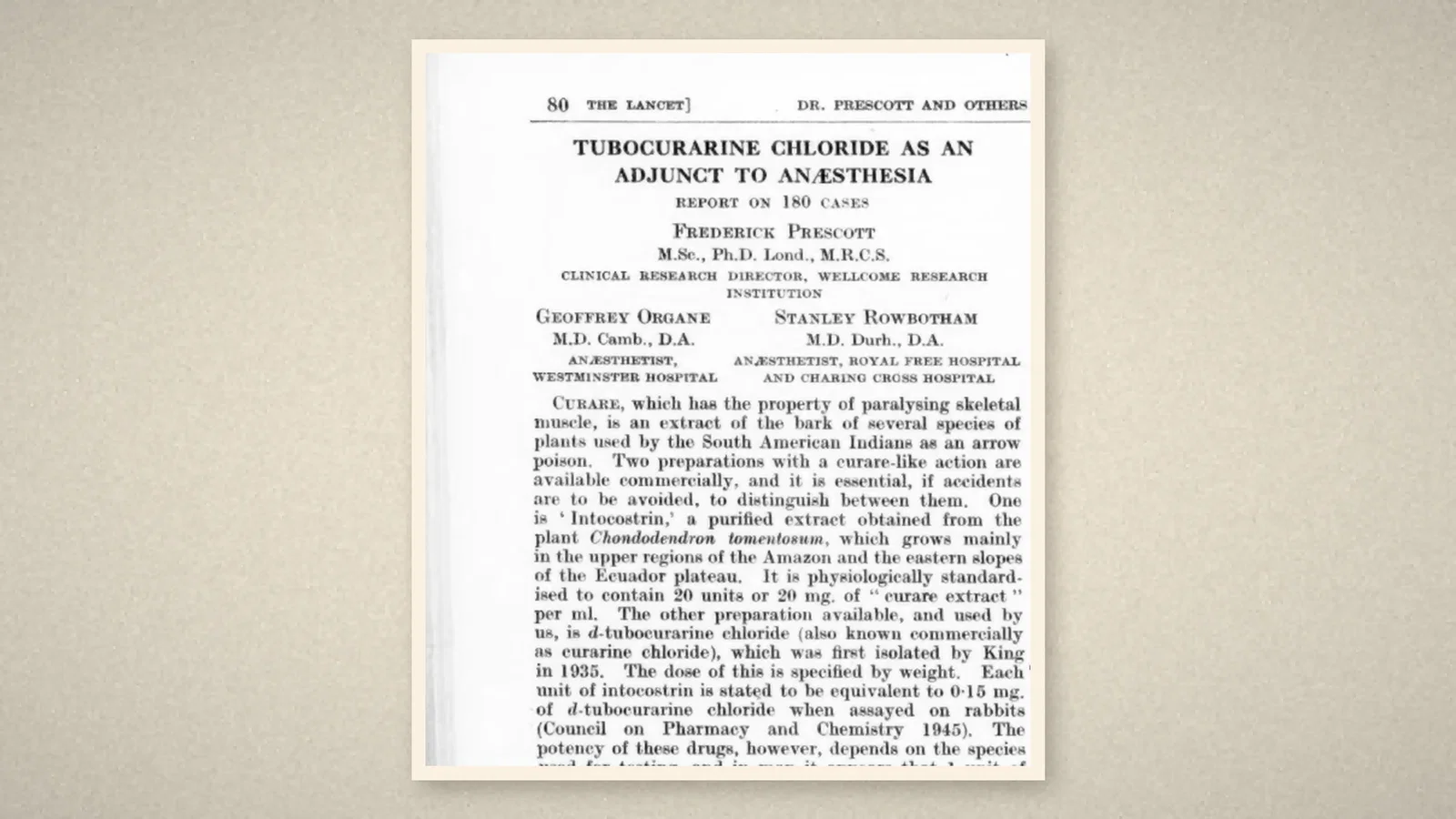
The Lancet of 20 July 1946, pp. 80-84, carried "Tubocurarine chloride as an adjunct to anaesthesia: report on 180 cases" by Frederick Prescott, clinical research director of the Wellcome Research Institution; Geoffrey Organe, anaesthetist at Westminster Hospital; and Stanley Rowbotham, anaesthetist at the Royal Free and Charing Cross Hospitals. [2, p. 80]
They began with a warning: two curare-like preparations were on sale, and "it is essential, if accidents are to be avoided, to distinguish between them". Intocostrin was a purified extract of Chondodendron tomentosum, standardized by physiological assay and used in America and Canada for abdominal relaxation since 1942; d-tubocurarine chloride, the drug they used, had been isolated by King in 1935, was dosed by weight, and had only recently been used as an adjunct to general anaesthesia. All curare-like drugs, they wrote, block the nerve impulse at the myoneural junction; elimination is rapid, so the effect is quickly reversible, and physostigmine and neostigmine antagonise it. [2, p. 80]
Trying it first
Before extensive use, "the effect of the drug was observed on one of us (F. P.)", to learn the dosage and the best method of giving it. [2, p. 80]
A small dose produced only partial weakness, ptosis, squint and double vision. A larger dose brought squint, diplopia, ptosis and weakness within a minute; within two minutes the face and neck were paralysed, then larynx, limbs, abdomen and intercostals in that order; speech was lost and the face was mask-like, as in myasthenia gravis. Power returned in the reverse order. [2, p. 80]
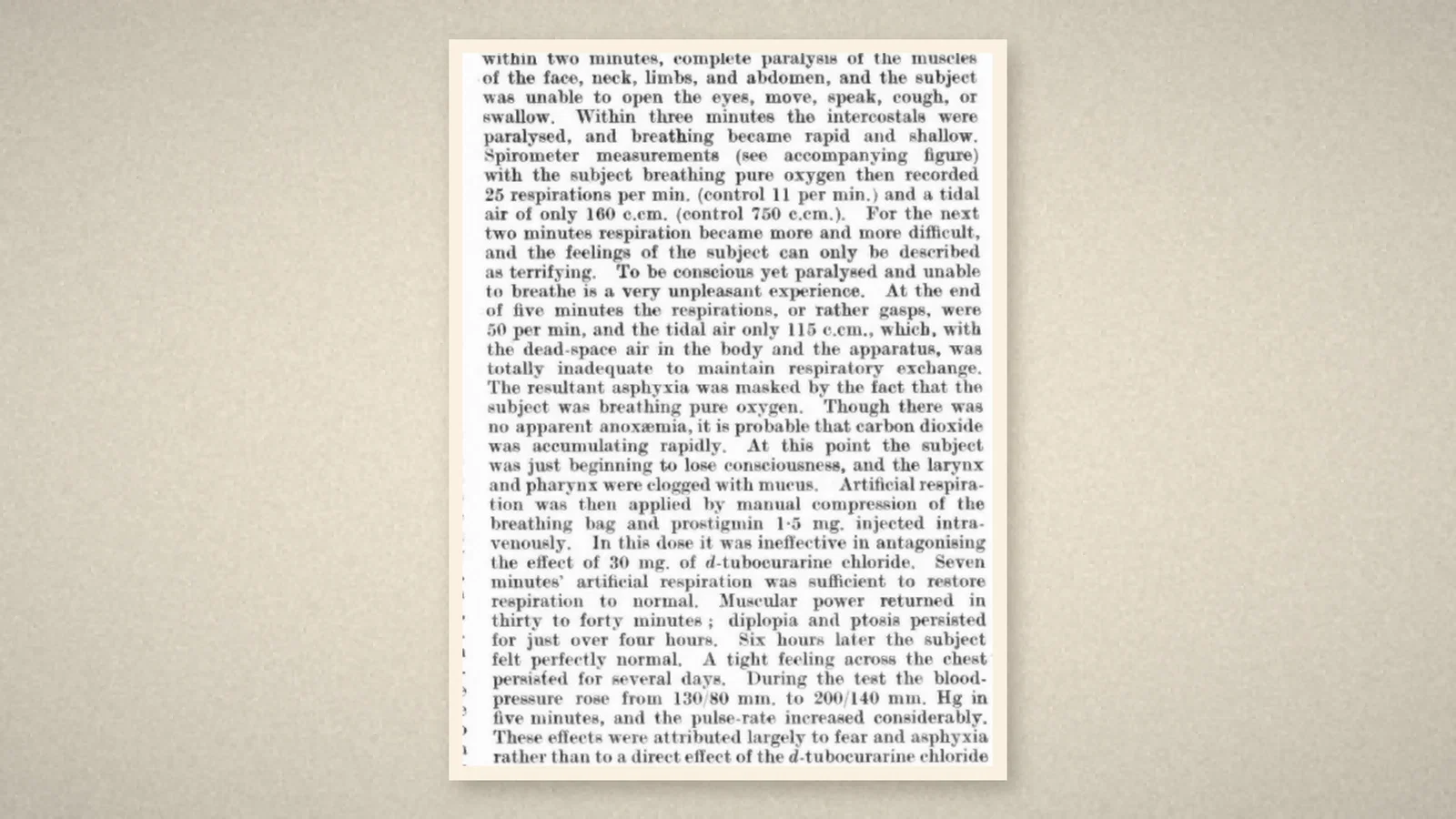
With a still larger dose, face, neck, limbs and abdomen were completely paralysed within two minutes: the subject could not open the eyes, move, speak, cough or swallow. Within three minutes the intercostals were paralysed and breathing became rapid and shallow, then more and more difficult. "The feelings of the subject can only be described as terrifying. To be conscious yet paralysed and unable to breathe is a very unpleasant experience." As the subject began to lose consciousness, with larynx and pharynx clogged with mucus, artificial respiration was given by squeezing the breathing bag, and within minutes breathing returned to normal; the neostigmine injected at that point did not reverse the drug. [2, p. 80]
There was one more finding: "No analgesic action was observed". Adhesive plaster torn from a hairy part of the body still caused considerable pain. The authors concluded that no conscious patient should receive a dose that depresses breathing excessively or abolishes swallowing or coughing: "the effects are far too unpleasant". [2, p. 80][2, p. 81]
180 cases
The clinical trials covered 180 operations, gastric surgery the most numerous, all under thiopentone, nitrous oxide and oxygen in second-plane anaesthesia. There was, the authors found, an "optimal dose": less gave poor abdominal relaxation, and very little more paralysed the diaphragm. All patients were intubated, with a well-fitting mask, and no bronchospasm or laryngospasm was seen. [2, p. 81][2, p. 82]
The chief complication was respiratory depression, even arrest. Because the drug was quickly eliminated, the authors regarded this as temporary, managed by rhythmic compression of the bag; it "never gave any cause for alarm", they wrote, "as the respiratory depression is purely peripheral, not central". The advantages they listed were ease of administration, profound relaxation, freedom from shock and rapid recovery. [2, p. 82][2, p. 84]
What the record shows
Two steps joined together. First there had to be a pure substance of known composition, dosed by weight, before dosage could mean anything. Then, once doses were set, the most important lesson came from a researcher's own body: the drug could leave a person conscious and unable to move, and gave no relief of pain at all, so it could only be used with an anaesthetic and with control of breathing.
Sources and reading limits
Read: Prescott, Organe and Rowbotham, "Tubocurarine chloride as an adjunct to anaesthesia: report on 180 cases", Lancet 20 July 1946;2(3):80-4, in full with the summary; Wintersteiner and Dutcher, "Curare alkaloids from Chondodendron tomentosum", Science 21 May 1943;97(2525):467-8, the opening and the isolation, the later chemical detail not read closely.
Not covered: King's 1935 paper in the Journal of the Chemical Society; Gray and Halton's 1946 paper in the Proceedings of the Royal Society of Medicine (not accessible); Griffith and Johnson's 1942 report; the 1945 Australian use and the 1949 rabbit head-drop assay.
Limits: the self-experiment is reported by its authors, one of whom was the subject; the 180 cases are described in outline without controls; "never gave any cause for alarm" is the authors' judgement. All doses, dose rates, spirometer volumes and blood pressures in the papers are left out. King's 1935 isolation is reported as the two papers state it.
Three illustrations are crops of the 1946 Lancet (two from p. 80) and the 1943 Science (p. 467); one is a text diagram drawn from both papers, with no people drawn and no doses shown.
- Wintersteiner O, Dutcher JD. Curare alkaloids from Chondodendron tomentosum. Science. 1943;97(2525):467-70. Internet Archive
- Prescott F, Organe G, Rowbotham S. Tubocurarine chloride as an adjunct to anaesthesia: report on 180 cases. Lancet. 1946;2(3):80-4. Internet Archive
Continue exploring
Related reading connects shared questions and contexts; it does not by itself establish historical influence.
- 1940: Bennett Uses Curare to Prevent Fractures in Shock Therapy
- 1850: Pelouze and Bernard Show Curare Kills Injected, Not Swallowed
Anesthesia Epochs · The Source Room · About & Editorial Method
Published November 3, 2026. Sources and reading limits are stated above. Illustrations are labelled as original source images or AI-made. Historical accounts are educational; they are not current treatment instructions.